










Film photography: the complete guide to getting started
The go-to guide for getting started with film photography: formats, camera types, choosing film, exposure, developing, budget, and mistakes to avoid.
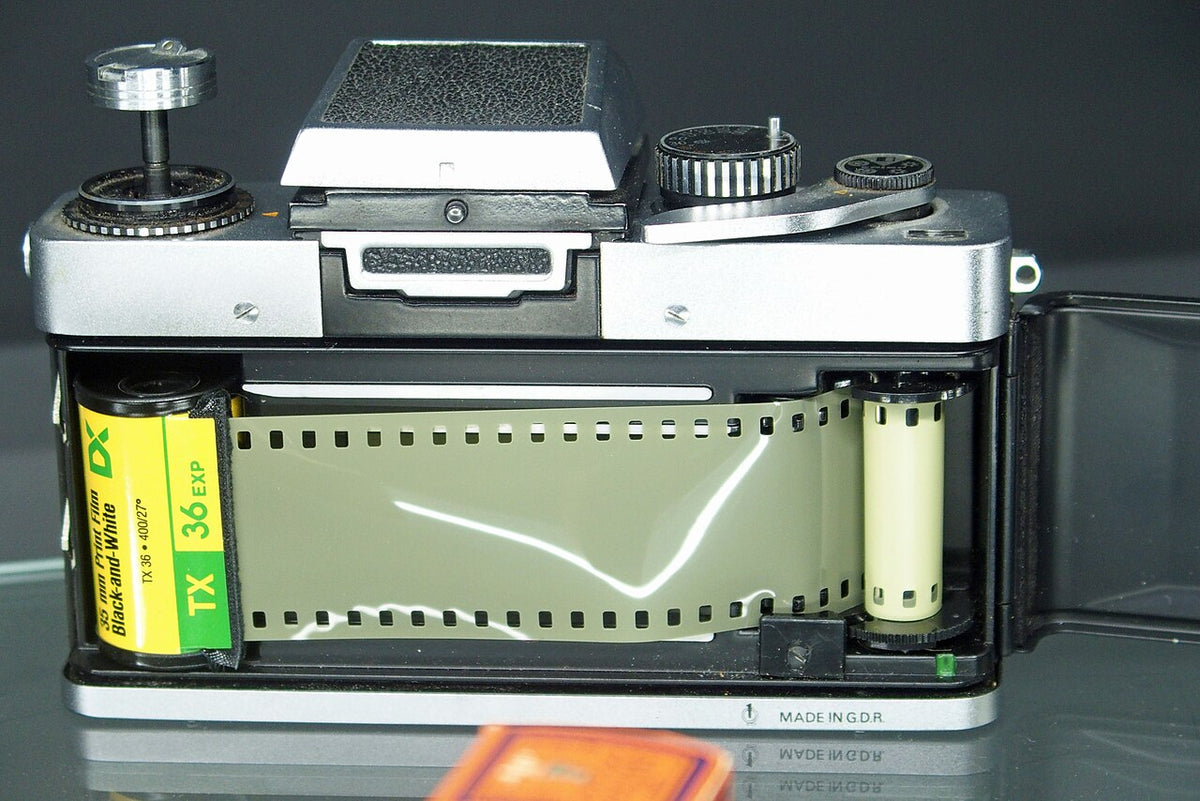
Film photography means taking photos on film rather than on a sensor: light exposes a film, which is then developed to produce negatives, scans, or prints. To get started, you only need three things: a working camera, film suited to the light, and a lab. This guide covers everything you need to know, from choosing a camera body to your first scan, and links to our detailed articles at each step.

How film photography works
Film is a plastic sheet coated with emulsion containing light-sensitive silver halide crystals. When you press the shutter button, the shutter opens for a fraction of a second: the light passing through the lens forms a latent image, invisible until the film is developed. At the lab, chemical baths reveal and then fix this image. You get negatives (color or black and white) or slides (positives), which can be scanned or printed on paper.
Three settings determine the amount of light received: the aperture, the shutter speed, and the film's sensitivity (ISO). Unlike digital, the sensitivity is fixed for the entire roll: you choose your film based on the light you'll encounter. Our page the exposure triangle explains these three settings step by step.
Film or digital: what really changes
| Film | Digital (digicam, mirrorless) | |
|---|---|---|
| Cost per photo | Film + developing for each roll | Almost zero after purchase |
| Result | Visible after developing | Instant on the screen |
| Look | Grain, colors unique to each film, good tolerance for overexposure (color negative) | Depends on the sensor and processing; CCD look appreciated on digicams |
| Pace | 24 to 36 exposures: you choose your images | Unlimited bursts |
| Maintenance | Mechanical, foam, cell batteries | Battery, memory card, electronics |
Unsure which one to choose? Our comparison of film or vintage digital helps you decide based on your use and budget.
Film formats
| Format | Image size | Exposures per roll | Who is it for? |
|---|---|---|---|
| 35 mm (135) | 24 × 36 mm | 24 or 36 (sometimes 27 on disposables) | The standard: the most camera and film choices, development everywhere |
| Half-frame | 18 × 24 mm on 135 film | 48 to 72 | Double the number of exposures, make diptychs |
| 120 (medium format) | 6 × 4.5 / 6 × 6 / 6 × 7 / 6 × 9 cm | 16 / 12 / 10 / 8 | More detail and a "large negative" look, bulkier cameras |
| 110 | 13 × 17 mm | 24 in general | Very lightweight pocket cameras, pronounced grain, fewer labs |
| Instant (Polaroid, Instax) | Depending on the film | 8 to 10 per cartridge | A single photo, instantly, without a lab |
To get started, 35 mm is almost always the right choice: it's where you'll find the most reliable second-hand cameras and the widest variety of film.

Film camera families
| Family | Principle | Strengths | Limitations | Examples |
|---|---|---|---|---|
| Automatic compact (point & shoot) | Autofocus, automatic exposure and film advance, built-in flash | Lightweight, discreet, ideal for parties and travel | Little control; electronics on some models are not repairable | Olympus Mju II, Yashica T4, Canon Prima |
| Zone or rangefinder compact | Manual or rangefinder focusing, exposure often automatic | Simple, often without a finicky battery (selenium-cell Trip 35) | Focusing by estimation | Olympus Trip 35, Canonet QL17, Olympus XA |
| Manual SLR | View through the lens, interchangeable lenses | For learning exposure, robust, repairable | Heavier | Pentax K1000, Canon AE-1, Nikon FM2, Olympus OM-1 |
| Autofocus SLR (1980s-2000s) | Autofocus, automatic modes, motor | Easy to use, often inexpensive | Electronics, plastic, need for specific batteries | Canon EOS, Nikon F80, Minolta Dynax |
| Medium format | 120 film, waist-level viewfinder or prism | Image quality | Weight, price, 8 to 16 exposures | Yashica Mat-124G, Mamiya, Pentax 67 |
| New disposable or reusable | Fixed lens, flash, minimum settings | Simple and new | Modest optical quality | Kodak Ektar H35, reusable cameras |

Choosing your first film camera
The right question is not "which is the best camera?" but "how will I take photos?". Here is the simple rule we give:
- You just want to point and shoot, at a party or on a trip: an autofocus compact with a flash.
- You want to learn shutter speed, aperture, and focusing: a 35 mm manual SLR with a 50 mm lens.
- You want a camera without or with almost no battery: a mechanical SLR (Pentax K1000, Nikon FM2, Olympus OM-1) or an Olympus Trip 35.
- You want to test before investing: a new reusable camera or a disposable.
Our guide which film camera to choose for beginners details the models by budget. For the iconic models, read our reviews: Canon AE-1, Pentax K1000, Olympus Trip 35, as well as our comparisons Mju II vs Yashica T4 and Contax T2 vs Yashica T4. And if compact prices surprise you, we explain why film compacts have become so expensive.
New or vintage? Recent reusable cameras have the advantage of being new, but their lenses and settings remain limited: our article reusable film camera: new or vintage compares the two, and our review of the Kodak Ektar H35 details the best-known of them.
Choosing your film
Film makes up a large part of the look. Three guidelines are enough to get started:
- Sensitivity: 100-200 ISO in bright sunlight, 400 ISO for everything (including well-lit interiors), 800 ISO and higher for low light. See 200 or 400 ISO film.
- Color or black and white: color negative (C-41 process) is developed everywhere; black and white offers different grain and contrast. See which black and white film to choose.
- Look: warm and saturated, neutral for skin tones, very high contrast… Our comparison Kodak Gold 200 vs Portra 400 illustrates the difference between consumer film and professional film.
Our page choosing your film goes further. Expired film has its surprises (see expired film: can you still use it?), and if you are flying, read film, X-rays, and CT scanners before you go.
Exposing correctly without the hassle
On an automatic compact, the camera takes care of everything: it reads the DX code on the cartridge to know the sensitivity. On a manual camera, you can rely on the built-in light meter, a light meter app on your smartphone, or the Sunny 16 rule: in bright sunlight, at f/16, the shutter speed is approximately the reciprocal of the sensitivity (1/125 s for 100-125 ISO film, 1/250 s for 200, 1/500 s for 400).
Tip: color negative film handles overexposure well and underexposure poorly. If in doubt, give it a little more light rather than less.
The light meter of many cameras from the 1970s-1980s works with a button cell battery (LR44, SR44, PX625…). Our guide which battery for my film camera tells you the right reference.
Loading, shooting, rewinding
- Load the film in the shade, engage the take-up spool, then advance two or three exposures with the back closed. Our page loading film shows every step.
- Check that the rewind crank turns when you cock the camera: it is proof that the film is advancing.
- Set the sensitivity (ISO/ASA dial) if the camera does not read the DX code.
- Shoot: on a manual camera, focus, set the aperture, set the shutter speed, then press the shutter button.
- Rewind completely at the end of the roll (release button under the camera on most SLRs) before opening the back.
Developing, scanning, and printing
You can entrust your film to a lab near you or by mail, or develop black and white yourself. Most labs offer three options: developing only, developing + scanning (files sent by link), developing + prints. Our lab map helps you find a lab, and our printing guide explains how to choose formats and papers. To read your negatives, see reading a negative. Disposables are developed like regular film: here is how.

How much does it cost?
The budget is divided into two: the camera (once) and each roll (film + developing + scanning or prints). It is this second item that surprises the most. We have detailed the costs and budget examples in how much film photography costs. To reduce the bill: shoot in 35 mm, prefer scanning over systematic printing, and take the time to choose each image.
The most common mistakes
| Symptom | Probable cause | Solution |
|---|---|---|
| Completely blank film | Film poorly loaded (did not advance) or shutter stuck | Check that the rewind crank turns when cocking |
| Very dark images | Underexposure: wrong ISO, weak cell battery, interior without flash | Set the ISO, change the battery, use 400-800 ISO or the flash |
| Orange or red streaks | Light leak: back open, worn sealing foam | Rewind before opening; replace the foam |
| Blurry photos | Shutter speed too slow, missed focus, minimum distance not respected | Stay above 1/60 s handheld, check the focus |
| Black bands on part of the image | Flash sync speed outdated or tired shutter | Respect the sync speed (often 1/60 or 1/125 s) |
Our failed photos clinic analyzes the most common cases with examples.
Buying a second-hand film camera without risk
A film camera is often 30 to 60 years old: the shutter, cell, foam, and lens must be checked. Our checklist buying a second-hand film camera: the 10 checks guides you, and our guide warranty, condition, and confidence explains what warranties cover. For the future, maintaining and storing a vintage camera will help you avoid the most common breakdowns.
At Vibes Photo, every camera is checked before being put up for sale and covered by a six-month commercial warranty, in addition to legal guarantees of conformity and against hidden defects. Details can be found in our general terms and conditions of sale.
Discover our checked film cameras →
All our film photography guides
The complete library, to explore according to your camera and your needs:
- Buying a used film camera: the 10 checks
- Contax T2 alternatives: 7 compacts with a premium rendering
- Olympus Mju II alternatives: 10 film compacts to consider
- Automatic film camera: the guide to choosing the right one
- Film camera without a battery: the mechanical cameras to know
- Panoramic film camera: Horizon, Widelux, XPan and compacts
- Reusable film camera: new or vintage?
- Half-frame camera: 72 photos per roll, which model to choose?
- 110 "pocket" camera: format, models and films in 2026
- APS camera (Advantix, IXUS): the format, its history and its use today
- Which film camera to choose for beginners?
- Disposable camera: which model to choose and how to get good photos
- Film or vintage digital: what to choose?
- Canon A-1: review and buying guide
- Canon AE-1: review and buying guide
- Canon AE-1 vs AE-1 Program: which one to choose?
- Canon AE-1 vs Pentax K1000: which one to choose for beginners?
- Film Canon EOS: which model to choose?
- Canon Prima (Sure Shot): which model to choose?
- Canonet QL17 GIII: review, battery, handling and buying tips
- Light meter and cell in film photography: app, handheld cell or Sunny 16?
- Loading a film roll: SLR, compact and medium format
- CineStill 800T: review, red halo and exposure tips
- DX code: how your camera reads the film sensitivity
- How many photos on a roll? 35 mm, 120, half-frame
- Compact or film SLR: which one to choose?
- Storing your film: fridge, freezer, heat, what you need to know
- Contax T2: review, Zeiss Sonnar rendering, settings and buying tips
- Contax T2 vs Yashica T4: which one to choose?
- How much does film photography cost in 2026?
- How to get a disposable camera developed
- Developing a color film (C-41) at home: the method
- Developing your black and white film yourself: the complete guide
- Double exposure in film photography: technique, settings and cameras
- The 15 beginner mistakes in film photography (and how to avoid them)
- Color filters for black and white: yellow, orange, red, green
- Flash on film SLR: sync, guide number and voltage
- Fujifilm 200 and 400 films: characteristics, uses and comparison
- Holga, Diana, Lomo LC-A: which Lomo camera to choose?
- Gift ideas: giving a vintage camera
- Ilford HP5 Plus: review, rendering, pushing and developing
- Kodak ColorPlus 200: review of the most affordable color film
- Kodak Ektar 100: review of the finest grain color film
- Kodak Ektar H35: review and alternatives
- Kodak Gold 200 vs Portra 400: which film to choose?
- Kodak Portra 400: review, rendering and exposure tips
- Kodak Tri-X 400: review, rendering, development and pushing
- Kodak Ultramax 400: review, rendering and exposure tips
- Konica Big Mini: review, versions and buying guide
- Photo lab by mail: how to send your film
- Leica M6: review, versions (Classic, TTL, 2022) and buying tips
- Lomography films: the complete guide (Color Negative, LomoChrome, Kino)
- Cheap film camera: our selection to get started
- The best film compacts: our selection by budget
- The best used film SLRs: our ranking by profile
- Minolta Riva: review and which model to choose
- Minolta X-700: review and buying guide
- Minolta X-700 vs Canon AE-1: which film SLR to choose?
- Film lens mounts: FD, F, OM, K, M42, MD, compatibilities
- Getting started in film medium format: formats, cameras and 120 film
- Nikon F3: review and buying guide
- Nikon FM, FM2, FE or FE2: the comparison to choose the right one
- Nikon FM2: review and buying guide
- Nikon FM2 vs Olympus OM-1: which mechanical SLR to choose?
- The 50 mm in film: why it is the ideal lens, and which one to choose
- Olympus Mju I vs Mju II: which one to choose?
- Olympus Mju II (Stylus Epic): review, technical sheet and buying tips
- Olympus Mju II vs Yashica T4: which one to choose?
- Olympus OM-1: review and buying guide
- Olympus OM-10: review, manual adapter and buying tips
- Olympus Pen EE, EE-2, EE-3 and Pen F: review of half-frames
- Olympus Trip 35: review and buying guide
- Olympus XA: review, versions XA1 to XA4 and buying guide
- Back open with film inside: what to do and what can be saved?
- Film 200 or 400 ISO: which one to choose?
- Taking film on a plane: X-rays and CT scanners
- Slide film (E-6): Ektachrome, Velvia, Provia, the guide
- Cheap film: the cheapest film stocks (prices collected)
- Expired film: can it still be used?
- Redscale film: principle, exposure and how to make it
- Pentax K1000: review and buying guide
- Pentax ME Super: review and buying guide
- Why are my film photos blurry? Causes and solutions
- Which battery for my film camera?
- LR9 or 625 battery instead of a PX625: compensate exposure
- Why have film compacts become so expensive?
- Push or pull film (push/pull): the complete guide
- Film developing price: comparison of rates from 5 labs
- Why is the price of film increasing so much (and how to save)
- Which black and white film to choose?
- Autofocus film SLR: which model to choose?
- Rewinding film: the method, and what to do if it is stuck
- Ricoh GR1, GR1s and GR1v: review, differences and buying tips
- Scanning your negatives yourself: the 4 methods and the step-by-step
- Overexposing your film: why, by how much, and when to avoid
- Film rangefinder camera: the complete guide
- Yashica Electro 35: review and buying guide
- Yashica T4 (and T5): review, versions, Zeiss rendering and buying tips
Frequently Asked Questions
Is film photography difficult for a beginner?
No, especially with an automatic compact: you load, you aim, you shoot. A manual SLR requires learning three settings, which can be done in a few rolls.
Which film to buy for my first roll?
A 400 ISO color negative with 36 exposures: it forgives exposure mistakes and is suitable for both sunlight and well-lit interiors.
Can you still get film developed in France?
Yes. Color negative (C-41) and black and white are developed in many labs and by mail; slide (E-6) and 110 format are offered by fewer laboratories.
Do you need a camera with a battery?
Many mechanical cameras work without a battery, as it is only used for the light meter. Automatic compacts and autofocus SLRs, however, depend entirely on it.
How to digitize your film photos?
The easiest way is to ask for the scan at the lab when developing. You can also scan your negatives yourself with a film scanner or a digital camera equipped with a macro lens.