










Olympus Trip 35: review, how it works and buying guide
The most famous battery-free film compact camera explained in detail: selenium cell, Zuiko 40 mm, settings, film, common faults and points to check before buying.
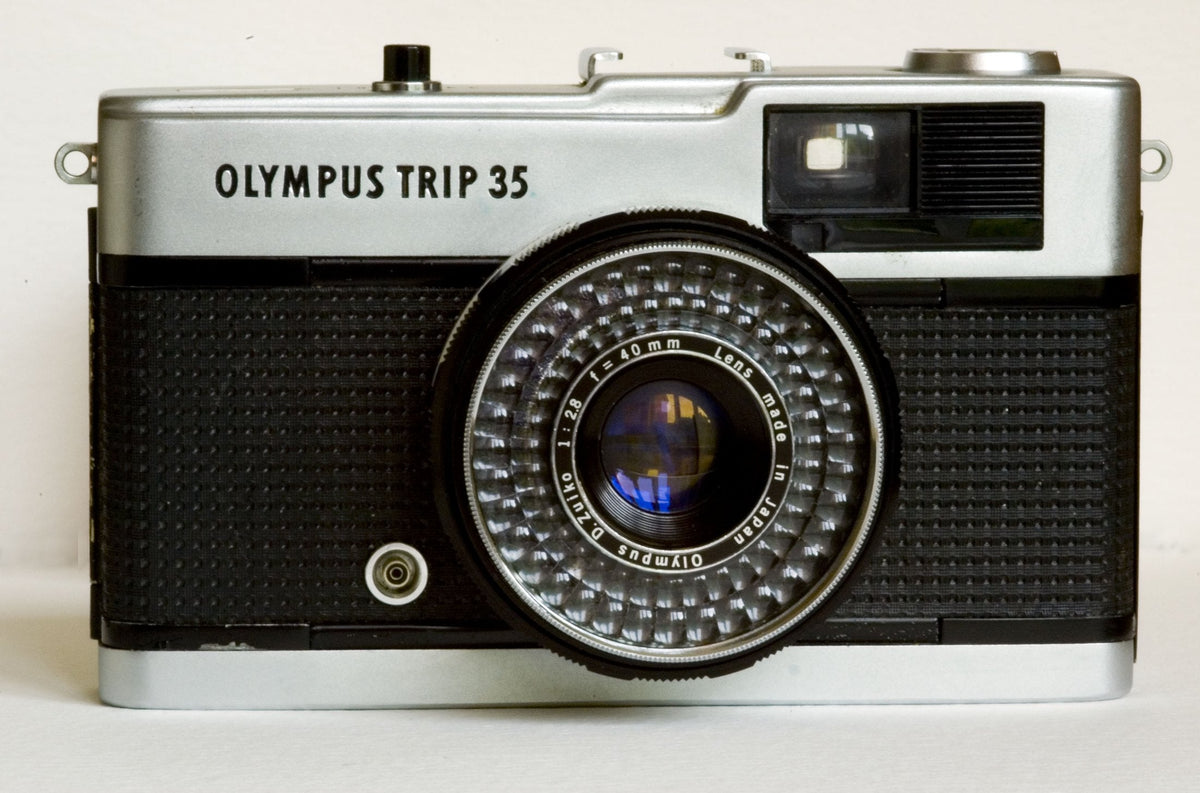
Reference sheet · Film compact · October 2026 update
Launched in 1967, the Olympus Trip 35 is the quintessential travel compact: a highly regarded, sharp Zuiko 40 mm lens, a selenium cell that works without any battery, and only two shutter speeds. Here is how it really works, how to choose one second-hand, and what it produces on modern film.
The name says it all: “Trip,” travel. Olympus designed this compact for holidays, using the formula of its Pen EES half-frame camera and adapting it to the 24×36 full-frame format. The principle is remarkably simple. A selenium cell ring around the lens converts light into current and controls the exposure, without a battery. You choose one of four distance zone symbols, frame, and shoot. If it is too dark, a small red flag appears in the viewfinder and locks the shutter: it is impossible to miss a photo due to underexposure. Produced for seventeen years and promoted in the United Kingdom with advertisements featuring photographer David Bailey, the Trip 35 sold by the millions. Today, it is one of the easiest film compacts to find and have serviced. It also has its limits, which are best known before heading out.
The essentials in 30 seconds
- The highlight: zero battery: the selenium cell powers the light meter. It works as long as there is light.
- The weakness: only two shutter speeds (1/40 s and 1/200 s) and a light meter that stops around IL 8: in dark interiors, the red flag blocks everything.
- The limit to know: focusing is estimated by zone. At f/2.8 and 1 m, the margin of error is small.
- The right reflex: check by hand that the red flag appears in low light and that the aperture blades do not stick.
- The alternatives: Olympus XA or Canonet QL17 for more control, Olympus mju II for autofocus and flash.

The holiday compact
At the end of the 1960s, Olympus already dominated the consumer market with the Pen range, half-frame cameras that doubled the number of shots per roll. The Pen EES, in particular, offered fully automatic exposure with a selenium cell. Olympus reused this mechanism, combined it with a 40 mm lens for the 24×36 full-frame format, and launched the Trip 35 in 1967. The brand presented it as a camera that is easy to take on holiday, hence its name.
The success was immediate and long-lasting. The Trip 35 remained in the catalog until 1984, with very few changes. In the United Kingdom, a 1970s advertising campaign featured David Bailey, one of the country's best-known fashion photographers. Olympus announced more than ten million copies sold.
To check
The figure of “ten million” is quoted everywhere, but camera-wiki notes that the known serial numbers of the original Trip 35 do not exceed around 5.4 million. The total could include later plastic compacts sold under the “Trip” name. Remember “several million,” which in any case makes it one of the most produced compacts in history.
- Olympus Pen EE, automatic selenium half-frame.
- Pen EES, mechanical basis of the future Trip.
- Launch of the Olympus Trip 35.
- Advertising campaign with David Bailey in the United Kingdom.
- The silver metal shutter button becomes black, plastic.
- End of production.


How exposure works
The Trip 35 has no battery, no motor, no electronics. The honeycomb ring around the lens contains selenium cells, a material that produces a small electric current when light hits it. This current deflects the needle of a galvanometer, hidden in the body. The more light, the more the needle deflects.
When you press the shutter button halfway, a bar comes to “trap” the needle against a plate. Just behind, a cam connected to the aperture blades advances until it touches the trapped needle. The distance traveled sets the aperture. The exposure is therefore memorized halfway: you can aim, hold, then reframe.
The program chooses between two shutter speeds. According to the program chart published by Olympus and analyzed by camera-wiki, the Trip stays at 1/40 s and opens the aperture when the light drops; above around IL 13 (a beautiful cloudy day), it switches to 1/200 s and gradually closes up to f/22. The total range goes from IL 8.3 (f/2.8 at 1/40 s) to around IL 17 at 100 ISO. Below, the red flag comes out and the shutter button locks.
| Light | Approx. IL | Speed | Aperture |
|---|---|---|---|
| Dark interior, evening | less than 8 | Locked (red flag) | – |
| Bright interior near a window | 8 to 10 | 1/40 s | f/2.8 to f/5.6 |
| Very overcast sky, shade | 10 to 12 | 1/40 s | f/5.6 to f/11 |
| Bright cloudy sky | 13 to 14 | 1/200 s | f/5.6 to f/8 |
| Full sun | 15 | 1/200 s | f/11 |
| Beach, snow in the sun | 16 to 17 | 1/200 s | f/16 to f/22 |
Did you know?
As the shutter button locks when light is lacking, the Trip 35 also refuses to shoot if you have left the cap on the lens. An involuntary safety that has saved many holiday rolls.
The only “manual setting” is for flash. If you turn the aperture ring from “A” to a value (f/2.8 to f/22), the speed is fixed at 1/40 s. But the cell remains active: the chosen value is the maximum allowed aperture, and the Trip can still close further if it judges that there is too much light. To correct the exposure, the method is therefore to play with the sensitivity ring: set 200 ISO with a 400 ISO film to overexpose by one stop.


The Zuiko 40 mm f/2.8 lens
The Trip 35 uses a D. Zuiko 40 mm f/2.8 with four lenses in three groups, a formula close to the Tessar. The letter “D” indicates, in the Olympus nomenclature of the time, the number of lenses (D for the fourth letter of the alphabet). Focusing moves the front lens. The filter step is 43.5 mm, an unusual diameter: plan an adapter ring if you want a yellow filter for black and white.
Its reputation for sharpness is solid. American tester Ken Rockwell reports sharper corners on film than those of a professional digital zoom from his time, an anecdotal but revealing comparison. In practice, from f/5.6, that is to say most of the time outdoors, the image is very detailed from edge to edge. At f/2.8, contrast drops a bit and vignetting (darkening of the corners) is visible on a plain sky.
Forty millimeters, two shutter speeds, no battery: the Trip 35 proves that a good lens counts more than a thousand settings.
The Vibes Photo editorial team
The 40 mm focal length is a bit wider than the “normal” 50 mm of SLRs: ideal for the street, monuments, and group photos on holiday. Our street photography guide shows how to make the most of it.
Technical specifications of the Olympus Trip 35
- Type
- 24×36 automatic exposure compact
- Lens
- D. Zuiko 40 mm f/2.8, 4 lenses in 3 groups
- Focusing
- Zones: 1 m, 1.5 m, 3 m, infinity (4 symbols)
- Shutter
- Central, mechanical
- Speeds
- 1/40 s and 1/200 s (auto), 1/40 s (flash)
- Apertures
- f/2.8 to f/22
- Light meter
- Selenium cell, no battery
- Range
- IL 8.3 to 17 (100 ISO)
- Sensitivity
- 25 to 400 ISO (200 on the very first ones)
- Viewfinder
- Albada ×0.55, parallax marks
- Flash
- Hot shoe and PC socket, 1/40 s
- Filter
- 43.5 mm screw-on
- Film advance
- Thumbwheel, on the back
- Dimensions, weight
- 116 × 70 × 57 mm, 410 g
Sources: Olympus commercial documentation (Trip 35 Outfit), camera-wiki.org, Wikipedia.
Versions and date markers
The Trip 35 has changed very little in seventeen years, which makes it an easy purchase. The differences are mainly in finishing details that can help date a copy. The very first models stop at 200 ISO on the sensitivity ring; later ones go up to 400 ISO. The shutter button is silver-colored metal until June 1978, then black plastic. There are also all-black Trips, which are rarer.
| Feature | Early version | Late version |
|---|---|---|
| Shutter button | Silver-colored metal (before June 1978) | Black plastic (after June 1978) |
| Maximum sensitivity | 200 ISO (early years) | 400 ISO |
| Finish | Chrome | Chrome or black (rarer) |


Classic trap
Don't confuse the Trip 35 with more recent plastic compacts sold under the name "Trip" (Trip AF, Trip XB...). These are different cameras with simpler lenses and mechanisms. Check for the "TRIP 35" inscription on the lens cover and the selenium ring around the lens.
How to use it on a trip
The strength of the Trip 35 is that you can forget about it. But a few simple steps make the difference between "okay" photos and truly sharp ones.
- Set the sensitivity on the ring around the lens. This is the only information the Trip cannot guess.
- Leave the aperture ring on A. Only turn it for flash.
- Choose the zone: portrait (1 m), couple (1.5 m), group (3 m), or landscape (infinity). The small window below the viewfinder displays the chosen symbol.
- Press halfway to lock the exposure. If the red flag appears, there is not enough light.
- Frame while accounting for parallax: at close range, use the viewfinder markings, as it does not see exactly what the lens sees.
- Advance the film with the thumb wheel until it stops, then release the shutter.
| Symbol | Distance | When to use it |
|---|---|---|
| Portrait (one head) | 1 m | Close-up portrait, object. The most demanding: it measures the distance. |
| Two people | 1.5 m | Half-length portrait, table at a restaurant. |
| Group | 3 m | The "default" zone in town: street, group, candid scene. |
| Landscape | Infinity | Landscape, distant monument, view from a train. |
Expert tip
Keep the Trip on the "group" zone (3 m) when walking around town. In broad daylight, it stops down to f/8 or smaller: the depth of field will then range from approximately 2 m to 5.5 m at f/8, and from approximately 1.6 m to over 25 m at f/16. You are ready to release the shutter without thinking. The method is detailed in our guide on hyperfocal and zone focusing.
Indoors, 1/40 s and f/2.8 quickly reach their limits. The Trip accepts a flash on its hot shoe: then set the aperture according to the flash's guide number and the distance, and the shutter speed will be set to 1/40 s. Our article on flash photography explains the calculation. With a modern flash, check its compatibility before mounting it.
Photos taken with the Olympus Trip 35
These images are published under a free license by their authors, who indicate the camera and, for most, the film. They clearly show the qualities of the Zuiko outdoors: sharpness, strong contrast on Kodak ColorPlus 200, and beautiful tonal range in black and white.


Other recent examples, on a wide variety of films, can be seen in the Lomography community gallery: see examples of photos taken with the Olympus Trip 35 on Lomography (external link, photos not reproduced here).
Breakdowns and pre-purchase inspection
The Trip 35 has few parts and a robust mechanism. Its breakdowns are few and well known. Most can be spotted in two minutes, camera in hand, without film.
| Symptom | Probable cause | Severity |
|---|---|---|
| The red flag never comes out | Weak selenium cell or seized pin trap mechanism | Moderate to severe |
| The flag comes out even in full sun | Dead cell or stuck pin | Severe: cell needs replacement (used part) |
| Overexposed photos | Aperture blades stuck together by oil | Moderate: cleaning the lens block |
| Light leaks | Worn back foams | Low |
| Shutter button stuck in full light | Seized blades or mechanism | Moderate |
| Foggy viewfinder, pale bright frame | Dust, tarnished Albada mirror | Low to moderate |
Pre-purchase checklist
- Without film, set the ring to A, point at a lamp: the shutter button should work.
- Cover the lens with your hand and press halfway: the red flag should appear in the viewfinder and block the shutter release.
- Open the back, set the ring to f/22 then f/2.8, press halfway while looking through the lens: the two blades should move clearly (tip given by camera-wiki).
- In full sun, the aperture should close significantly; in the shade, open.
- Check the selenium ring: no cracks or marked haze.
- Check the back foams and the cleanliness of the lens (fungus, scratches).
- Turn the advance wheel and check that the counter advances.
If a seller cannot confirm these points, consider the camera "to be serviced". The Trip lens block is easily disassembled by a technician. Our guide for buying a used film camera details the other tests, and getting an old camera repaired helps you find a workshop.
What makes its price
The Trip 35 was produced in very large numbers: it is one of the easiest film compacts to find, and it remains more affordable than the "premium" autofocus compacts of the 1990s. Without giving a specific figure, here is what makes its price vary:
- The condition of the light meter: a Trip with a working red flag and light meter is worth significantly more than a "parts" Trip.
- A recent overhaul (cleaned shutter curtains, replaced foam) justifies a higher price.
- The black finish, which is rarer, and the cosmetic condition.
- Accessories: original case, PS200 flash, box.
To understand why film point-and-shoots have increased in value, read why film point-and-shoots are so expensive.
The Trip 35 compared to other point-and-shoots
| Model | Focusing | Exposure | Battery | Best for |
|---|---|---|---|---|
| Olympus Trip 35 | Zone (4) | Auto, 2 speeds | None | Travel, simplicity |
| Olympus Pen EE | Fixed | Selenium auto-exposure | None | Half-frame, 72 exposures |
| Canonet QL17 G-III | Rangefinder | Shutter-priority, manual | PX625 (cell) | Total control |
| Olympus XA | Rangefinder | Aperture-priority | 2 × LR44 | Pocket, discretion |
| Olympus mju II | Autofocus | Auto, built-in flash | CR123A | Fully automatic, evening |

Olympus mju II
Autofocus, 35 mm f/2.8, built-in flash, and splash resistance. The choice if you also photograph in the evening.
Canonet QL17 G-III
Rangefinder, 40 mm f/1.7 lens, and real shutter speed control. More than one stop brighter.
Olympus XA
The smallest rangefinder point-and-shoot of its generation, with aperture priority.
Olympus Pen EE
The half-frame cousin: same selenium logic, twice as many exposures.
Pros
- Works without a battery, anywhere
- Zuiko lens very sharp from f/5.6
- Reliable automatic exposure outdoors
- Simple, robust, easy to overhaul
- Still affordable
Cons
- Two speeds: limited indoors
- Estimation-based focusing
- No real manual control
- Capped at 400 ISO
- Selenium light meter irreplaceable if dead
To compare with all point-and-shoots, our selection of the best film point-and-shoots and the film point-and-shoot or SLR guide help you decide.
What film in a Trip 35?
The Trip's dial stops at 400 ISO (200 on early models), and the program saturates around IL 17 at 100 ISO. In practice: 200 ISO is the most versatile choice for travel, 400 ISO for overcast days or Northern Europe in winter, 100 ISO for the beach and snow. Beyond that, you can load 800 ISO film by setting the dial to 400: the negative will be overexposed by one stop, which most color films handle well.
| Film | ISO | Why |
|---|---|---|
| Kodak ColorPlus 200 | 200 | Affordable, warm, used in our examples. Our review |
| Kodak Gold 200 | 200 | Sunny colors, ideal for travel. |
| Kodak UltraMax 400 | 400 | For overcast days. Our review |
| Kodak Portra 400 | 400 | Maximum latitude for portraits. |
| Ilford HP5 Plus | 400 | Forgiving black and white, classic grain. |
To choose according to your destination, our guide traveling with a vintage camera also gives the rules for X-ray checks at the airport.
Frequently asked questions
Does the Olympus Trip 35 need a battery?
No. The selenium light meter produces the current needed for the measurement itself. The camera works as long as there is enough light.
What does the red flag in the viewfinder mean?
That there is insufficient light for a correct exposure (below about IL 8 at 100 ISO). The shutter is locked. Switch to flash, or go out into the light.
What speeds does the Trip 35 use?
Only two: 1/40 s and 1/200 s, chosen automatically. In flash mode, the speed is set to 1/40 s.
Can you set the exposure manually?
Not really. The manual apertures are for flash. To overexpose or underexpose, change the sensitivity displayed on the ISO dial.
Is the Trip 35 good for beginners?
Yes, for photographing without worrying about settings, outdoors. To learn exposure, a manual SLR is more educational: see which film camera to start with.
How to tell if the light meter still works?
Cover the lens: the red flag should come out. Aim at a bright light: the shutter should work and the aperture close. If nothing changes, the light meter is probably dead.
What is the filter thread size of the Olympus Trip 35?
43.5 mm. It is an uncommon diameter: you can find dedicated filters or adapter rings.
Vibes Photo
The point-and-shoot that goes with you
We select and check used film point-and-shoots. Hesitating between a Trip 35 and an autofocus point-and-shoot? Write to us, we'll help you choose.
Sources
- Olympus, "Trip 35 Outfit" sales sheet (lens, IL range, sensitivities, dimensions, weight).
- camera-wiki.org, Olympus Trip 35 (captive needle mechanism, IL 13 threshold, serial numbers, shutter curtains, 1978 shutter).
- Wikipedia (en), Olympus Trip 35 (1967–1984, David Bailey, ISO range and first 200 ISO models).
- OM Digital Solutions, Trip 35 history (derived from the Pen EES, origin of the name).
- Ken Rockwell, Olympus Trip 35 (optical formula, sharpness).
Images: authors, licenses and sources indicated under each photo.