










Point-and-shoot or film SLR: which should you choose?
Size, settings, lenses, low light, reliability: the complete comparison between compact and film SLR cameras, with our advice based on your profile.
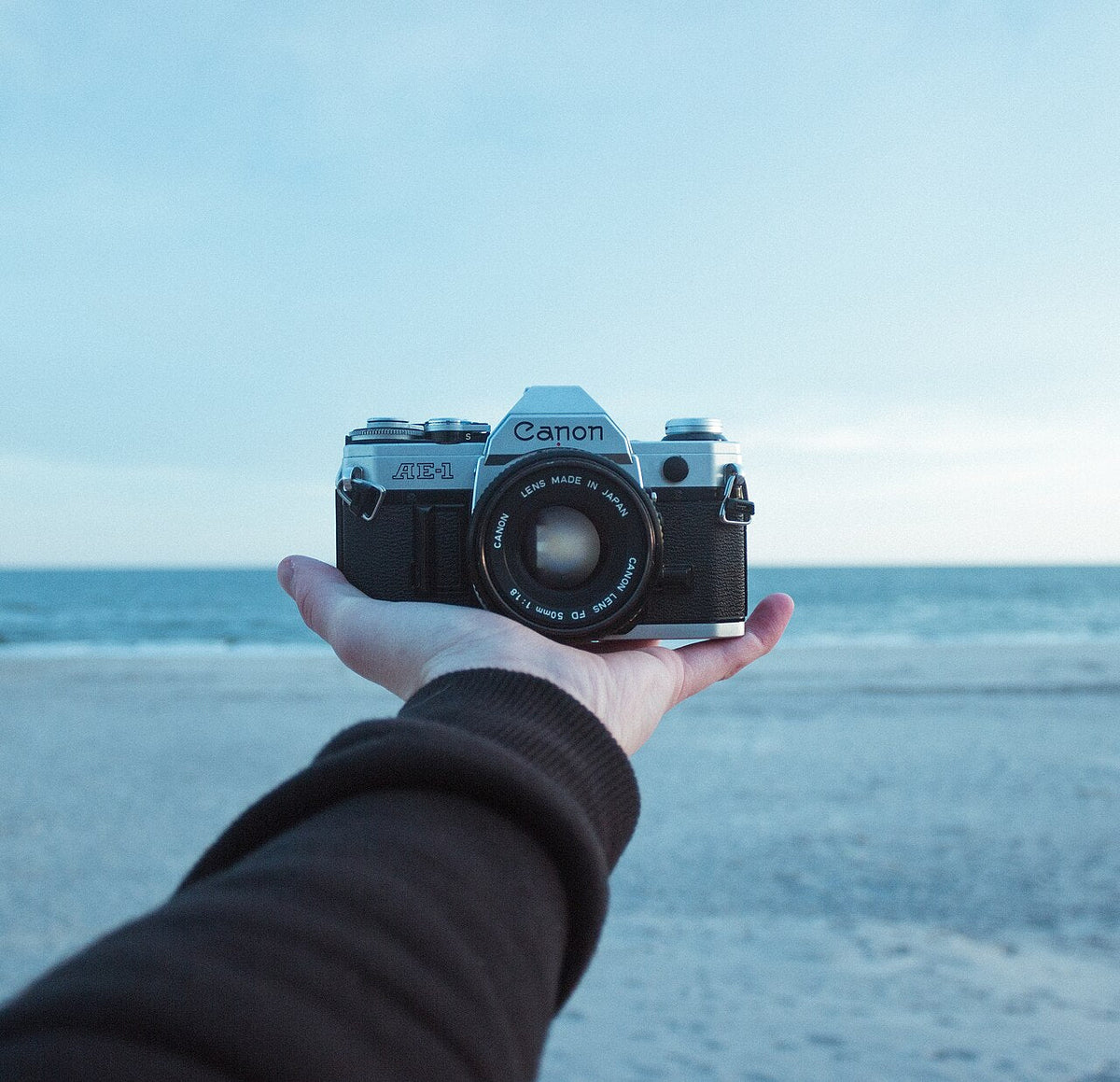
Point-and-shoot or SLR: that's the first question when you're getting into film photography. The point-and-shoot fits in your pocket and does everything itself; the SLR offers full control, interchangeable lenses, and a viewfinder that shows exactly what the image will look like. Neither is "better": it all depends on what you want to photograph and how much you want to learn the technique. Here's a point-by-point comparison to help you decide.
The verdict in 30 seconds
Get a point-and-shoot if…
- You want to photograph your everyday life, at parties, on trips, without thinking about settings.
- You want a camera that's always with you.
- You like the spontaneous look and direct flash.
Get an SLR if…
- You want to learn about exposure and depth of field.
- You want to change lenses (portrait, wide-angle, telephoto).
- You want to master every photo and photograph in low light with a fast lens.

Point-by-point comparison
| Feature | Film point-and-shoot | Film SLR |
|---|---|---|
| Size | Fits in a pocket | Requires a bag or strap |
| Settings | Automatic (often with little control) | Manual or semi-automatic |
| Viewfinder | Separate from the lens: slight framing discrepancy when shooting close up | Through the lens: you see exactly what the image will look like |
| Lens | Fixed (fixed focal length or small zoom) | Interchangeable, with a wide selection of used lenses |
| Low light | Depends on the aperture (usually f/2.8 to f/3.5) and flash | Very fast lenses (f/1.4 to f/2) |
| Flash | Built-in | External, except for a few SLRs with built-in flash |
| Depth of field | Little to no control | Full control via the aperture |
| Battery | Essential | Essential for electronic models, only for the light meter on mechanical models |
| Repairability | Limited (electronic) | Good for mechanical models |
| Discretion | Very discreet | More noticeable, mirror noise |
Why choose a film point-and-shoot
A point-and-shoot is the camera you really take with you. It focuses, measures the light, fires the flash, and advances the film all by itself: you only have to think about the photo. It's the camera for parties, holidays, and spontaneous photos, with that highly sought-after direct flash look. The best ones (Olympus Mju II, Yashica T4, Contax T2) have excellent lenses. Our selection: the best film point-and-shoots.
Its limitations: little control over exposure and depth of field, often a less fast lens, and electronics that are difficult to repair.
Why choose a film SLR

An SLR puts you in control: you choose the shutter speed, aperture, and focus, and you see exactly what the film will capture in the viewfinder. With a 50mm f/1.8 or f/1.4, you get blurred backgrounds and can photograph indoors without flash. You can then add a wide-angle or telephoto lens. And mechanical SLRs can be repaired for decades. Our ranking: the best used film SLRs.
Its limitations: weight, bulk, and the need to understand the basics of exposure. Our exposure triangle page helps you get started.
What about the in-between options?
- The rangefinder point-and-shoot (Olympus XA, Yashica Electro 35, Canonet): the size of a point-and-shoot, precise manual focus, and often aperture priority. See the Olympus XA and the Yashica Electro 35.
- The automatic SLR (Canon AE-1 Program, Minolta X-700): a program mode that does everything, with the option to take control yourself. See the Minolta X-700.
- The premium point-and-shoot (Contax T2, Ricoh GR1): aperture priority and exposure compensation in a pocket-sized body. See the Contax T2.
Three profiles, three recommendations
| Your profile | Our recommendation | Examples |
|---|---|---|
| "I just want beautiful souvenir photos" | Autofocus point-and-shoot | Canon Prima, Konica Big Mini, Olympus Mju |
| "I want to learn photography" | Mechanical or semi-automatic SLR | Pentax K1000, Nikon FM2, Canon AE-1 |
| "I want both" | An SLR at home, a point-and-shoot in your pocket, or a rangefinder point-and-shoot | Olympus XA, Yashica Electro 35 |
For more information, our guide which film camera to start with and the complete guide to film photography answer the other questions.
All cameras sold by Vibes Photo are checked before being put up for sale and covered by a six-month commercial warranty, in addition to legal warranties. Details can be found in our general terms and conditions of sale.
Frequently asked questions
Film point-and-shoot or SLR to start with?
A point-and-shoot if you want to photograph without worrying about settings; an SLR if you want to learn the technique. Both take excellent photos.
Does a film SLR take better photos than a point-and-shoot?
Not necessarily. A good point-and-shoot takes very sharp images. An SLR mainly offers control, fast and interchangeable lenses.
Which is more reliable?
A mechanical SLR (Pentax K1000, Nikon FM2) is easy to repair. An electronic point-and-shoot is more difficult to repair if it breaks down.
Do film point-and-shoots have a flash?
Almost all of them do. SLRs rarely do: you need an external flash.
Can you use the same film?
Yes, point-and-shoots and 35mm SLRs use the same 135 film.