










Contax T2: Review, Sonnar 38mm, Versions and Complete Buying Guide
History, Zeiss Sonnar 38 mm f/2.8, specifications, versions, known faults, pre-purchase inspection and comparison with the T3, T4, GR1 and mju-II: the definitive guide to the Contax T2.
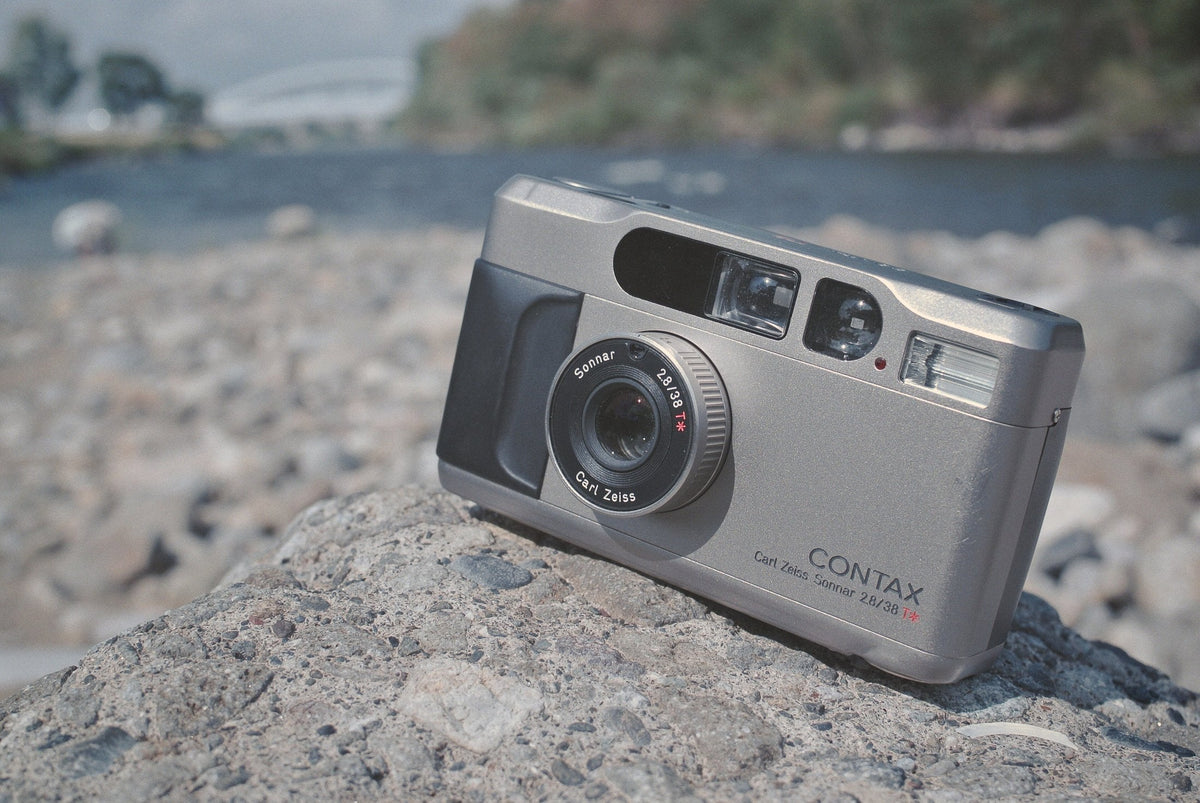
Reference sheet · Film compact · Updated October 2026
A titanium body, a Carl Zeiss Sonnar 38 mm f/2.8, an aperture ring under the thumb: the Contax T2 is the compact camera that invented the "luxury point-and-shoot". Here is everything you need to know before buying one, and how to use it properly.
There are cameras we buy for their specifications, and others for what they tell. The Contax T2 ticks both boxes. Launched by Kyocera in 1990 under the Contax brand, this 295-gram body combines what no consumer compact camera dared to offer: titanium covers, a sapphire viewfinder window, a ceramic film advance lever, and above all, a Carl Zeiss lens with a large aperture and a real aperture ring. Thirty-five years later, it is one of the most sought-after film compact cameras in the world, and one of the most expensive. This page separates myth from reality: history, lens, settings, versions, known faults, comparison with the T3, Yashica T4, Ricoh GR1, and Olympus mju-II, and the films that suit it best.
The essentials in 30 seconds
- The strong point: the Sonnar 38 mm f/2.8 (5 lenses in 4 groups, T* coating), high-contrast and bright, with real aperture and focus control.
- The weak point: 1990s electronics with no factory parts since Contax ceased production in 2005. The lens ribbon cable and LCD screen are the areas to watch.
- The limitation to know: 1/500 s maximum and minimum focus at 0.7 m. At f/2.8 in bright sunlight, even a 100 ISO film will be overexposed.
- The right buying reflex: demand a camera tested with film, with the possibility of return. A beautiful photo of the body proves nothing.
- The alternatives: T3 (smaller and sharper, more expensive), Ricoh GR1 (28 mm, very light), Yashica T4 and Olympus mju-II (much more affordable, without manual control).

History: from Zeiss Ikon to Kyocera
The name Contax was born in 1932 at Zeiss Ikon, in Dresden, on a rangefinder designed to rival the Leica. After the war, the brand stood still, until Carl Zeiss signed an agreement in the mid-1970s with the Japanese Yashica: Zeiss designed the lenses and lent its name, Yashica manufactured the bodies. The first fruit of this alliance is the Contax RTS reflex. In 1983, the ceramics giant Kyocera bought Yashica and inherited the brand.
In 1984, Kyocera launched the Contax T, a small manual-focus rangefinder equipped with a 38 mm f/2.8 Sonnar and a clip-on flash. It laid the foundations of the range: a professional-quality compact camera, to carry every day. Six years later, the T2 changed the era. Autofocus replaced the rangefinder, the flash was integrated, film advance was motorized, but Kyocera kept the essentials: the same 38 mm f/2.8 optical design and the possibility of taking back control of the aperture and focus.
The T2 was released in Japan in November 1990, at the price of 120,000 yen: the price of a good reflex with its lens. It paved the way for a whole generation of "luxury compacts": Nikon 28Ti and 35Ti, Leica Minilux, Ricoh GR1, Konica Hexar… The Contax T3 succeeded it in 2001, smaller and equipped with a new 35 mm Sonnar. In 2005, Kyocera announced the cessation of all activity related to Contax cameras. Since then, the repair of T2s depends on independent technicians and salvaged parts.
- Zeiss Ikon launches the first Contax, a 24×36 rangefinder.
- Carl Zeiss – Yashica agreement, then the release of the Contax RTS reflex.
- Kyocera buys Yashica and the Contax license.
- Contax T: compact rangefinder, 38 mm f/2.8 Sonnar, separate flash.
- Contax T2 in Japan (natural titanium), 120,000 yen.
- Black and gold titanium finishes, "60 Years" edition, Platinum version.
- Contax T3, completely recalculated 35 mm f/2.8 Sonnar.
- Kyocera stops the Contax brand.
- Return of film photography, the T2 becomes a cult object and its value skyrockets.
Design and materials
What strikes when picking up a T2 is the sensation of cold metal. The top and bottom covers are made of titanium, a rare material on a compact, which resists scratches well without weighing heavily. Kyocera, an industrial ceramics specialist, took care of the details: the viewfinder window is protected by a synthetic sapphire pane, the shutter release is also carved from sapphire, and the film advance lever is made of ceramic, a hard and very flat material that keeps the film perfectly flat. Even the battery cover is a milled metal disc, which screws on with a coin.
The ergonomics are the opposite of the automatic compacts of the 1990s. You turn on the camera by turning the dial located to the right of the cover: a titanium flap slides and the lens extends. The same dial is then used to choose between autofocus (A position) and engraved manual distances: 0.7 m, 1 m, 2 m, 5 m and infinity. Around the lens, a knurled ring displays the apertures from 2.8 to 16, plus a "P" position for program. A third dial, to the left of the cover next to the frame counter, corrects the exposure by ±2 EV per half-stop. Everything is visible at a glance, camera turned off.


Did you know?
The T2 owes a good part of its recent notoriety to television. In 2017, model Kendall Jenner photographed host Jimmy Fallon with a Contax T2 live on the Tonight Show. The moment was widely relayed, and high-end compacts became a coveted object for a whole generation discovering film photography. (Source: Casual Photophile, 2019.)
The Sonnar 38 mm f/2.8
The Sonnar is one of Zeiss's great optical designs, designed by Ludwig Bertele in the late 1920s for the first Contax. Its principle: limit the number of air-glass surfaces by gluing lenses together, which reduces stray reflections and gives high contrast. The T2 version has 5 lenses in 4 groups, with Zeiss's T* multi-layer coating.
Concretely, what users look for in this 38 mm is a sharp contrast from wide open, dense colors on negative and a good hold in backlight. At f/2.8, vignetting (darkening of the corners) is visible on a uniform sky; it disappears by closing to f/5.6–f/8, where the lens gives its best sharpness. The background blur remains that of a 38 mm: pleasant at a short distance, discreet beyond 2 to 3 meters.
The 38 mm focal length is a little tighter than the classic 35 mm: wide enough for street, travel and indoors, neutral enough for a bust portrait without distorting faces. Be careful, however, with the minimum distance of 0.7 m. At this distance, the frame covers about 42 × 63 cm: a bust, not a tight portrait of the face. The T3 goes down to 0.35 m, the Olympus mju-II too.
The T2 does not perform optical miracles. It simply lets you choose the aperture, and it is this choice that makes the images.
Vibes Photo Editorial Team
Complete technical sheet
- Type
- 24×36 autofocus compact, central shutter
- Lens
- Carl Zeiss Sonnar T* 38 mm f/2.8, 5 lenses in 4 groups, retractable
- Apertures
- f/2.8 to f/16 by ring, + P position (program)
- Focus
- Active autofocus or manual, from 0.7 m to infinity
- Speeds
- 8 s to 1/500 s, managed by the camera
- Modes
- Program and aperture priority
- Metering
- External SPD cell, center-weighted, mid-point memory
- Correction
- ±2 EV per half-stop, dedicated dial
- Sensitivity
- DX coding from 25 to 5000 ISO; uncoded film read at 100 ISO
- Viewfinder
- Collimated with bright frame, speed and focus signals
- Flash
- Integrated, 0.7 to 3 m at 100 ISO, 3.5 s recycle, pre-flash anti-red-eye
- Film
- Automatic loading, motorized advance and rewind, rewind in progress of film possible
- Materials
- Titanium covers, sapphire viewfinder pane and shutter release, ceramic film advance lever
- Power
- 1 3 V CR123A lithium battery (+ CR2025 for the date back)
- Dimensions
- 119 × 66 × 33 mm
- Weight
- 295 g without battery
Sources: manufacturer sheet taken over by Contax documentation (T / T2 / T3), Camera-wiki.org. The speed ranges vary according to the sources (1 s in program according to some sheets, automatic exposure beyond).
Versions and finishes
There is only one Contax T2 optically and mechanically: all versions share the same lens and the same electronics. What changes is the finish, and therefore the rarity and the value. Japanese sources (specialized resellers and collectors) agree on the following chronology.
| Version | Year | What distinguishes it | Rarity |
|---|---|---|---|
| Natural titanium ("champagne") | 1990 | The base version, warm silver-colored titanium covers | The most common |
| Black titanium | 1991 | Anthracite gray treated titanium, more discreet | Common |
| Gold (gold titanium) | 1991 | Gold finish, very "bubble years" | Less common |
| 60 Years | 1992 | 60 years of Contax: gold-plated covers, walnut box, leather case; 2,000 copies in Japan, 4,000 exported | Limited edition |
| Platinum | 1992 | Platinum coating, ostrich leather, walnut box; sold on order 240,000 yen | Rare |
| Glossy black (Black) | Late 1990s | Deep black paint, limited edition produced after the end of the standard version (2,000 copies according to Japanese resellers) | The most sought after |


Check
Don't confuse black titanium (anthracite gray, fairly common) with lacquered black (deep black, rare). Listings often mix them up. For limited editions, the case and original box carry significant weight in value. There are also T2s with a date back (“Data Back”), which use an additional CR2025 battery.
Using it well: settings and method
The T2 can be used like a simple point-and-shoot: set the ring to P, the dial to AF, and shoot. But it only gives its best when you take control of two things: aperture and distance.
1. Choose your aperture according to the light
Primarily, the maximum shutter speed remains locked at 1/500 s. This is the most important constraint. Do the math: in full sun, 400 ISO film requires approximately f/16 at 1/500 s. If you open to f/2.8, you will overexpose by about five stops. Color negative film handles overexposure well, but not to this extent without losing contrast. To play with shallow depth of field, keep f/2.8 for shade, indoors, or late in the day, or load 100 ISO film.
| Light | 100 ISO | 400 ISO |
|---|---|---|
| Full sun | f/8 – f/11 | f/16 (limit) |
| Overcast sky | f/5.6 | f/11 |
| Deep shade | f/2.8 – f/4 | f/5.6 – f/8 |
| Bright interior | f/2.8, slow speed | f/2.8 at approximately 1/30 s |
These guidelines follow the “Sunny 16” rule, explained on our Sunny 16: exposing without a light meter page. They are used to anticipate: the T2's light meter always calculates the speed.
2. Switch to manual focus for street photography
The T2's active autofocus is reliable, but it targets the center and takes a brief moment to lock on. For street photography, the best method is zone focusing. At f/11 with the dial set to 5 m, everything is sharp from approximately 2.3 m to infinity. At f/8 at 5 m, the sharp zone goes from approximately 2.7 m to nearly 30 m. You just have to frame and shoot, without delay.
Expert tip
For a portrait at f/2.8, first focus on the eyes by pressing the shutter button halfway: the exposure and distance are memorized. Then recompose without releasing. Stay beyond 0.7 m: below that, the autofocus cannot focus and the photo will be blurry.
3. Use exposure compensation
Center-weighted metering can be fooled by very bright backgrounds (snow, beach, sky in the frame): the subject then comes out too dark. In these cases, add +1 EV. Conversely, on a subject lit against a black background, subtract 1/2 to 1 EV. The dedicated dial makes this action instantaneous, and it is one of the T2's great advantages over fully automatic point-and-shoots.
4. Master the flash
The built-in flash reaches up to approximately 3 m at 100 ISO. It is mainly used as fill light, indoors, or to open up a backlit shot. The T2 lets you turn it off, which avoids annoying flashes in a museum or at a concert. For a natural nighttime look, turn off the flash, open to f/2.8, load 800 ISO film, and lean against a wall.
For the basics of loading and rewinding, see our guides loading film and rewinding film.
The results in images
The following photos were taken with a Contax T2 by photographers who publish their work under a Creative Commons license, with the camera body and film indicated by the author. They show the camera's versatility, from daylight to urban night, in color and black and white. The result also depends on the film, the lab, and the scan.


To learn more, you can see thousands of examples of photos taken with a Contax T2 on Lomography. These images belong to their authors. We do not reproduce them here.
Known issues and pre-purchase check
A T2 is now between 25 and 35 years old. It is a fully electronic camera, with no mechanical backup mode, and Kyocera has not supplied parts since 2005. The good news: its high value makes repairs worthwhile, and specialized technicians know it well. Here are the most frequently reported defects by repair shops and user forums.
| Symptom | Probable cause | Severity |
|---|---|---|
| The lens no longer extends or the camera remains dead | Lens ribbon cable (flexible cable) worn out by repeated insertions and removals | Repairable by a specialist |
| The counter flashes "00" after loading | Film not properly engaged, dirty infrared sensor, or cracked solder joint on this sensor | Often minor |
| LCD screen stained or segments missing | Heat or impact; may indicate a drop | Avoid |
| Flash does not recharge | Weak battery, capacitor, or flash circuit | Variable |
| Premature rewinding, irregular advance | Worn motor, gears, contacts | Avoid |
| Non-original screws, missing viewfinder cover | Previous amateur repair | Warning sign |
Classic trap
The counter flashing "00" does not necessarily mean the camera is dead. Before concluding it's broken: put in a new battery, check that the film leader reaches the take-up spool, and try another roll of film. Some very transparent films are poorly detected by the infrared sensor that counts the perforations. If the problem persists with several films, it's a case for a repairer.
The checklist before buying
- Powering on: with a new CR123A, the lens should extend without jerking or grinding noise, and retract when turned off.
- Manual focus: turn the dial at each distance; the lens should move with each click.
- LCD screen: all segments visible, without dark stains or leaks.
- Viewfinder: sapphire cover present, clean, without internal fogging; bright frame clearly visible.
- Aperture ring and correction dial: clear clicks, without play.
- Flash: visible charging and flash.
- Battery door and screws: good condition threads, original screws, no tool marks.
- Front lens: no deep scratches, fungus, or haze (look through it with a lamp).
- Test roll: check spacing, exposure, sharpness, and flash. It's the only true judge.
These points complement our general guide for buying a used film camera. If a T2 breaks down, our article repairing an old camera helps you know who to contact.
Why it is so expensive
The T2 already cost the price of a reflex camera when it was released. Its current value is explained by several factors: production stopped for over twenty years, high demand since the return of film, the effect of social media and celebrities, and repairs that require salvaged parts. The finish also plays a role: a lacquered black or complete limited edition, with a box, sells significantly more than natural titanium marked by use.
We do not publish prices here: they move quickly and depend on the actual condition of the camera. To understand the logic of the market, read our analysis why film compacts are so expensive. If the budget is tight, look at our selection of alternatives to the Contax T2.
T2, T3, T4, GR1 or mju-II?
The T2 is often compared to four other "premium" compacts from the 1990s and 2000s. All have a quality fixed lens and autofocus. What distinguishes them is manual control, focal length, size, and robustness.
| Model | Release | Lens | Min. map. | Aperture control | Body | Weight | Battery |
|---|---|---|---|---|---|---|---|
| Contax T2 | 1990 | Zeiss Sonnar 38 mm f/2.8 (5/4) | 0.7 m | Yes, + manual map. | Titanium | 295 g | CR123A |
| Contax T3 | 2001 | Zeiss Sonnar 35 mm f/2.8 (6/4) | 0.35 m | Yes, + manual map. | Titanium | 230 g | CR2 |
| Yashica T4 | 1992 | Zeiss Tessar 35 mm f/3.5 (4/3) | 0.35 m | No (fully automatic) | Plastic | 170 g | CR123A |
| Ricoh GR1 | 1996 | GR 28 mm f/2.8 (7/4) | 0.35 m | Yes | Magnesium | 175 g | CR2 |
| Olympus mju-II | 1997 | 35 mm f/2.8 (4/4, aspherical) | 0.35 m | No (fully automatic) | Plastic, splash resistant | 135 g | CR123A |
In parentheses: number of lenses / groups. Sources: Contax documentation, Olympus press release of February 18, 1997, Camera-wiki.org (GR1, T4).
Contax T3
Smaller, lens recalculated sharper to the edges, 1/1200 s in program and focus at 35 cm. It's the best of the two on paper, but it costs more and its dial is less readable than that of the T2.

Ricoh GR1
A superb 28 mm in a very thin magnesium body: the choice of the street photographer who wants a wide angle. Its LCD screen ages poorly, to be checked. Read our review of the Ricoh GR1.

Yashica T4
The "little brother" Kyocera, with a Zeiss Tessar. Excellent rendering, but no aperture control or focus. Read our review of the Yashica T4 and the duel Contax T2 vs Yashica T4.

Olympus mju-II
Minuscule, bright, splash resistant, with spot metering. The best value for money in the segment, but fully automatic. Read our review of the Olympus mju-II.
Choose the T2 if…
- you want to choose your aperture and distance like on an expert camera;
- you like the 38 mm, versatile and natural;
- build quality matters as much as the result.
Look elsewhere if…
- you take a lot of close-up portraits (0.7 m minimum);
- you want the smallest camera possible (mju-II, GR1);
- your budget is limited: an mju-II or a T4 give 90% of the pleasure.
For a broader panorama, consult our guide to the best film compact and our Contax camera guide.
Which films to choose
With a high-contrast lens and a speed limited to 1/500 s, the choice of sensitivity matters more than on an ordinary compact. Here are our recommendations according to use.
| Use | Film | Why |
|---|---|---|
| Versatile, travel | Kodak Portra 400 | Wide latitude, natural skin tones; f/16 at 1/500 s in full sun remains within the T2 range |
| Sun and f/2.8 aperture | Kodak Ektar 100, Kodak Gold 200 | Low sensitivity to open up more without exceeding 1/500 s |
| Small color budget | Kodak Gold 200, Kodak UltraMax 400 | Warm colors, ideal for filling a test roll |
| Black and white | Kodak Tri-X 400, Ilford HP5 Plus, Ilford XP2 | The Sonnar contrast gives dense blacks; the XP2 develops in C-41 in any lab |
| Urban night | CineStill 800T, Portra 800 | Sensitive enough for f/2.8 handheld under neon lights |
To go deeper: our review of Portra 400, Ektar 100, Tri-X 400, Gold 200 or Portra 400, and our guide which black and white film to choose. On a trip, keep your films in your carry-on and read our tips on X-rays at the airport.
Frequently asked questions
Does the Contax T2 have a manual mode?
No fully manual mode: you never choose the speed. However, you control the aperture (aperture priority, from f/2.8 to f/16), manual focus from 0.7 m to infinity, exposure compensation (±2 EV) and flash. It's much more than most compacts.
What battery does the Contax T2 use?
A 3 V CR123A lithium battery (or DL123A). Versions with a date back also use a CR2025 for date printing. Always keep a spare CR123A: the camera does not work at all without a battery.
Contax T2 or T3: which one to choose?
The T3 is smaller, its 35 mm is sharper in the corners and it focuses at 35 cm. The T2 has a more readable ergonomics (dedicated dials) and a more "classic" rendering. If you take close-up portraits or if size matters, choose the T3. If you like physical controls and the 38 mm focal length, the T2.
Is the Contax T2 repairable?
Yes, by technicians specializing in high-end compacts, even if Kyocera no longer provides parts since 2005. Lens ribbon cable, counter, or flash failures are repairable. A damaged LCD screen is more delicate. Before buying, favor a camera tested with a film and accompanied by a return option.
Why are my photos overexposed at f/2.8?
Because the speed cannot exceed 1/500 s. In full sun, f/2.8 at 1/500 s lets in far too much light, even with a 100 ISO film. Close to f/8–f/16 in broad daylight, or keep the wide aperture for shade and indoors.
Are the T2 and the T the same camera?
No. The Contax T from 1984 is a small manual focus rangefinder, with a separate flash. The T2 from 1990 is an autofocus compact with built-in flash and motorized advance. Both use a Sonnar 38 mm f/2.8 with 5 lenses in 4 groups.
Can you still find films for the T2?
Yes: it accepts all standard 135 (24×36) films, color, black and white or slide, from 25 to 5000 ISO thanks to DX coding. Non-DX coded films are read at 100 ISO.
Vibes Photo
Find your film compact
The Contax T2 is not the only compact offering an exceptional rendering. Browse our used film cameras, or write to us to be notified when a T2 arrives in the shop.
Sources
- Camera-wiki.org, « Contax T2 » (specifications).
- Contax T / T2 / T3 comparison sheet (manufacturer data).
- Contax T3: manufacturer specifications; Contax T3 manual.
- Wikipedia, « Contax T » (range, end of Contax in 2005).
- Filmcamera-kaitori (Japan): release date, launch price and versions; Wonder Price: finish chronology; Camera Kaukau: 60th anniversary edition.
- Casual Photophile, « The Contax T2 – Searching for Value Amongst the Hype » (2019).
- Olympus, µ[mju:]-II press release, February 18, 1997; Camera-wiki.org, Ricoh GR1; Camera-wiki.org, Yashica T4.
- Away Repairs, diagnosis of a T2 displaying « 00 » (infrared sensor).
Sample photos: authors credited under each image, Creative Commons licenses indicated. Depth of field distances calculated for a circle of confusion of 0.03 mm.