










Kodak Ektar 100: Review of the Finest-Grain Color Film
The finest-grained color film according to Kodak: saturated rendering, exposure, comparison with Portra and photo examples.
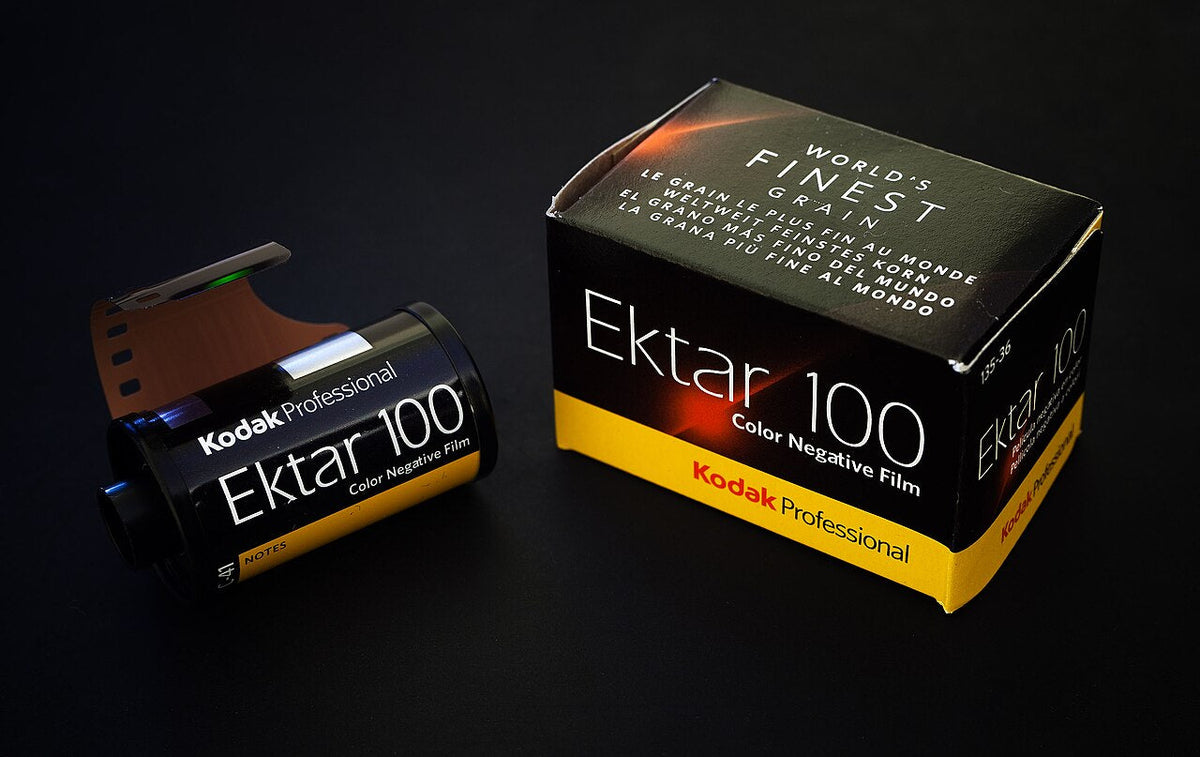
Kodak presents Kodak Ektar 100 as the world's finest-grained color negative film. Highly saturated colors, remarkable sharpness, ideal for scanning and large prints: it's the film for landscapes, travel, and photography in bright sunlight. However, it requires more precision than Portra. Here is our full review.
The verdict in 30 seconds
What we like
- Extremely fine grain, ideal for enlarging and scanning.
- Vivid and saturated colors, intense blues and reds.
- Available in 35 mm, 120, and sheet film.
Things to know
- 100 ISO: you need light or a tripod.
- Less tolerant of underexposure than Portra.
- Can make skin tones look reddish: less suitable for portraits.

Technical specifications
| Feature | Kodak Ektar 100 |
|---|---|
| Type | Professional color negative, daylight, T-GRAIN emulsions |
| Sensitivity | ISO 100 |
| Formats | 35 mm (135), 120, sheet film |
| Processing | C-41 |
| Launch | 2008 (35 mm), then 120 and sheet film; an earlier Ektar film existed from 1989 to 1997 |
The Ektar look
Ektar was designed for very vivid colors: deep blue skies, intense greens, brilliant reds. Its grain is so fine that a 35 mm scan almost looks like medium format. It's the dream film for landscapes, architecture, sunny travel, and colorful objects.

Exposing Ektar correctly
- Expose at 100 ISO, or meter the shadows: like all color negatives, it prefers a little too much light rather than too little.
- It has less latitude than Portra: underexposure quickly leads to crushed shadows and color casts.
- In low light, use a tripod or a wide aperture. For night photography, prefer a CineStill 800T.
- When scanning, saturation can be reduced if it's too strong for your taste.
For the basics of exposure, read our light meter guide.


Want to see more images? Browse the most popular photos taken on Kodak Ektar 100 on Lomography (Lomography community gallery, photos protected by the copyright of their authors).
Ektar 100 or Portra?
For landscapes and daytime travel: Ektar. For portraits, weddings, and varied lighting: Portra 400, which is softer and much more tolerant.
| Film | ISO | Look | Best for |
|---|---|---|---|
| Kodak ColorPlus 200 | 200 | Warm, visible grain, affordable | Starting out on a budget, bright daylight |
| Kodak Gold 200 | 200 | Warm, saturated | Summer, travel, daylight |
| Kodak Ultramax 400 | 400 | Saturated, high contrast, versatile | All conditions, compact cameras |
| Kodak Portra 400 | 400 | Natural, soft skin tones, wide latitude | Portraits, weddings, high-quality scans |
| Kodak Ektar 100 | 100 | Highly saturated, finest grain | Landscapes, travel, bright sunlight |
| CineStill 800T | 800 | Tungsten, red halos | City nights |
Processing, scanning, and storage
Kodak Ektar 100 is processed in C-41, the standard color process: all labs process it, often within a few days. You need a scan with a known pixel resolution if you want to make prints. If you scan it yourself, carefully inverting the orange mask is key to accurate colors.
Before exposure, store the film cool and dry, away from sunlight (the refrigerator is ideal for storage). After exposure, process it quickly: the latent image degrades with heat. When traveling, keep it in your carry-on bag (film and X-rays). Expired film can still be used with a few precautions: see expired film.
In what cameras?
Ektar reaches its full potential with a good lens and fast shutter speeds: a rangefinder like the Nikon FM2 (1/4000 s) or the Minolta X-700, or a medium format camera. In an automatic compact camera, it works well in the sun.
Frequently asked questions
Is Kodak Ektar 100 good for portraits?
It can make skin tones look reddish and too high-contrast. For portraits, Portra 160 or 400 is more suitable.
Ektar 100 or Portra 400?
Ektar for landscapes and saturated colors in bright daylight; Portra for portraits and changing light.
Can you overexpose Ektar?
A slight overexposure is not a problem; it remains less tolerant than Portra, especially in underexposure.
Is Ektar available in 120?
Yes, in 35 mm, 120, and sheet film.
Why is Ektar ideal for scanning?
Its very fine grain and sharpness allow for highly detailed scans and large enlargements.
Sources: Kodak – Ektar 100 data sheet E-4046 (PDF); Wikipedia – Kodak Ektar.