










Film exposure meter and light meter: app, handheld meter, or Sunny 16?
Understand light metering, choose between an app, a handheld meter, and Sunny 16, and know when to adjust your reading to properly expose your film.
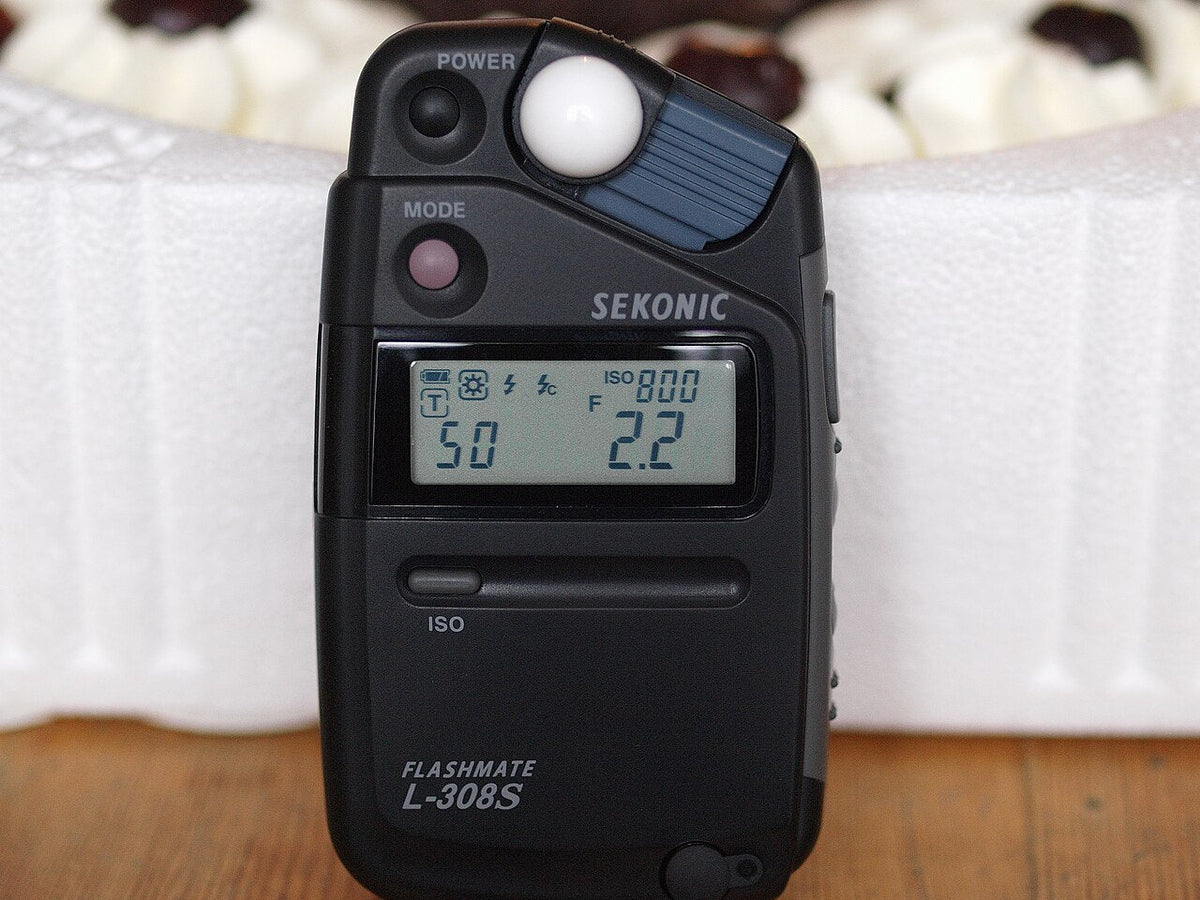
The cell (or light meter) measures light and gives you the shutter speed/aperture combination to properly expose your film. Your camera may have one built in, but it may be broken, inaccurate, or simply absent (Leica M2 or M3, Nikon F with a single prism, Zenit B, many old medium format cameras...). So do you need a handheld light meter, a phone app, or the Sunny 16 rule? This guide explains how light metering works, the types of light meters, and when to correct what they tell you.
The verdict in 30 seconds
We like
- To get started with a camera without a light meter: a free light meter app is more than enough for color negative or black and white.
- For portraiture, slide film, or medium format: a handheld incident light meter gives more consistent exposures.
- The Sunny 16 remains the easiest solution in good weather.
To know
- A reflected measurement is "fooled" by snow, backlighting, or a black background.
- Old selenium cells weaken with age: check them before trusting them.
- Many vintage cells were designed for mercury batteries that are now banned.

How light metering works
Every light meter works on the same principle: it assumes that the scene is, on average, a "medium gray" brightness (often called 18% gray). It therefore calculates the exposure that will make what it measures medium gray. This works very well for a normal scene, but not for a very bright or very dark scene. To understand how shutter speed, aperture, and sensitivity balance each other, review our exposure triangle page.
Reflected measurement
The cell points at the subject and measures the light it reflects. This is what built-in camera cells and apps do. The downside: a light subject (snow, white wall) reflects a lot of light, the cell "brings it back" to gray and underexposes. A dark subject is, on the contrary, overexposed.
Incident measurement
The cell, equipped with a diffusing white dome, is placed at the level of the subject, dome facing the camera. It measures the light illuminating the subject, regardless of its color. Result: light or dark skin, a white dress, or a black suit are rendered at their true value. This is the most reliable measurement for portraiture and in the studio.

Spot measurement
A spot light meter measures a very narrow angle (often 1°). It allows you to precisely measure a chosen area: a face in backlighting, a shadow whose detail you want to preserve. It is the tool of the zone method in black and white.
Types of cells
| Type | Battery | Strengths | Limitations |
|---|---|---|---|
| Selenium (e.g. Sekonic L-398, many old cells) | None | Works without a battery, no battery-related drift | Low sensitivity in low light, may weaken with age |
| CdS (cadmium sulfide) | Yes | Sensitive in low light | Slow to react, "memory" after strong light, often designed for mercury batteries |
| Silicon (SPD/GPD), digital | Yes | Fast, accurate, flash measurement on some models | Depends on a battery |
| Smartphone app | The phone | Free, always with you | Average reflected measurement, to be checked depending on the phone |

Your cell or your 1960s-70s camera is waiting for a 1.35 V mercury battery? Replacement batteries do not always have the same voltage. Everything is explained in our guide on batteries for film cameras.
App, handheld light meter, or Sunny 16: what to choose?
| Solution | Ideal for | Avoid for |
|---|---|---|
| Light meter app | Getting started, cameras without a light meter, color negative and black and white | Slide film, flash, very high-contrast scenes |
| Handheld incident light meter | Portraiture, medium format, slide film, studio | The street, where you need to measure quickly |
| Spot light meter | Landscape, mastered black and white, backlighting | Getting started |
| Sunny 16 (without measurement) | Bright daylight, light travel | Indoors, night, changing light |
The Sunny 16 rule is detailed on our Sunny 16 page: in bright sunlight, at f/16, the shutter speed is the inverse of the sensitivity (1/125 s with a 100 ISO, about 1/500 s with a 400 ISO).
When to correct the measurement
| Situation | Reflected measurement | Recommended correction |
|---|---|---|
| Snow, beach, white subject | Underexposes | +1 to +2 stops |
| Backlighting (subject in front of the sky) | Underexposes the subject | +1 to +2 stops, or close-up measurement on the face |
| Dark subject on dark background | Overexposes | −1 stop |
| Night scene with streetlights | Variable | Measure on a medium area, then take several exposures |
Good news: color negative tolerates overexposure very well (often 2 to 3 stops), much less underexposure. In case of doubt, overexpose by one stop. Slide film, on the other hand, does not forgive: expose for the highlights. A photo already ruined? Our ruined photos clinic helps you diagnose.
Checking the cell of a used camera
- Put in a new battery of the correct voltage.
- Set the same sensitivity on the camera and on an app or a reference light meter.
- Aim at a uniform, well-lit surface (a wall, a cloudy sky) with both.
- Compare: a difference of one-third or half a stop is normal; beyond one stop, compensate with the ISO setting or use an external light meter.
Our cameras are checked in the workshop, including the cell when they have one. To find out what we check, discover our workshop.
All cameras sold by Vibes Photo are checked before being put on sale and covered by a six-month commercial warranty, in addition to legal warranties. The details are in our general terms and conditions of sale.
Frequently Asked Questions
Is a light meter app reliable?
For color negative and black and white, yes in the vast majority of cases, especially if you aim for a medium area of the scene. Compare it once to a reliable light meter to check that there is no discrepancy.
What is the difference between a cell and a light meter?
None: both words refer to the instrument that measures light. We often say "cell" for the one that is built into the camera.
Incident or reflected measurement?
Incident measures the light falling on the subject and is not fooled by its color; reflected measures what the subject reflects, like the cell of your camera.
Does my selenium cell still work?
Often yes, but it may have lost sensitivity. Compare it to an app: if the needle barely moves in broad daylight, it is exhausted.
Do you need a light meter for an automatic camera?
No, a camera that manages exposure (compact, reflex in auto mode) measures by itself. A handheld light meter is mainly used for manual or cell-less cameras.
Sources: Wikipedia – Light meter ; Wikipedia – Exposure value ; Wikipedia – Sunny 16 rule.