










Kodak Ultramax 400: Review, rendering and exposure tips
Kodak’s all-conditions color film: rendering, grain, exposure, comparison with Gold 200 and Portra 400, and photo examples.
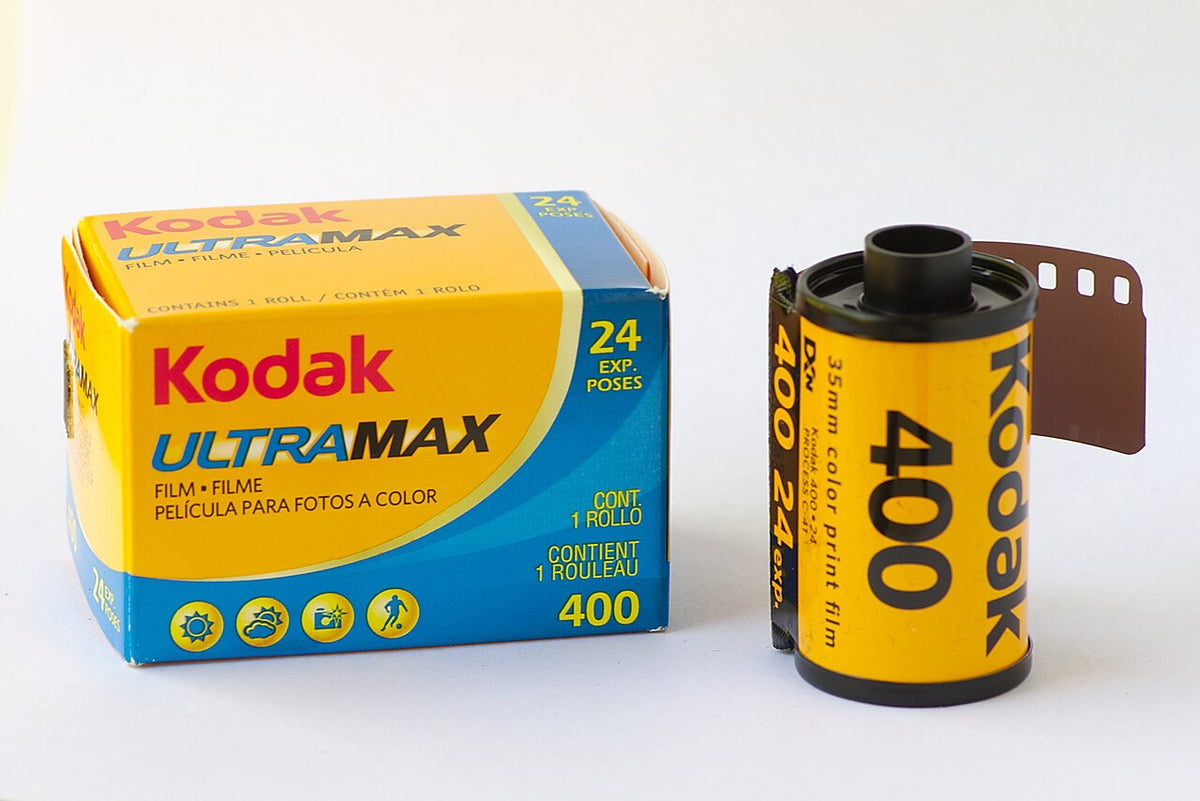
Kodak Ultramax 400 is Kodak's "all-conditions" color film: 400 ISO, vivid colors, good tolerance for exposure mistakes, and a significantly lower price than Portra. For a compact, a reloadable disposable, or an everyday SLR, it is often the best choice. Here is its look, how to expose it, and how it compares to other Kodak films.
The verdict in 30 seconds
What we like
- Versatile: sun, shade, bright interiors, late afternoon.
- Vivid, contrasting colors, warm "Kodak" look.
- Handles overexposure well.
- Cheaper than professional films.
Things to know
- Grain is more visible than on Portra 400.
- More saturated look, less neutral on skin tones.
- Available only in 35 mm.

Technical specifications
| Feature | Kodak Ultramax 400 |
|---|---|
| Type | Consumer color negative, daylight balanced |
| Sensitivity | ISO 400 |
| Format | 35 mm (135), 24 or 36 exposures, DX coded |
| Processing | C-41, at all labs |
| History | Successor to Kodak Gold 400 (renamed Ultramax in 2007) |
What is the look?
Kodak presents it as a film with vivid colors and natural skin tones. In practice, Ultramax produces high-contrast images, with rich blues and reds and a slightly warm cast. The grain is noticeable, especially in underexposed shadows, but remains subtle on a well-exposed photo. It is a highly popular "vacation souvenir" look, punchier than Portra.

Exposing Ultramax 400
- In bright sunlight: expose at 400 ISO; with a compact limited to 1/500 s or less, there is no need to worry, the negative handles overexposure.
- In the shade or on cloudy days: this is where it shines compared to a 200 ISO film.
- Indoors: sufficient near a window; otherwise, use flash.
- Tip: many photographers expose it at 200 or 320 ISO for cleaner shadows and finer grain.
To choose the right sensitivity, read 200 or 400 ISO?, and for settings, our light meter and meter guide.

Want to see more images? Browse the most popular photos taken on Kodak Ultramax 400 on Lomography (Lomography community gallery, photos protected by the copyright of their authors).
Ultramax or another film?
| Film | ISO | Look | For whom |
|---|---|---|---|
| Kodak ColorPlus 200 | 200 | Warm, visible grain, economical | Starting out on a budget, bright daylight |
| Kodak Gold 200 | 200 | Warm, saturated | Summer, travel, daylight |
| Kodak Ultramax 400 | 400 | Saturated, contrasting, versatile | All conditions, compacts |
| Kodak Portra 400 | 400 | Natural, soft skin tones, wide latitude | Portraits, weddings, careful scanning |
| Kodak Ektar 100 | 100 | Very saturated, finest grain | Landscapes, travel, bright sun |
| CineStill 800T | 800 | Tungsten, red halos | Night in the city |
Processing, scanning and storage
Kodak Ultramax 400 is processed in C-41, the standard color process: all labs process it, often in a few days. Requires a scan with a pixel definition you know if you want to make prints. If you scan it yourself, a careful inversion of the orange mask is the key to accurate colors.
Before exposure, store the films cool and dry, away from the sun (the refrigerator is ideal for storage). After exposure, process it quickly: the latent image degrades with heat. When traveling, keep them in the cabin (film and X-rays). An expired film remains usable with a few precautions: see expired film.
The most frequent match: Gold 200 vs Portra 400. Ultramax sits between the two: more sensitive than Gold, more affordable than Portra.
In which cameras?
In a compact with an f/3.5 lens like the Yashica T4 or a Canon Prima, a 400 ISO avoids a lot of blur and flash. In a fixed-aperture camera like the Kodak Ektar H35, it is even the recommended sensitivity to get out of the bright sun range.
Frequently Asked Questions
Is Kodak Ultramax 400 a good film?
Yes, it is one of the most versatile color films: 400 ISO, vivid colors, tolerant, and more affordable than professional films.
Ultramax 400 or Portra 400?
Portra offers more natural tones, finer grain, and greater latitude; Ultramax is more saturated, more contrasting, and cheaper.
Ultramax 400 or Gold 200?
Ultramax gains a stop of sensitivity, useful in the shade and indoors; Gold 200 is a bit warmer and finer in bright sunlight.
Can you overexpose Ultramax 400?
Yes, like most color negatives, it handles overexposure well. Underexposure, on the other hand, produces gray and grainy shadows.
Is Ultramax available in 120?
No, it is sold only in 35 mm.
Sources: Wikipedia – List of photographic films; Kodak Ultramax 400 – Lomography.