










Yashica T4 (and T5): reviews, versions, Zeiss rendering and buying advice
Yashica T4 and T4 Super / T5: specifications, versions, Carl Zeiss Tessar lens rendering, Super Scope, flash, known faults and points to check before buying used.
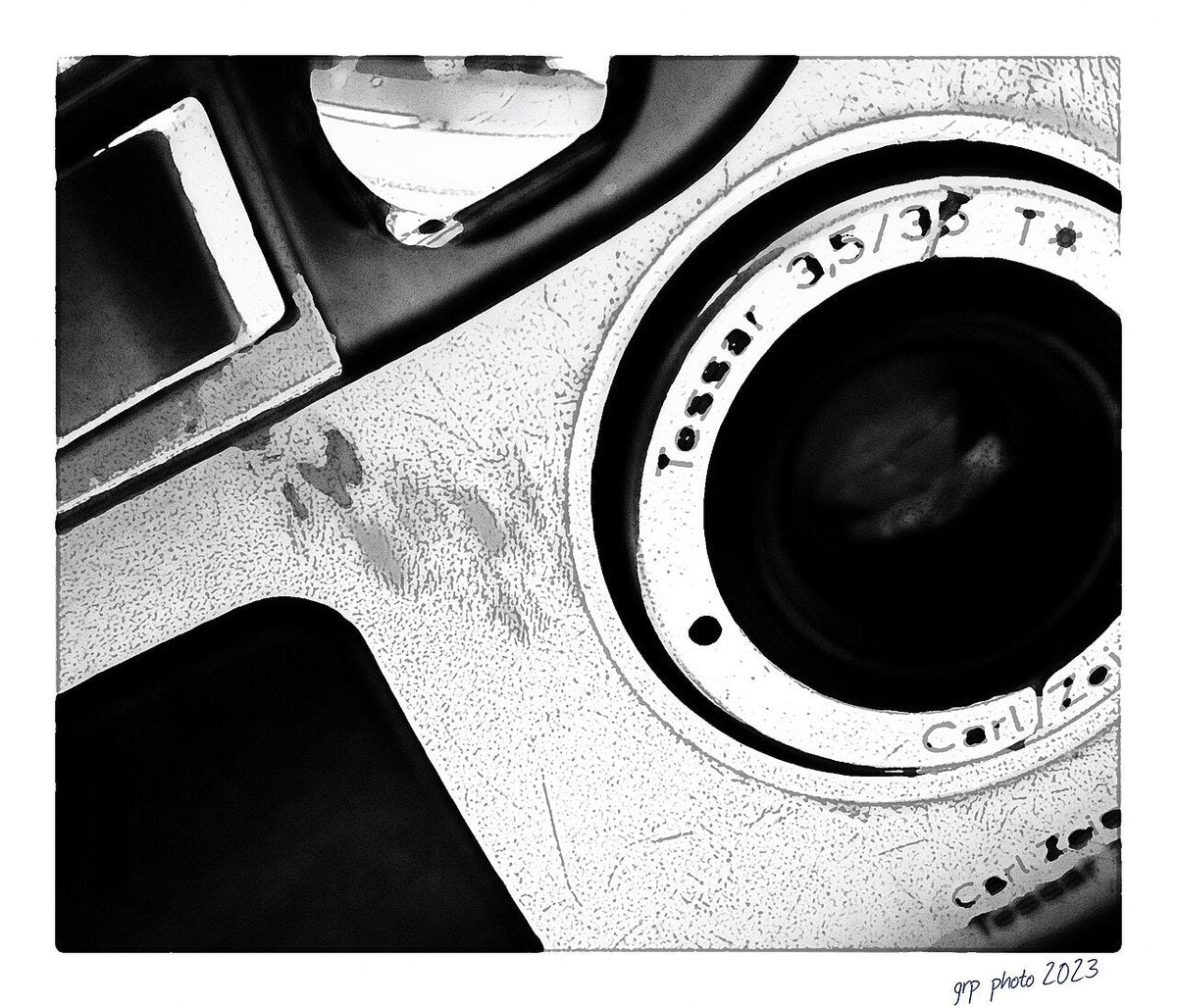
Reference guide · Film point-and-shoot · November 2026 update
Launched in 1990 by Kyocera under the Yashica brand, the T4 is a simple, fully automatic plastic point-and-shoot camera with one detail that changes everything: a Carl Zeiss Tessar T* 35 mm f/3.5 lens. Its successor, the T4 Super (T5 in Europe), adds a weather-sealed body and an amazingly useful waist-level viewfinder. Versions, image quality, pitfalls and pre-purchase checks: here is what you need to know.
The Yashica T4 has two lives. In the 1990s, it was just another well-made point-and-shoot, appreciated for its lens but marketed as a family camera. Since the film revival, it has become one of the most sought-after point-and-shoots, thanks to its reputation for sharpness and its popularity on social media. The result: a plastic camera that now commands high prices. This guide separates legend from reality, drawing on technical specifications, published tests and repairer feedback to help you decide whether the T4 is right for you and which version to choose.
The essentials in 30 seconds
- The highlight: a Carl Zeiss Tessar T* 35 mm f/3.5 lens with four elements in three groups, renowned for its sharpness and contrast even at wide open.
- The two versions: the original T4, lightweight and simple; the T4 Super, also known as the T5 or Kyocera T Proof, which is weather-sealed and features the Super Scope waist-level viewfinder.
- The limitations: f/3.5 only, maximum shutter speed of 1/700 s, no manual settings or exposure compensation.
- The risk: increasingly frequent electronic and film transport failures, with rare replacement parts.
- The best approach: test the camera with a new CR123A battery and a roll of film, and check the lens with a flashlight before buying.

A Zeiss in a plastic body
In the early 1990s, the Yashica brand was operated by Kyocera, which designed its point-and-shoot cameras. The T4, introduced in 1990 according to Lomography and MPB, followed the formula of a line of Kyocera point-and-shoots with Tessar lenses, such as the Yashica T AF-D that preceded it.
The formula is simple: a lightweight and discreet body, full automation, and a 35 mm Carl Zeiss Tessar T* lens with four elements in three groups and multi-coating (the "T*"). Blue Moon Camera describes this lens as "legendary for its sharpness and contrast". MPB highlights a deliberate choice: while many point-and-shoots of the era opened at f/2.8, this one settles for f/3.5, sacrificing some light for sharpness at wide open.
The T4 Super, sold as the T5 in Europe and the Kyocera T Proof in Japan, retains the same lens but adds weather sealing and the Super Scope, a small waist-level viewfinder on the top cover. According to Lomography, it is the last model in the T series designed by Kyocera for Yashica. Blue Moon Camera dates the production of the range from the early 1990s to the early 2000s.
- Kyocera / Yashica point-and-shoots with Tessar lenses, such as the Yashica T AF-D.
- Launch of the Yashica T4 (Kyocera Slim T in Japan): Tessar T* 35 mm f/3.5.
- Introduction of the T4 Super / T5 / Kyocera T Proof, weather-sealed, with Super Scope viewfinder.
- End of the range, according to Blue Moon Camera.
- The T4 becomes a cult point-and-shoot; second-hand prices soar.

Did you know?
The "T*" engraved on the lens refers to Zeiss's multi-coating, which reduces stray reflections. In Japan, the T4 was sold as the Kyocera Slim T, and the T4 Super as the Kyocera T Proof.
Technical specifications
- Type
- Motorized 24 × 36 autofocus point-and-shoot
- Lens
- Carl Zeiss Tessar T* 35 mm f/3.5, four elements in three groups, multi-coated
- Focusing
- Active infrared 3-point autofocus, focus lock, from 0.35 m
- Shutter
- Programmed, from 1 s to 1/700 s
- Metering range
- IL 3.5 to 17 (100 ISO)
- Sensitivity
- DX reading, from 50 to 3200 ISO
- Flash
- Built-in, from 0.35 to 3 m at 100 ISO and up to 6 m at 400 ISO
- Flash modes
- Auto, red-eye reduction, forced, off, landscape (∞)
- Battery
- 3 V CR123A lithium
- Dimensions
- 116.5 × 63.5 × 37 mm
- Weight
- 170 g
- Weather sealing
- None on the T4; T4 Super / T5 weather-sealed
Sources: Camerapedia and Lomography (Lomopedia) for the T4; Analog.Cafe T5 test for flash and modes.

T4, T4 Super, T5: how to tell them apart
Names vary by market, and listings often mix them up. In reality, there are only two different cameras, available with or without a date back. The table below shows the correspondences provided by Blue Moon Camera and Camerapedia.
| Name | Other names | Differences |
|---|---|---|
| Yashica T4 | Kyocera Slim T (Japan) | Original version, no weather sealing or waist-level viewfinder |
| Yashica T4 D | — | T4 with date back (date and time on the image) |
| Yashica T4 Super | T5 (Europe), Kyocera T Proof (Japan) | Same lens, weather-sealed body, Super Scope viewfinder |
| Yashica T4 Super D | T5 D | T4 Super with date back |
| T4 "Safari" | — | Limited edition in green |
Check
The Yashica T4 Zoom (or T Zoom) is another camera, with a 28–70 mm zoom and without the fixed-focal-length Tessar. Always check for the "Carl Zeiss Tessar 3.5/35 T*" inscription around the lens.
Which one to choose? The T4 is lighter and slightly more compact. The T4 Super / T5 is slightly larger but is weather-sealed, and Analog.Cafe notes an unexpected advantage: its seals muffle the motor noise, making it quieter than the T4. Its Super Scope also allows for impossible compositions with a conventional viewfinder. At purchase, the prices of the two versions are often very close: choose based on the condition of the individual camera before deciding on the version.
Image quality of the Tessar lens
This is the reason for the T4's existence. Analog.Cafe, which used a T5 for years, describes "excellent" sharpness and contrast at short and medium distances, with no noticeable vignetting or aberrations, and good flare resistance. According to the same author, the sharpness is "very close" to that of the Konica Big Mini, Olympus Mju II and Pentax Espio Mini, but the T4/T5 does not underexpose or vignette like the Big Mini. MPB, for its part, judges the exposure metering to be "remarkably accurate".
On color negative film, the Tessar's contrast produces bold, saturated colors; in black and white, dense blacks. It is a "punchy" image quality, highly appreciated in bright daylight. The downside is the aperture: at f/3.5, the T4 needs light. Indoors, it quickly fires the flash, and the maximum shutter speed of 1/700 s can be insufficient with very sensitive film in bright sunlight.


| Film | Sensitivity | Best for |
|---|---|---|
| Kodak Ektar 100 | 100 ISO | Bright sunlight, landscapes, highly saturated colors |
| Kodak Gold 200 | 200 ISO | Summer, outdoors, warm image quality |
| Kodak Portra 400 | 400 ISO | Versatile, portraits, bright interiors |
| Kodak UltraMax 400 | 400 ISO | Travel and everyday use, budget-friendly |
| Ilford HP5 Plus | 400 ISO | Black and white, street photography, changing light |
400 ISO is the best compromise to compensate for f/3.5. Be aware of one detail noted by Blue Moon Camera: the DX reader rounds down to the nearest hundred, so Portra 160 is exposed at 100 ISO, resulting in slight overexposure, with no consequence on color negative film. To help you choose, read 200 or 400 ISO? and our review of the Portra 400.
Handling and the Super Scope
The T4 is fully automatic: it reads the sensitivity using the DX code, focuses, selects the shutter speed and aperture, advances and rewinds the film. Controls are limited to three buttons: the shutter release, the self-timer and the flash mode. Halfway through the exposure, a green light confirms focus; an orange light indicates that the flash will fire or that the light is low. For an off-center subject, focus on it, hold the shutter release halfway, then recompose.
MPB describes the autofocus as "not particularly fast, but not sluggish either"; Blue Moon Camera speaks of fast autofocus and minimal lag time. The viewfinder is bright, but Analog.Cafe notes limited eye relief: with glasses, you cannot always see the entire frame. The black parallax marks are difficult to read in low light.
The Super Scope on the T4 Super / T5 is a small window on the top cover that shows an approximate view of the lens. You hold the camera at waist level or close to the ground and frame by looking down. According to Analog.Cafe, the image is flipped left-to-right, like on a twin-lens reflex camera, and significantly tighter than the actual framing: the photo contains more on the sides than you see. This viewfinder is especially useful at less than about one meter, for discreet shooting, close to the ground or over an obstacle.
Expert tip
The low-light indicator lights up early, around 1/60 s according to Analog.Cafe. If you hold the camera steady, you can shoot without flash at 1/30 s, or even 1/15 s: turn off the flash, brace your elbows against your body and press the shutter gently.


The flash and modes
The built-in flash covers from 0.35 to 3 m with 100 ISO film and up to 6 m with 400 ISO. It offers five modes: automatic (default), red-eye reduction, fill-flash (ideal for backlit shots), off, and landscape (∞). Its power is variable, which limits overexposure at close range. The manual states a recharge time of 3.5 seconds, but Analog.Cafe saw it take up to 10 seconds with a dying battery.
As with the Mju II, the flash setting is not saved: if you turn it off, the camera reverts to automatic mode when powered on next. MPB considers the T4 "quite aggressive" in its use of flash: indoors, it often fires. This is also what gives the direct flash look, lit faces and dark background, that many people are looking for today.
| Situation | Mode | Why |
|---|---|---|
| Bright daylight | Auto | The flash won't fire, automatic exposure |
| Backlit portrait | Fill-flash | Illuminates the face |
| Evening, indoors | Auto or red-eye reduction | Direct flash look, power adjusted for close range |
| Landscape, through a window | Landscape (∞) | Flash off and focus at infinity |
| Night atmosphere | Flash off, 400 to 800 ISO | Preserves ambient light |
To check
Autofocus is active via infrared: through a train or airplane window, it focuses on the glass. Switch to landscape mode (∞), which also turns off the flash and avoids reflection.
Traveling and everyday use
The T4 shines in bright daylight: travel, vacations, street photography. It is lightweight, fits in a pocket more easily than a Contax T2 according to Blue Moon Camera, and its simplicity allows you to focus on framing. The T5 adds peace of mind in rainy weather: Analog.Cafe describes it as weather-resistant but not waterproof. It handles rain and snow, not immersion or a jet of water. The lens protective cover does not protect the lens from drops: wipe it before shooting.
Indoors or in the evening, it is a flash camera, or one for fast film. Take a 400 ISO for versatility, an 800 ISO if you want to keep the atmosphere without flash. Keep a spare CR123A battery: the motor, autofocus, and flash depend entirely on it, and the flash recharge slows down significantly when it weakens.


Limitations and known failures
The T4 offers no exposure control: impossible to intentionally overexpose, force sensitivity, or choose the depth of field. It is a design choice, not a flaw, but you need to know this before paying the price of an enthusiast camera.
The real issue is reliability. Blue Moon Camera reports more and more broken examples in recent years, especially due to circuit failures. Analog.Cafe cites film transport failure as the most common on the T5, and notes that cracks in the plastic body cancel out the rain protection. MPB adds light leaks, a lens that does not fully extend (which messes up the focus), and a viewfinder that is often dusty. The plastic body scratches and marks easily. Finally, on an electronic camera over 30 years old, repairs can be expensive, and original parts are rare.
| Problem | Symptom | Severity |
|---|---|---|
| Electronic circuit | Camera no longer turns on or freezes | High, rare parts |
| Film transport | Film does not advance or rewind | High |
| Lens | Does not fully extend, blurry images | High |
| Light leaks | Red or orange veils on negatives | Medium, repairable |
| Dusty viewfinder | Spots or haze in the viewfinder | Low, no effect on the image |
| Cracked body (T5) | Ineffective rain protection | Medium |
Yashica T4 or another compact?
The T4 compares to other fixed-focal length compacts from the 1990s. Depending on the budget and control desired, several alternatives exist.
| Compact | Lens | Why choose it |
|---|---|---|
| Yashica T4 / T5 | Carl Zeiss Tessar 35 mm f/3.5 | Zeiss signature, simplicity, T5 rain protected |
| Olympus Mju II | 35 mm f/2.8 | Brighter, lighter, spot metering |
| Konica Big Mini | 35 mm f/3.5 | Very sharp rendering, often more affordable |
| Contax T2 | Carl Zeiss Sonnar 38 mm f/2.8 | Titanium, settings, brighter, much more expensive |
| Ricoh GR1s | 28 mm f/2.8 | Wide-angle, close price, fragile LCD screen according to MPB |
| Nikon 35Ti | Comparable quality according to MPB | More control, analog dials, rare |
MPB considers the Contax T2 to be better equipped optically, but bulkier, heavier, and now very expensive. Analog.Cafe places the Minolta TC-1 above it in lens quality, for about twice the price. To go further, read our comparisons Mju II vs Yashica T4 and Contax T2 vs Yashica T4.


Control before purchase
Blue Moon Camera reported prices around 500 dollars in 2025 for what it calls "a plastic camera". At this level, buying an untested copy is a risky bet. Here are the points to check.
- Power supply: with a new CR123A battery, the camera turns on, the lens extends fully, and the flash charges.
- Film transport: the motor winds, advances, and rewinds the film without abnormal noise. Ideally, test with expired film.
- Lens: look at it with a lamp: no haze, scratches, or mold.
- Viewfinder: clear, and the Super Scope on a T5. A little dust is common and has no effect on the image.
- Indicators: green light at half speed on a close subject, orange in low light.
- Body: no cracks, especially on a T5 whose rain protection depends on it. The flaps close well.
- Exact model: "Carl Zeiss Tessar 3.5/35 T*" around the lens, not a T Zoom.
To check
Ask for a scan of a recent film taken with the camera. It is the only way to check together the autofocus, exposure, and absence of light leaks. Our used film camera buying checklist details each point.
At Vibes Photo, each camera is checked before being put on sale and covered by a six-month commercial warranty, in addition to the legal warranties of conformity and hidden defects. The details are in our general terms and conditions of sale.
Our verdict
The Yashica T4 deserves its optical reputation: its Tessar gives sharp and contrasty images, and its automation is reliable when the camera works well. MPB goes as far as designating it as the best 35mm compact available. But it is a daylight camera, limited by its f/3.5, and its electronics age poorly. If you mostly photograph outdoors and want a Zeiss look without thinking, it is an excellent choice, provided you buy a tested and guaranteed copy. If you are looking for brightness or control, look elsewhere.
For
- Sharp and contrasty Zeiss Tessar lens
- Accurate metering
- Lightweight and discreet
- T5 rain protected
- Super Scope for original framing
- Variable power flash
Against
- f/3.5 aperture only
- No manual settings
- Flash to be turned off at every power on
- Fragile electronics and transport
- Price inflated by fashion
Frequently asked questions
What is the difference between the Yashica T4 and the T5?
The T5 (T4 Super in North America, Kyocera T Proof in Japan) keeps the same Zeiss Tessar lens but adds a rain-protected body and a Super Scope viewfinder. It is a little bigger.
Is the Yashica T4 waterproof?
No. Only the T4 Super / T5 / T Proof resist rain and snow, without being able to be immersed or put under a jet of water.
What battery for the Yashica T4?
A 3V CR123A lithium battery, which powers the motor, autofocus, and flash.
Can you set the ISO on the Yashica T4?
No, it reads the DX code of the cartridge, from 50 to 3200 ISO, rounding down to the nearest hundred: a 160 ISO is exposed at 100 ISO.
How to turn off the flash on the Yashica T4?
Press the flash button until the flash off mode, or switch to landscape mode (∞). The setting reverts to automatic at every power off.
Does the Yashica T4 Zoom have the same lens?
No. The T4 Zoom (or T Zoom) has a 28–70 mm zoom, not the 35 mm f/3.5 fixed focal length Tessar.
Is the Yashica T4 worth its price?
For its lens and simplicity, yes if you mostly photograph during the day and the copy is tested. If you want more brightness, look at the Olympus Mju II; for a softer budget, the Konica Big Mini.
Vibes Photo
Find your film compact
We check each camera before it is put on sale: lens, flash, motor, and electronics. A question about a model? Write to us.
Sources
- Lomography, Lomopedia: Yashica T4.
- Camerapedia, Yashica T4 (spec sheet).
- Analog.Cafe, Yashica T5 / Kyocera T-Proof Camera Review.
- MPB, Review: Yashica T4.
- Blue Moon Camera, Yashica T4, T4 Super, T4 Super D.
- camera-wiki.org, Yashica T4.
Images: photos published under a free license on Wikimedia Commons; author, license and source indicated under each image.