










Canon Prima (Sure Shot): which model to choose?
Prima, Sure Shot, Autoboy: our guide to navigating Canon's range of compact film cameras, with verified specs for the most common models and our tips based on how you plan to use them.
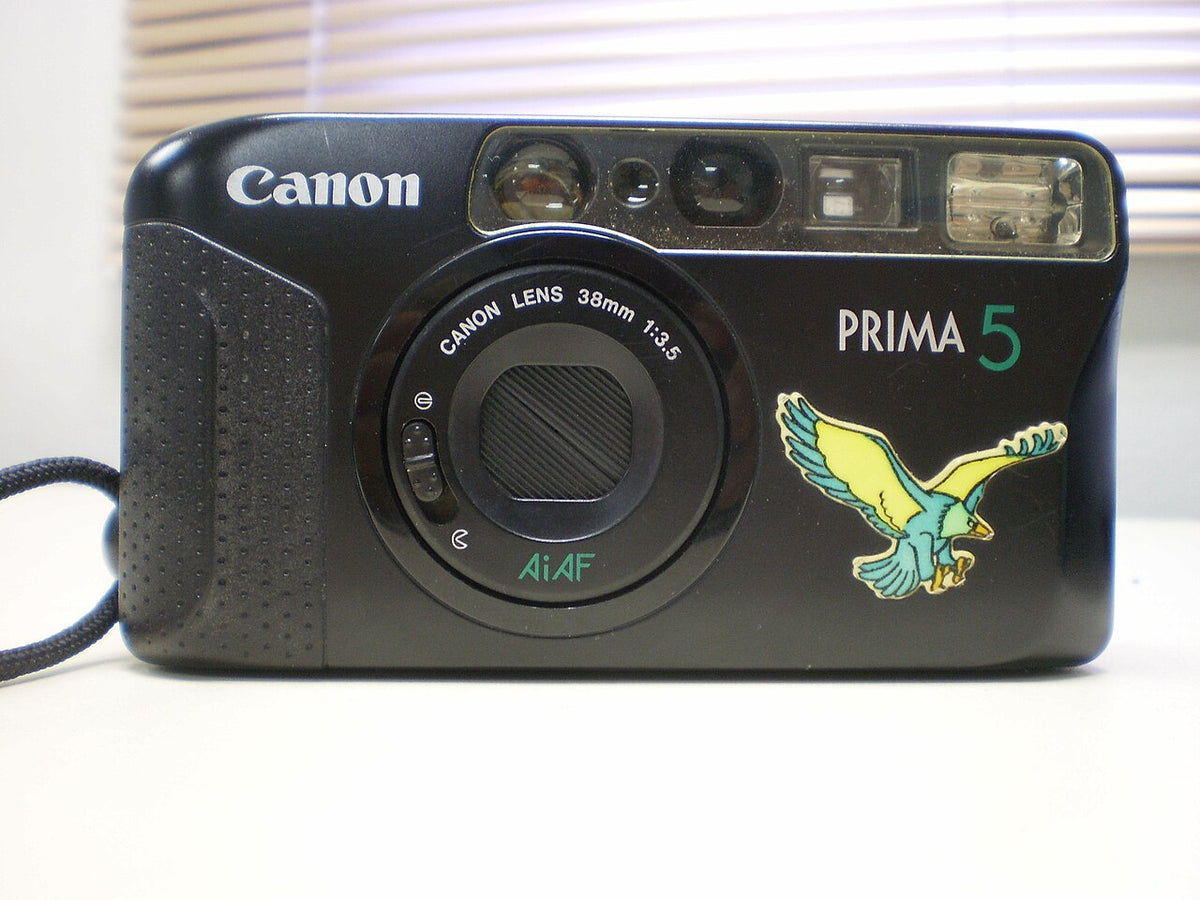
Buying Guide · Film Compacts · November 2026 Update
Behind the Canon Prima name are dozens of film compacts sold from 1979 to the mid-2000s, from the fixed-focus BF to the 38–120 mm zoom. They are also known as the Sure Shot (North America) and Autoboy (Japan). This guide sorts the range by family, with verified specs for the models you'll encounter most often, to help you choose the one that suits your way of shooting.
A Canon Prima is often the first film camera you'll find in a family drawer or at a flea market. It makes sense: Canon produced a huge number of them, under dozens of model names, for over twenty years. The downside is that it's difficult to navigate. A Prima BF has nothing to do with a Prima Mini, and a 1991 Prima Zoom 76 is not the same camera as the 2000 Prima Zoom 76. This guide uses technical sheets published by the Canon Museum and collector databases to classify the range into four families, then tells you which ones to choose according to your use, what to check before buying, and what film to put in it.
The essentials in 30 seconds
- Three names, one camera: Prima in Europe, Sure Shot in North America, Autoboy in Japan. Remember to search for all three to find a manual.
- The best image quality: autofocus prime lenses like the Prima Mini, Prima Mini II, or Prima 5, which are brighter than zooms.
- Versatility: Prima Super and Prima Zoom models, with a zoom range up to 105, 120, or 135 mm, but an aperture that drops at the telephoto end.
- The simplest: Prima BF fixed-focus models, which only need two AA batteries and DX-coded film.
- The reflex: check the battery compartment (for corrosion), the lens mount, and the flash before buying.

Prima, Sure Shot, Autoboy: one camera, three names
Canon sold the same compact under a different name depending on the market for a long time. The very first one, the 1979 AF35M, was called AF35M in Europe, Sure Shot in North America, and Autoboy in Japan. The Prima name then became the standard in Europe for the entire range, which was offered under these three names until the mid-2000s.
This naming system is the first source of confusion when looking for a specific model. The European Prima 5 is thus the American Sure Shot Max and the Japanese Autoboy Mini. The Prima Mini II is the Sure Shot Sleek and the Autoboy F XL. The Prima Super 105 is the Sure Shot 105 Zoom and the Autoboy Luna 105. The entry-level fixed-focus models, meanwhile, are not called Sure Shot in the United States but Snappy: the Prima BF-7 is sold there under the name Snappy LX.
Did you know?
There are two different "Prima Zoom 76" models. The first, from 1991, is called the Sure Shot Mega Zoom 76 in the United States and is derived from the Prima Zoom 105 released a few months earlier. The second, from 2000, is the Sure Shot 76 Zoom (Autoboy Juno 76), with a 38–76 mm f/4.2–7.8 zoom. Look at the year or the design before relying on a spec sheet found online.
- AF35M (Sure Shot, Autoboy): Canon's first autofocus compact.
- AF35ML (Super Sure Shot) and its 40 mm f/1.9 lens.
- AF35M II (New Sure Shot), which replaces the AF35M.
- Prima 5, Prima Twin S, then Prima Zoom 105, then Prima 76.
- Prima Mini, 32 mm f/3.5 autofocus compact weighing 180 g.
- Prima BF-7 and Prima AF-7, the "big finder" entry-level models.
- Prima Mini II (Sure Shot Sleek).
- Prima BF-80, new version Prima Zoom 76, Prima Super 120…
The four families of the range
Rather than remembering dozens of references, it is more useful to think in terms of families. Each family has its own logic, strengths, and limitations, and the model name almost always gives a clue.
| Family | Examples | Focus | What you need to know |
|---|---|---|---|
| The pioneers | AF35M, AF35ML, New Sure Shot | Autofocus | 1980s, bright lenses (f/2.8, f/1.9), AA batteries, sensitivity set manually on the AF35M |
| The BF (Big Finder) | BF-7, BF-8, BF-80, BF-90, Prima BF | Fixed | Very simple, large viewfinder, two AA batteries, only a few DX sensitivities recognized |
| Autofocus prime lenses | Prima 5, Prima Mini, Mini II, AF-7, AF-8, AF-10 | Autofocus | The best compromise between image quality and size; CR123A battery on the Prima 5 and Mini |
| Zooms and bifocals | Prima Zoom 76, 85, 105, Super 105, 115, 120, 135, Twin | Autofocus | Versatile, but small aperture at the telephoto end (f/7.8 to f/10 approximately) |
The letters "BF" stand for Big Finder: according to the Canon Museum, it was this enlarged viewfinder that gave the series its name. The "AF" models from the same era, such as the Prima AF-7 (Sure Shot Owl in the United States), add autofocus to an equally simple body. "Super" and "Zoom" refer to zoom models, with the number generally indicating the maximum focal length.


The pioneers: AF35M and AF35ML
The story begins in November 1979 with the AF35M. The Canon Museum describes it as a fully automatic central-shutter compact: a 38 mm f/2.8 lens with 4 elements in 3 groups, triangulation focusing using a near-infrared beam, a manual-release flash, and motorized film advance. It runs on two AA batteries, weighs 405 g, and the sensitivity is set manually from 25 to 400 ISO using a ring around the lens. Its autofocus works even in low light, which contributed greatly to its success.
In July 1981 came the AF35ML (Super Sure Shot). Its lens changed to 40 mm f/1.9, with 5 elements in 5 groups, making it one of the few autofocus compacts with such a bright lens. Focusing now uses a linear CCD sensor, with focus locking. It weighs 440 g with its two AA batteries. In 1983, the AF35M II (New Sure Shot) replaced the AF35M: the same 38 mm f/2.8, in a revised body with a more pronounced grip and simplified film loading.


These pioneers are larger and heavier than the Prima models of the 1990s, but their lenses are significantly brighter. Our full review of the Canon AF35M details its operation, quirks, and points to check.
Specs for the most common models
The table below brings together the specifications we were able to verify in the Canon Museum, Kamerastore, 135compact, and Collection Appareils sheets. When information was missing or contradicted from one source to another, we left it aside rather than guessing.
| Model | Other names | Year | Lens | Focus | Battery |
|---|---|---|---|---|---|
| AF35M | Sure Shot, Autoboy | 1979 | 38 mm f/2.8 | Infrared autofocus | 2 × AA |
| AF35ML | Super Sure Shot, Autoboy Super | 1981 | 40 mm f/1.9 | Autofocus | 2 × AA |
| Prima 5 | Sure Shot Max, Autoboy Mini | 1991 | 38 mm f/3.5 | Autofocus | CR123A |
| Prima Twin S | Sure Shot Tele Max, Autoboy Mini T | 1991 | Bifocal 38 / 70 mm | — | — |
| Prima Mini | Sure Shot M, Autoboy F | 1993 | 32 mm f/3.5 | Autofocus | CR123A |
| Prima AF-7 | Sure Shot Owl | 1994 | 35 mm f/4.5 | Autofocus | — |
| Prima BF-7 | Snappy LX | 1994 | 35 mm f/4.5 | Fixed | 2 × AA |
| Prima Mini II | Sure Shot Sleek, Autoboy F XL | 1996 | 32 mm f/3.5 | 3-point autofocus | CR123A |
| Prima BF-80 | Snappy QT | 1997 | 32 mm f/6.7 | Fixed | 2 × AA |
| Prima Super 105 | Sure Shot 105 Zoom, Autoboy Luna 105 | — | 38–105 mm f/3.8–9.9 | Autofocus | CR123A |
| Prima Super 120 | Sure Shot Classic 120 | 1999 | 38–120 mm f/4.5–10.9 | 3-point autofocus | 2 × CR2 |
| Prima Zoom 76 (2000) | Sure Shot 76 Zoom, Autoboy Juno 76 | 2000 | 38–76 mm f/4.2–7.8 | Autofocus | CR123A |
Dashes indicate data we were unable to confirm. For the Prima Twin S, Collection Appareils states that it uses many parts from the Prima 5, is about one centimeter thicker and 20 g heavier, and that Canon priced it lower than the zooms to compete with bifocals.
Autofocus prime lenses: the best image quality
If you want a Canon compact that takes great images without the hassle, this is the family to look in. The Prima 5 (1991) combines a 38 mm f/3.5 with autofocus that 135compact considers highly reliable. The sensitivity is read from the DX code from 25 to 3200 ISO, shutter speeds range from 1/8 s to 1/250 s, and the flash is controlled by a three-position slider (off, auto, forced). The very flat body weighs 220 g with its CR123A battery. Its limitation: no slow shutter speed, so few possibilities at night without flash.
The Prima Mini (1993) is thinner and lighter, weighing 180 g. Its 32 mm f/3.5 with 3 elements is a bit wider, the minimum focus is 45 cm, and above all, the shutter goes down to 2 seconds, with slow flash sync that allows you to keep the atmosphere of an interior or a street at night. The Prima Mini II (1996) uses the same formula with three-point autofocus and a weight of 183 g according to Kamerastore.

The Prima AF-7, AF-8 and AF-10 make up the entry-level autofocus range. The 1994 Prima AF-7 has a 35 mm f/4.5 lens and only four shutter speeds (1/70, 1/100, 1/125 and 1/180 s) according to Collection Appareils, with a very large viewfinder. Less bright than the Prima Mini, they require 400 ISO film to avoid constantly using the flash, but remain good everyday cameras.
Expert tip
On a Prima Mini, hold down the slow-sync button when taking the shot: the flash illuminates the subject and the long exposure captures the background. This is the best way to avoid the "black background" effect in the evening. Place the camera or stand very still, as the exposure can last up to 2 seconds.


Zooms and bifocals: versatility
The Prima Zoom and Prima Super are the most numerous on the used market. Their appeal is obvious: one camera for landscapes, close-up portraits and group photos. The Prima Super 105 covers 38 to 105 mm, with a CR123A battery and a weight of around 245 g. The Prima Super 120 goes up to 120 mm and runs on two CR2 batteries. The Prima Zoom 76 from 2000, more modest, covers 38–76 mm for 225 g, with a DX sensitivity of 25 to 3200 ISO and speeds of 1/4 s to 1/500 s according to Kamerastore.
The downside is brightness. The longer the zoom, the lower the maximum aperture at the telephoto: f/7.8 on the Zoom 76, f/9.9 on the Super 105, f/10.9 on the Super 120. In practice, these cameras fire the flash as soon as you enter a room, and zooming all the way in requires a lot of light. Bifocals like the Prima Twin S (38 and 70 mm) are an interesting compromise: more compact than a zoom, with just two focal lengths.
| Model | Wide-angle | Telephoto | In practice |
|---|---|---|---|
| Prima Zoom 76 (2000) | 38 mm f/4.2 | 76 mm f/7.8 | Good outdoors, flash often needed indoors |
| Prima Super 105 | 38 mm f/3.8 | 105 mm f/9.9 | 400 ISO film recommended |
| Prima Super 120 | 38 mm f/4.5 | 120 mm f/10.9 | Reserve for full daylight at telephoto |
| Prima 5 (reference) | 38 mm f/3.5 | — | Fixed focal length, brighter |


The Prima BF: simple and fun
The BF are the simplest Prima cameras. The Prima BF-7 from 1994, documented by the Canon Museum, has a fixed-focus 35 mm f/4.5 lens, three shutter speeds (1/45, 1/60 and 1/250 s) and only recognizes DX-coded 100, 200 and 400 ISO film. The flash fires automatically in low light, with red-eye reduction. The camera runs on two AA batteries and weighs 280 g. The Prima BF-80 from 1997 is even more basic: 32 mm f/6.7, two recognized sensitivities (100 and 400 ISO) and an effective flash between 1.5 and 3 m with 400 ISO film.
These cameras do not rival a Prima Mini in sharpness, but they have other qualities: they are almost impossible to mess up, AA batteries are found everywhere, and their direct flash gives exactly the "luxury disposable camera" look that many are looking for for parties. It is an excellent first camera to discover film without breaking the bank.
To check
A BF does not set the focus: below about 1.5 m, faces become blurry. Keep a distance of one or two steps from your subject, and choose a 400 ISO DX-coded film: it is the one that gives the best flash range.


Which Prima to choose according to your use
| Your need | Recommended model | Why |
|---|---|---|
| The best rendering in your pocket | Prima Mini or Prima Mini II | 32 mm f/3.5, autofocus, exposures up to 2 s, around 180 g |
| A simple and reliable point-and-shoot | Prima 5 | 38 mm f/3.5, autofocus considered very reliable, automatic DX sensitivity |
| Travel and portraits | Prima Super 105 or 120 | A zoom to do everything, provided you have light |
| The "party with flash" look | Prima BF-7, BF-80 or AF-7 | Automatic flash, no settings, AA batteries (BF) |
| A bright lens | AF35ML | 40 mm f/1.9, rare on an autofocus point-and-shoot |
| A historical object | AF35M | Canon's first autofocus point-and-shoot |
For a first roll of film, an autofocus fixed focal length remains the safest choice: you enjoy a brighter lens, a lightweight body and automatically set sensitivity. Zooms are perfect for travel, but require accepting the flash indoors. To broaden the comparison to other brands, read our guide to the best film cameras.
Prima are not the only point-and-shoots from their generation. An Olympus Mju II, for example, offers a brighter 35 mm f/2.8 than the Prima Mini, but its price has risen sharply. Our articles Olympus Mju I or Mju II and why film cameras have become so expensive detail these differences. For a new camera, the Kodak Ektar H35 in half-frame is another entry point, without autofocus.
The appeal of Prima is the relationship between what they cost and what they deliver. A Prima Mini or a Prima 5 in good condition offers the essentials of a "premium" point-and-shoot (autofocus, DX sensitivity, detachable flash) for a fraction of the price. To see what these cameras produce, the Lomography community shares its members' photos: Prima Mini, Prima Mini II and AF35M (photos protected by the copyright of their authors).
Batteries and film
The battery is the first point to check. The Pioneers and the BF use two AA batteries, easy to find. Most autofocus Prima cameras from the 1990s (Prima 5, Mini, Mini II, Super 105, Zoom 76) take a CR123A lithium battery, while the Prima Super 120 uses two CR2. Our guide which battery for a film camera gathers the equivalents. Always remove the battery if the camera remains stored for a long time: a leaking battery can corrode the contacts, as explained in our article leaking battery.
On the film side, almost all Prima cameras after the AF35M read the DX code of the cartridge. According to Camera-wiki, some models like the Prima Mini or the Prima Super 120 expose an uncoded 25 ISO cartridge, which overexposes it greatly: always use a DX-coded film. A 400 ISO is the best choice for these point-and-shoots, especially for the zooms and the BF. The Kodak Ultramax 400 is a safe and affordable bet, the Portra 400 gives softer skin tones.
Check before purchase
Prima cameras were produced in very large numbers and many still work. However, they are mostly made of plastic, and an electronic failure is not always repairable at a reasonable cost. Take five minutes to check these points.
- The battery: put in a new battery. The camera must turn on, the lens or zoom must come out and go back in without abnormal noise.
- The battery compartment: green or white traces indicate oxidation. On the Prima 5 that he tested, 135compact found the hinges of the battery cover broken: check that it closes well.
- The shutter: open the back and without film, fire it while looking through the lens: you must see a flash of light.
- The flash: force it indoors and check that it recharges.
- The optics: no deep scratches, no haze, no mold on the lens; the autofocus window must be clean.
- The LCD screen: if there is one, it must be readable and without leakage.
- The back foams: they must not be sticky or crumbling.
To check
A seller who cannot test the camera with a new battery is actually selling a camera "as is". Our complete checklist: buying a used film camera.
At Vibes Photo, each camera is checked before being put on sale and covered by a six-month commercial warranty, in addition to the legal warranties of conformity and hidden defects. The details are in our general terms and conditions of sale.
Our verdict
The Prima range is the best entry point into the film point-and-shoot: models everywhere, reasonable prices and ease of use that leaves all room for photography. For rendering, aim for a Prima Mini, a Mini II or a Prima 5. For versatility, a Prima Super, provided you accept the flash. For pure pleasure and parties, a BF with two AA batteries. And if you want a piece of history, the AF35M remains a very beautiful object.
For
- A lot of models at a reasonable price
- Automatic DX sensitivity on most
- Very reliable autofocus fixed focal lengths
- AA batteries on the BF and Pioneers
- Detachable flash on the Prima 5 and Prima Mini
Against
- Little or no manual control
- Low-light zooms at telephoto
- Plastic bodies, electronic failures difficult to repair
- Different names depending on the country, source of confusion
- Uncoded DX film poorly handled by some models
Frequently asked questions
Canon Prima and Canon Sure Shot, is it the same thing?
Yes: Prima is the European name, Sure Shot the North American name and Autoboy the Japanese name of the same range. The entry-level fixed-focus models are called Snappy in the United States.
What is the best Canon Prima?
For rendering, autofocus fixed focal lengths like the Prima Mini, the Prima Mini II or the Prima 5. For versatility, a Prima Super 105 or 120. For a very bright lens, the AF35ML and its 40 mm f/1.9.
What battery for a Canon Prima?
Most often a CR123A on the 1990s autofocus models (Prima 5, Mini, Mini II, Super 105). Two AA batteries on the AF35M, the AF35ML and the BF, two CR2 on the Prima Super 120.
Can you set the ISO on a Canon Prima?
On the AF35M, yes, with a ring around the lens. On most subsequent models, no: the sensitivity is read on the DX code of the cartridge. So use DX-coded films.
My Canon Prima no longer turns on, what to do?
Start with a new battery and check the contacts of the compartment. A leaking battery can oxidize the contacts and prevent turning on; a delicate cleaning is sometimes enough.
What film to put in a Canon Prima?
A 400 ISO DX-coded, like the Kodak Ultramax 400. It compensates for the modest apertures of the zooms and gives the best flash range to the BF.
Why two Prima Zoom 76s?
Canon used this name twice: in 1991 (Sure Shot Mega Zoom 76, derived from the Prima Zoom 105) and in 2000 (Sure Shot 76 Zoom, 38–76 mm f/4.2–7.8 zoom). They are two different cameras.
Vibes Photo
Find your Prima
We check every film camera before it goes on sale: power, lens, shutter, flash, and seals. Have a question about a model? Write to us.
Sources
- Canon Camera Museum, AF35M / Sure Shot.
- Canon Camera Museum, AF35ML / Super Sure Shot.
- Canon Camera Museum, Prima BF-7 / Snappy LX.
- Canon Camera Museum, Snappy QT / Prima BF-80.
- 135compact, Canon Prima 5 and Canon Prima Mini.
- Kamerastore, Canon Prima Mini II and Canon Prima Zoom 76.
- Collection Appareils, Prima AF-7, Prima 76 and Prima Twin S.
- Mike Eckman, Canon AF35ML (1981).
- Camera-wiki, Canon Sure Shot / Prima / Autoboy.
Images: photos by Vibes Photo, unless otherwise stated under the image (author, license, and source indicated).