










Canon cameras: history, ranges and which model to choose
SLRs, Canonet and Prima compacts, IXUS and PowerShot digicams, EOS SLRs: the history of Canon, its ranges explained one by one and a method for choosing the right used model.
Brand Guide · Canon · November 2026 Update
Canon is the brand you encounter most often on the second-hand market, both film and digital. Reflex FD, Canonet and Prima compacts, IXUS and PowerShot digicams, EOS SLRs: here is the brand's history, its ranges explained one by one, and a simple method for choosing the right model.
Ninety years ago, Canon was just a small laboratory in Tokyo that dreamed of competing with Leica. Today, its name is on a huge share of the cameras circulating second-hand: the AE-1 SLR that is recommended for learning, the Prima compact found in a drawer, the IXUS of 2000s parties, the G7 X of vloggers. This abundance is a chance, because parts, batteries, and manuals are easily found. It is also a trap, because two Canon cameras that look alike may have nothing in common. This guide puts things in order: first history, then each family of cameras, then a table to choose according to your use and the points to check before buying. The dates come from the Canon Museum and the brand's data sheets; the detailed reviews are in our articles model by model.
The essentials in 30 seconds
- To learn film photography: an A-series SLR with FD mount (AE-1, AE-1 Program, A-1) with a 50 mm. Be careful, they do not fire without a 6 V battery.
- For a pocket film camera: a Prima autofocus compact (Sure Shot outside Europe) or, for more character, a Canonet QL17 G-III with a f/1.7 lens.
- For the digicam look: an IXUS with a CCD sensor from the second half of the 2000s, or a PowerShot A with AA batteries if you want to avoid hard-to-find batteries.
- For today's quality: a G7 X (1-inch sensor) compact, a second-hand EOS SLR to learn with numerous lenses.
- The breakdowns to know: the "Canon squeal" of FD SLRs, the "lens error" of IXUS cameras, and the CCD sensor defect that affected models from the mid-2000s.

Canon's history by dates
It all started in November 1933, in an apartment in the Roppongi neighborhood of Tokyo. Goro Yoshida, Saburo Uchida, and Takeo Maeda founded the Precision Optical Instruments Laboratory with a clear goal: to build a 35 mm rangefinder camera, at a time when Leica and Contax dominated the market. Their first prototype was called "Kwanon", after the Buddhist deity of mercy. According to the Canon Museum, the variants shown in advertisements at the time were only drawings or wooden models.
The first camera marketed arrived in February 1936: the Hansa Canon, equipped with a Nikkor 50 mm f/3.5 lens supplied by Nippon Kogaku, the ancestor of Nikon. The name "Kwanon" became "Canon" at this time, and the brand was registered in 1935. The company Precision Optical Industry was founded in 1937, took the name Canon Camera Co. in 1947, then Canon Inc. in 1969.
The following is a series of steps that can be found today on the second-hand market. Canon launched its first SLR in 1959, created the FD mount in 1971, democratized automation with the AE-1 in 1976, launched its first autofocus compact, the AF35M, in 1979, then switched its entire SLR system to EOS autofocus in 1987. In digital, the brand has been present since 1996 with the first PowerShot and became essential from 2000.
- Foundation of the Precision Optical Instruments Laboratory in Tokyo; "Kwanon" prototype.
- Hansa Canon, first camera marketed, with a Nikkor lens.
- Creation of Precision Optical Industry, Co. Ltd.; Canon Camera Co. in 1947, Canon Inc. in 1969.
- Canonflex, the brand's first SLR.
- The first Canonet launched the rangefinder trend with automatic cell.
- Professional F-1 SLR and FD mount.
- AE-1, first 24×36 SLR driven by a microprocessor.
- AF35M (Autoboy, Sure Shot), infrared autofocus compact.
- Fully electronic EOS system and EF mount: end of the FD mount.
- PowerShot 600, first digital camera in the series, and APS format film IXUS.
- Digital IXUS, PowerShot G1 and EOS D30 SLR with CMOS sensor.
- EOS 300D, consumer digital SLR; IXUS II, first IXUS on SD card.
- EOS 5D Mark II, the brand's first SLR to shoot in Full HD.
- PowerShot G7 X, compact with 1-inch sensor.
- EOS R: full-frame hybrid and new RF mount.
Did you know?
The first Canon sold, the Hansa Canon, had a Nikkor lens: Nippon Kogaku, future Nikon, participated in its development. The two great rivals of Japanese photography thus started side by side. For the continuation of their duel, read Canon or Nikon: which brand to choose.
Film SLRs with FD mount
The FD mount, launched in 1971 with the professional F-1 SLR, is the most popular entry point into Canon film photography. It equipped millions of bodies until 1987, and the lens inventory is huge: a 50 mm f/1.8 FD is easily found and costs little. It exists in two versions: the original FD, fixed by a chrome ring that you screw, and the "New FD" from 1979, which mounts like a classic bayonet. Both work on all bodies in the series.
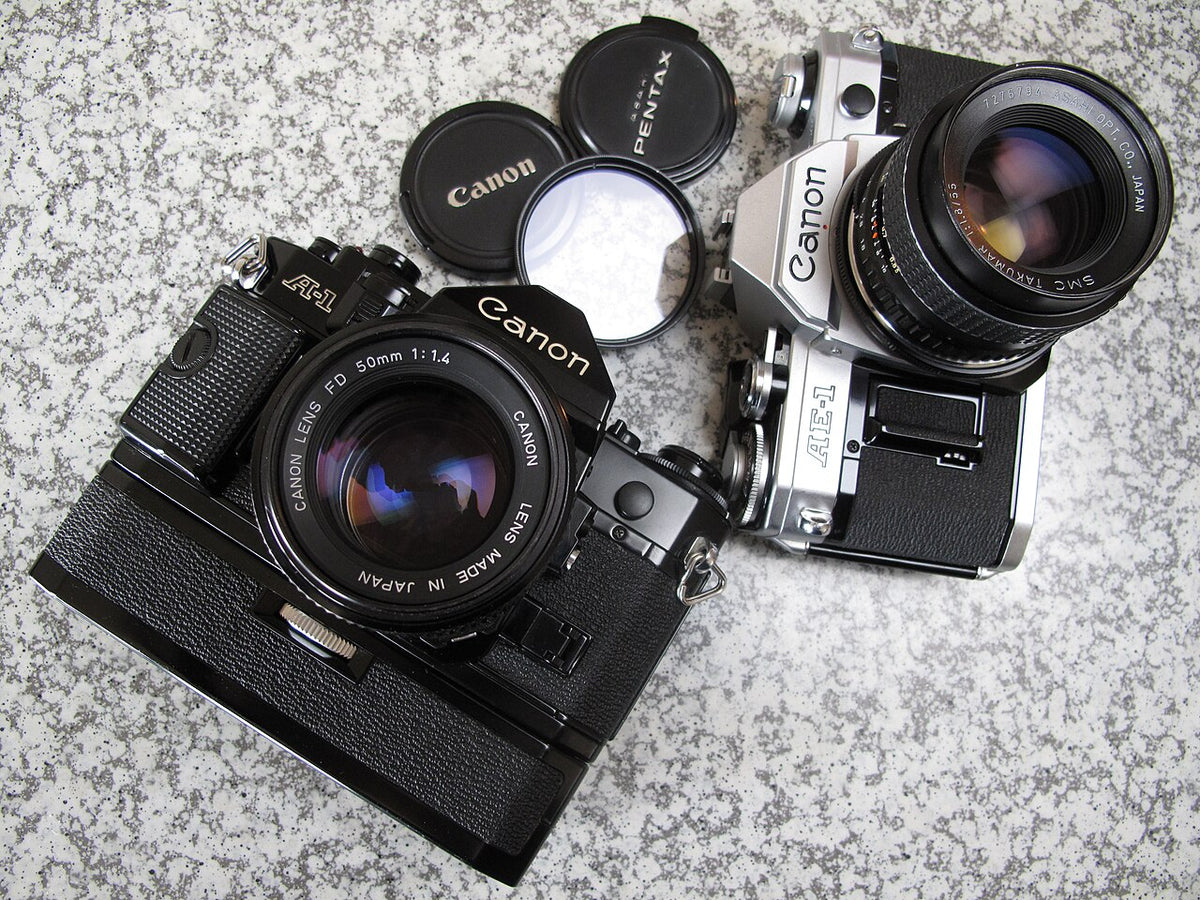
The flagship model is the AE-1. Released in April 1976, it is the first 24×36 SLR driven by a microprocessor. It offers shutter priority: you choose the speed, the camera calculates the aperture and shows it to you in the viewfinder. It remained in the catalog until 1984 and sold several million copies. It opens the "A series", a family of bodies that share the same chassis and the same shutter: AE-1 (1976), AT-1 (1977), A-1 (1978), AV-1 (1979), AE-1 Program (1981) and AL-1 (1982).
The A-1 is the peak of the series: in 1978, it brought together program, shutter priority, aperture priority, and manual in a single body, the "PASM" quartet that we find on almost all current cameras. The AE-1 Program of 1981 takes the program mode in a simpler body, with an LED viewfinder. For the purists of mechanics, the FTb, older, is set with a needle.
| Model | Year | Modes | For whom |
|---|---|---|---|
| Canon FTb | 1970s | Manual, needle metering | Learn in pure manual |
| Canon AE-1 | 1976 | Shutter priority, manual | Begin with a simple automatic |
| Canon A-1 | 1978 | Program, Tv, Av, manual | Do everything in a single body |
| Canon AV-1 | 1979 | Aperture priority | Simple use, without speed setting |
| Canon AE-1 Program | 1981 | Program, Tv, manual | Begin in automatic, progress in manual |
| Canon F-1 / New F-1 | 1971 / 1981 | Professional | Robustness, complete system |


After 1987, Canon switches to autofocus with the EOS 650 and the fully electronic EF mount. The film EOS SLRs (EOS 500, EOS 30, EOS-1 in 1989 for professionals) are often cheap and have an advantage: their EF lenses also mount on EOS digital SLRs.
To check
FD lenses do not mount on EOS SLRs: the mount changed in 1987. On the other hand, they easily adapt on most hybrids with a ring. Our guide vintage lens on hybrid details the method.
Canonet, AF35M and Prima: film compacts
Canon was also strong in compacts as in SLRs. The first Canonet comes out in January 1961, at the price of 18,800 yen, with a 45 mm f/1.9 lens and automatic shutter priority. According to Canon, the stock planned for a week leaves in less than two hours in Tokyo. In 1965, the Canonet QL17 introduces the quick film loading ("Quick Loading"). Then comes in 1972 the Canonet QL17 G-III, a compact rangefinder with a 40 mm f/1.7 lens, manufactured for eleven years and sold to more than 1.2 million copies. It remains one of the most sought-after rangefinders for street photography.
In November 1979, Canon changes the game with the AF35M, named Autoboy in Japan and Sure Shot in the United States. It is a fully automatic compact: a 38 mm f/2.8 lens, triangulation autofocus with an infrared beam that works even in the twilight, a built-in flash and two AA batteries. The Canon Museum notes that the name "Autoboy" became synonymous with autofocus compact.
In the 1990s, the successor is called Prima in Europe (Sure Shot or Autoboy elsewhere). The range is huge: small fixed focal length models (Prima 5, BF, AF-7), zoom compacts (Prima Zoom 76, Zoom 105, Super 105, Super 115…). These are simple, light, often affordable cameras, with built-in flash and date on some models. Their weakness is that of all autofocus compacts: electronics, difficult to repair when it breaks. A tested copy therefore is worth much more than an "untested" camera.


Expert tip
For your first Canon film compact, check the battery first. Depending on the model, Prima cameras use lithium batteries or AA batteries; the AF35M runs on two AA batteries. The Canonet QL17 G-III was designed for a PX625 mercury battery, which is now banned: you need an adapter or an equivalent battery. Our PX625 battery guide explains the solutions.
IXUS digicams, icons of the 2000s
The IXUS name predates digital. In 1996, Canon launched a small compact for APS film, called ELPH in the United States, IXY in Japan, and IXUS in Europe. In 2000, the formula went digital with the Digital IXUS (PowerShot S100 Digital ELPH in the United States): a stainless steel body, a 2 MP CCD sensor, a 2x zoom, and CompactFlash cards. In 2003, the IXUS II adopted the SD card, and the bodies became even slimmer.
It is the 2006-2009 generation that is still dreamed of today: IXUS 60, 70, 75, 80 IS, 85 IS, 95 IS. 6 to 10 MP CCD sensors, metal bodies, and a direct flash that gives that recognizable party look. In 2010, the IXUS 105 and 130 switched to a 28 mm wide-angle, and the IXUS 300 HS introduced the backlit CMOS sensor at Canon. The HS designation indicates these CMOS sensors, which are better in low light but lack the CCD look. The last IXUS cameras with CCD sensors are the 175, 185, and 190, released in 2016 and 2017.
The same camera often goes by three names depending on the country: IXUS in Europe, PowerShot SD or ELPH in the United States, IXY in Japan. The complete table of equivalents and features is in our which Canon IXUS to choose guide.


Did you know?
In the mid-2000s, Canon issued a service notice about defective CCD sensors equipping several PowerShot and IXUS cameras: the image becomes black, purple, or blurry. The defect affected other brands. A simple test photo can spot it, and our CCD defect and recall article lists what you need to know.
PowerShot: one family, five characters
PowerShot is the generic name for Canon digital compacts, and it covers very different cameras. The first, the PowerShot 600 from July 1996, had a 0.57 MP CCD sensor, a fixed lens equivalent to 50 mm, no rear screen, and 1 MB of internal memory, which is about four photos in full definition. Thirty years later, the name still covers several series.
| Series | Examples | Character | Our article |
|---|---|---|---|
| A | A520, A570 IS, A590 IS | AA batteries, optical viewfinder, manual modes on some models | A Series |
| G | G1, G9, G10, G11, G12 | Expert compacts, dials, RAW | Vintage G Series |
| G7 X | G7 X, Mark II, Mark III | 1-inch sensor, 24-100 mm f/1.8-2.8 zoom | Used G7 X |
| SX | SX200 IS, SX740 HS | Travel zooms, from 12x to 40x | SX Series |
| S / bridges | S2 IS, SX10 IS | Large zooms with a grip | S2 IS and SX10 IS |
The A series is the most interesting for discovering the digicam look without risk: it runs on AA batteries, which you replace with NiMH rechargeable batteries found everywhere. The PowerShot A590 IS from 2008, for example, combines an 8 MP CCD sensor, a stabilized 35-140 mm zoom, an optical viewfinder, and P, Av, Tv, and M modes. The G series was born in 2000 with the G1 (3.34 MP, 1/1.8-inch CCD sensor, manual exposure); the G9 from 2007 goes up to 12.1 MP with a 35-210 mm zoom and RAW. The G7 X, meanwhile, breaks with the small sensors in 2014: it adopts a 1-inch type sensor of 20.2 MP, about four times larger than that of a classic compact.


If you hesitate between the two large families of compacts, our article IXUS or PowerShot compares their philosophies, and expert compact or digicam helps you choose between retro look and modern quality.
Digital EOS reflex and EOS R hybrids
In 2000, Canon launched the EOS D30, a digital reflex equipped with a CMOS sensor designed by the brand. Three years later, the EOS 300D (Digital Rebel in the United States) put the digital reflex within reach of the general public. Then, in 2008, the EOS 5D Mark II surprised everyone by filming in Full HD with a full-frame sensor; Canon presents it as the first camera to integrate this feature, and it becomes a shooting tool for many videographers.
To learn photography today, a used EOS reflex remains an economical solution: EF and EF-S lenses are very numerous, the ergonomics are clear, and batteries are found without difficulty. The entry-level models (EOS 350D, 400D, 450D and their successors) and the historic full-frame (5D, 5D Mark II, 6D) are the most common. Our guides which used EOS reflex and EOS 5D and 5D Mark II detail the models.
Since 2018, Canon has been developing its full-frame EOS R hybrids, with a new RF mount. They accept EF lenses via an adapter ring, which extends the life of the entire EOS lens range. If you hesitate between the two worlds, read reflex or used hybrid.


Which Canon to choose according to your use?
The right question is not "which is the best Canon?", but "what do I want to do with it?". Here are our suggestions, from the simplest to the most demanding.
| Your need | Our suggestion | Why |
|---|---|---|
| First film camera to learn | AE-1 Program or AE-1 + FD 50 mm f/1.8 | Guided exposure, affordable lenses |
| Film camera in your pocket | Prima with fixed focal length or AF35M | Autofocus, flash, no settings |
| Light rangefinder | Canonet QL17 G-III | 40 mm f/1.7 lens, compact |
| Digicam for parties | IXUS CCD 2006-2010 with SD card | Direct flash, pocket format |
| Digicam without battery worries | PowerShot A (A520, A570 IS, A590 IS) | AA batteries available everywhere |
| Vlog and quality photo | G7 X (I, II or III) | 1-inch sensor, tilt screen |
| Learn in digital | Entry-level EOS SLR + 18-55 mm | Affordable price, many lenses |
Two tips complete this table. First, do not pay extra for a keyword: a "CCD digicam" listing only makes sense if the model sheet confirms the sensor. Next, count the full budget: a camera sold without a battery or charger can end up costing more than a complete copy. To go further, our guide the best digicam according to your budget ranks the models by level, and which film camera to start with helps you choose between compact and SLR.
Batteries, batteries and cards
This is often the first question after purchase. Here are the most common references; always check the manual of your exact model.
| Camera | Power supply | Support |
|---|---|---|
| AE-1, AE-1 Program, A-1 | 4LR44 / PX28 battery (6 V), essential | 35 mm film |
| Canonet QL17 G-III | Original mercury PX625: adapter or equivalent | 35 mm film |
| AF35M | 2 AA batteries | 35 mm film |
| Digital IXUS (2000) | NB-1L battery | CompactFlash |
| IXUS 60, 70, 75, 80 IS, 130 | NB-4L battery | SD / SDHC |
| IXUS 85 IS, 95 IS, 105 | NB-6L battery | SD / SDHC (SDXC on the 105) |
| IXUS 132, 145, 175, 185 | NB-11L / NB-11LH battery | SD / SDHC / SDXC |
| PowerShot A (many models) | 2 or 4 AA batteries | SD (CompactFlash on the oldest) |
| G7 X, Mark II, Mark III | NB-13L battery | SD / SDHC / SDXC |

To identify your reference, consult our guides battery for old digital camera, battery for film camera and memory card for old camera.
Points of vigilance before buying
Each Canon family has its known weaknesses. Here is what to check, family by family.
- FD SLR: listen to the shutter. A high-pitched squeak, the "Canon squeal", betrays a mirror brake that needs relubrication. Also check the plastic battery door, which breaks easily on the A series, the sealing foams on the back and the cell.
- FD lenses: illuminate them at an angle to spot fungus, haze and oil on the diaphragm blades. Our article fungus on lens helps to judge.
- Prima and AF35M compacts: test the flash, the zoom, the autofocus and the film advance with a new battery. The electronics are rarely repairable.
- IXUS and PowerShot: the lens must come out and go back in without a hitch. The "Lens Error" message is the most frequent failure, often after a fall or sand (lens error: causes).
- CCD sensors from the mid-2000s: a test photo in full definition reveals a black, purple or distorted image.
- PowerShot with AA batteries: open the door and look at the contacts. White or green traces signal batteries that have leaked. Use good quality NiMH rechargeable batteries and remove them if the camera remains stored for a long time.
- Digital EOS SLRs: ask for the number of shutter actuations and look at the state of the sensor on a photo of a plain sky.
To check
Always ask for a photo taken the same day with the camera, or a test roll for a film camera. Our complete checklists: buying a used film camera and buying a used digicam.
At Vibes Photo, each camera is checked before being put on sale and covered by a six-month commercial warranty, in addition to the legal warranties of conformity and hidden defects. The details are in our general terms and conditions of sale.
All our Canon items
Detailed reviews, comparisons and model by model guides, to go further on each family.
| Family | Articles |
|---|---|
| FD SLR | AE-1 · A-1 · AE-1 or AE-1 Program · AE-1 or Pentax K1000 · X-700 or AE-1 · FTb |
| Film compacts | Canonet QL17 · AF35M · Prima / Sure Shot |
| IXUS | Which IXUS · IXUS 70 · 80 IS · 105 · 130 · 185 · IXUS or Cyber-shot |
| PowerShot | A Series · G9 · G10, G11, G12 · G7 X or RX100 · SX740 HS |
| EOS and video | Film EOS · Old digital EOS · Canon MV camcorders |
To compare with the other manufacturers, our camera brand guide presents each one, and our in-depth guides cover film photography and digicams.
Frequently asked questions
What is the best film Canon to start with?
The AE-1 Program is often the simplest thanks to its program mode, while allowing manual. The AE-1, priority shutter, is also an excellent choice. Both require a 6 V battery to work.
Are FD lenses compatible with EOS SLRs?
No. The EF mount replaced FD in 1987 and the two are not directly compatible. FD lenses, however, easily adapt to most mirrorless cameras with a ring.
Which Canon IXUS to choose for the 2000s look?
A CCD sensor model from the 2006-2010 period with SD card (IXUS 60, 70, 75, 80 IS, 95 IS, 105…) is the most practical compromise. Avoid HS models if you are looking for the CCD look: they have a CMOS sensor.
What difference between Prima and Sure Shot?
None in essence: they are the same autofocus compacts, sold under the name Prima in Europe and Sure Shot or Autoboy in other countries. Check the model number to compare.
Are Canon PowerShot with AA batteries reliable?
They are simple and robust cameras. The main weakness is the oxidation of the contacts when batteries have leaked. Use good quality NiMH rechargeable batteries and remove them if the camera remains stored for a long time.
What is the Canon squeal?
A squeak at the shutter release of certain Canon A series SLRs, due to the mirror brake lacking lubricant. It does not prevent taking photos immediately, but it is better to have the camera serviced before the mechanism gets damaged.
Where does the name Canon come from?
From the "Kwanon" prototype of 1934, named after the Buddhist deity of mercy. The name becomes "Canon" at the launch of the Hansa Canon, in 1936, and the brand is registered from 1935.
Vibes Photo
Find your Canon
FD SLR, Prima compacts, IXUS and PowerShot: we check each camera before being put on sale. A question about a model? Write to us.
Sources
- Canon Museum, history 1933-1936 (laboratory foundation, Kwanon, Hansa Canon and Nikkor lens).
- Canon, company history (trademark registration in 1935, foundation in 1937, Canon Camera Co. in 1947).
- Canon Asia, The History of Canon (Canonflex, Canonet, F-1 and FD, AE-1, AF35M, EOS-1, IXUS, EOS D30, 300D, 5D Mark II, EOS R).
- Canon Museum, AF35M sheet (November 1979, 38 mm f/2.8, infrared autofocus, AA batteries).
- PetaPixel, history of the Canonet (1961, Quick Loading, G-III 17 and its sales).
- Digital Camera World, the most striking PowerShot (PowerShot 600, G1, G7 X).
- Our detailed sheets Canon AE-1, Canon A-1, Canon IXUS and digicams by budget, and their sources.
Images: Vibes Photo photos, unless otherwise stated under the image (author, license and source indicated).