










Canon PowerShot A Series: the AA battery-powered digicam (A520, A570 IS, A590 IS…)
From the AA-powered, manual-mode A520 and A570 IS to the A2200, A3400 IS, and A4000 IS with 28 mm wide-angle lenses: our comprehensive guide to the Canon PowerShot A series, model by model, with verified specs, image quality, and controls to check before buying.
Buying Guide · Digicam · November 2026 Update
The A series is Canon's "everyday" range: simple, solid, and affordable compacts, powered for a long time by two AA batteries, then by a lithium battery from 2011 onwards. From A520 and A570 IS models with manual modes to the A2200, A3400 IS, or A4000 IS with a 28 mm wide-angle lens, here is how to navigate the range, what these cameras are worth today, and which one to choose second-hand.
The IXUS is often mentioned when talking about Canon compacts from the 2000s and 2010s. Yet the A series sold a considerable number, because it targeted exactly the audience that didn't want to ask questions: a camera that turns on, focuses, and takes a decent photo, for a reasonable price. Behind this unassuming image are two very different families. Until the late 2000s, the best PowerShot A cameras were thick AA-battery bodies, with an optical viewfinder and full manual modes: real tools for learning. From 2011 onwards, the range modernized, became slimmer, switched to a 28 mm wide-angle lens, HD video, and a lithium battery. This guide covers both, model by model, based on Canon's spec sheets and reviews published at their launch, and helps you choose according to what you want to use it for.
The essentials in 30 seconds
- Two families: the "classic" AA-battery A models (A520, A570 IS, A590 IS, A720 IS) and the "modern" lithium-battery A models (A2200 to A4000 IS), slimmer and with a 28 mm wide-angle lens.
- For learning: the A570 IS and A590 IS offer P, Av, Tv, and M modes, an optical viewfinder, and stabilization, all on two AA batteries.
- For your pocket: the A2400 IS, A3400 IS, A3500 IS, and A4000 IS offer a 16 Mpx CCD sensor, optical stabilization, and 720p video in a 135 to 145 g body.
- The trap: the A2200, A2300, and A2500 do not have optical stabilization. They remain good party cameras with flash, but are less comfortable without flash.
- The right reflex: on a battery-powered model, inspect the battery compartment (signs of oxidation); on all of them, check the lens release and the battery door, which are often fragile.

Twelve years of PowerShot A, from the A10 to the A4000 IS
The A series started in early 2001 with the PowerShot A10, TrustedReviews recalls. The idea was set from the start: an entry-level or mid-range compact, powered by off-the-shelf batteries, larger than an IXUS but easier to handle and cheaper. Throughout the decade, Canon expanded the range into dozens of models, with a simple logic: the lower-numbered models were the most basic, while those with higher numbers added a longer zoom, stabilization, or manual modes.
The mid-2000s were the golden age of this formula. The A520, marketed in March 2005, combined a 4 Mpx CCD, a 35–140 mm 4x zoom, an optical viewfinder, and P, Av, Tv, and M modes, on just two AA batteries, while its predecessor, the A85, required four. In 2007, the A570 IS added optical stabilization and the DIGIC III processor; the A720 IS pushed the zoom to 6x. The A590 IS then took over from the A570 IS with 8 Mpx.
The turning point came on January 5, 2011. Canon introduced the A3300 IS, A3200 IS, and A2200: no more AA batteries, but a lithium battery, a slim body, a lens starting at 28 mm, a larger screen, and 720p video. In February 2012, six new A models were announced at once, including the A2300, A2400 IS, A3400 IS (touch screen), and A4000 IS (8x zoom). In January 2013, the A3500 IS received built-in Wi-Fi, while the A2500 returned to the simple formula without optical stabilization. AA batteries did not disappear for this reason: they remained on the most affordable models, such as the A810, A1300, and A1400.
- PowerShot A10, the first model in the A series.
- A520: 4 Mpx, 35–140 mm zoom, manual modes, two AA batteries.
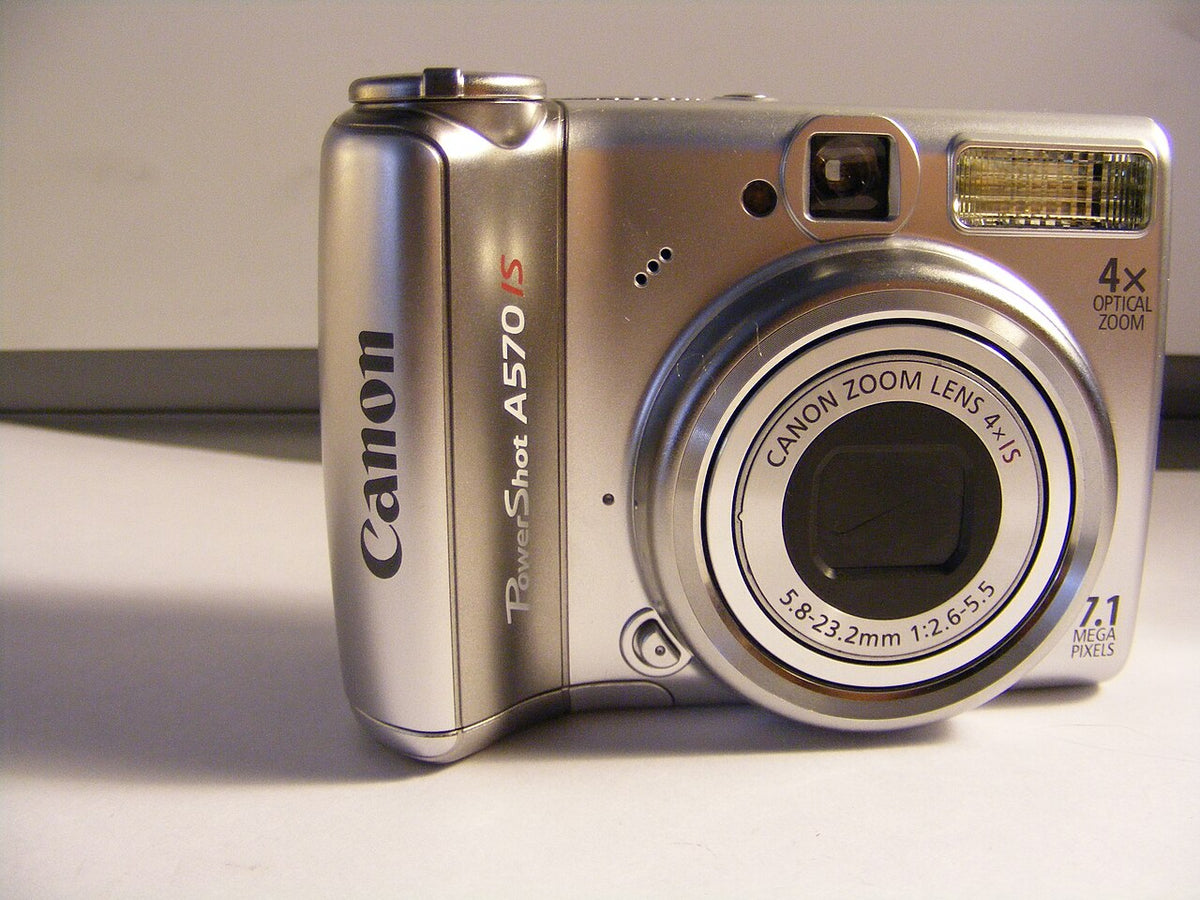
- A570 IS (7.1 Mpx, stabilized, DIGIC III) and A720 IS (8 Mpx, 6x zoom).
- A590 IS, the direct successor to the A570 IS, moves to 8 Mpx.
- A2200, A3200 IS, and A3300 IS: lithium battery, 28 mm, 720p video.
- A2300, A2400 IS, A3400 IS (touch), and A4000 IS (8x zoom).
- A3500 IS with built-in Wi-Fi; A2500 as the entry-level model.
Did you know?
The switch to two AA batteries on the A520 was a real selling point at the time: DPReview measured about 300 shots per pair of NiMH rechargeable batteries with the screen on, and nearly 800 when framing through the optical viewfinder with the screen off.
AA batteries or lithium battery: what really changes
This is the first question to ask yourself, because it determines the use. On a used digicam, the battery is often the first headache: an untraceable model, a lost charger, a questionable quality compatible one. With an A model powered by batteries, the question disappears. Two AAs are enough, you can find them in any convenience store, and a set of rechargeable batteries will follow you from one camera to another.
Of course, you have to choose the right ones. Canon's figures for the A570 IS are telling: about 120 shots with alkaline batteries, about 400 with NiMH. TrustedReviews only got about 120 shots with alkaline batteries on the A590 IS, far from the 200 advertised. Alkaline batteries collapse under the current demands of the flash and the zoom motor; NiMH batteries, on the other hand, hold their charge. Get low self-discharge rechargeable batteries (often called "LSD" or "ready to use"), which keep their charge for months in a drawer.

Recent models run on a proprietary lithium battery. The A2200, A3200 IS, and A3300 IS use the NB-8L: Imaging Resource indicates about 280 shots for the A2200, Cameralabs about 230 for the A3200 and A3300 IS. The A2400 IS, A3400 IS, A3500 IS, and A4000 IS switch to the NB-11L, advertised for 175 to 180 shots depending on the model. It is less, but the body gains in slimness. A spare battery is highly recommended, and our guide battery and charger for old digital camera helps you choose a reliable compatible one.
Expert advice
If a battery-powered A displays "Replace batteries" when they are new, it is almost always alkaline batteries that are too weak for the zoom and flash. Switch to freshly charged NiMH before concluding there is a failure. Our article AA battery digicams details the subject.
The "classic" A models powered by AA batteries
The four models that come up most often second-hand share the same architecture: a 1/2.5-inch CCD, a zoom starting at 35 mm equivalent, an optical viewfinder, and two AA batteries. They are thick (around 40 mm) and weigh about 225 g with batteries, but their pronounced grip makes them very comfortable to hold. DPReview already pointed it out on the A570 IS: solid build, good grip, responsiveness, and very low shutter lag for a camera at this price.
- Sensor
- 1/2.5-inch CCD, 7.1 effective Mpx
- Processor
- DIGIC III
- Lens
- 5.8–23.2 mm f/2.6–5.5, i.e., 35–140 mm equivalent (4x zoom)
- Stabilization
- Optical, by lens shift
- Modes
- Auto, scene, P, Av, Tv, M
- Speeds
- 15 s to 1/2000 s
- Sensitivity
- 80 to 1600 ISO, plus Auto
- Viewfinder
- Optical zoom, about 80% of the field
- Screen
- 2.5 inches, about 115,000 dots
- Flash
- About 45 cm to 3.5 m at wide-angle
- Burst
- About 1.7 shot/s
- Video
- 640 × 480
- Cards
- SD, SDHC, MMC
- Power
- 2 AA batteries (alkaline or NiMH)
- Dimensions
- 89.5 × 64.3 × 42.8 mm
- Weight
- About 175 g bare, 225 g with batteries
Sources: Canon Camera Museum (PowerShot A570 IS) and DPReview review (2007).
Around the A570 IS revolve three similar models. The A520 is the ancestor: 4 Mpx, only a 1.8-inch screen, no stabilization, but already manual modes and a viewfinder. DPReview criticized it for slow focus in low light and about 7 seconds between two photos with flash. The A590 IS takes over the A570 IS almost identically with 8 Mpx; TrustedReviews praises the richness of the settings, the build, and the low-light autofocus, but judges the image as lacking: noise from 200 ISO, blown-out highlights, soft corners. The A720 IS, finally, shares the A590 IS 8 Mpx sensor but mounts a 6x zoom of 35–210 mm (f/2.8–4.8); according to TrustedReviews, it handles noise better than the A590 IS.
| Model | Sensor | Zoom (equiv.) | Stabilization | Screen |
|---|---|---|---|---|
| A520 (2005) | 1/2.5" CCD 4 Mpx | 35–140 mm, f/2.6–5.5 | No | 1.8" |
| A570 IS (2007) | 1/2.5" CCD 7.1 Mpx | 35–140 mm, f/2.6–5.5 | Optical | 2.5" |
| A720 IS (2007) | 1/2.5" CCD 8 Mpx | 35–210 mm, f/2.8–4.8 | Optical | 2.5" |
| A590 IS (2008) | 1/2.5" CCD 8 Mpx | 35–140 mm, f/2.6–5.5 | Optical | 2.5" |


Learning exposure with a PowerShot A
This is what distinguishes the classic A models from most compacts of their time, including the IXUS: a real selector with aperture priority (Av), shutter priority (Tv), and manual mode (M). On the A590 IS, the aperture is set from f/2.6 to f/8 and the speed from 15 s to 1/2000 s, by third of a stop. You can therefore concretely understand what a slow speed does on a river, or a large aperture on a portrait, without investing in a reflex.
Limits exist. The 115,000-dot screen is judged imprecise by all reviewers, the viewfinder only covers about 75 to 80% of the field and has no diopter correction, and there is no dedicated ISO button on the A570 IS, as DPReview pointed out. But for a first approach to exposure, these cameras remain among the most educational and least expensive on the second-hand market.
They are also known by tinkerers. CHDK, an unofficial community software that loads from the SD card without modifying the camera, adds many functions missing from the original to many PowerShot cameras, such as RAW recording. It is an amateur tool, without Canon warranty: to be used knowingly.
Expert advice
For a first exercise, switch to Av, choose f/2.6 at wide-angle and get close to a subject: you will see the background stand out a little. Then switch to Tv at 1/2000 s on a moving scene. Two settings, two lessons, in ten minutes.
The "modern" A models from 2011 to 2013
From 2011 onwards, the A series changes its face. The bodies become slimmer around 20 to 24 mm thick, the lens starts at 28 mm equivalent, and video switches to 720p. These cameras bet above all on automation (Smart Auto with 32 scenes on the 2012 generation, according to TechRadar). We move away from the learning tool towards the pocket compact, which makes them excellent party and travel cameras today.
| Model | Sensor | Zoom (equiv.) | Stabilization | Screen | Battery |
|---|---|---|---|---|---|
| A2200 (2011) | 14.1 Mpx CCD | 28–112 mm (4x) | Non-optical | 2.7" | NB-8L |
| A3200 IS (2011) | 14.1 Mpx | 28–140 mm (5x) | Optical | 2.7" | NB-8L |
| A3300 IS (2011) | 16 Mpx CCD | 28–140 mm (5x) | Optical | 3" | NB-8L |
| A2300 (2012) | 16 Mpx | 28 mm, 5x zoom | Non-optical | — | Lithium-ion |
| A2400 IS (2012) | 16 Mpx CCD | 28–140 mm (5x) | Optical | 2.7" | NB-11L |
| A3400 IS (2012) | 16 Mpx CCD | 28–140 mm (5x) | Optical | 3" touchscreen | NB-11L |
| A4000 IS (2012) | 16 Mpx CCD | 28–224 mm (8x) | Optical | 3" | NB-11L |
| A2500 (2013) | 16 Mpx | 28–140 mm (5x) | Digital only | 2.7" | — |
| A3500 IS (2013) | 16.1 Mpx CCD | 28–140 mm (5x) | Optical | 3", Wi-Fi | NB-11L |
The dashes indicate data that we have not been able to confirm from a reliable source. Above all, remember the line between models with and without "IS" in the name: this is what separates devices with optical stabilization from those that make do with electronic blur reduction, which Cameralabs considers "far inferior" to the optical stabilization of the A3500 IS and A4000 IS.


The A3400 IS deserves a mention: it is the only one in the series with a 3-inch touchscreen, with touch focus and shutter release. PhotographyBlog gives it 4.5 out of 5, praising the image quality at low sensitivity, the metal tripod mount, and the responsiveness of the touch autofocus, while noting a fragile battery cover and a burst rate of about 0.8 frames per second. The A3500 IS, its successor, gives up the touchscreen but gains Wi-Fi, a 4 mm thinner body, and optical zoom during video; Cameralabs gives it 80% while judging its image quality as average and its ISO performance as poor.
To be checked
The A3500 IS Wi-Fi works through the CameraWindow app and, for online sharing, through the Canon iMAGE GATEWAY service, which requires registration; Cameralabs already considered its operation complicated in 2013. Don't buy it for this feature: consider it a bonus, and plan for an SD card reader to retrieve your photos.
The case of the A4000 IS, the most versatile
Announced in February 2012, the A4000 IS is the first PowerShot A with 8x zoom. Its 5–40 mm lens covers the equivalent of 28–224 mm, opens to f/3.0–5.9, and relies on optical stabilization announced at 4 speeds. The metal body weighs about 145 g including battery and card, measuring 95.3 × 56.3 × 24.3 mm. PhotographyBlog gives it 4.5 out of 5 and calls it a "great little camera" for family outings.
- Sensor
- 1/2.3-inch CCD, 16 effective Mpx
- Processor
- DIGIC 4
- Lens
- 5.0–40.0 mm f/3.0–5.9, or 28–224 mm equivalent
- Stabilization
- Optical (4 announced speeds) + Intelligent IS
- Sensitivity
- 100 to 1600 ISO, plus Auto
- Screen
- 3 inches, approximately 230,000 dots
- Video
- 1280 × 720, plus 640 × 480
- Burst
- Approximately 0.7 frames/s measured
- Cards
- SD, SDHC, SDXC
- Battery
- NB-11L, approximately 175 frames
- Dimensions
- 95.3 × 56.3 × 24.3 mm
- Weight
- Approximately 145 g with battery and card
Sources: PhotographyBlog test (June 2012) and TechRadar announcement (February 2012).
Compared to the A2400 IS, which shares the same 16 Mpx sensor and the same ergonomics, Reviewed.com rated the A2400 IS as significantly noisier, despite seemingly identical hardware, and the A4000 IS as barely less sharp at the telephoto despite its longer zoom. Their conclusion: the A2400 IS for lightness, the A4000 IS for low light. PhotographyBlog's criticisms concern a slow burst rate (about 0.7 frames per second), a longer-than-expected shutter lag, limited dynamic range, and disappointing macro.


Image quality, sensitivity by sensitivity
The two families do not have the same sensor, but the logic is the same: small CCDs that give bold colors and a lot of detail in good light, and that drop off quickly when it gets low. Classic A models use a 1/2.5-inch 7 to 8 Mpx, recent A models use a 1/2.3-inch 14 to 16 Mpx. More pixels on a small surface means more detail at low sensitivity, but more smoothing beyond 400 ISO.
| Sensitivity | A590 IS (TrustedReviews) | A3400 IS / A4000 IS (PhotographyBlog) |
|---|---|---|
| 80–100 ISO | Excellent at 80, slight colored speckling at 100 | Sharp, no visible colored noise |
| 200 ISO | Visible noise | Practically identical to 100 ISO |
| 400 ISO | Noise attacks fine details | First drop, contours still good |
| 800 ISO | Significant noise | Colored noise and JPEG artifacts |
| 1600 ISO | "Practically unusable" | Maximum, reserved for small formats |
The recent A models therefore hold up better to increasing sensitivity than the A590 IS, at least up to 400 ISO. On the color side, DPReview described natural tones and faithful flash on the A570 IS, but an automatic white balance struggling under incandescent bulbs, with an orange cast that is also found on the A520. PhotographyBlog highlights realistic skin tones on the A4000 IS. For the "digicam" look sought today, these flaws often become a charm: marked contrast with flash, warm colors indoors. Our article CCD or CMOS: what difference explains where this look comes from.

To be checked
The A2200 "Low Light" scene mode goes up to 6400 ISO, but by reducing resolution. Check the image size in the menu before an evening: a low-resolution photo cannot be fixed.
In the evening, on a trip, every day
In the evening, direct flash does all the work. On the recent A models, the 28 mm wide-angle allows you to frame a group without backing up against the wall, which the 35 mm of the classic A models makes more difficult. Stay one or two meters from your subject: beyond that, the flash of a compact runs out of steam. On the A570 IS, Canon announces a range of about 3.5 m at wide-angle and 2.2 m at telephoto. Be careful with the recycle time on battery-powered models: DPReview measured up to 8 to 10 seconds with low batteries. With well-charged NiMH batteries, it is significantly better.
On a trip, the two families each have their advantage. The A models with batteries recharge anywhere, even without a socket, with a set of batteries bought locally. The recent A models are lighter and more discreet, and the A4000 IS with its 224 mm covers both monuments and distant details just as well. Without flash, choose an optically stabilized model: it is what allows you to lower the shutter speed indoors, provided the subject remains still.
| Use | Recommended model | Why |
|---|---|---|
| Learn photography | A570 IS, A590 IS | P/Av/Tv/M modes, viewfinder, stabilization |
| Travel without a socket | A570 IS, A720 IS | AA batteries available everywhere |
| Evenings with flash | A2200, A2300, A2500 | 28 mm, light, simple |
| Versatility | A4000 IS | Stabilized 8x zoom, metal body |
| Touch handling | A3400 IS | 3" touchscreen, touch focus |
| Video with zoom | A3500 IS | Optical zoom usable while filming |
To set your camera to the 2000s look, our digicam settings guide details each option, and our flash photography tips will help you avoid burnt faces.
The A series in pictures
These examples passed through our stock. Each device is checked before being put up for sale: lens cap, screen, flash, battery, and full-resolution test photo.


A series, IXUS or SX series?
At Canon, the A series is just one of the three families of consumer compacts. The IXUS are thinner and more elegant, with a lithium battery; they target the pocket and style. The SX focus on zoom, from 10x to much more. The A series is between the two: simpler and cheaper than an IXUS, with for the classic models a unique advantage, AA batteries and manual modes.
To learn more: which Canon IXUS to choose, Canon PowerShot SX: which model and our comparison of the IXUS or PowerShot. If your budget is tight, our selection of the best budget digicams also compares other brands.
Pre-purchase check
The PowerShot A cameras were designed to last, but they have often lived a life as family cameras: bags, beaches, drawers. A few checks are necessary before paying, especially when buying from private sellers.
- The battery compartment (AA models): no green or white residue on the contacts. Leaking batteries that have been left inside can prevent the camera from turning on.
- The lens: it must extend and retract without friction or an "Lens Error" message, the most common failure in compact cameras. Our article on lens errors details the causes.
- The battery and card door: PhotographyBlog considers it flimsy on the A3400 IS and A4000 IS. Check that it locks and holds the battery.
- The screen and viewfinder: no spots, lines, or dark areas.
- The flash: take a photo with forced flash indoors and time the recycle.
- The test photo: at full resolution, check the sharpness of the corners and the absence of internal dust spots on a computer.
- The accessories: for recent A models, an NB-8L or NB-11L battery depending on the model and its charger. For AA-powered A models, nothing is mandatory, but plan on NiMH batteries.
To check
Always ask for a photo taken on the same day with the camera. If the seller cannot provide it, assume the camera has not been tested. Our complete checklist: checks before buying a digicam.
At Vibes Photo, every camera is checked before being put up for sale and covered by a six-month commercial warranty, in addition to legal warranties for conformity and hidden defects. Details can be found in our general terms and conditions of sale.
Our verdict
The A series has never been the most glamorous of Canon's ranges, and that is precisely its strength on the used market. If you want to learn and travel without worrying about a battery, an A570 IS or A590 IS remains a very sensible choice. If you want a pocket camera for parties, a recent A will do perfectly well; opt for an "IS" model if you also photograph without flash, and the A4000 IS if you want a single camera to do it all.
For
- AA batteries on classic models
- Full manual modes (A520 to A720 IS)
- CCD with vivid colors
- 28 mm wide-angle on recent models
- Optical stabilization on IS models
- Affordable used prices
Against
- Thick classic bodies
- Imprecise screens before 2011
- Slow burst shooting (0.7 to 1.7 fps)
- Flimsy battery doors on some models
- No optical stabilization on A2200, A2300, A2500
Frequently asked questions
Which Canon PowerShot A to choose?
To learn and travel, the A570 IS or A590 IS: manual modes, viewfinder, stabilization, and AA batteries. For a versatile pocket camera, the A4000 IS and its stabilized 8x zoom. For parties with flash, an A2200, A2300, or A2500 is enough.
Do all PowerShot A cameras run on AA batteries?
No. Classic models like the A520, A570 IS, A590 IS, and A720 IS use two AA batteries, as do recent entry-level models (A810, A1300, A1400). The A2200, A3200 IS, and A3300 IS use an NB-8L battery, and the A2400 IS, A3400 IS, A3500 IS, and A4000 IS use an NB-11L.
Which batteries to put in a PowerShot A?
Rechargeable NiMH batteries, preferably low self-discharge. Canon claims around 400 shots with NiMH batteries on the A570 IS, compared to around 120 with alkaline batteries.
Do PowerShot A cameras have a CCD sensor?
The models mentioned in this guide for which we were able to verify this use a CCD: A520, A570 IS, A590 IS, A720 IS, A2200, A3300 IS, A2400 IS, A3400 IS, A4000 IS, and A3500 IS.
Can you shoot RAW with a PowerShot A?
Not natively. The CHDK community software allows RAW to be added to many models without hardware modification, but it is not official.
Do PowerShot A cameras record in HD?
Models from 2011 onwards (A2200, A3200 IS, A3300 IS, and later) record in 720p. The A570 IS and A590 IS, however, are limited to 640 × 480.
What is the difference between PowerShot A and IXUS?
IXUS cameras are thinner and sleeker, with a lithium battery. PowerShot A cameras are simpler and cheaper; classic models add AA batteries, a viewfinder, and manual modes.
Vibes Photo
Find your PowerShot
We check every digicam before it is put up for sale: lens, screen, flash, battery, and test photo. Have a question about a model? Write to us.
Sources
- DPReview, Canon PowerShot A570 IS Review (2007).
- DPReview, Canon PowerShot A520 Review (March 2005).
- Canon Camera Museum, PowerShot A570 IS and PowerShot A520.
- Canon, PowerShot A590 IS specifications.
- TrustedReviews, Canon PowerShot A590 IS Review.
- Digital Trends, Canon PowerShot A720 IS Review (2007).
- DPReview, Canon introduces PowerShot A3300 IS and A3200 IS (January 2011).
- Photography Bay, PowerShot A3300 IS and A2200 announced (January 2011).
- Cameralabs, Canon PowerShot A3200 IS / A3300 IS.
- Imaging Resource, Canon A2200 specifications and Canon A2400 IS specifications.
- TechRadar, Six new Canon PowerShot A cameras launched (February 2012).
- PhotographyBlog, Canon PowerShot A3400 IS Review.
- PhotographyBlog, Canon PowerShot A4000 IS Review (June 2012).
- Reviewed, Canon PowerShot A2400 IS vs. A4000 IS.
- Cameralabs, Canon PowerShot A3500 IS (2013).
Images: Vibes Photo photos, unless otherwise stated under the image (author, license, and source indicated).