










Best digicams by budget: which point-and-shoot camera to choose?
Four budget levels, twelve detailed models: from battery-powered compacts to test the look risk-free to cult digicams and enthusiast compacts, with hidden costs to consider.
Buying Guide · Digicams · October 2026 Update
The best digicam isn't the most expensive or the one that's most famous on TikTok. It's the one that fits your budget, your needs, and your patience with hard-to-find batteries. Here's our selection by budget, from the AA-powered compact that lets you test the look risk-free to the expert compact that lasts ten years.
Since 2000s flash photography has come back into fashion, the used digital compact market has exploded. Cameras that were sleeping in drawers are now being resold with a magic keyword, "digicam", and sometimes at prices that have nothing to do with their actual quality. To help you see clearly, we have classified the families and models into four relative budget levels. We don't give prices in euros, because they vary too much depending on condition, accessories, and current trends, but we explain what drives up the bill, and where your money is best placed.
The essentials in 30 seconds
- To test risk-free: an AA battery compact (Canon PowerShot A, Kodak EasyShare, Nikon Coolpix L): no proprietary battery to look for, NiMH rechargeable batteries are enough.
- The best compromise: a pocket compact from 2006-2014 (Canon IXUS, Sony Cyber-shot W and T, Olympus mju, Panasonic Lumix FS and FX), with a lithium-ion battery.
- The "cult" models: Fujifilm FinePix F30 and F31fd, Ricoh GR Digital, Canon PowerShot G9, Panasonic LX3: more expensive, but with real photo quality.
- Above that: recent expert compacts (Canon G7 X, Sony RX100, Fujifilm X100): much better, but without the CCD look.
- The golden rule: a complete and tested camera is better than a more prestigious model sold "as is".

How to read this ranking
This guide is not based on an in-house test bench: it combines manufacturers' specifications, tests published at the time of release, and what we know today about their reliability. We have selected five criteria, in this order:
- The look: what the camera really produces, in broad daylight, with flash, and in low light.
- Reliability: known failures of the family (lens, sensor, screen) and the sturdiness of the body.
- Power supply: AA batteries, proprietary battery still produced or hard to find, charger included or not.
- Availability: a model produced in large numbers is easily found in good condition, with parts.
- Media: common SD card, or obsolete format like xD-Picture Card and Memory Stick.
The levels are relative: level 1 groups the generally most affordable cameras, level 4 the most expensive. A highly sought-after IXUS 70 can cost as much as a level 3 model. To understand the logic, start with the following section.
What makes the price
On the digicam market, the specifications no longer make the price. A 20 Mpx compact with 8x zoom often sells for less than a 7 Mpx model released ten years earlier. Five factors explain most of the differences:
The fifth factor is the color and finish: black, colored, or brushed metal versions are more in demand than standard silver. To go further and compare listings, read how to estimate the value of a used camera.
Expert advice
Set your total budget, accessories included, before looking at listings. A cheap camera without a charger or battery can end up costing more than a complete copy, especially if the original battery is no longer produced.
Level 1: AA battery compacts
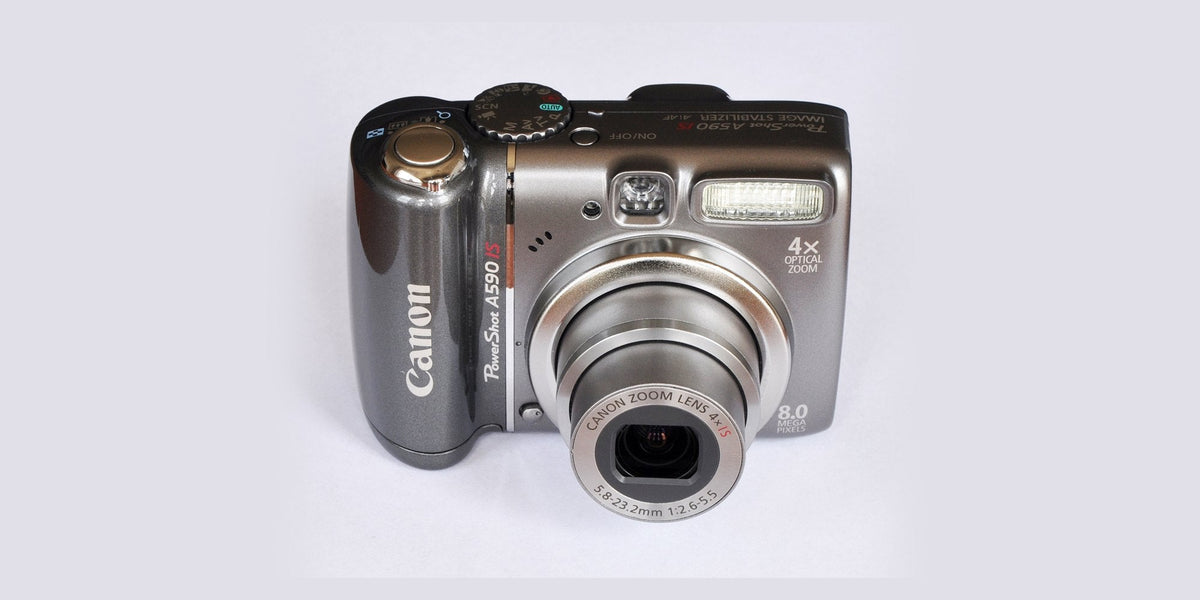
This is the best entry point to discover the digicam look without taking a risk. These cameras run on two AA batteries: you can use NiMH rechargeable batteries found everywhere, and you never have to look for a lost proprietary battery. They are a bit thicker than pocket compacts, but often better in hand.
- Announcement
- February 2008
- Sensor
- CCD 1/2.5", 8 Mpx
- Lens
- 35-140 mm f/2.6-5.5 (4x)
- Stabilization
- Optical
- Viewfinder
- Optical viewfinder + 2.5" screen
- Power supply
- 2 AA batteries
- Card
- SD, SDHC
- Settings
- P, Av, Tv and M modes
Source: Canon Camera Museum and Canon USA spec sheet.

Canon's A series is the most interesting of level 1. The A520, A570 IS, A590 IS or A720 IS add an optical viewfinder and semi-automatic and manual modes to the AA power supply, which also makes them excellent cameras for learning exposure. The A series guide details the models.

Two other families complete this level. The Kodak EasyShare C and CX series bet on simplicity and warm colors (our review of Kodak EasyShare). The Nikon Coolpix L series, Nikon's entry-level, also run on AA batteries on most models (which Nikon Coolpix to choose).
Why start here
- No hard-to-find battery
- NiMH rechargeable batteries easy to find and recharge
- Comfortable grip
- Often the most affordable digicams
The limits
- Thicker than an IXUS
- Alkaline batteries drain quickly: prefer NiMH
- Sometimes slow startup and writing
- Low-resolution screens
Our AA battery digicam guide explains which batteries to choose and why the camera may reject even new batteries.
Level 2: pocket compacts
This is the digicam as everyone imagines it: thin, metallic or lacquered, with a lithium-ion battery and a flash right next to the lens. The years 2006 to 2014 are the most interesting: CCD sensors are mature, SD cards are becoming widespread, and the cameras were sold by the millions, which guarantees a wide choice.

Canon IXUS
The reference. IXUS 70 and 80 IS for the Y2K look, IXUS 105 and 130 for wide-angle, IXUS 175 and 185 for zoom.

Sony Cyber-shot W
The W800 and W830 (20.1 Mpx, CCD) are among the most recent CCD compacts. The W830 has a Zeiss 8x zoom from 25 to 200 mm.
The other families to know: Sony Cyber-shot T, with internal lens and sliding shutter (our guide), Olympus mju digital, often waterproof (our review), and Panasonic Lumix FS and FX, with wide-angle Leica lenses (which Lumix compact to choose). To choose between the two largest brands, read Canon IXUS or Sony Cyber-shot.
- Announcement
- 2014
- Sensor
- Super HAD CCD 1/2.3", 20.1 Mpx
- Lens
- Zeiss 25-200 mm (8x)
- Battery
- NP-BN
- CIPA battery life
- About 210 shots
- Strong point
- New or almost new, parts available
Source: Sony France / United Kingdom spec sheets and Sony manual.
To check
On a Sony from this era, check the card type. Recent Cyber-shots like the W830 accept the SD card, but many older models only accept the Memory Stick Duo or PRO Duo, which is more expensive and rarer. Our guide memory card for old digital camera summarizes.
Level 3: cult models
Some digicams have a reputation that far exceeds their specifications. These are cameras that already did better than their competitors at their release, thanks to a larger sensor, a brighter lens, or full settings. They cost more, but they also have real photographic qualities, beyond the fashion effect.
- Announcement
- 2006
- Sensor
- Super CCD HR 1/1.7", 6.3 Mpx
- Sensitivity
- Up to 3,200 ISO
- Lens
- 36-108 mm f/2.8-5 (3x)
- Battery
- NP-95
- CIPA battery life
- About 580 shots
- Card
- xD-Picture Card
- F31fd
- Adds face detection
Sources: Fujifilm Japan press release, Fujifilm manual, DPReview review.
The F30 became iconic because its Super CCD sensor, larger than those in most compact cameras, remained usable at sensitivities where its competitors produced a mess of noise. Its stated battery life of around 580 shots is also remarkable. Its weakness: the xD-Picture Card, a discontinued format that you have to hunt for second-hand. Everything is detailed in our review of the F30 and F31fd.

Ricoh GR Digital (2005)
28 mm f/2.4 prime lens, 8.13 MP 1/1.8" CCD, DNG RAW. The digital successor to the film GR, loved for street photography in black and white.

Canon PowerShot G9 (2007)
12.1 MP 1/1.7" CCD, 35-210 mm stabilized zoom, RAW, dials, optical viewfinder and hot shoe. A pocket-sized "mini DSLR".

Panasonic Lumix LX3 (2008)
24 mm Leica lens with f/2 aperture, 10.1 MP 1/1.63" CCD, 3" screen, HD video. The most modern of this group.
To keep in mind
The G9 is power-hungry: Canon rated it at around 240 shots per charge with the screen on. Its NB-2LH battery and the one used by the GR Digital are old, and original units are often worn out. Budget for a spare battery.
The results in images
These photos were taken by Wikimedia Commons contributors using the cameras mentioned (model confirmed by EXIF data). They give an idea of the results you can expect from each level, without any editing on our part.


In broad daylight, the difference between an AA-powered compact and an iconic model is less dramatic than it seems on a phone screen. It becomes apparent in three situations: low light, highlights (skies, reflections), and cropping. If you mostly post on Instagram or TikTok, a well-used Level 1 or 2 camera is more than enough. Our settings for the 2000s look apply to all levels.
Level 4: expert compacts
Above this, we leave the digicam world behind. Expert compacts from the 2010s use much larger CMOS sensors, such as 1-inch or APS-C. They produce significantly better images, highly flexible RAW files, and modern video. But they lack the CCD look and simplicity of an IXUS, and they cost much more.

Canon PowerShot G7 X
1-inch sensor, 24-100 mm f/1.8-2.8 zoom, front-tilting screen. The Mark III shoots 4K video and accepts an external microphone.

Sony RX100
Seven generations, 1-inch sensor, retractable viewfinder from the III onwards. The most complete expert compact camera.

Fujifilm X100
APS-C sensor, 35 mm equivalent prime lens, hybrid viewfinder. The ultimate street camera, expensive but very durable.
If you're torn between these two worlds, our expert compact or digicam article asks the right questions, and Canon G7 X or Sony RX100 separates the two bestsellers.
The summary table
| Level | Recommended families | Strengths | For whom |
|---|---|---|---|
| 1. AA batteries | PowerShot A, EasyShare C/CX, Coolpix L | Simple power supply, easy to hold, price | Test the results, first camera, gift |
| 2. Pocket compacts | IXUS, Cyber-shot W/T, mju, Lumix FS/FX | Thinness, built-in flash, huge choice | Evenings, everyday use, Y2K look |
| 3. Iconic models | FinePix F30/F31fd, GR Digital, G9, LX3 | Larger sensor, settings, RAW (except F30) | Low light, street, learning |
| 4. Expert compacts | G7 X, RX100, X100 | Modern image quality, video | Travel, vlogging, demanding photography |
The hidden costs
The listed price is never the final cost. Before buying, calculate these four items:
- The battery: a fifteen-year-old original battery has lost some of its capacity. Budget for at least one new, compatible or original battery. See battery and charger for old camera.
- The charger: often missing from listings. A universal charger can help.
- The memory card: simple for SD, more expensive for xD or Memory Stick.
- The repair: a stuck lens or broken screen often costs more than the camera. Hence the benefit of a tested unit.
Did you know?
AA-powered digicams have no hidden battery cost: a set of four NiMH batteries and a standard charger can also be used for a flash, remote control, or toys. This is one of the reasons we recommend them for a first purchase or a gift for a teenager.
The traps to avoid
- The "works, untested due to no battery": this is an untested camera. Consider it broken.
- The confused model: many listings misname the camera. Check the name engraved on the front or under the body.
- The lens that "binds a bit": first sign of the lens error, the most common failure.
- The defective sensor: some compact cameras from the mid-2000s have a known CCD sensor defect. Read the recall of defective CCDs.
- The "TikTok" price: an ordinary model presented as "the digicam of such influencer". Compare with equivalent models.
- Payment outside the platform: classic sign of a scam. See the signs of a scam.
Our complete checklist is in the 10 checks before buying a digicam.
Frequently asked questions
What is the best affordable digicam?
AA-battery compacts like the Canon PowerShot A, Kodak EasyShare, or Nikon Coolpix L are often the most affordable and easiest to power. The Canon PowerShot A590 IS is one of the most comprehensive: image-stabilized, with an optical viewfinder and manual modes.
Which digicam to choose for parties?
A pocket compact with a flash close to the lens, like a Canon IXUS or a Sony Cyber-shot. It's this front flash that gives the "2000s" look. Also read our article camera for parties and weddings.
Why are some digicams so expensive?
Because they are in higher demand for their image quality or features (FinePix F30, Ricoh GR Digital, Canon G9), because they have become visible on social media, or because they are sold complete, tested, and in very good condition.
Does a digicam take better photos than a smartphone?
Not in resolution or image processing. It offers a different look, real optical zoom, and a direct flash that phones don't really reproduce. We compare the two in digicam or smartphone.
Should you buy a tested digicam?
It's safer: a lens, screen, or battery failure can cost more than the camera. A seller who has checked the camera can also tell you if it is complete and compatible with a recent card.
What digicam to give a teenager?
An AA-battery compact or a recent SD card pocket compact, like a Canon IXUS 145, 175, or 185, or a Sony W830: simple, robust, and easy to power. See our gift ideas.
Vibes Photo
Find the digicam that suits you
Our digicams are checked before being put up for sale. Tell us your budget and intended use: we will advise you on the right model. Do you have a camera to sell? We buy it back.
Sources
- Canon Camera Museum, PowerShot A590 IS and Canon USA spec sheet (8 Mpx, 35-140 mm, IS, AA batteries, viewfinder).
- Sony, DSC-W830 spec sheet (Super HAD CCD 20.1 Mpx, 25-200 mm, NP-BN, 210 views).
- Fujifilm Japan, FinePix F30 specifications and DPReview, F30 review (Super CCD HR 1/1.7", 3,200 ISO, NP-95, 580 views).
- Ricoh, GR Digital specifications (CCD 1/1.8", 8.13 Mpx, 28 mm f/2.4, RAW DNG).
- Canon Camera Museum, PowerShot G9 and DPReview, G9 announcement (12.1 Mpx, 35-210 mm, RAW, NB-2LH, 240 views).
- Wikipedia (en), Panasonic Lumix DMC-LX3 (CCD 1/1.63", 24 mm f/2.0-2.8, HD video).
- Wikipedia (en), Canon PowerShot A (powered by two AA batteries).
Images: authors, licenses, and sources indicated under each photo.