










Used camera price: estimate the right price in 5 steps
There is no official price guide: here is how to estimate the price of a used camera based on actual sales and its condition.
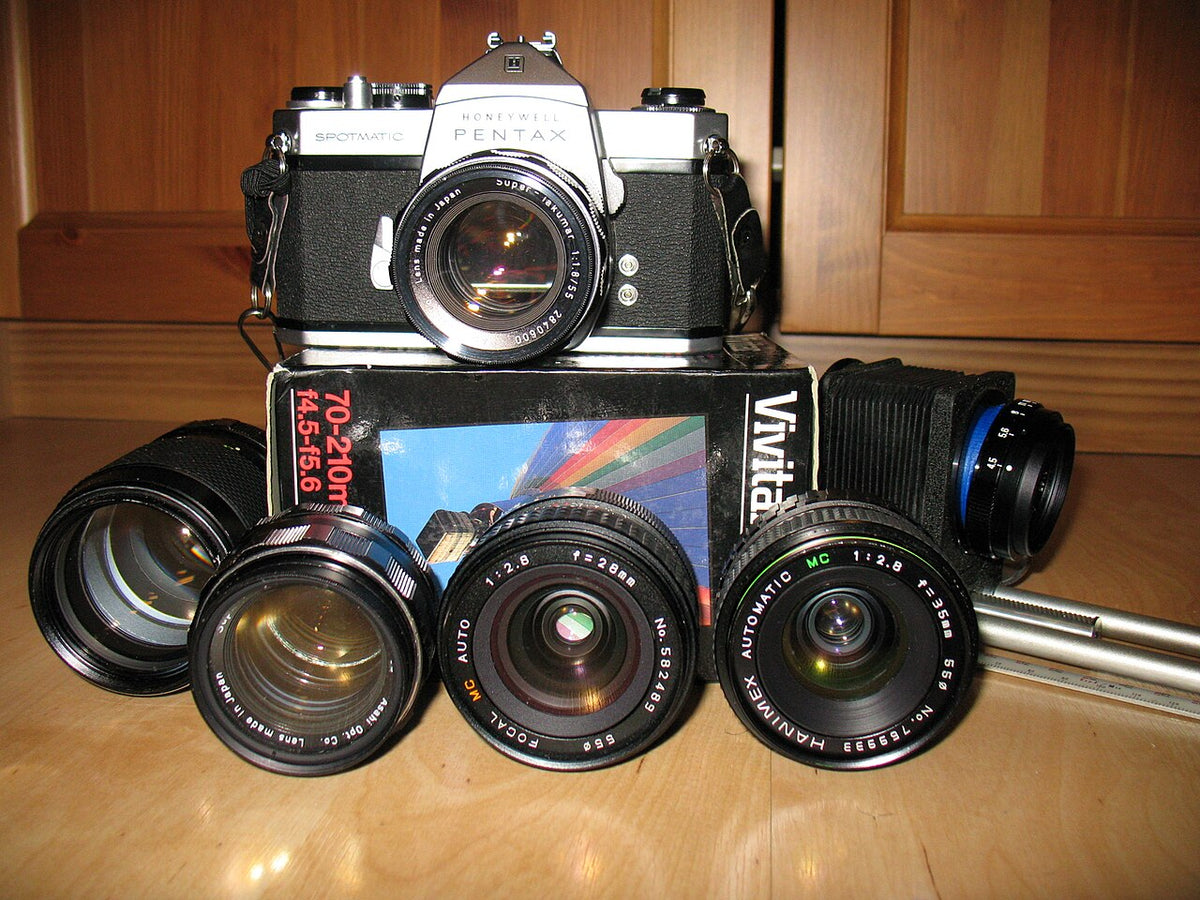
How much is your old Canon, that Pentax found in the attic, or the digicam you want to buy worth? There is no official price guide for cameras. The only reliable valuation comes from completed sales, adjusted for condition and what is included. Here is a five-step method to estimate a fair price, whether buying or selling.
The 5-step method
- Identify the exact model. The full name is engraved on the top cover or the bottom (Canon AE-1 or AE-1 Program, Olympus Mju II or Mju II Zoom, Sony DSC-W80 or W800). Price differences between versions can sometimes be huge. See AE-1 or AE-1 Program and Mju I or Mju II.
- Look for completed sales, not listings. On eBay, the "sold items" filter shows what buyers actually paid. A Leboncoin listing that has been online for three months is overpriced.
- Compare items in the same condition. Separate tested and guaranteed cameras, "untested" cameras, and those sold "for parts".
- Adjust according to what is included. A lens, battery, charger, box, manual, and case add value; the absence of a battery or proprietary charger for a digicam reduces it.
- Use a price range. Take the median of comparable sales rather than the highest price you saw once.
What makes the price go up or down
| Factor | Effect on price | Why |
|---|---|---|
| Verified and guaranteed working | Significant increase | The risk of failure is the main hidden cost of an old camera. |
| Lens: fungus, haze, scratches | Significant decrease | A fungus-affected lens degrades all photos, and cleaning is delicate. |
| Dead light meter or electronics | Significant decrease for point-and-shoots | On an automatic point-and-shoot, without electronics, the camera is useless. |
| Broken LCD screen, flash, or retractable lens (digicam) | Significant decrease | Parts are rarely available. |
| Original battery and charger included | Increase | Some proprietary batteries have become rare. |
| Cosmetic condition (scratches, shine) | Moderate | Sought after by collectors, less important for use. |
| Rare version or special color | Targeted increase | Limited editions, black or titanium finishes. |
| Social media trend | Rapid, sometimes temporary increase | Demand quickly outstrips supply for models seen everywhere. |
The most common estimation mistakes
- Relying on the highest asking price in a listing, instead of completed sales.
- Comparing an "untested" camera to a guaranteed one. The former is a gamble, the latter a product.
- Forgetting costs: shipping, batteries, buying a replacement battery, developing a test roll of film, possible servicing.
- Confusing two versions that have almost the same name.
- Believing that an old camera is necessarily worth a lot. Many mass-produced SLRs and point-and-shoots remain affordable.
Why some models are skyrocketing
High-end film point-and-shoots (Contax T2, Yashica T4, Olympus Mju II) and certain CCD digicams have seen their prices rise with the return of film and 2000s aesthetics on social media. Supply is finished and decreases with every failure, while demand increases. We detail this phenomenon in why film point-and-shoots are so expensive and offer cheaper alternatives in alternatives to the Contax T2.
To sell quickly, price yours slightly below the median of completed sales and show proof of operation. When buying, a "too good to be true" price for a skyrocketing model deserves extra verification: see common scams.
Frequently asked questions
Is there an official price guide for used cameras?
No. The best reference remains the sales history of completed sales for the same model, in the same condition.
Is my old camera worth anything?
It depends on the exact model and its condition. Some are worth a few euros, others several hundred. Identify the model, then look at completed sales.
Why do prices vary so much for the same model?
Because of the condition, whether it has been verified as working, the accessories included, and the warranty. A tested and guaranteed camera costs more than a camera sold "as is".
Is a vintage camera a good investment?
No one can guarantee how prices will evolve. Buy a camera to use it; if its value holds, that is a bonus.