










Canon AE-1 vs AE-1 Program: which one to choose?
Program mode, viewfinder, grip, price: the real differences between the Canon AE-1 and the AE-1 Program to choose the right SLR.
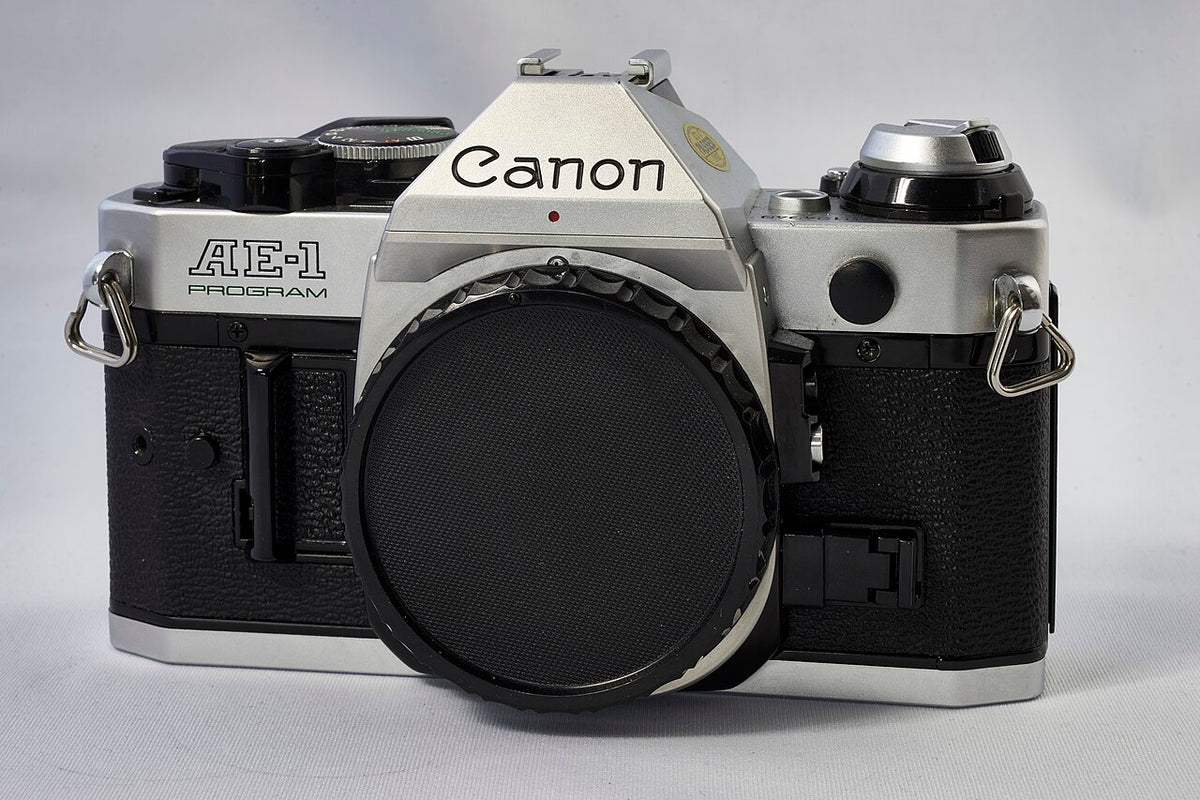
Five years after the global success of the AE-1, Canon released the AE-1 Program in 1981, adding a fully automatic mode. The two are very similar and share the same lenses. Which one to choose for getting started or treating yourself? Here are their real differences.
The verdict in 30 seconds
Get the AE-1 if…
- you want to learn exposure with a focus on shutter priority and manual mode;
- you like the charm of the needle in the viewfinder;
- you find a nice copy for a little less.
Get the AE-1 Program if…
- you want to be able to leave everything in automatic;
- you prefer a brighter and more informative viewfinder;
- you appreciate a grip for handling.
Comparative technical sheet
| Canon AE-1 | Canon AE-1 Program | |
|---|---|---|
| Production | 1976 to 1984 | 1981 to 1989 |
| Modes | Shutter priority, manual | Program, shutter priority, manual |
| Viewfinder display | Needle | Illuminated display |
| Viewfinder glass | Fixed | User-replaceable, brighter |
| Grip | No | Yes |
| Speeds | 2 s to 1/1000 s | 2 s to 1/1000 s |
| Flash sync | 1/60 s | 1/60 s |
| Mount | Canon FD | Canon FD |
| Battery | 4LR44 or 4SR44 (6 V) | 4LR44 or 4SR44 (6 V) |
The key difference: the program mode
In program mode, the AE-1 Program sets both the shutter speed and the aperture, with a slight preference for a sufficient shutter speed. You focus, you shoot, that's it. The AE-1, on the other hand, always asks you to choose the shutter speed: it's more educational, but less convenient for shooting candid shots.
The viewfinder
The AE-1 indicates the chosen aperture with a needle. The AE-1 Program displays its information with an illuminated display and has a clearer viewfinder glass that the user can change themselves. It makes focusing easier with low-light lenses.
What they share
The same cloth-shutter mechanism, limited to 1/1000 s, the same 1/60 s flash sync, the same FD mount, and the same total dependence on batteries. Both can also develop the infamous mirror slap, and their battery cover is fragile. More details in our Canon AE-1 guide.
Same body, two approaches: the AE-1 teaches you, the Program frees you.
The real-life result
With the same FD lenses, both give exactly the same result.
To judge the result in person, browse the photos shared by the Lomography community: photos taken with the Canon AE-1 and photos taken with the Canon AE-1 Program. These images belong to their authors: we simply link to them.
Price
Both are found at similar prices. On the second-hand market, the price depends mainly on the condition, the lens provided, and a possible overhaul; many private listings are sold without a warranty. A tested and guaranteed copy, with a lens, costs more but saves you from unpleasant surprises.
Our verdict
For most beginners, the AE-1 Program is the most comfortable choice: you can start in automatic mode, then move on to shutter priority and manual. If you really want to learn exposure from the start, or if you find a very nice AE-1, it remains an excellent teacher.
Also read: Which film camera to choose for getting started? and Buying a second-hand camera: warranty, condition, and confidence.
Frequently asked questions
Are the lenses compatible with both?
Yes, both use the Canon FD mount.
Does the AE-1 Program work without a battery?
No, like the AE-1: it needs a 4LR44 or 4SR44 battery. See our guide Which battery for my film camera?
Which one to choose for getting started?
The AE-1 Program, for its automatic mode that allows you to start without stress, while still retaining the possibility to learn.
Cover photo: Denis Barthel, via Wikimedia Commons, license CC BY-SA 4.0.
Les premières photos prises au Canon AE-1 arrivent bientôt dans la galerie.
Tu en as un ? Envoie-nous tes photos →Les premières photos prises au Canon AE-1 Program arrivent bientôt dans la galerie.
Tu en as un ? Envoie-nous tes photos →