










Canon AE-1: Review, Specifications and Buying Guide
The first microprocessor reflex camera, the Canon AE-1 remains the best teacher of exposure. History, FD lenses, known issues, buying checklist and alternatives: everything you need to know before buying one.
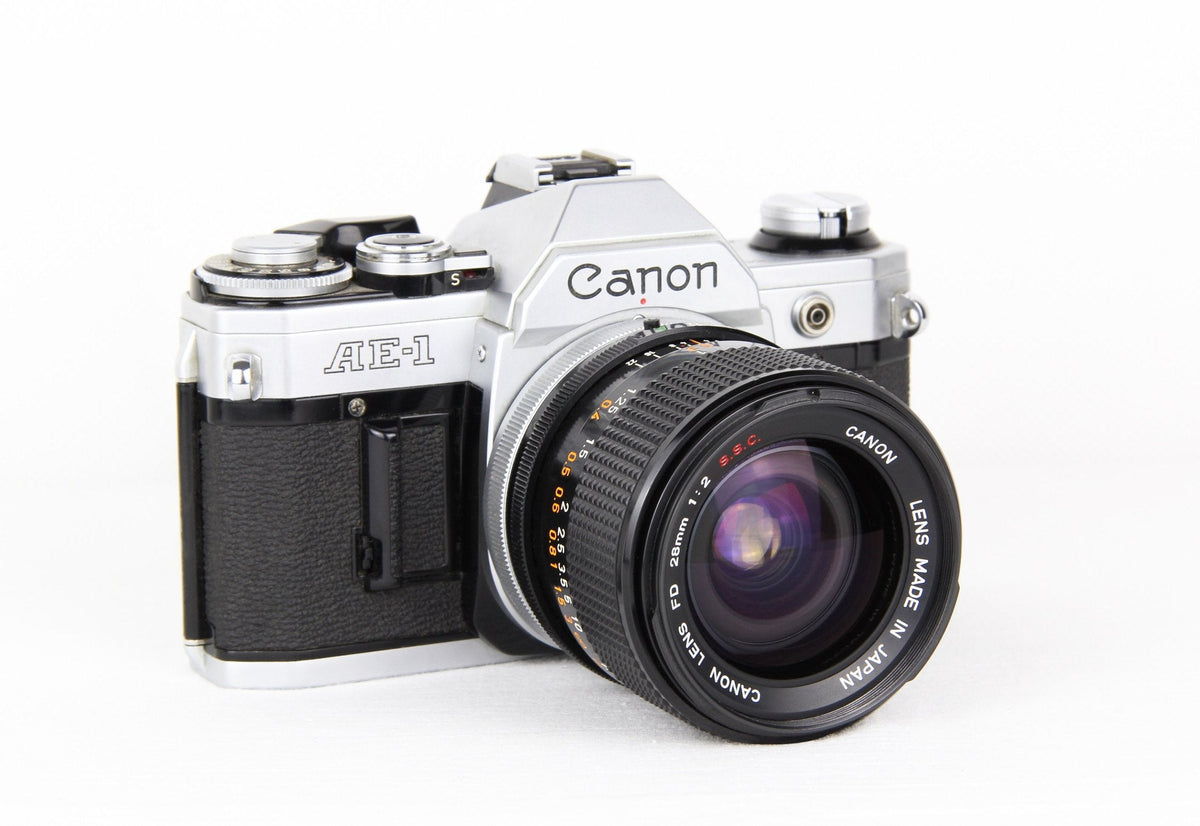
Reference guide · Film SLR · Updated October 2026
Released in April 1976, the Canon AE-1 is the first microprocessor-controlled 35mm SLR and one of the best-selling cameras in history. Fifty years later, it is still the SLR recommended for learning exposure. Here is everything you need to know before buying one: history, controls, FD lenses, known faults, and alternatives.
In the mid-1970s, automatic exposure was reserved for high-end SLRs, which were expensive and produced in small batches. Most people still set their cameras using a needle meter, like on the Canon FTb. Canon then made an industrial gamble: design a camera body around a central electronic circuit, with five major modules and twenty-five subassemblies, to eliminate over 300 parts and automate assembly. The result, the AE-1, prioritized speed at the price of a standard SLR. Its success was worldwide and lasted until 1984. Today, the AE-1 is easily found second-hand, accepts dozens of still-affordable FD lenses, and remains an excellent teacher. It also has well-documented weaknesses: it does nothing without a battery, its battery cover breaks, and its mirror often ends up "squeaking". This guide helps you choose a good example and get the best out of it.
The essentials in 30 seconds
- The strong point: shutter-priority: you choose the shutter speed, the camera chooses the aperture and shows it to you in the viewfinder. Ideal for understanding exposure.
- The weak point: everything is electronic. Without a 4LR44 battery, neither the shutter nor the light meter works.
- The limitation to know: no program mode, no aperture priority, maximum shutter speed of 1/1000 s, and a viewfinder that does not indicate the aperture actually set in manual mode.
- The right reflex: listen to the shutter release: a high-pitched squeal ("Canon squeal") indicates that the mirror lock-up needs to be relubricated.
- The alternatives: the AE-1 Program if you want a P mode, the Pentax K1000 or the Nikon FM if you want a mechanical shutter.

The SLR that democratized automation
During the 1960s, Canon was chasing Nikon. The brand dominated the consumer compact market (Canonet), but its SLRs did not have the aura of the Nikon F among professionals. Canon's first electronic SLR, the EF from 1973, remained expensive and exclusive. The project that became the AE-1 started with a simple set of requirements: an SLR that anyone could use, with unbeatable value for money.
To achieve this, Canon combined electronics, precision mechanics, and computer-aided design. The Canon Museum summarizes the recipe: five main units and twenty-five secondary units, controlled by a microcomputer, 300 fewer parts than an equivalent SLR, and a largely automated production process. The top cover and casing are made of metallic ABS plastic, with a chrome-plated brass base. Purists cried out in sacrilege; customers, however, bought it.
The launch was accompanied by a massive advertising campaign, unprecedented for a consumer SLR. In Japan, Canon marketed the AE-1 as the "burst SLR" thanks to the Power Winder A (2 frames per second), a rare accessory at this price point. In April 1976, the AE-1 cost 81,000 yen with the FD 50 mm f/1.4 S.S.C. according to the Canon Museum. It remained in the catalog until 1984 and sold several million copies.
- Launch of the FD mount and the Canon F-1 professional SLR.
- Canon EF, the brand's first electronic SLR, with shutter-priority.
- Release of the AE-1, the first microprocessor-controlled 35mm SLR.
- AT-1, a simplified version without automation (needle meter).
- A-1, the flagship of the A series with five exposure modes.
- AV-1 (aperture priority) and new "New FD" bayonet mount.
- AE-1 Program: addition of a program mode and an LED viewfinder.
- End of AE-1 production.
- Canon launches EOS and the EF mount: the FD mount is discontinued.
Did you know?
The simulated shutter sound when you take a screenshot on a Mac or iPhone comes from a Canon AE-1. Apple sound designer Jim Reekes recorded it with the camera he used in high school (source: English Wikipedia, Canon AE-1 article).
Design and controls: everything at your right hand
The AE-1 measures 141 × 87 × 48 mm and weighs 590 g without a lens. It is more compact than the FTb it replaces, but heavier than an Olympus OM. The handling is straightforward: the body is thick, the advance lever falls under the thumb, and the shutter release is located in the center of the shutter speed dial.
On the top cover, from left to right: the rewind crank (which also opens the back when you pull it), the hot shoe, then the shutter speed dial with the ISO window. To set the ISO, you lift the knurled ring of this dial and turn it, from 25 to 3200 ISO. Next to it are the 120° advance lever and the frame counter. On the front, to the left of the mount, are three controls: the 10-second timer lever (with a flashing red LED) which also serves as the shutter lock, the black metering button, and the small chrome backlighting button, which adds 1.5 stops of exposure as long as you hold it down.


The viewfinder is fixed (no interchangeable prism). It magnifies 0.86 times with a 50 mm and covers about 94% of the image height and 96% in width: you frame a little tighter than what you get. In the center, a rangefinder (two half-images that join when it's in focus) surrounded by a microprism crown. On the right, a vertical aperture scale and a needle. That's it. No shutter speed displayed, no tracking needle.
The battery cover is on the front, to the left of the mount. It is made of plastic and its tab breaks easily: it is one of the most cited weaknesses of the entire A series. Replacement covers are available, but a body delivered with an intact original cover is a good sign of care.

Canon FD lenses
The AE-1 uses the Canon FD mount, launched in 1971. It exists in two generations. The "original" FD lenses attach with a chrome ring that you screw in: the lens does not turn, only the ring turns. From 1979, the "New FD" (often noted FDn) mount like a classic bayonet: you turn the entire barrel. Both work perfectly on the AE-1, with full aperture metering and automation.
To enjoy shutter-priority, the aperture ring must be on position A. If you turn it to a value, the camera switches to manual and an "M" lights up in the viewfinder. With a non-FD lens (a Takumar M42 with an adapter ring, for example), the AE-1 knows how to meter at real aperture, closed diaphragm: the exposure is correct when the needle falls on the central mark of the scale, at f/5.6.


| Lens | For what | To know |
|---|---|---|
| FD 50 mm f/1.8 | The standard, versatile, light | The most common and affordable. Very good from f/4. |
| FD 50 mm f/1.4 | Low light, background blur | Delivered in kit at launch. One stop brighter. |
| FD 28 mm f/2.8 | Street, travel, interior | Compact wide-angle, ideal for street photography. |
| FD 35 mm f/2 | Reportage, daily life | Sought after, often more expensive than the 28 mm. |
| FD 135 mm f/2.8 or 3.5 | Close portrait, details | Many and little-demanded fixed long focal lengths. |
| FD 100 mm f/2.8 | Portrait | Compact, yet capable of strong 24×36 portrait photography. |
The FD catalogue counted more than fifty lenses by the late 1970s, from 15 mm fisheye to 800 mm. Since Canon abandoned this mount in 1987 in favour of the EF (autofocus), FD lenses cannot be mounted on EOS SLRs without an adapter. Fortunately, they remained cheaper than Nikon or Leica lenses from the same era. They are also highly prized by videographers and mirrorless camera users: our guide to vintage lenses on mirrorless cameras explains how to adapt them.
Expert tip
Start with a 50 mm f/1.8 or a 28 mm f/2.8, and nothing else for three or four rolls of film. Using a single focal length forces you to move and compose. Our article on the 50 mm film lens explains why it is the best school.
Technical specifications of the Canon AE-1
- Type
- 24×36 manual focus SLR
- Mount
- Canon FD (FD and New FD)
- Modes
- Shutter-priority, manual
- Shutter
- Speeds
- 2 s to 1/1000 s, B exposure
- Flash sync
- 1/60 s, hot shoe and PC socket
- Metering
- Centre-weighted, silicon photodiode (SPC)
- Metering range
- IL 1 to 18 (100 ISO, f/1.4)
- Sensitivity
- 25 to 3200 ISO, manual setting
- Correction
- Backlight button: +1.5 stops
- Viewfinder
- Fixed pentaprism, ×0.86, 93.5% × 96%
- Focusing
- Rangefinder and microprisms
- Power
- 1 6 V 4LR44, 4SR44 battery (formerly 4G-13 mercury)
- Self-timer
- Electronic, 10 s, LED
- Accessories
- Power Winder A / A2, Data Back A, Speedlite 155A, 177A
- Dimensions, weight
- 141 × 87 × 48 mm, 590 g
Sources: Canon Museum (AE-1 data sheet), camera-wiki.org, Canon AE-1 user manual.
Versions, finishes and the A family
There is only one AE-1, but two finishes: chrome (the most common, silver top and black covering) and all-black, which is rarer and often slightly more sought after. Special editions are mostly bodies or caps in the colours of the events Canon sponsored at the time, such as the Olympic Games: a "Montreal 1976" lens cap or a "Winter Games 1980" cap do not change the camera, but appeal to collectors.
The real story is the family. The AE-1 is the first in a series of six SLRs, all built on the same compact aluminium alloy chassis, with the same fabric focal-plane shutter and the same automatic flash system. This shared design explains the low prices at the time, and also why the faults are the same from one model to another.
| Model | Year | Modes | For whom today |
|---|---|---|---|
| AT-1 | 1977 | Manual with needle (no automation) | Those who want to set everything themselves |
| AE-1 | 1976 | Shutter-priority, manual | Learning exposure, on a tight budget |
| A-1 | 1978 | Program, shutter-priority, aperture-priority, manual, flash | Demanding photographers, see our Canon A-1 review |
| AV-1 | 1979 | Aperture-priority only | Simple automatic use |
| AE-1 Program | 1981 | Program, shutter-priority, manual | Beginners who want P mode |
| AL-1 | 1982 | Aperture-priority, assist focusing | Curiosity, rare |


Check
Do not confuse AE-1 and AE-1 Program in an ad. The Program features the "PROGRAM" label below the AE-1 logo, a shutter speed dial with a green "P" position and, often, a small removable grip. Our comparison Canon AE-1 vs AE-1 Program details all the differences.
Using it properly: the five-step method
Shutter-priority is an excellent school: you decide the movement (freeze or blur), the camera calculates the aperture, and the viewfinder shows you what it has chosen. You thus see in real time the relationship between shutter speed and aperture. Here is the routine to follow.
- Put in a new battery and test it: press the battery check button to the left of the pentaprism. The needle should drop below the central mark on the scale.
- Set the film sensitivity by lifting the ring on the shutter speed dial. An error here will ruin the entire roll.
- Set the lens to A, then choose a shutter speed: 1/125 s in broad daylight, 1/60 s in the shade, 1/250 s or faster to freeze a moving subject.
- Read the needle by pressing halfway: it indicates the chosen aperture. If it rises into the red zone at the top, speed up; if the red LED at the bottom lights up, slow down.
- Focus with the rangefinder: align the two halves of a vertical line of the subject, then press the shutter.
| Situation | Recommended shutter speed | What the AE-1 will choose |
|---|---|---|
| Bright sunlight, beach, snow | 1/1000 s | f/11 to f/16 (overexposure possible at 400 ISO) |
| Overcast sun, street | 1/500 s | around f/8 |
| Shade, overcast sky | 1/250 s | f/4 to f/5.6 |
| Bright interior | 1/60 s | f/2 to f/2.8 |
| Evening, lit street | 1/30 s | wide open, watch out for camera shake |
In manual mode, it is less convenient: you turn the aperture ring, the needle indicates the recommended aperture for the chosen shutter speed, and it is up to you to match the value engraved on the ring. There is no needle showing your actual setting. It works very well in stable light, less so in fast-paced situations. To understand the metering modes, read our guide shooting modes and exposure metering.
Expert tip
In backlight (face in front of a window, subject in front of a clear sky), keep the chrome backlight button pressed during the shot: the AE-1 adds 1.5 stops. It is often the difference between a black silhouette and a visible face.
For flash, the AE-1 syncs at 1/60 s. With a Canon A series flash (Speedlite 155A, 177A, 188A, 199A), the camera automatically sets itself to 1/60 s and reads the aperture set on the flash. With a modern flash, check the sync voltage before mounting it on the hot shoe: our guide to film SLR flash explains why some old flashes can damage the electronics of a body.
Photos taken with the Canon AE-1
The images below were taken by the photographer Acroterion between 1980 and 1981 with a Canon AE-1, on slide film (Kodachrome and Ektachrome), then scanned. They show what an AE-1 and its FD lenses deliver on demanding film: slides have almost no latitude, every exposure error is visible. The AE-1's centre-weighted metering does well in high-contrast scenes, provided you aim at an area of midtones.


To see recent images taken with the AE-1 on modern film, the Lomography community gallery has thousands of them: see examples of photos taken with the Canon AE-1 on Lomography (external link, photos not reproduced here).
Known issues and pre-purchase inspection
An AE-1 is between 40 and 50 years old. Most problems are known, repairable, and inexpensive if caught early. The most important thing is knowing how to recognize them in an ad or in person.
| Symptom | Probable cause | Severity |
|---|---|---|
| High-pitched squeal when firing | Dry mirror brake: the "Canon squeal" | Moderate: relubricate quickly, otherwise permanent wear |
| Nothing happens when firing | Dead battery, oxidized contacts, engaged timer lock | Often minor |
| Battery door no longer stays closed | Broken plastic tab | Low: replacement part |
| Light trails on negatives | Disintegrated light seals on the back | Low: replacement of the seals |
| Blurry image in the viewfinder, smudges | Mirror foam stuck to the viewfinder glass | Low to moderate |
| Frozen or erratic needle | Dirty shutter speed contact, electronics | Moderate to high |
| Overlapping or spaced-out views | Film advance or curtain issue | High: complete overhaul |
Classic trap
The "squeal" is often presented as "a small normal noise" in ads. It is not. According to camera-wiki, this mirror brake squeal, common to the entire A series, is corrected by relubrication; if ignored, it can end up damaging the mechanism irreparably. Ask for a video of the camera firing at 1/1000 s and 1/15 s before buying remotely.
Pre-purchase checklist
- Open the battery door: no green or white traces of corrosion, tab intact.
- With a new battery, perform the battery test: the needle should drop below the center mark.
- Lens on A, fire at all speeds from 1/1000 s to 2 s: the sound should vary significantly, without squealing.
- Aim at a lamp then a dark wall: the needle should move freely and the low LED light up in the dark.
- Test the timer and red LED, then the exposure compensation button.
- Open the back: foam in good condition (neither sticky nor crumbling), curtains clean and without creases.
- Look through the viewfinder: no black spots stuck on the glass, rangefinder clearly visible.
- On the lens, illuminate it with a lamp: no fungus, no haze, diaphragm blades dry (without oil).
To go further, our guide for buying a used film camera details each test, and the used camera scams page lists the warning signs in ads. If your copy already has a defect, read getting an old camera repaired.
What makes its price
We do not give a numerical valuation: prices move quickly and vary depending on condition. Here, however, is what raises or lowers the value of an AE-1, so you can judge an ad.
- Verified operating condition outweighs everything else. A body that is "tested, no squeal, foam replaced" is worth significantly more than a body "sold as is, battery not included".
- The lens included: a 50 mm f/1.4 adds more value to the kit than an f/1.8; a generic 1980s zoom adds almost no value.
- The black finish, less common, often sells for a little more than the chrome one, all things being equal.
- The aesthetics: dent-free body, complete covering, original battery door.
- The demand: the AE-1 and AE-1 Program are among the most sought-after SLRs by beginners, which supports their value compared to less well-known equivalent models.
To understand the logic of prices and what developing a roll of film really costs, read how the value of a used camera is determined.
The AE-1 versus its rivals
In 1976, the AE-1 arrived in a SLR war where every Japanese brand was releasing a model every year. Today, its direct competitors on the used market are the learning SLRs from the same era. The main dividing line: electronic (automatic, but battery dependent) versus mechanical (everything works without a battery, except the light meter).
| Model | Year | Modes | Shutter | Without battery? |
|---|---|---|---|---|
| Canon AE-1 | 1976 | Speed, manual | Electronic, 1/1000 s | No |
| Canon AE-1 Program | 1981 | Program, speed, manual | Electronic, 1/1000 s | No |
| Pentax K1000 | 1976 | Manual with needle | Mechanical, 1/1000 s | Yes (except light meter) |
| Nikon FM | 1977 | Manual with LED | Mechanical, 1/1000 s | Yes (except light meter) |
| Minolta X-700 | 1981 | Program, aperture, manual | Electronic, 1/1000 s | No |
| Olympus OM-10 | 1979 | Aperture priority (manual with adapter) | Electronic, 1/1000 s | No |

Canon AE-1 Program
The same spirit with a P mode, a more readable LED viewfinder and a grip. The simplest choice if you want to delegate everything.

Pentax K1000
The ultimate student SLR: all mechanical, indestructible, but zero automation. Here in the SE version.

Nikon FM
Mechanical, compact, Nikon F lenses. More expensive to buy, but a reliable choice that works without batteries.

Minolta X-700
The most automated of the bunch: program and aperture priority modes, very clear viewfinder. Electronic, like the AE-1.
And if you're still hesitating between the major families, our selection of the best film SLRs ranks the models by profile.
Pros
- Shutter priority, educational and fast
- Clear viewfinder with light meter and microprisms
- Huge and affordable FD lens selection
- Parts and repairers are still relatively easy to find
- Iconic design, chrome or black
Cons
- Totally dependent on its 6V battery
- No program mode or aperture priority
- Viewfinder without shutter speed display or tracking needle
- Frequent mirror squeal if not serviced
- Battery cover and fragile plastics
The AE-1 doesn't just teach you how to photograph. It teaches you to look at light, then decide.
Vibes Photo Editorial Team
What film in an AE-1?
The AE-1 accepts all 135 (24×36) film, from 25 to 3200 ISO. Since it doesn't read the DX code, you have to set the sensitivity yourself. With a shutter speed limited to 1/1000 s, 400 ISO film in bright summer sun already requires stopping down to around f/11: it's still within range, but to open wide in bright light, opt for 100 or 200 ISO.
| Film | Use | Why with the AE-1 |
|---|---|---|
| Kodak Gold 200 | Color, bright daylight, budget | Soft and economical in bright sunlight. Gold 200 or Portra 400? |
| Kodak Portra 400 | Portraits, variable light | Wide latitude, forgives metering errors. Our review |
| Kodak UltraMax 400 | Versatile color | Good compromise at 1/1000 s maximum. |
| Ilford HP5 Plus | Black and white, street | Can be pushed to 1600 ISO for night. Our review |
| Kodak Ektar 100 | Landscape, saturated colors | Ideal for opening wide in bright sunlight. |
| CineStill 800T | Night, neon lights | The 50 mm f/1.4 wide open does the rest. |
For loading, our step-by-step guide to loading film applies directly to the AE-1 (spool take-up slot); the rewind release button is located under the body.
Frequently asked questions
Is the Canon AE-1 a good camera for beginners?
Yes. Shutter priority teaches you the relationship between shutter speed and aperture without holding you back, and the light meter makes focusing easy. Its only real limitation for a beginner is its dependence on batteries. Compare it with the other options in what film camera to start with.
What battery does the Canon AE-1 take?
A 6V battery in 4LR44 (alkaline) or 4SR44 (silver oxide, more stable voltage) format. The original 4G-13 mercury battery is no longer sold. All formats are listed in what battery for my film camera.
Does the Canon AE-1 work without batteries?
No. The shutter is entirely electronic: without batteries, the camera will not fire at any speed, not even in B exposure. Always keep a spare battery in your bag.
What is the "Canon squeal"?
It is a high-pitched squeal when firing, caused by the mirror brake lacking lubrication. It affects the entire A series. A repairer can fix it by relubricating it; you should not wait, as the wear can become irreversible.
What is the difference between the AE-1 and the AE-1 Program?
The Program (1981) adds a fully automatic program mode, an LED aperture display in the viewfinder, a metering lock, and a removable grip. The AE-1 only has shutter priority and manual modes. Details in AE-1 vs AE-1 Program.
Can you use modern lenses on an AE-1?
Only FD mount lenses (Canon or third-party brands in FD). EOS reflex lenses do not fit. With an adapter, M42 lenses can be used with stopped-down aperture metering.
Is the Canon AE-1 reliable?
Yes, for a 50-year-old camera, provided it has been serviced. Its electronics are robust; its weaknesses are mechanical (mirror brake, foam, battery cover). A serviced copy can still serve for years.
What lens should you buy for an AE-1?
The FD 50 mm f/1.8 to start: lightweight, sharp, and affordable. Then, a 28 mm for street photography or a 135 mm for tight portraits.
Vibes Photo
Your first reflex, checked
We select and inspect used film SLRs, including Canon A series cameras when available. Have a question about a specific copy or a breakdown? Write to us.
Sources
- Canon Museum, AE-1 page (release date, launch price, technical specifications, modular design).
- Canon Museum, 1976–1986 history (first microprocessor reflex, Power Winder A, slogan).
- camera-wiki.org, Canon AE-1 (controls, stopped-down aperture metering, battery, back-button exposure).
- camera-wiki.org, Canon AE-1 Program (mirror brake squeal, battery cover, A series).
- Wikipedia (en), Canon AE-1 (A series, ABS plastic, FD and New FD mount, Jim Reekes anecdote).
- Wikipedia (fr), Canon AE-1 (exposure modes, 10 s delay shutter).
Images: authors, licenses and sources indicated under each photo.