










The 50mm in film photography: why it’s the ideal lens, and which one to choose
Why the 50mm is the ideal film lens: choosing its aperture, mount models, the Helios 44-2, usage tips and pre-purchase checks.
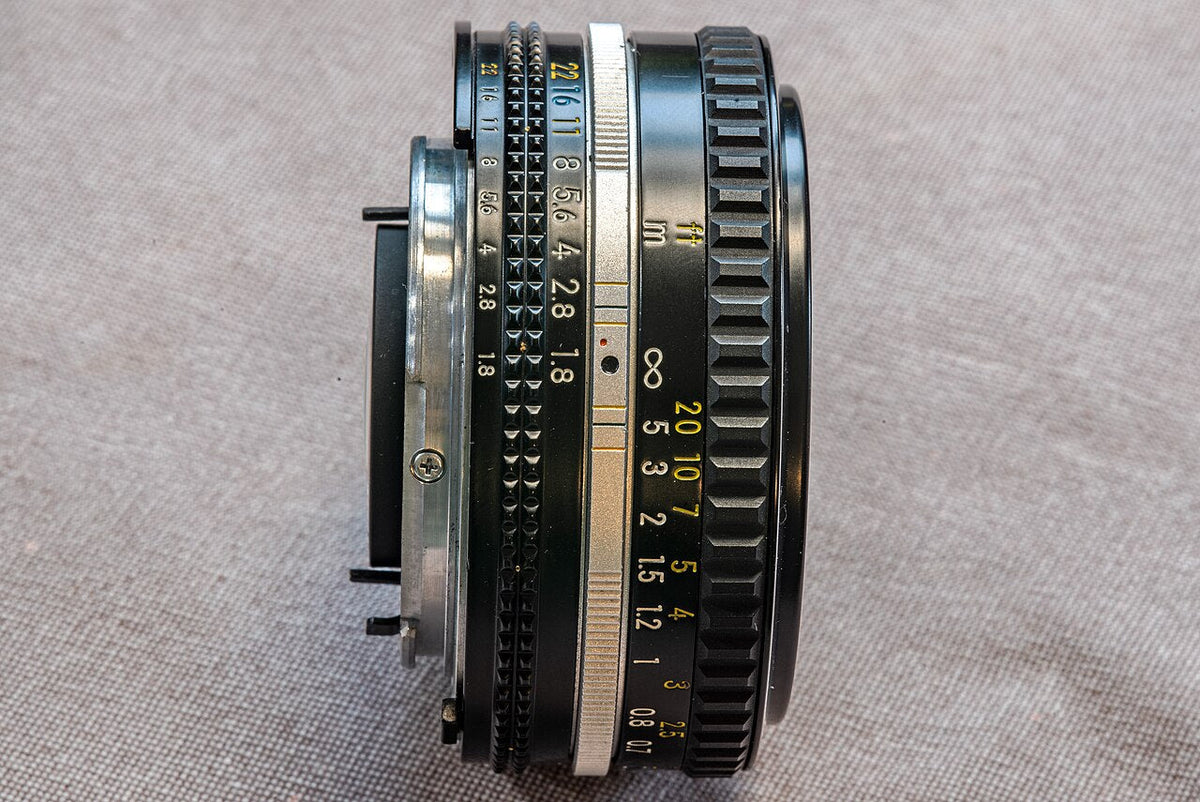
The 50 mm is the iconic lens of film photography. For decades, almost all SLR cameras were sold with a 50 mm f/1.8 or f/1.4. As a result, they are now among the most affordable and fastest lenses on the used market. Why is it the first lens to get, which aperture should you choose, and which models should you look for in each mount? Here is the guide.
Why the 50 mm?
- A natural angle of view, close to what we perceive without any particular effort: neither wide-angle nor telephoto.
- Very fast: f/1.8 or f/1.4 allow you to photograph indoors without flash and blur the background.
- Compact and light, it keeps the SLR manageable.
- Affordable: produced in very large numbers, it is easily found used.

f/1.8, f/1.4 or f/1.2?
| Aperture | Advantages | Disadvantages |
|---|---|---|
| f/1.8 – f/2 | Light, affordable, very good quality | Slightly less fast |
| f/1.4 | Faster (about 2/3 of a stop faster than f/1.8) | Heavier and more expensive |
| f/1.2 | Maximum speed | Heavy, expensive, very shallow depth of field |
To start, an f/1.8 is more than enough: at a wide aperture, the area of sharpness is already very thin, and an f/1.4 only brings about two-thirds of a stop. Review the basics with our exposure triangle guide.
The 50 mm by mount
| Mount | Common models | Bodies |
|---|---|---|
| Canon FD | FD 50 mm f/1.8 and f/1.4 | AE-1, A-1 |
| Nikon F | Nikkor 50 mm f/1.8 (including AI-S "pancake") and f/1.4, E Series 50 mm f/1.8 | FM2, FE, F3 |
| Olympus OM | Zuiko 50 mm f/1.8 and f/1.4 | OM-1, OM-10 |
| Pentax K | SMC Pentax(-M/-A) 50 mm f/1.7 and f/1.4, 50 mm f/2 | K1000, ME Super |
| Minolta MD | MD Rokkor 50 mm f/1.7 and f/1.4 | X-700 |
| M42 | Helios 44-2 58 mm f/2 (close to 50 mm) | Zenit, Praktica |
Always check the exact compatibility with your body: see our mount guide.

The Helios 44-2 case
The Helios 44-2, a Soviet 58 mm f/2 with an M42 mount, became famous for its background blur that "swirls" at wide open. Originally mounted on many Zenits, it is very common and easily adapted, including to digital bodies.
How to use a 50 mm properly
- Portrait: at f/2–f/2.8, the subject stands out; focus on the closest eye.
- Street and travel: f/8 and focus at 3–5 m to shoot quickly.
- Indoors: wide open and 400 ISO film, at least 1/60 s.
- Landscape: f/8 to f/11 for maximum sharpness.
Checks on a used 50 mm
- No mold, haze, or deep scratches (flashlight through the lens).
- Smooth focus ring, without hard points.
- Dry diaphragm: the blades must not be greasy and must close quickly.
- Mount and contacts undamaged.
See also fungus in a lens.
All cameras sold by Vibes Photo are checked before being put on sale and covered by a six-month commercial warranty, in addition to legal warranties. Details are in our general terms and conditions of sale.
Frequently Asked Questions
Why is the 50 mm recommended for beginners?
It is fast, light, affordable, and versatile: ideal for learning depth of field and composition.
Should you get a 50 mm f/1.4 or f/1.8?
An f/1.8 is enough to start. The f/1.4 gains about two-thirds of a stop, at the cost of weight and budget.
Is the 50 mm suitable for portraits?
Yes, especially for half-body or bust shots. For a very tight portrait, an 85 to 105 mm distorts less.
Does a 50 mm film lens work on a digital camera?
Yes, with an adapted ring, especially on mirrorless cameras, in manual focus.