










Nikon FM2: Review, Versions (FM2, FM2n, FM2/T) and Buying Guide
The mechanical SLR at 1/4000 s thoroughly examined: history, shutter, three-LED light meter, FM2, FM2n and FM2/T versions, compatible Nikkor lenses, common faults, buying checklist, rivals and film.
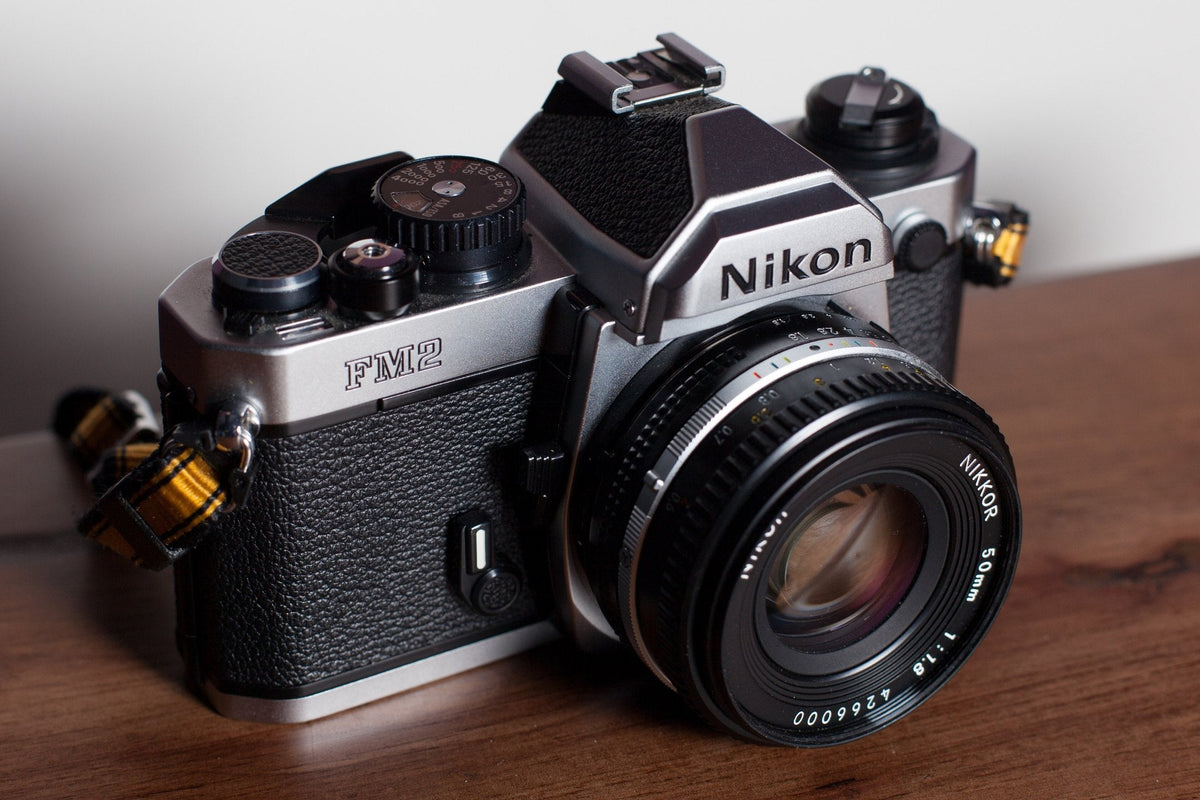
Reference sheet · Film SLR · Updated October 2026
A metal-slat shutter that reaches 1/4000 s without a battery, a Nikon F mount, and a body built to last: the FM2 is the mechanical SLR that photojournalists kept as a backup. Versions, settings, lenses, common failures, and rivals: everything you need to know before buying one.
In the early 1980s, SLRs were becoming electronic, automatic, and slightly more fragile every year. Nikon took a contrarian gamble: a compact, fully mechanical body with no automation whatsoever, but equipped with the fastest shutter on the market. The FM2 was released in 1982 with an unprecedented 1/4000 s shutter speed, and Nikon produced it for nineteen years, until 2001, long after far more sophisticated rivals had disappeared. Today, it remains one of the best SLRs for learning exposure and one of the most reliable for travel. This sheet details its history, its three versions (FM2, FM2n, FM2/T), its three-LED light meter, its compatible lenses, its known failures, the pre-purchase checklist, its alternatives, and the film stocks that suit it best.
The essentials in 30 seconds
- The highlight: a mechanical shutter from 1 s to 1/4000 s, with 1/250 s flash sync on the FM2n, that works without a battery.
- The downside: no automation: you always set the shutter speed and aperture yourself, using a simple but unnuanced three-LED light meter.
- The limitation to know: pre-1977 non-AI Nikon lenses must not be mounted without conversion: they can damage the light meter coupling.
- The right buying approach: listen for slow shutter speeds, check the foam in the back and the mirror, compare the light meter to a light meter, and shoot a test roll.
- The alternatives: the Nikon FM (slower, cheaper), the FE2 (automatic), the FM3A (the best of both, much more expensive), or an Olympus OM-1 and a Pentax K1000.

History: from the FM to the FM3A
In 1977, Nippon Kogaku (which became Nikon Corporation in 1988) launched the FM, the first member of a family of compact SLRs built on a copper-aluminum-silicon alloy chassis. The FM is mechanical, reaches 1/1000 s, and synchronizes flash at 1/125 s. It was followed in 1978 by the FE, its electronic aperture-priority version. These bodies offered a lighter and cheaper alternative to the professional Nikon F2, with the same lenses.
The FM2 arrived in 1982. It retained the FM's silhouette but changed its heart: a new vertical metal-slat shutter, mounted on bearings, which reaches 1/4000 s and synchronizes flash at 1/200 s. According to Wikipedia, its slats travel across the frame in 3.3 milliseconds, twice as fast as the metal shutters of the time. In 1984, Nikon installed the FE2's improved shutter in it: it became the FM2n ("New FM2" in Japan), synchronized at 1/250 s. In 1989, the titanium slats gave way to an aluminum alloy. In 1993, the FM2/T with titanium covers appeared.
What is striking is its commercial longevity. The FM2 sold for $364 (bare chrome body) in the United States at its launch; its catalog price reached $745 in 1995 and remained there until production ended in 2001. In the meantime, dozens of electronic SLRs appeared and disappeared. The FM3A, launched in July 2001, succeeded it with a hybrid shutter (mechanical or automatic) until January 2006.
- Nikon FM: compact alloy chassis, mechanical shutter at 1/1000 s.
- Nikon FM2: vertical metal shutter at 1/4000 s, flash sync at 1/200 s.
- Nikon FE2: same family, aperture-priority automation, 1/4000 s and sync at 1/250 s.
- FM2n ("New FM2"): FE2 shutter, sync at 1/250 s, serial number prefixed with N.
- Aluminum shutter slats instead of titanium (smooth slats).
- FM2/T: titanium covers and back, sold alongside the FM2 until 1997.
- End of FM2 production; the FM3A (hybrid shutter) takes over until 2006.
Construction and controls
The FM2 weighs about 540 g without a lens and fits well in the hand despite its lack of a grip. Its lightweight alloy chassis, hardened gears, and ball bearings explain its reputation. Wikipedia reports guaranteed operation from −40 °C to +50 °C, thanks to lubrication reduced to the bare minimum. It was the camera you took on a polar expedition or into the desert, where an electronic SLR risked failing.
The controls are those of a classic SLR. On the top cover, to the left, is the film advance lever (pull it up to open the back). In the center is the flash hot shoe. To the right is the shutter speed dial from 1 s to 1/4000 s, with B and a red "250" mark for flash sync on the FM2n; around it is the ISO sensitivity ring from 12 to 6400. The cocking lever has a dual role: when pulled away from the body by 30°, it releases the shutter release; when folded back, it locks it. On the front, you find the self-timer lever (about 10 s), the depth-of-field preview lever, and, below the cocking lever, the small lever for multiple exposures.


Did you know?
The FM2's multiple exposure lever disengages the counter while you re-cock it: the shutter reloads, but the film does not advance. This allows you to stack two, three, or more exposures on the same frame, with precise alignment. Find the method in our guide to film double exposure.
The 1/4000 s shutter
The shutter is the FM2's great strength. It is a vertical metal-slat curtain, set and cocked entirely by springs: the battery is only used for the light meter. On the FM2n, it synchronizes electronic flash at all speeds up to 1/250 s, while most SLRs of the time were limited to 1/60 or 1/125 s. This is a real advantage in broad daylight, for opening up a face in backlight without overexposing the background.
The 1/4000 s, meanwhile, is mainly used to open wide in bright light. Do the calculation with the "Sunny 16" rule: in full sun, a 100 ISO film is exposed at f/16 at 1/125 s. Opening to f/2.8 means gaining five stops of light; you must therefore compensate with five stops of speed, i.e., 1/4000 s. With a 100 ISO, the FM2 therefore allows you to photograph at f/2.8 in full sun; with a 400 ISO, you must close to f/5.6. That is two stops better than an SLR limited to 1/1000 s.
Classic trap
The shutter slats are thin and fragile. Never touch them, not even with a hard-tipped blower, when loading film or cleaning the body. A bent slat jams the shutter and costs a serious repair. It is one of the most avoidable causes of failure on the FM2.
The three-LED light meter
The FM2 light meter measures light through the lens, wide open, thanks to two silicon photodiodes. Its weighting is said to be "60/40": 60% of the measurement comes from the 12 mm central circle engraved on the viewfinder glass, 40% from the rest of the image. It turns on with a light press on the shutter release (cocking lever pulled away), remains active for about 30 seconds, and turns off by itself or in B position.
In the viewfinder, to the right, three LEDs (+, o, −) indicate the exposure deviation. Their combination actually gives five pieces of information: "o" alone (correct exposure), "+" and "o" together (overexposure by one-fifth to one stop), "+" alone (more than one stop), and the equivalents on the "−" side. It is rudimentary compared to a needle, but quick to read. At the top of the viewfinder, a small window displays the aperture read directly on the lens ring (ADR system). The measurement range goes from IL 1 to IL 18 at 100 ISO with an f/1.4 lens.
| Display | Meaning | Action |
|---|---|---|
| o | Correct exposure (within 1/5 of a stop) | Shoot |
| + and o | Overexposure by 1/5 to 1 stop | Close by one-third to half a stop, or speed up |
| + | Overexposure by one stop or more | Close the aperture or speed up the shutter |
| o and − | Underexposure by 1/5 to 1 stop | Open slightly or slow down |
| − | Underexposure by one stop or more | Open the aperture or slow down |
Expert tip
The central measurement can be fooled by a white sky, snow, or a very dark background. Aim at a midtone (cobblestones, grass, gray wall) in the same light, set until "o", then recompose. Facing a backlit subject, open one to two stops beyond what the light meter indicates. To learn more, read our guide to exposure metering modes.
Complete technical sheet
- Type
- Single-lens 24×36 monochrome SLR, manual focus
- Mount
- Nikon F, AI, AI-S, E Series, AF lenses with aperture ring
- Shutter
- Vertical focal plane with metal slats, fully mechanical
- Speeds
- 1 s to 1/4000 s + B exposure (14 positions)
- Flash sync
- 1/200 s (FM2), 1/250 s (FM2n); ISO hot shoe and sync socket
- Metering
- TTL 60/40 center-weighted, two silicon photodiodes
- Metering range
- IL 1 to IL 18 (100 ISO, f/1.4 lens)
- Sensitivity
- 12 to 6400 ISO, manual setting
- Viewfinder
- Fixed pentaprism, coverage ≈ 93%, magnification 0.86× (50 mm)
- Viewfinder lenses
- Original K2 (rangefinder + microprisms), B2 and E2 optional
- Functions
- Self-timer ≈ 10 s, depth-of-field preview, multiple exposures
- Accessories
- MD-12 motor (3.2 frames/s), MF-16 date back, SB-15 and SB-16B flashes
- Power
- 2 SR44 or LR44 batteries, or 1 CR1/3N lithium battery, for the light meter
- Construction
- Copper-aluminum-silicon alloy chassis
- Dimensions
- 142.5 × 90 × 60 mm
- ≈ 540 g empty body
Sources: FM2 repair manual and manufacturer specifications, Wikipedia (Nikon FM2), Nathan Jones. Weight varies by source (520 to 540 g).

FM2, FM2n or FM2/T?
All three versions bear the same name on the front. Two clues are enough to tell them apart: the serial number on the back of the cover (a leading "N" indicates an FM2n) and the sync mark on the shutter speed dial ("200" on the first FM2, red "250" on the FM2n). To find out whether an FM2n has titanium or aluminum shutter blades, open the back and look at the shutter: a honeycomb pattern for titanium, smooth blades for aluminum.
| Version | Years | What changes | For whom |
|---|---|---|---|
| FM2 | 1982 – 1984 | 1/200 s flash sync, honeycomb-patterned titanium blades | Collectors, flashless use |
| FM2n (titanium) | 1984 – 1989 | FE2 shutter, 1/250 s sync, "N" serial number, honeycomb blades | All-purpose use |
| FM2n (aluminum) | 1989 – 2001 | Smooth aluminum alloy blades, same performance | The most common, the most recent |
| FM2/T | 1993 – 1997 | Titanium covers and back, catalog price $1,120 | Intensive use, collectors |


For photography, a late-model FM2n is the safest choice: it is the most recent and the easiest to find. The sync difference between FM2 and FM2n only matters if you use flash a lot in broad daylight. For a detailed comparison with its predecessor, read our duel Nikon FM or FM2.
Which Nikkor lenses
The Nikon F mount is one of the FM2's major selling points. It accepts all lenses with automatic aperture indexing (AI) introduced in 1977: AI, AI-S, Series E, and recent autofocus lenses if they have an aperture ring (AF, AF-D), used in manual focus. The used market is enormous, from fisheye to super-telephoto lenses.
| Lens | For what | Note |
|---|---|---|
| Nikkor 50 mm f/1.8 AI-S or Series E | First lens, versatile | Lightweight, sharp, very common |
| Nikkor 50 mm f/1.4 AI-S | Low light, portrait | Faster, more pronounced background blur |
| Nikkor 35 mm f/2 AI-S | Street, travel, interiors | Ideal everyday focal length |
| Nikkor 28 mm f/2.8 AI-S | Landscape, architecture | Excellent for close-up |
| Nikkor 105 mm f/2.5 AI-S | Portrait | A classic with a soft rendering |
| Nikkor AF-D (35, 50, 85 mm) | If you already own one | Work in manual mode thanks to the aperture ring |
Watch out for lenses
Three families pose problems. Non-AI lenses (pre-1977) should not be mounted as they are: the FM2's cell coupling lever is not retractable and can be damaged; an AI conversion solves the problem. G and E lenses (without an aperture ring or with electronic aperture) can be mounted, but you will not be able to set the aperture. Finally, IX-Nikkor lenses for APS should never be mounted: their rear lens element can strike the mirror.
To choose your first 50 mm, read our guide to the 50 mm film lens, and to understand mounts, our guide to mounts.
Using it properly: method and settings
1. Insert the batteries and set the sensitivity
Unscrew the cover under the body and insert two SR44 batteries (silver oxide, more stable voltage) or LR44, or one CR1/3N. The FM2 does not read the DX code: lift the ring around the shutter speed dial and turn it to the film sensitivity. If the LEDs do not light up when the shutter button is pressed, first check that the advance lever is folded out and that the dial is not on B. Our guide to batteries for film cameras lists the equivalents.
2. Load the film
Pull the rewind crank up, the back opens. Place the cartridge, slide the leader into a slot in the take-up spool, advance once while checking that the perforations engage on the sprocket, close it. Advance and fire until "1" while watching the crank: it must turn. The counter returns to "S" when you open the back. Full step-by-step in our article for loading film.
3. Choose speed and aperture
Start with the speed: at least 1/60 s with a 50 mm handheld, 1/250 s to freeze a passerby, 1/1000 s or faster for sports. Then turn the aperture ring to the "o". For a portrait, open (f/2 to f/2.8) and let the speed rise; for a landscape, close (f/8 to f/11) and check that the speed remains sufficient. The depth of field gauge shows you the sharp zone before firing.
| Light | 100 ISO | 400 ISO |
|---|---|---|
| Bright sunlight | f/16 at 1/125 s, or f/2.8 at 1/4000 s | f/16 at 1/500 s, or f/5.6 at 1/4000 s |
| Overcast sun | f/11 at 1/125 s | f/11 at 1/500 s |
| Overcast sky | f/8 at 1/125 s | f/8 at 1/500 s |
| Shadow or very dark sky | f/5.6 at 1/125 s | f/5.6 at 1/500 s |
| Bright interior | f/2 at 1/30 s | f/2 at 1/125 s |
These guides are valuable if the batteries die: all speeds remain available. The complete method is on our page Sunny 16: exposing without a light meter.
4. The flash
With a dedicated Nikon flash (SB-15, SB-16B and compatible), an LED in the viewfinder indicates that the flash is charged and flashes if the chosen speed exceeds the sync speed. The FM2 does not do TTL flash metering: the flash measures the flash with its own sensor, in automatic mode. Set the speed to 250 (FM2n) or less. Our guide to flash on film SLR cameras details the guide numbers.
Expert tip
When traveling, keep the advance lever folded in the bag: the shutter button is then locked, which prevents ruining a shot or leaving the cell on by an accidental press. And bring two spare SR44 batteries: they weigh two grams.
The rendering in images
An SLR does not make the image alone: the lens, the film, the lab and the scan count more. The following photos were taken with the Nikon FM2 by photographers who publish them under a free license, with the lens and film indicated by the author when they specified them. The last one is a historical document: the FM2 was the camera of many press photographers.


Pour d'autres exemples, tu peux parcourir les photos prises au Nikon FM2 sur Lomography. Ces images appartiennent à leurs auteurs ; nous ne les reproduisons pas ici.
Pannes et contrôle avant achat
Un FM2 a entre 25 et 44 ans. Sa mécanique est robuste et bien connue des réparateurs, mais le temps use les mousses, sèche les lubrifiants et encrasse les contacts. Voici les défauts les plus souvent signalés.
| Symptôme | Cause probable | Gravité |
|---|---|---|
| Voiles de lumière, traînées rouges sur les négatifs | Mousses d'étanchéité du dos dégradées (collantes ou en miettes) | Entretien courant |
| Miroir qui claque fort ou laisse des miettes noires | Mousse d'amortissement du miroir désagrégée | Entretien courant |
| LED qui sautent ou clignotent sans raison | Piles faibles, contacts oxydés, piste résistive encrassée | Souvent bénin |
| Vitesses lentes (1 s, 1/2 s) qui traînent ou collent | Lubrifiant séché dans le mécanisme de retard | Révision |
| Bande sombre au 1/4000 s, obturateur bloqué | Lamelles déformées ou désynchronisées | À éviter |
| Levier d'armement qui ne revient pas, vues superposées | Ressort fatigué, entraînement usé | À éviter |
Piège classique
Un FM2 « bloqué » ne l'est pas toujours. Si le déclencheur refuse de s'enfoncer, vérifie que le levier d'armement est bien écarté du boîtier, que le film a été armé jusqu'au bout et que la molette n'est pas en position de surimpression mal enclenchée. Beaucoup d'annonces « en panne » cachent simplement un levier replié.
La checklist avant d'acheter
- Vitesses à l'oreille : dos ouvert, objectif retiré, déclenche à 1 s, 1/2 et 1/4 ; la durée doit être franche et régulière. Les vitesses rapides doivent claquer net.
- Obturateur : regarde les lamelles à 1/4000 s face à une lumière ; elles doivent être planes, sans pli ni trace de doigt.
- Mousses : passe le doigt dans la rainure du dos et sous le miroir ; pas de résidu collant ni de miettes.
- Cellule : avec des piles neuves, compare la mesure à un posemètre ou une application sur un mur gris ; écart toléré d'une demi-valeur.
- Viseur : clair, sans champignon ni prisme désargenté (taches sombres) ; verre de visée propre.
- Levier et compteur : armement fluide, retour franc, compteur qui avance et revient à « S » à l'ouverture du dos.
- Numéro de série et repère « 250 » : cohérents avec la version annoncée (FM2 ou FM2n).
- Rouleau test : un film complet, avec des vues à 1/4000 s sur un ciel uni et quelques poses lentes.
Ces points complètent notre guide pour acheter un appareil argentique d'occasion. En cas de doute sur une réparation, lis réparer un appareil photo ancien.
Ce qui fait son prix
Le FM2 est plus cher que les reflex mécaniques grand public de la même époque, comme le Pentax K1000 ou le Canon AE-1. Trois raisons à cela : sa réputation de fiabilité, son 1/4000 s rare chez les mécaniques, et la monture Nikon F, qui permet de réutiliser des objectifs AF modernes. La finition (noir ou chromé), la version (FM2n, FM2/T), l'état cosmétique et surtout une révision récente avec facture font varier la cote.
Nous ne publions pas de cote chiffrée, qui bouge vite. Pour comprendre la logique, lis comment se fixe la cote d'un appareil d'occasion. Pour un budget plus serré, regarde le Nikon EM ou le Pentax K1000.
FM2 ou un autre reflex mécanique ?
| Modèle | Sortie | Vitesses | Synchro | Automatisme | Sans pile ? |
|---|---|---|---|---|---|
| Nikon FM2n | 1984 | 1 s – 1/4000 s | 1/250 s | Non | Oui (sauf cellule) |
| Nikon FM | 1977 | 1 s – 1/1000 s | 1/125 s | Non | Oui (sauf cellule) |
| Nikon FE2 | 1983 | 8 s – 1/4000 s | 1/250 s | Priorité ouverture | Non (1/250 s et B de secours) |
| Nikon FM3A | 2001 | 8 s – 1/4000 s | 1/250 s | Priorité ouverture | Oui, 1 s – 1/4000 s mécaniques |
| Olympus OM-1 | 1972 | 1 s – 1/1000 s | 1/60 s | Non | Oui (sauf cellule) |
| Pentax K1000 | 1976 | 1 s – 1/1000 s | 1/60 s | Non | Oui (sauf cellule) |

Nikon FM
Le grand frère, moins rapide (1/1000 s) et synchronisé au 1/125 s, mais aussi robuste et souvent moins cher. Notre duel FM ou FM2 détaille les différences.
Olympus OM-1
Plus petit et plus léger, viseur immense, mais conçu pour une pile au mercure disparue. Lis notre avis sur l'OM-1 et le duel FM2 ou OM-1.
Pentax K1000
Le reflex d'école par excellence : simple, solide, abordable, avec une cellule à aiguille. Lire notre avis sur le K1000.
Nikon F3
Le professionnel de Nikon, automatique et électronique, avec viseur interchangeable. Une autre philosophie : lire notre avis sur le Nikon F3.
Choisis le FM2 si…
- tu veux apprendre l'exposition sur un boîtier qui ne fera rien à ta place ;
- tu voyages loin et veux un appareil qui marche sans pile ;
- tu veux ouvrir grand en plein jour grâce au 1/4000 s.
Look elsewhere if…
- you prefer an automatic camera (FE2, FM3A, or a reflex like the Canon AE-1);
- you want the lowest possible budget (Nikon EM, Pentax K1000);
- you mainly have non-AI lenses that haven't been converted.
For a complete overview, check out our ranking of the best film SLR cameras.
Which film to choose
The FM2 accepts all 35mm film and has an ISO range of 12 to 6400. Its 1/4000s shutter speed makes fast films usable in broad daylight, which simplifies the choice: 400 ISO covers almost every situation.
| Use | Film | Why |
|---|---|---|
| Versatile, travel | Kodak Portra 400, Kodak UltraMax 400 | Wide latitude, usable from bright sunlight to indoors thanks to the 1/4000s |
| Learning black and white | Ilford HP5 Plus, Kodak Tri-X 400 | Forgiving of exposure errors, can be pushed to 1600 ISO |
| Wide aperture in bright sunlight | Kodak Ektar 100, Kodak Gold 200 | f/2.8 at 1/4000s in bright sunlight with 100 ISO |
| Slide film | Fujifilm Velvia 50, Provia 100F | The central cell helps with accurate exposure, low latitude |
| Night and indoors | CineStill 800T, Portra 800 | For f/1.4 to f/2 at 1/30s handheld |
To learn more: our review of Portra 400, on HP5 Plus, and 200 or 400 ISO film.
Frequently asked questions
Does the Nikon FM2 work without a battery?
Yes. All shutter speeds, from 1s to 1/4000s, are mechanical. Without a battery, only the light meter is inactive: you then expose using the Sunny 16 rule or an external light meter.
Which battery for the Nikon FM2?
Two SR44 button cells (silver oxide, recommended) or LR44 (alkaline), or a CR1/3N lithium battery. They only power the light meter and last a long time if you rewind the advance lever after use.
How to tell an FM2 from an FM2n?
Look at the serial number on the back of the cover: an "N" at the beginning indicates an FM2n. On the shutter speed dial, the FM2n has a red "250" mark for flash sync, while the first FM2 has a "200".
Is the FM2 a good camera for beginners?
Yes, if you really want to learn exposure: it forces you to choose shutter speed and aperture, and its three-LED light meter is easy to read. If you want an automatic camera first, a Canon AE-1 Program, Nikon FE2, or Minolta X-700 will be more forgiving.
Can you use autofocus lenses on an FM2?
Yes, Nikkor AF and AF-D lenses with an aperture ring work in manual focus. G and E lenses, without a ring or with electronic aperture, can be mounted but do not allow you to set the aperture.
Does the FM2 have a self-timer?
Yes, a mechanical self-timer of about 10 seconds, armed by the lever on the front. It also has a depth-of-field indicator and a double exposure lever.
FM2 or FM3A?
The FM3A (2001-2006) adds aperture priority and DX reading while retaining a mechanical backup shutter from 1s to 1/4000s. It is more convenient, but it was produced for much less time and costs significantly more used.
Is the FM2 still repairable?
Yes. Its mechanics are well known to independent repairers, and replacing the foam, cleaning, and lubrication are common operations. A folded-blade shutter is more delicate and more expensive.
Vibes Photo
Find your film SLR
The FM2 is chosen in person, with the shutter speeds listened to and the light meter checked. Browse our inspected film cameras, or write to us to be notified when a Nikon arrives in the shop.
Sources
- Wikipedia, "Nikon FM2" (dates, FM2n and FM2/T versions, titanium then aluminum blades, catalog price, lens compatibility).
- Nikon FM2, repair manual and manufacturer specifications (shutter speeds, light meter, IL 1-18 range, 93% and 0.86× viewfinder, K2/B2/E2 lenses, batteries, weight).
- Nikon, FM2 user manual (official archive) (double exposure, self-timer, 12 mm measuring circle, meaning of the LEDs to within 1/5 of a stop).
- Nathan Jones, technical review of the Nikon FM2 (two-photodiode light meter, measuring range, viewfinder).
- Wikipedia, Nikon FM, Nikon FE2, Nikon FM3A (comparison).
Images: authors, licenses and sources indicated under each photo.