










Nikon FM, FM2, FE or FE2: the comparison to help you choose
Nikon's four compact reflex cameras compared: mechanical or electronic, 1/1000 or 1/4000 s, flash, compatible lenses, and which one to choose based on your needs.
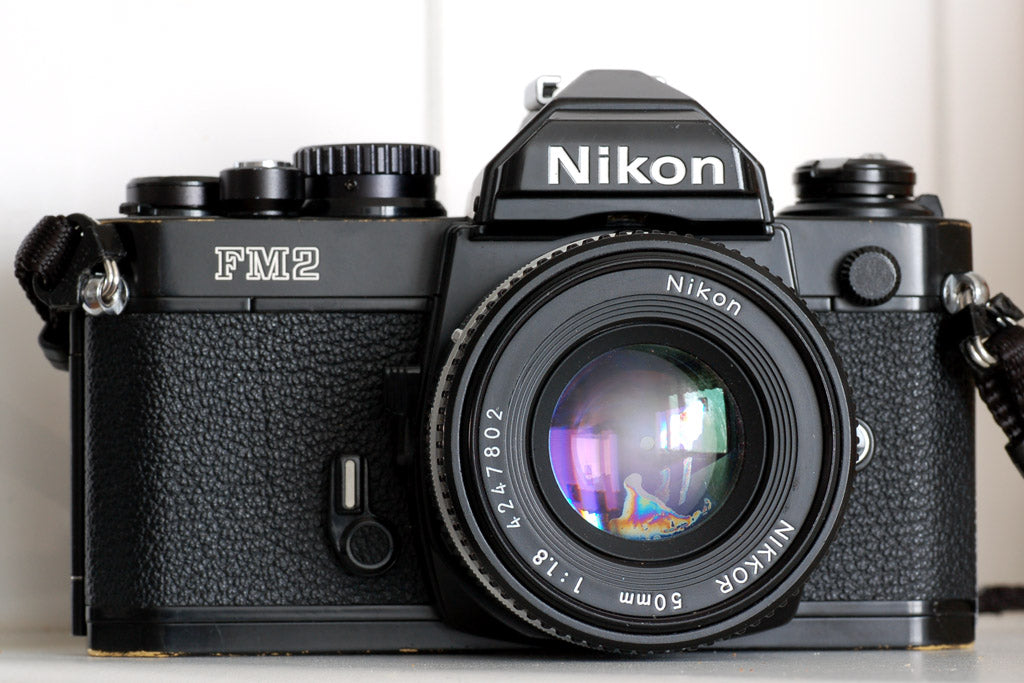
Nikon FM, FM2, FE or FE2? These four SLRs share the same compact alloy chassis, the same F mount, and a reputation for robustness. But the FM and FM2 are mechanical, while the FE and FE2 have an electronic shutter with aperture priority. And the “2” models have much higher shutter speeds. Here is the complete comparison to help you choose the right one.
Comparison table
| Nikon FM | Nikon FM2 / FM2n | Nikon FE | Nikon FE2 | |
|---|---|---|---|---|
| Production | 1977-1982 | 1982-2001 | 1978-1983 | 1983-1987 |
| Shutter | Mechanical | Mechanical | Electronic | Electronic |
| Shutter speeds | 1 s to 1/1000 s | 1 s to 1/4000 s | 8 s to 1/1000 s | 8 s to 1/4000 s |
| Flash sync | 1/125 s | 1/200 s (FM2), 1/250 s (FM2n) | 1/125 s | 1/250 s |
| Modes | Manual | Manual | Aperture priority + manual | Aperture priority + manual |
| Without battery | Everything works except the light meter | Everything works except the light meter | Mechanical backup shutter speeds only | Mechanical backup shutter speeds only |
| Display | LED +/O/− | LED +/O/− | Two needles | Two needles |
| TTL flash | No | No | No | Yes |
Data from Wikipedia and camera-wiki.org.

FM or FM2: the mechanical models
The FM (1977) is a fully mechanical SLR: the batteries only power the LED light meter. The FM2 (1982) retains the same design but reaches 1/4000 s, an exceptional speed for a mechanical shutter at the time. The FM2n version (from 1983) synchronizes the flash at 1/250 s instead of 1/200 s. The FM2 is renowned for its robustness and tolerance to extreme temperatures. Our full review: Nikon FM2, our review.
FE or FE2: the automatic models
The FE (1978) adds aperture priority: you choose the aperture, and it calculates the shutter speed, which is displayed by a black needle next to a green needle indicating the set speed. It requires batteries to function normally. The FE2 (1983) reaches 1/4000 s, synchronizes the flash at 1/250 s, adds TTL flash metering, and features a brighter viewfinder. However, it no longer accepts older non-AI lenses, which the FE could still use.


Lenses
All four bodies use the Nikon F mount and are designed for AI and AI-S lenses. Autofocus lenses with an aperture ring can also be mounted (without autofocus). G (no aperture ring) and DX lenses are not compatible, and IX-Nikkor lenses should never be mounted: they can damage the mirror.
Which one to choose?
- You want a camera that always works, even without batteries: FM or FM2.
- You want automation for shooting quickly: FE or FE2.
- You shoot with flash in broad daylight: FM2n or FE2 (1/250 s sync).
- You have older non-AI Nikon lenses: the FE is the most tolerant; the others require AI or converted lenses.
- You are on a tight budget: the FM and FE are often less sought after than the FM2.

Checkpoints
- Slow and fast shutter speeds are consistent (listen for 1 s and 1/1000 or 1/4000 s).
- The light meter responds with fresh batteries (LED or needles).
- The mirror and foam seals are in good condition.
- On an FE or FE2, the mechanical backup shutter speeds work.
- The film advance lever is smooth and returns firmly.
More details in our used camera buying checklist.
All cameras sold by Vibes Photo are inspected before being listed and covered by a six-month commercial warranty, in addition to statutory warranties. Details can be found in our general terms and conditions of sale.
Want to see more images? Browse the most popular photos taken with the Nikon FM2 on Lomography (Lomography community gallery, photos protected by the copyright of their authors).
Want to see more images? Browse the most popular photos taken with the Nikon FE2 on Lomography (Lomography community gallery, photos protected by the copyright of their authors).
To learn more: the Nikon F3, the best film SLRs, and our Nikon camera guide.
Frequently Asked Questions
What is the difference between the Nikon FM2 and the FE2?
The FM2 is mechanical and manual; the FE2 has an electronic shutter with aperture priority and TTL flash metering. Both reach 1/4000 s.
Does the Nikon FE work without batteries?
Only with its mechanical backup shutter speeds. For normal use, it requires batteries.
Which batteries are needed for the Nikon FM, FM2, FE, and FE2?
Two LR44 / SR44 button-cell batteries (or one 1/3N lithium battery).
Is the FM2 worth more than the FM?
It is more sought after for its 1/4000 s shutter speed and faster flash sync, but the FM remains an excellent mechanical SLR.
Sources: Wikipedia – Nikon FM; Wikipedia – Nikon FE; Wikipedia – Nikon FE2; camera-wiki.org – Nikon FM2.