










Nikon F3: review, versions (HP, T, P), viewfinders and buying guide
Nikon's professional SLR from 1980 to 2001 examined: history and NASA mission, quartz shutter, in-body metering, interchangeable viewfinders, F3HP, F3/T and F3P versions, flash, lenses, common faults, buying checklist and rivals.
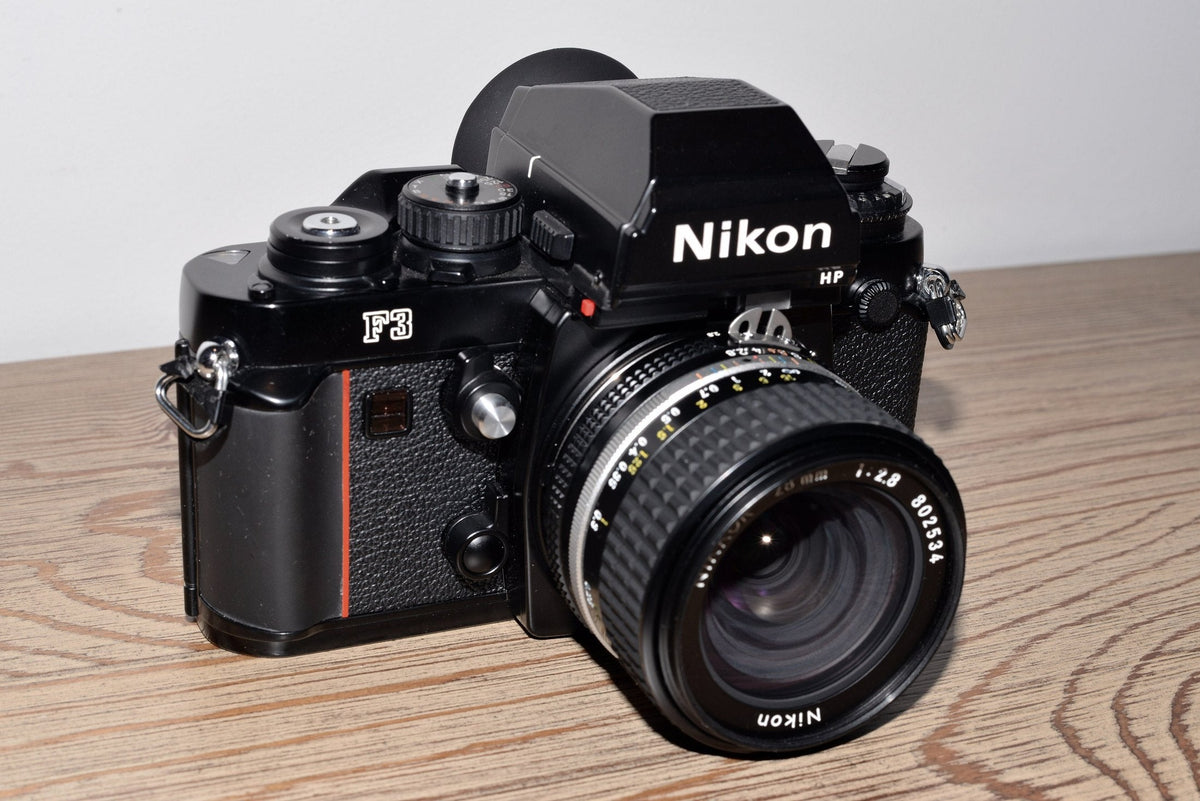
Reference sheet · Professional SLR · Updated October 2026
Twenty-one years of production, a space shuttle, thousands of reports, and a red stripe that became Nikon's signature: the F3 is the longest-produced professional film SLR by the brand. Versions, viewfinders, metering, lenses, failures, and rivals: the complete guide before buying one.
In the late 1970s, professional photographers swore by the Nikon F2, an all-mechanical body renowned for being indestructible. Replacing such a legend with an electronic shutter camera, dependent on batteries, is a risky bet. Nikon took the plunge with the F3, introduced in March 1980: sophisticated electronics, a quartz-driven shutter, aperture-priority automation, and an interchangeable viewfinder covering practically 100% of the image. The bet paid off: the F3 sold over 751,000 copies in twelve years, outlasted the arrival of its F4 and F5 successors, and remained in the catalog until 2001. This sheet details its history, its shutter, its unique metering, its viewfinders, its many versions, its lenses, its accessories, its typical failures, a buying checklist, its competitors, and the films that suit it.
The essentials in 30 seconds
- The strong point: an interchangeable viewfinder covering practically 100% of the image, continuous aperture priority, and a quartz-driven shutter.
- The weak point: flash sync limited to 1/80 s and a flash hot shoe placed on the film advance lever, which requires a dedicated flash or an adapter.
- Safety: without batteries, a mechanical emergency lever fires at 1/60 s, and T exposure works without consuming energy.
- The right buying reflex: check the contrast of the LCD screen, the presence of the exposure memory button, the foams, and the version of the viewfinder (DE-2 or HP).
- The alternatives: the Nikon FM2 (mechanical, 1/4000 s), the FE2 (lighter), the F2 (all mechanical), or the Canon New F-1.

History: succeeding the F2
According to the historical chronicle published by Nikon, the design of the F3 officially starts in March 1977. The goal is clear: keep the reliability of the F2, but take advantage of electronics to gain in precision and comfort. The team chooses a horizontal titanium-curtain shutter, driven by a quartz oscillator, and an LCD display, less power-hungry than the LEDs of the time. A prototype is completed in November 1978.
It is at this moment that NASA makes contact. It is looking for automatic cameras for the first flight of the space shuttle. Nikon develops two special versions from the F3, a "Big Camera" for 250 exposures and a "Small Camera" for 72 exposures on thin film, delivered in May 1980. The little one flies aboard Columbia in April 1981, without a backup camera, and fulfills its mission.

The production F3 comes out in March 1980, only in black, at the price of 175,000 yen with a 50 mm f/1.4. In the United States, Wikipedia indicates 1,174.90 dollars in 1981 for the same set. The design of the body and its MD-4 motor is entrusted to the Italian designer Giorgetto Giugiaro, who signs there the first red stripe in Nikon's history. The beginnings are cautious: many professionals distrust a body that needs batteries, and the F2 remains on sale until June 1980, after 816,000 copies.
Confidence comes with time. The F3HP with "High Eyepoint" viewfinder arrives in March 1982, followed by a titanium version, a press version, an experimental autofocus model, and even a fixed-mirror version for the Nagano Olympic Games. The F4 (1988) then the F5 (1996) succeed it without replacing it: Nikon announces the end of production in 2000 and the removal from the range in 2001. Wikipedia describes it as the Nikon professional SLR that remained in production the longest.

- Official start of design, based on the F2.
- Nikon F3 with DE-2 viewfinder, 175,000 yen with a 50 mm f/1.4.
- A "Small Camera" derived from the F3 flies aboard the Columbia shuttle.
- F3HP, with High Eyepoint DE-3 viewfinder. First F3/T in titanium the same year.
- F3P (press) and F3AF, Nikon's first autofocus SLR.
- Kodak DCS 100: one of the first digital SLRs, built on an F3.
- Removal from the F3 range, after more than 751,000 copies sold by the end of 1992.
Construction and handling
The F3 weighs 700 g with its DE-2 viewfinder and measures 148.5 × 96.5 × 65.5 mm. It is therefore significantly heavier than an FM2 (about 540 g), but more compact than its F4 and F5 successors, because it is the last professional F without a built-in motor. Wikipedia reports that Nikon required its suppliers a twenty-year availability guarantee for electronic components, and that ball bearings equip the shutter and film drive. Result: an advance so smooth that it is sometimes difficult to know if there is film in the camera.
The controls are few and well placed. On the top: the speed dial with its A (automatic), T, B and X position, the threaded electromagnetic shutter release for a soft release, surrounded by the main switch, and the advance lever. On the front: the depth of field control button, coaxial with the mirror lift lever, the timer lever (10 s, quartz-driven), and, under the advance lever, the double exposure lever. To the left of the prism, the exposure and sensitivity correction dial. The exposure memory button is located near the shutter release.


Did you know?
When you load film with the dial on A (or on a fast speed), the F3 automatically switches to 1/80 s until the counter reaches "1". The first "blank" shots are therefore fast, even in the dark. A professional attention, noted in the user manual.
A quartz shutter
The heart of the F3 is its horizontal titanium-curtain shutter. All speeds, from 8 s to 1/2000 s, are timed by a quartz oscillator: they remain exact, especially the slow ones, where a clockwork mechanism drifts with age. In A mode, the speed is continuous: if the scene requires 1/108 s, the F3 shoots at 1/108 s, even if the viewfinder displays 125.
This choice of a horizontal curtain has a price: flash sync caps at 1/80 s. Wikipedia recalls that this limit pushed many press photographers to keep FM, FE, FM2 or FE2, synchronized faster, for fill flash in broad daylight. It will be necessary to wait for the F4 for a professional F to sync at 1/250 s.
| Setting | Operation | Batteries required? |
|---|---|---|
| A (automatic) | Continuous speed from 8 s to 1/2000 s, calculated by the cell | Yes |
| 8 s to 1/2000 s | Manual speeds timed by quartz | Yes |
| X | 1/80 s, flash sync | Yes |
| B | Open as long as you press the shutter release | Yes |
| ('T',) | Open until you turn the dial: mechanical | No, no consumption |
| ('Emergency lever',) | Fires at 1/60 s regardless of the dial (except T) | No |
Expert advice
T exposure is an unknown treasure: the shutter remains open without consuming energy, as long as you wish. For an exposure of several minutes (starry sky, city at night), it is safer than B exposure. Then close the viewfinder cover, red when closed, to prevent stray light from distorting anything.
Metering in the body
On the F2, the cell was housed in the viewfinder. The F3 moves it to the bottom of the body, under the mirror. To allow light to reach it, Nikon drilled approximately 50,000 elliptical micro-holes into the main mirror, forming a semi-transparent area in the center; a small secondary mirror reflects this light toward the silicon photodiode. A decisive advantage: the meter works with all viewfinders and all viewfinders lenses, without correction, and the same cell measures the dedicated flash's flash directly on the film.

The weighting is very center-weighted. The user manual states that the cell reads the entire viewfinder but clearly favors the central 12 mm circle; Wikipedia estimates this share at 80%. It is almost a semi-selective measurement: aim at your main subject, memorize with the dedicated button, then reframe. The range goes from IL 1 to IL 18 at 100 ISO with an f/1.4 lens, the sensitivity from 12 to 6400 ISO, and exposure compensation of ±2 EV per third of value.
Before believing it's broken
The cell only activates with the switch on ON and a press of the shutter; it then stays lit for 16 seconds. If the display remains empty, check the switch and the batteries before concluding it's broken. And don't forget to turn the switch back to OFF in the bag.
Viewfinders and viewfinder lenses
The F3 was designed as a modular system. The viewfinder comes off in two moves, and Nikon offers twenty viewfinder lenses (the K type, rangefinder, and microprisms, as standard). The original DE-2 viewfinder magnifies 0.8× with a 50 mm and covers practically 100% of the image: what you see is what you get, right to the edge.
| Viewfinder | Type | For what |
|---|---|---|
| DE-2 | Standard prism | Largest image, without glasses |
| ('DE-3 (HP)',) | "High Eyepoint" prism | Full image visible at 2.5 cm from the eye: ideal with glasses |
| DE-4 | Titanium-clad HP prism | Supplied with the F3/T |
| DA-2 | Sport viewfinder | Image visible from a distance, with a helmet, diving goggles or in a tank |
| DW-3 | Chest viewfinder (hood) | Aiming at waist height or at arm's length |
| DW-4 | 6× loupe | Macro, microscopy |


In the viewfinder, a small LCD screen displays the speed. In A mode, "+2000" indicates overexposure outside the range and "−8−" underexposure; in manual, an "M" appears with the signs +, − or −+ for correct exposure. The aperture is read directly on the lens ring thanks to a small window (ADR). A button lights up the screen in the dim light. Wikipedia notes that the screen is one of the F3's few weak points: with age, it loses contrast, but the camera remains fully usable since all settings are read on the dials.
Full specifications
- Shutter
- Horizontal focal plane, titanium curtains, quartz driven
- Speeds
- Auto: 8 s to 1/2000 s continuous; manual: 8 s to 1/2000 s, B, T, X
- Backup
- Mechanical lever at 1/60 s, mechanical T setting
- Flash sync
- 1/80 s; direct TTL with SB-12 (SB-11 via cable)
- Modes
- Aperture priority, manual
- Metering
- Silicon photodiode in the body, center-weighted (12 mm)
- Range and sensitivity
- IL 1 to 18 (100 ISO, f/1.4); 12 to 6400 ISO
- Correction
- ±2 EV per third, exposure memory
- Viewfinder
- Interchangeable, ≈100%, 0.8× (DE-2)
- Viewfinder lenses
- 20 types, K as standard
- Power
- 2 SR44 batteries (or LR44), or the MD-4 motor
- Weight and dimensions
- 700 g; 148.5 × 96.5 × 65.5 mm
Sources: Nikon F3 user manual and Nikon historical chronicle; Wikipedia for the 80% weighting. Verified in October 2026.
F3, F3HP, F3/T, F3P… finding your way
Wikipedia highlights that the F3 family has more variants than any other Nikon F. The good news: the mechanics are the same for the common models, and the DE-2, DE-3 and DE-4 viewfinders are interchangeable (except on the F3P). An "F3" is therefore often just an F3HP with the other viewfinder fitted, and vice versa.
| Version | Years | What changes | For who |
|---|---|---|---|
| F3 | 1980 – 2001 | DE-2 viewfinder, larger image | Without glasses |
| ('F3HP',) | 1982 – 2001 | DE-3 "High Eyepoint" viewfinder | The default choice, especially with glasses |
| F3/T | From 1982 | Titanium hoods, backs and DE-4 viewfinder, protected circuit; champagne (until around 1985) then black | Intensive use, collectors |
| F3P | 1983 | Reinforced seals, DE-5 titanium viewfinder with standard mount, rubberized shutter release, no delay or multiple exposures | Press, rare |
| F3AF | 1983 | DX-1 autofocus viewfinder and two dedicated AF lenses (80 and 200 mm) | Collector's curiosity |
| F3 Limited | 1994 (Japan) | F3P version with special logo and wooden box | Collection |
| F3H | 1990s | Fixed semi-transparent mirror, up to 13 fps with the MD-4H | Very rare, collection |


To check
An F3 advertised as "HP" must bear the HP designation on the viewfinder. Also check that the viewfinder is original and in good condition: it is an expensive piece, which weighs heavily in the value of an F3. An F3/T is recognized by the "F3/T" designation on the front and the DE-4 titanium viewfinder.
Which Nikkor lenses
The F3 accepts lenses with automatic aperture indexing (AI): AI, AI-S, E Series, and recent autofocus lenses if they have an aperture ring (AF, AF-D), used in manual focus. The user manual insists: before mounting a lens, check that it bears the AI coupling ridge on its aperture ring. A non-AI lens (before 1977) must be converted. G and E lenses, without an aperture ring, do not allow setting the aperture.
| Lens | For what | Note |
|---|---|---|
| ('Nikkor 50 mm f/1.4 AI-S',) | Versatile, low light | The standard of reporting |
| Nikkor 50 mm f/1.8 AI-S or E Series | First lens | Light and affordable |
| Nikkor 35 mm f/2 AI-S | Street, reporting | The focal length of photojournalism |
| Nikkor 28 mm f/2.8 AI-S | Landscape, interior | Excellent up close |
| Nikkor 85 mm f/2 AI-S | Portrait | Compact for an 85 mm |
| Nikkor 180 mm f/2.8 ED AI-S | Sports, show | Very renowned |
To choose your first 50 mm, read our guide of the 50 mm film lens, and to understand the mount families, our dossier on mounts.
The flash and the MD-4 motor
The F3 hot shoe is the detail that surprises: it is not on the prism, but around the rewind crank, and it is proprietary to Nikon. The SB-12 flash, designed for it, measures the flash in TTL directly on the film thanks to the body cell; it also automatically sets the sync to 1/80 s, even in A mode. The SB-11 does the same via a cable. For a standard hot shoe flash, you need an adapter (AS-4 or AS-7); with a cable, the threaded sync socket accepts any flash. An indicator in the viewfinder lights up when a dedicated flash is loaded.
The MD-4 motor was designed with the body, and not as an accessory. Powered by 8 AA batteries or the MN-2 NiCd battery, it also powers the F3, which saves its SR44 batteries. Nikon announces up to 6 images per second; it also allows motorized rewinding and a countdown counter. The MF-4 back accepts, itself, 10 m of film, i.e. 250 exposures.

Our guide of the flash on film reflex explains the calculation of the aperture with the guide number, useful with a non-dedicated flash.
Using it well: method and settings
1. The batteries
Unscrew the cover under the viewfinder with a coin and install two SR44 silver oxide batteries, recommended by Nikon (alkaline LR44s are okay in a pinch). Turn it on with the switch around the shutter button and check the display. In cold weather, batteries lose power: the manual recommends new batteries and a spare pair kept warm in a pocket. Our film camera battery guide lists the equivalents.
2. Loading and setting
Lift the ring on the left dial to set the sensitivity; the F3 does not read the DX code. Load the film as you would in any manual SLR, checking that the advance lever turns when you cock the shutter. See our step-by-step guide for loading film.
3. Working primarily in aperture priority
Set the dial to A, choose the aperture on the lens according to the desired depth of field, and read the shutter speed in the viewfinder. At speeds below 1/60 s with a 50 mm lens held freehand, open the aperture further or increase the sensitivity. For an off-center or backlit subject, frame it in the center, hold down the memory button, reframe, and shoot. The button only works in A mode.
| Situation | Compensation | Why |
|---|---|---|
| Snow, beach, sky in the center circle | +1 to +1.5 EV | The meter wants to make white look grey |
| Backlit portrait | Memory on the face | The bright background tricks the meter |
| Bright subject on a black background (scene) | -1 EV | The meter wants to brighten the black |
| Landscape with a lot of sky | Aim a little lower, use memory | The sky would underexpose the ground |
| Color negative in doubt | +1/3 to +2/3 EV | Negative film tolerates overexposure better |
4. If the batteries die
Push the mechanical emergency lever next to the shutter button: the F3 fires at 1/60 s, regardless of the dial setting. Then expose using the Sunny 16 rule, adjusting the aperture: at ISO 100 in full sun, f/16 at 1/60 s is equivalent to an overexposure value that negative film handles easily. The method is detailed on our Sunny 16: exposing without a light meter page.
The results in pictures
The body doesn't make the image on its own: the lens, film, lab, and scan matter more. The photos below were taken by photographers who release them under an open license, from 1981 to 2019; we indicate the film when the author specifies it.


For more examples, browse photos taken with the Nikon F3 on Lomography. These images belong to their authors; we do not reproduce them here.
Malfunctions and pre-purchase checks
Many F3s have worked hard, while others have slept in display cases. Wikipedia notes that many models from the 1980s were never used professionally and are in perfect condition, including the display. Here are the defects to know.
| Symptom | Probable cause | Severity |
|---|---|---|
| Pale, blackened, or unreadable display | Aged LCD screen (heat, age) | Annoying, but the camera remains usable |
| Missing memory button | Simply pressed in on early models, often lost | Minor, but worth noting |
| Light trails on negatives | Degraded foam on the back | Routine maintenance |
| Nothing is displayed | Switch set to OFF, weak batteries, oxidized contacts | Often minor |
| Incorrect exposure in A mode | Non-AI lens, dirty cell, or dirty pinhole mirror | Check on the item |
| Dark spots in the viewfinder | Degrading pentaprism | Replace the viewfinder |
The pre-purchase checklist
- The viewfinder display: legible, good contrast, complete numbers; test the lighting with the dedicated button.
- A mode: the displayed shutter speed changes when you move from a bright area to a dark area, and the actual exposure is consistent.
- Slow shutter speeds: open the back, fire at 8 s, 4 s, and 1 s; the duration should be accurate.
- The emergency lever: without batteries, it should fire at 1/60 s.
- The memory button: present and functional.
- The viewfinder: HP mention if advertised, clean pentaprism, clean viewing glass.
- The foam: no sticky residue in the grooves on the back.
- The titanium curtains: flat, without creases or fingerprints.
- The test roll: a full roll of film, in A and manual modes.
This list complements our guide for buying a used film camera. We do not publish a price guide, which changes quickly. Remember that the viewfinder, the display, and the version (HP, titanium, press) weigh heavily in the price, and that Wikipedia describes the F3/T champagne as rarer and more expensive than the black one.
F3 or another pro SLR?
| Model | Release | Shutter speeds | Sync | Automation | Without batteries? |
|---|---|---|---|---|---|
| ('Nikon F3',) | 1980 | 8 s – 1/2000 s | 1/80 s | Aperture priority | 1/60 s and emergency T |
| Nikon F2 | 1971 | 1 s – 1/2000 s (10 s on the self-timer) | 1/80 s | No (cell in the viewfinder) | Yes, fully mechanical |
| Nikon FM2n | 1984 | 1 s – 1/4000 s | 1/250 s | No | Yes (except the cell) |
| Nikon FE2 | 1983 | 8 s – 1/4000 s | 1/250 s | Aperture priority | 1/250 s and emergency B |
| Canon New F-1 | 1981 | 8 s – 1/2000 s | 1/90 s | Aperture priority with AE viewfinder | Mechanical fast shutter speeds |
Nikon FM2
Lighter, mechanical, 1/4000 s and 1/250 s sync, but without automation or interchangeable viewfinders. Read our review of the FM2.
Nikon FE2 and FM
The "semi-pro" cameras for photojournalists who wanted faster sync. For the FM family, read our FM vs. FM2 comparison.
Other families
Canon, Olympus, Pentax: compare them in our ranking of the best film SLRs.
Choose the F3 if…
- you want a 100% viewfinder and the option to change viewfinders;
- you mostly shoot with aperture priority, in photojournalism or travel;
- you are looking for a durable, repairable pro body that is still very common.
Look elsewhere if…
- you do a lot of fill flash in broad daylight (1/80 s sync);
- you want a lightweight body or one that requires no batteries at all (FM2, Olympus OM-1);
- you want autofocus: an F100 or a film autofocus SLR will be more suitable.
Which films to choose
With its continuous shutter speeds up to 1/2000 s, the F3 can handle 400 ISO film in bright sunlight (f/11 to f/16 at 1/500 s) and performs just as well in low light thanks to timed long exposures. It is a photojournalism camera: it likes forgiving films.
| Use | Film | Why |
|---|---|---|
| Black-and-white photojournalism | Kodak Tri-X 400, Ilford HP5 Plus | Latitude, expressive grain, can be pushed to 1600 ISO |
| Versatile color | Kodak Portra 400 | Very forgiving, natural skin tones |
| Budget color | Kodak UltraMax 400, Kodak Gold 200 | For everyday rolls |
| Landscape | Kodak Ektar 100 | Very fine grain, saturated colors |
| Slide film | Fujifilm Velvia 50 or Provia 100F | The very center-weighted metering helps ensure accurate exposure |
| Night | CineStill 800T | Artificial lights, long exposures on a tripod |
To learn more: our review of Tri-X 400, of Portra 400, and how to push film.
Frequently asked questions
Does the Nikon F3 work without batteries?
Partially. The mechanical emergency lever fires at 1/60 s, and the T setting remains available. All other shutter speeds and the light meter require two SR44 batteries.
What is the difference between the F3 and the F3HP?
The viewfinder. The F3HP has the DE-3 "High Eyepoint" viewfinder, which shows the entire image at a distance of 2.5 cm from the eye: perfect for glasses, at the cost of a slightly smaller image. The viewfinders are interchangeable between the two models.
Which batteries should be used in the Nikon F3?
Two 1.55 V SR44 silver oxide button batteries (formerly G13), recommended by Nikon. Alkaline LR44 batteries can be used in a pinch. With the MD-4 motor, the body is powered by the motor.
How do you use a flash with an F3?
With an SB-12 flash designed for it on the hot shoe located on the rewind lever (TTL flash), an SB-11 via a cable, or a standard flash using an AS-4 or AS-7 adapter. Sync is available at 1/80 s (X-sync) or slower.
Does the F3 have a program mode?
No. It offers aperture priority and manual modes. For a program mode from Nikon at the same time, you should look at the FG or FA.
Is the Nikon F3 suitable for beginners?
Yes, thanks to aperture priority, provided you can accept its weight. An FE2 or FM2 is lighter. The main thing is to learn the logic of center-weighted metering.
The viewfinder screen is dim: is that a problem?
No, not for taking photos: the camera works normally, and the settings can be read on the dials. A faulty screen can be replaced by a repairer, but it is a point of negotiation.
Can autofocus lenses be mounted on an F3?
Yes, Nikkor AF and AF-D lenses with an aperture ring, using manual focus. G and E lenses without a ring do not allow you to adjust the aperture.
Vibes Photo
Find your film SLR
An F3 should be chosen in person: screen checked, shutter speeds tested, viewfinder inspected. Browse our inspected film cameras, or write to us to be notified when a Nikon arrives in the shop.
Sources
- Nikon, "Debut of Nikon F3" (historical chronicle) (design, prototype, NASA cameras, price, Giugiaro, micro-perforated mirror, sales, end of production).
- Nikon, F3 user manual (official archive) (shutter speeds, T setting, emergency lever, metering, display, viewfinders, flash, MD-4, specifications).
- Wikipedia, "Nikon F3" (HP, T, P, AF, Limited, H versions; 80% center weighting; continuous shutter speeds; screen; memory button; sync).
- Wikipedia, Kodak DCS (digital SLRs built on the F3).
Images: authors, licenses, and sources are indicated under each photo.