










Kodak Tri-X 400: review, rendering, development and pushing
The black-and-white film of photojournalists: rendering, official development times, push-processing at 800 and 1600 ISO, alternatives, and examples.
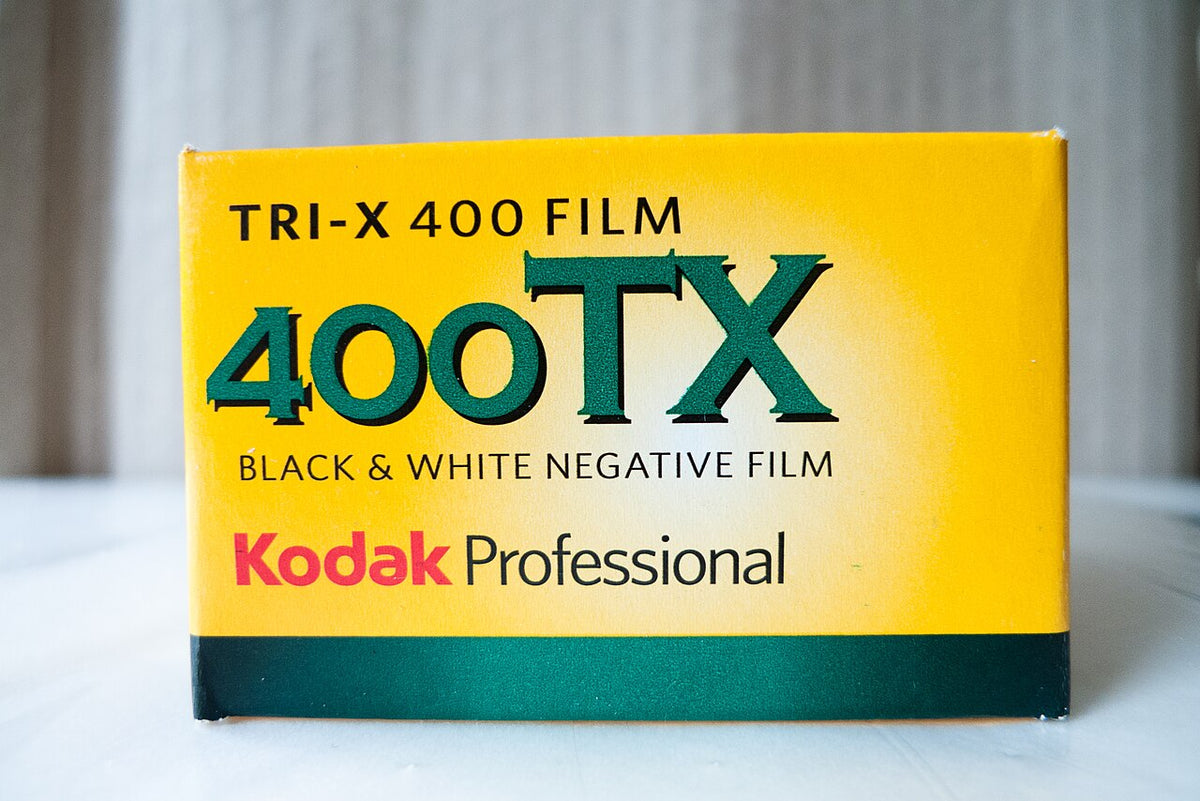
Kodak Tri-X 400 is the black-and-white film of photojournalists. Launched in 35 mm and 120 in 1954, it shaped the aesthetic of reportage: pronounced grain, bold contrast, deep blacks. It is easily pushed and can be developed in almost any developer. Here is its rendering, its official development times, and our tips for properly exposing it.
The verdict in 30 seconds
What we like
- Classic, high-contrast black-and-white rendering with reportage-style grain.
- Wide exposure latitude.
- Pushes very well to 800, and beyond with appropriate development.
- Available in 35 mm, 120, and rolls.
Things to know
- Grain is more visible than on T-Max 400 or Delta 400.
- More contrasty than HP5: highlights require attention.
- Requires a black-and-white lab or home development.

Technical specifications
| Feature | Kodak Tri-X 400 (400TX) |
|---|---|
| Type | Panchromatic black-and-white negative |
| Sensitivity | ISO 400/27° |
| Formats | 35 mm (24 and 36 exposures, 50 and 100-foot rolls) and 120 |
| Variant | Tri-X 320 (320TXP) sheet film |
| Development | Standard black-and-white developers (D-76, XTOL, HC-110, T-MAX…) |
The Tri-X rendering
Tri-X is recognizable by its visible but sharp grain, its strong contrast, and deep blacks. In a street scene, it immediately gives that "reportage" look that made it famous. Compared to Ilford HP5 Plus, it is more contrasty and "edgier"; HP5 is softer and more forgiving in harsh light.

Development times (20 °C)
Excerpts from the Kodak F-4017 data sheet for Tri-X 400, small tank development with the agitation recommended by Kodak. Always check the current version of the data sheet.
| Developer | Time at 20 °C (68 °F) |
|---|---|
| Kodak D-76 (stock) | 6 min 45 s |
| Kodak D-76 (1+1) | 9 min 45 s |
| Kodak XTOL (stock) | 7 min |
| Kodak XTOL (1+1) | 9 min |
| Kodak HC-110 (dilution B) | 3 min 45 s |
| Kodak T-MAX Developer | 6 min |
Short times (HC-110 B) require precision: many photographers prefer a weaker dilution to extend the time. To get started with home development, follow our guide on developing your own black-and-white film.
Pushing Tri-X
Exposed at EI 800 and developed longer in a standard developer, Tri-X gives very good results. At EI 1600, contrast and grain increase significantly, and more specific development is recommended. Methods such as "stand" development (very diluted developer, little agitation) allow you to go even further. The entire roll must be exposed at the same sensitivity.


Want to see more images? Browse the most popular photos taken on Kodak Tri-X 400 on Lomography (Lomography community gallery, photos protected by the copyright of their authors).
A little history
Tri-X appeared around 1940 in sheet film, then in 35 mm and 120 in 1954. Associated with lightweight cameras like Leicas and Nikons, it allowed reporters to photograph in ambient light, without flash: it is one of the films that defined 20th-century photojournalism and street photography. Distributed by Kodak Alaris from 2013 to 2026, it is now marketed directly by Eastman Kodak.
What cameras for Tri-X?
It pairs perfectly with a manual SLR where you choose the sensitivity, to push it if necessary: Nikon FM2, Olympus OM-1, Canon AE-1. In a DX-coded compact, it will be exposed at 400 ISO, which is enough in most situations, both outdoors and indoors in bright light.
Tri-X or another black-and-white film?
| Film | ISO | Character |
|---|---|---|
| Kodak Tri-X 400 | 400 | Contrasty, reportage grain, pushes well |
| Ilford HP5 Plus | 400 | Softer and more forgiving, pushes very well |
| Kodak T-Max 400 | 400 | Very fine tabular grain, modern rendering |
| Ilford FP4 Plus | 125 | Fine grain, bright daylight |
| Ilford XP2 Super | 400 | Black-and-white film developed in C-41 |
All the options are in our guide on which black-and-white film to choose.
Frequently asked questions
Tri-X or HP5?
Tri-X is more contrasty with more pronounced grain; HP5 is softer and more forgiving. Both push very well.
Can you push Tri-X to 1600?
Yes, with appropriate extended development. Contrast and grain increase significantly.
What developer for Tri-X?
D-76 (or ID-11) is the classic standard; HC-110 is economical; XTOL gives finer grain.
Is Tri-X developed in C-41?
No, it requires black-and-white development. For a color-only lab, choose Ilford XP2 Super.
Is Tri-X available in 120?
Yes, Tri-X 400 is available in 35 mm and 120.
Sources: Kodak – Tri-X F-4017 data sheet (PDF); Wikipedia – Kodak Tri-X.