










Pushing or holding back a film (push/pull): the complete guide
Exposing ISO 400 film at 1600 or pushing a roll of film: the principle, the times recommended by Ilford for HP5 Plus, color, what to tell the lab, and mistakes to avoid.
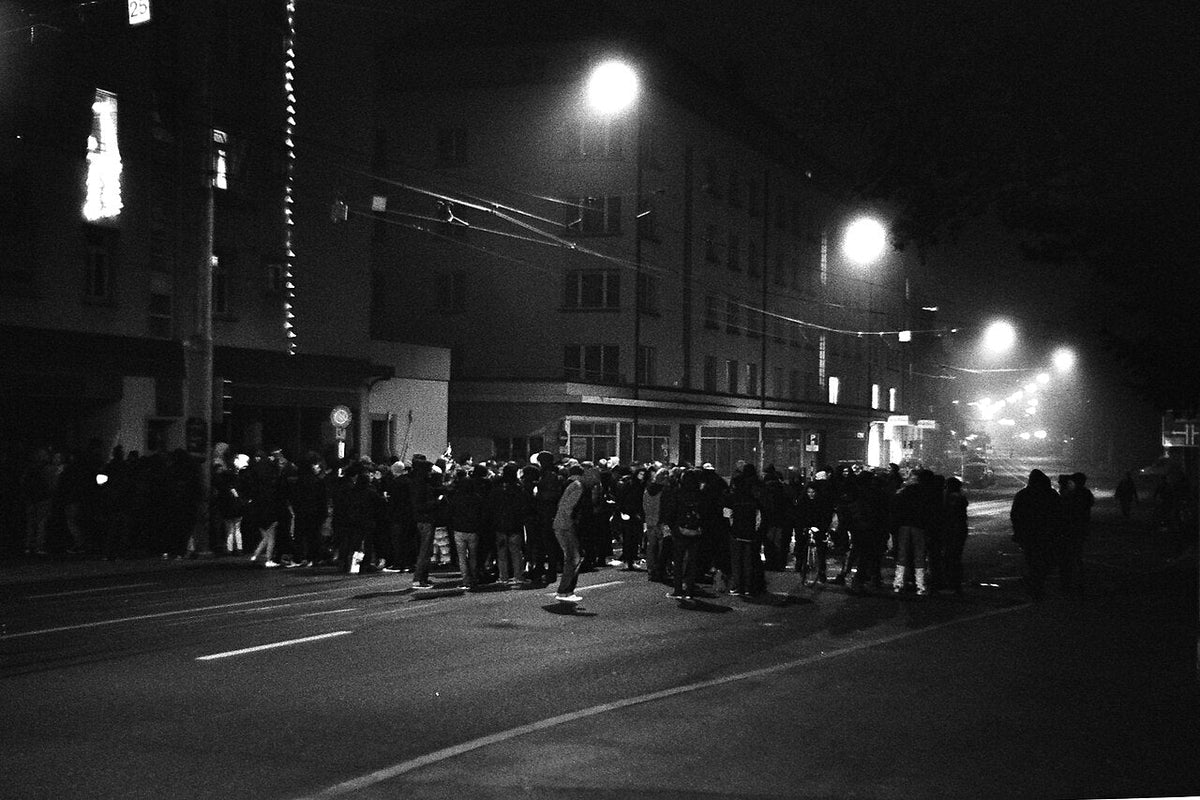
Pushing a film ("push") means exposing it as if it were more sensitive than its nominal sensitivity, then extending its development time to compensate. Pulling it ("pull") is the opposite. It is the technique that allows you to photograph at night with a 400 ISO film set to 1600, or to soften the contrast of a very bright scene. Here is how it works, when to use it, and what to tell your lab.
The principle in 1 minute
When you set your camera to a higher sensitivity than that of the film, you underexpose it. To recover the image, the lab extends the development time: that is the push. Each doubling of sensitivity corresponds to a "stop" (1 stop): a 400 ISO exposed at 800 is pushed by 1 stop, at 1600 by 2 stops, at 3200 by 3 stops. We talk about "exposure index" (EI) rather than ISO, because the actual sensitivity of the film does not change.
| Film | Exposed at | Operation |
|---|---|---|
| 400 ISO | 800 | Push +1 |
| 400 ISO | 1600 | Push +2 |
| 400 ISO | 3200 | Push +3 |
| 400 ISO | 200 | Pull −1 |
| 100 ISO | 50 | Pull −1 |
Why push a film?
- Lack of light: concerts, indoors, night. Gaining 2 stops allows you to use a speed 4 times faster.
- Aesthetic effect: more contrast and grain, highly sought after in black and white.
- Setting error: if you exposed an entire roll at the wrong sensitivity, you can ask for a push (or a pull) to compensate.

What the manufacturer says: the Ilford HP5 Plus example
The Ilford data sheet indicates that the HP5 Plus can be exposed up to EI 3200, with extended development. Some times given by Ilford, at 20 °C in a tank with intermittent agitation:
| Developer | EI 800 | EI 1600 | EI 3200 |
|---|---|---|---|
| ID-11 (pure) | 10 min 30 | 14 min | — |
| ILFORD DD-X (1+4) | 10 min | 13 min | 20 min |
| Microphen (pure) | 8 min | 11 min | 16 min |
Source: Ilford HP5 Plus data sheet. For the Kodak Tri-X 400, another push classic, Kodak also publishes times for higher indices in its data sheet.

And color film?
C-41 color negatives can also be pushed, generally by 1 or 2 stops, but the effect is less "clean" than in black and white: increased contrast, crushed shadows, possible color shifts. Films designed for low light, such as the CineStill 800T, are often pushed by 1 stop. For E-6 slide film, pushing is possible but rarely offered, and the margin of error is small (see slide film).
The pull: holding back a film
Pulling consists of overexposing (for example a 400 ISO at 200) and shortening the development. It reduces contrast and grain, useful in very contrasting bright sunlight. It is less common than pushing, and not all labs offer it.
How to do it in practice
- Decide before starting the roll: the entire film will be developed the same way. Do not change the index halfway through.
- Set the sensitivity on your camera (for example 1600 instead of 400). On a DX-coded compact, this is often impossible: use the exposure compensation if it exists.
- Write it on the cartridge: "HP5 @1600 – push +2".
- Inform the lab when ordering. At Labo Gris Souris, pushing was free during our survey on 30/10/2026; at LSD Lab, B&W push/pull was charged +€1 excl. tax (see our development price comparison).
- Or do it yourself in black and white, following the manufacturer's times: see developing your own film.
Errors to avoid
- Pushing a film already in extreme low light: pushing does not create details in completely black shadows.
- Mixing 400 and 1600 shots on the same roll.
- Forgetting to inform the lab: the film will be developed normally and underexposed.
- Pushing a color film for delicate portraits: skin tones suffer.
To expose properly, review the exposure triangle and our guide to the light meter and light meter. And if your negatives are too bright or too dark, the failed photos clinic helps you understand.
Frequently asked questions
Can you push a 400 film to 1600?
Yes, it is a 2-stop push, very common in black and white (HP5 Plus, Tri-X). You must inform the lab or adapt the development yourself.
Does pushing cost more at the lab?
It depends: during our survey on 30/10/2026, it was free at Labo Gris Souris and charged +€1 excl. tax in B&W at LSD Lab.
Can you push only a few photos?
No: the development applies to the entire roll.
Does pushing increase the grain?
Yes, as well as the contrast. It is often sought after in black and white.
What is the difference between ISO and EI?
ISO is the nominal sensitivity of the film; EI is the index at which you choose to expose it.
Sources: Ilford – HP5 Plus data sheet; Labo Gris Souris – prices (push); LSD Lab – prices.