










Used Sony RX100: which version to choose, from I to VII?
Seven generations, three objectives: we categorize the Sony RX100s by family, compare the viewfinder, 4K, ND filter, and battery life, and tell you what to check before buying.
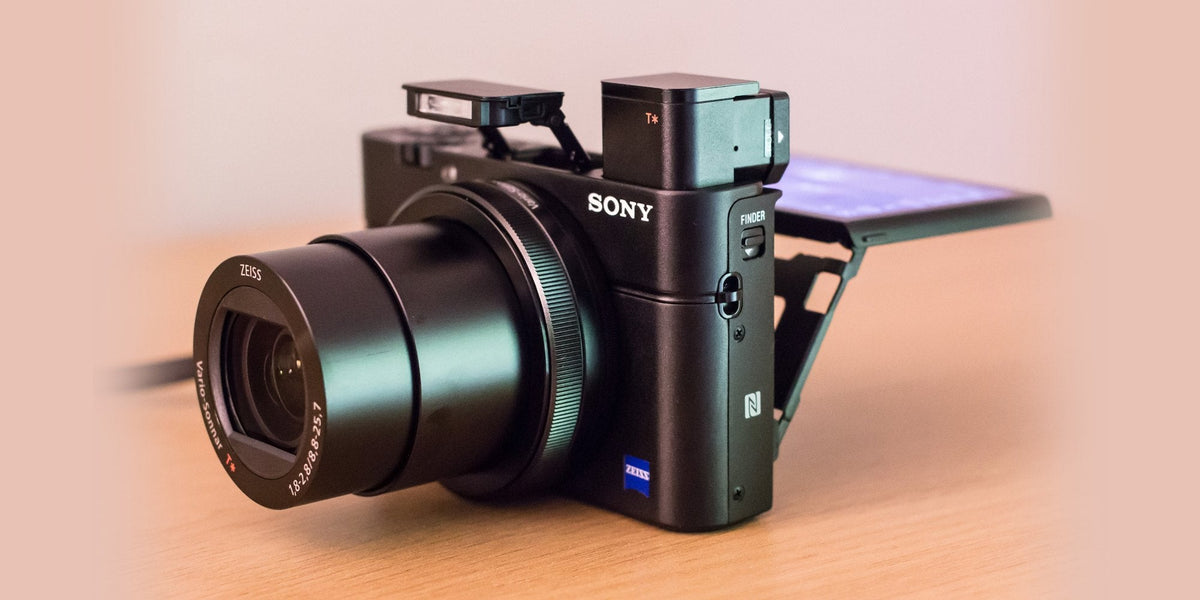
Buying Guide · Compact Expert · Updated October 2026
Seven generations in seven years, one common 1-inch sensor and three different lenses: the Sony RX100 series is the largest family of compact expert cameras. The real question isn't "which one is the newest," but "which lens do you need." Here's how to find your way around.
When Sony introduced the Cyber-shot DSC-RX100 on June 6, 2012, the idea seemed crazy: fitting a 1-inch type sensor, almost four times larger than that of a standard compact camera, into a 240-gram aluminum body. The gamble paid off. The camera was named European Compact Expert Camera of the Year 2012-2013 by EISA and was featured among Time magazine's "Best Inventions of 2012". Sony then repeated the formula every year until the RX100 VII in 2019, never removing the older models from the catalog for long. The result, on the used market, is a headache: eight almost identical cameras on the outside, but very different in use. This guide classifies them into three families, explains what really changes from one version to another, and gives you the method to check a copy before purchase.
The essentials in 30 seconds
- Three families: I and II (28-100 mm f/1.8-4.9, no viewfinder), III to VA (24-70 mm f/1.8-2.8, viewfinder, ND filter), VI and VII (24-200 mm f/2.8-4.5, viewfinder).
- The best compromise: the RX100 III for photography (bright lens, viewfinder, ND filter), the V or VA if you want 4K and fast autofocus.
- For travel: the VI or the VII and their 24-200 mm zoom, at the cost of less brightness indoors.
- For vlogging: the VII, the only one in the series to have a 3.5 mm jack microphone input and to shoot in 4K without a 5-minute limit.
- The right reflex: test the zoom, the pop-up viewfinder, and a photo of a plain sky: these are the three weak points of the series.

The history of the series
In the early 2010s, the digital compact camera was threatened by the smartphone. Sony, which also makes the sensors of most phones, chose to move upmarket: a larger sensor, a Carl Zeiss Vario-Sonnar T* lens, full manual modes, and a ring around the lens to set the aperture, speed, or zoom. The "1-inch" format (13.2 × 8.8 mm, 2.7x crop factor) quickly became the standard for compact expert cameras, later adopted by Canon with the G7 X and by Panasonic.
Each generation corrects or adds one specific thing. The II switched to a backlit sensor and gained an accessory shoe. The III changed lens and hid an electronic viewfinder in the cover. The IV introduced a stacked sensor with built-in memory, which allows 4K and slow motion at 960 frames per second. The V brought phase-detection autofocus and 24 fps burst shooting. The VI exchanged the bright lens for a 24-200 mm zoom. The VII refined autofocus and finally added a microphone input.
- RX100: 20.2 MP 1-inch sensor, 28-100 mm f/1.8-4.9 zoom.
- RX100 II: backlit sensor, tilt screen, multi-interface shoe, Wi-Fi and NFC.
- RX100 III: 24-70 mm f/1.8-2.8 zoom, pop-up OLED viewfinder, ND filter.
- RX100 IV: stacked sensor, 4K (5 min clips), slow motion up to 960 fps, 1/32,000 s electronic shutter.
- RX100 V: 315 phase-detection AF points, 24 fps burst.
- RX100 VI: 24-200 mm f/2.8-4.5 zoom, touch screen. The RX100 VA followed in July.
- RX100 VII: real-time eye tracking, microphone input, 4K without a 5-minute limit.
Did you know?
In 2013, the Swedish manufacturer Hasselblad marketed the "Stellar", an RX100 dressed in a wood or carbon handle, sold for much more than the original. A Stellar II based on the RX100 II followed in 2014. Under the shell, it's the same camera. (Source: Wikipedia, RX100 series.)
The three families of lenses
To choose an RX100, start with the lens: it's what determines the use. All the numbers are focal lengths in 24×36 equivalent.
| Versions | Lens | Brightness | Ideal for |
|---|---|---|---|
| RX100 I and II | 28-100 mm | f/1.8 at wide angle, but f/4.9 from the telephoto | Daytime photography, small budget |
| RX100 III, IV, V, VA | 24-70 mm | f/1.8-2.8: bright across the entire range | Low light, portrait, indoors |
| RX100 VI and VII | 24-200 mm | f/2.8-4.5 | Travel, distant details, amateur sports |
The difference in brightness is considerable. At 70 mm, the 24-70 mm of the III to VA opens to f/2.8, while the 28-100 mm of the I and II, which no longer opens past f/4.9 at 100 mm, has already lost a good part of its brightness at this focal length: you have to compensate with a slower speed or a higher sensitivity. The 24-200 mm of the VI and VII opens to f/2.8 only at wide angle and to f/4.5 at the telephoto, but it goes three times further.
The table of the seven versions
| Version | Lens | Viewfinder | Video | CIPA battery life | Weight |
|---|---|---|---|---|---|
| RX100 (2012) | 28-100 mm f/1.8-4.9 | No | Full HD | 330 views | 240 g |
| RX100 II (2013) | 28-100 mm f/1.8-4.9 | Optional (shoe) | Full HD | 350 views | 281 g |
| RX100 III (2014) | 24-70 mm f/1.8-2.8 | Pop-up | Full HD | 320 views | 290 g |
| RX100 IV (2015) | 24-70 mm f/1.8-2.8 | Pop-up | 4K (5 min) | 280 views | 298 g |
| RX100 V / VA (2016 / 2018) | 24-70 mm f/1.8-2.8 | Pop-up | 4K (5 min) | 220 views (V) | 299 g |
| RX100 VI (2018) | 24-200 mm f/2.8-4.5 | Pop-up | 4K (5 min) | 240 views | 301 g |
| RX100 VII (2019) | 24-200 mm f/2.8-4.5 | Pop-up | 4K without limit, microphone input | 260 views | 302 g |
Battery life according to the CIPA standard, weight with battery. Sources: Sony (press releases and product sheets), Wikipedia comparison table, DPReview.
RX100 I and II: the entry-level


The first RX100 remains a remarkable camera for daytime photography. Its 20.2 MP sensor produces very detailed images at 125-800 ISO, and its 28-100 mm opens to f/1.8 at wide angle, which allows beautiful close-up portraits with a softened background. It shoots Full HD video at 50 or 60 frames per second, offers "focus peaking" (highlighting in-focus areas) in manual focus, and a burst of 10 fps. Its fixed 3-inch screen is very bright thanks to a matrix that adds white pixels to the colored pixels.
The RX100 II, released a year later, adopts a backlit sensor, cleaner in low light, a tilt screen of about 84° upwards and 45° downwards, Wi-Fi and NFC. It especially gains a multi-interface shoe that accepts an external flash, a microphone, or the optional FDA-EV1MK viewfinder. It is the only RX100 with a shoe: Sony removed it from the III onwards to fit the built-in viewfinder.


Their common weak point is the telephoto lens: at 100 mm, the aperture drops to f/4.9. Indoors, this forces you to increase sensitivity. For street, landscape, or daytime travel photography, this is not a problem, and these are the most affordable RX100s.
RX100 III, IV, V and VA: the heart of the series
The RX100 III is the camera that made the series' reputation. Its new 24-70 mm f/1.8-2.8 lens is wider and significantly brighter at the telephoto. Its pop-up OLED electronic viewfinder comes out of the cover thanks to a slider on the side (you then have to pull the eyepiece towards you), and its screen flips 180° for selfies. A built-in 3-stop neutral gray filter allows you to stay at a wide aperture in full sun or shoot video with a slow shutter speed.


The IV retains all this and introduces a stacked sensor, with built-in memory that speeds up readout: 4K in XAVC S at 100 Mbit/s, slow motion up to 960 frames per second, electronic shutter up to 1/32,000 s. 4K is limited to clips of about 5 minutes to prevent overheating. Its burst rate reaches 16 fps. The V adds hybrid autofocus with 315 phase-detection points and a burst rate of 24 fps. The VA, which appeared without official announcement in July 2018, takes the processor, menus and larger buffer (233 files instead of 150) of the VI in the body of the V, without its touchscreen.
Expert advice
For pure photography, the III offers the essentials of what the IV, V and VA can do: same lens, same viewfinder, same ND filter. What you pay extra for with the later models is 4K, burst shooting and autofocus. If you don't shoot video and don't photograph sports, the III is the best value for money in the series.
RX100 VI and VII: the travel zoom


With the VI, Sony changes its target. The 24-200 mm f/2.8-4.5 covers almost everything a traveler needs, from landscapes to distant architectural details. In exchange, the lens is less bright and the ND filter disappears. The viewfinder now extends in a single motion and the screen becomes touchscreen (to place the focus point). It still shoots 4K with the 5-minute limit per clip.
The VII, presented on July 25, 2019, takes the autofocus of Sony's high-end hybrids: real-time tracking, eye detection in photo and video, 20 fps burst without viewfinder cut-out. It adds a 3.5 mm jack microphone input, the first in the series, and removes the 5-minute limit in 4K. It is the most complete RX100, and the most expensive used.
The rendering in images
These photos were published on Wikimedia Commons by their authors. The indicated body comes from the EXIF data of the files. They illustrate the leeway offered by a 1-inch sensor: highlights held in the snow, fine details, clean gradients.


Which one to choose
Small budget, daytime photography
RX100 I or II. The II if you want the tilt screen, Wi-Fi or the hot shoe for a mic or flash.
Low light and versatility
RX100 III for photography, V or VA if you also want 4K and fast autofocus. The IV is a good intermediate.
Travel with a real zoom
RX100 VI: the 24-200 mm replaces a bag of lenses. Bring a spare battery.

Vlogging with an external mic
RX100 VII, or the Canon G7 X Mark III if you prefer the Canon touchscreen and a brighter telephoto zoom.
If you're hesitating with a Canon, our Canon G7 X used guide details the three versions of the rival. And if it's the "2000s" look you're after rather than maximum image quality, an RX100 will be almost too clean: read compact expert or digicam and our digicam guide.
Check before buying
The RX100s are dense cameras, with a lot of mechanics in a small volume: retractable lens, retractable viewfinder, flash, articulated screen. Here are the points to check.
| Symptom | Probable cause | Severity |
|---|---|---|
| Lens error message, zoom stuck | Shock, sand or lens block motor | Avoid: costly repair |
| Viewfinder no longer extends or stays blurry (III to VII) | Damaged ejection mechanism or eyepiece | Repairable, but negotiable |
| Fixed spots on a plain sky | Dust entered the lens block | Visible especially at f/8-f/11 |
| 4K cut-out after a few minutes | Overheating, limit of IV to VI | Normal, not a failure |
| Screen no longer stays in position | Worn hinge | Annoying for selfies |
| Very low battery life | Worn NP-BX1 battery | Minor |
- Zoom: zoom in and out several times across the full range; no grinding noise or error message.
- Clear blue sky at f/8: enlarge the photo to check for dust. See also our lens error guide.
- Viewfinder (III to VII): it extends, turns on, displays a sharp image after diopter adjustment, and retracts.
- Screen: fully tiltable, no dead pixels; touchscreen on VI and VII.
- Lens ring and rear dial: they turn smoothly.
- Flash: it pops up and fires.
- Video: a test clip with sound.
- Mic jack (VII) and micro-USB port: no looseness or oxidation.
Classic trap
The trade name is not enough. In an ad, "RX100" can refer to any version. Identify the version by the code printed under the camera (DSC-RX100, DSC-RX100M2, M3… M7) and the lens: 28-100 mm (I, II), 24-70 mm (III to VA), 24-200 mm (VI, VII). For the rest, our tips for buying a used digital camera apply.
Battery, charging and accessories
Good news: all seven generations use the same Sony NP-BX1 battery, and all can be recharged in the camera via the micro-USB port. CIPA battery life ranges from 220 to 350 shots: one or two spare batteries are essential, especially for video. SD cards are supported; for 4K, choose a U3 Class SDXC UHS-I card.
- Adhesive grip (Sony AG-R2 type): the smooth front slips in the hand.
- External NP-BX1 charger: to charge one battery while using the other.
- Soft case: the retractable lens is vulnerable to sand.
- L-shaped microphone for the VII.
If a battery refuses to charge, our battery not charging guide helps you find the cause. To transfer your images, read how to transfer photos from a camera.
Frequently asked questions
Which RX100 has a viewfinder?
The RX100 III, IV, V, VA, VI and VII have a built-in pop-up electronic viewfinder. The RX100 II accepts an optional external viewfinder on its hot shoe. The original RX100 does not have one.
Which RX100 shoots 4K video?
The RX100 IV, V, VA, VI and VII. The IV, V and VI limit 4K clips to about 5 minutes; the VII no longer has this limit.
Which RX100 has a mic jack?
Only the RX100 VII has a 3.5 mm mic jack input. The RX100 II can accept a compatible microphone on its multi-interface shoe.
RX100 III or RX100 V?
Same 24-70 mm f/1.8-2.8 lens, same viewfinder, same ND filter. The V adds 4K, much faster phase-detection autofocus, and 24 fps burst shooting. For travel or family photography, the III is more than enough; for action and video, get the V or the VA.
Which battery for the Sony RX100?
The Sony NP-BX1, common to all versions, rechargeable in the camera via micro-USB.
Is the RX100 good for vlogging?
The RX100 III to VII have a flip-out screen for self-framing. The VII is the best suited thanks to its mic jack. Sony also designed the ZV-1, derived from the series, specifically for vlogging. Our used vlog camera guide compares the options.
What is the difference between the RX100 V and the VA?
The VA, released in July 2018, uses the V's body and lens but adopts the RX100 VI processor, its menus, and a larger buffer (233 files instead of 150 according to DPReview). It does not have the VI's touchscreen or pop-up viewfinder.
Vibes Photo
Find your expert compact
We check every digital camera before it goes on sale. Browse the collection or write to us for a specific version of the RX100.
Sources
- Wikipedia, "Sony Cyber-shot DSC-RX100 series" (announcement dates, comparison table: battery life, weight, viewfinder, ND, video limits).
- DPReview, "Sony replaces RX100 V with RX100 VA", July 13, 2018 (processor, buffer, no touchscreen or pop-up viewfinder on the VA).
- EISA, "European Advanced Compact Camera 2012-2013" price; Time, "Best Inventions of the Year 2012" (cited by Wikipedia).
Images: authors, licenses and sources indicated under each photo.