










Used Canon G7 X or Sony RX100: which one to choose?
Same 1-inch sensor, two philosophies: bright zoom and touchscreen at Canon, viewfinder and travel zoom at Sony. A criterion-by-criterion comparison and our verdict by profile.
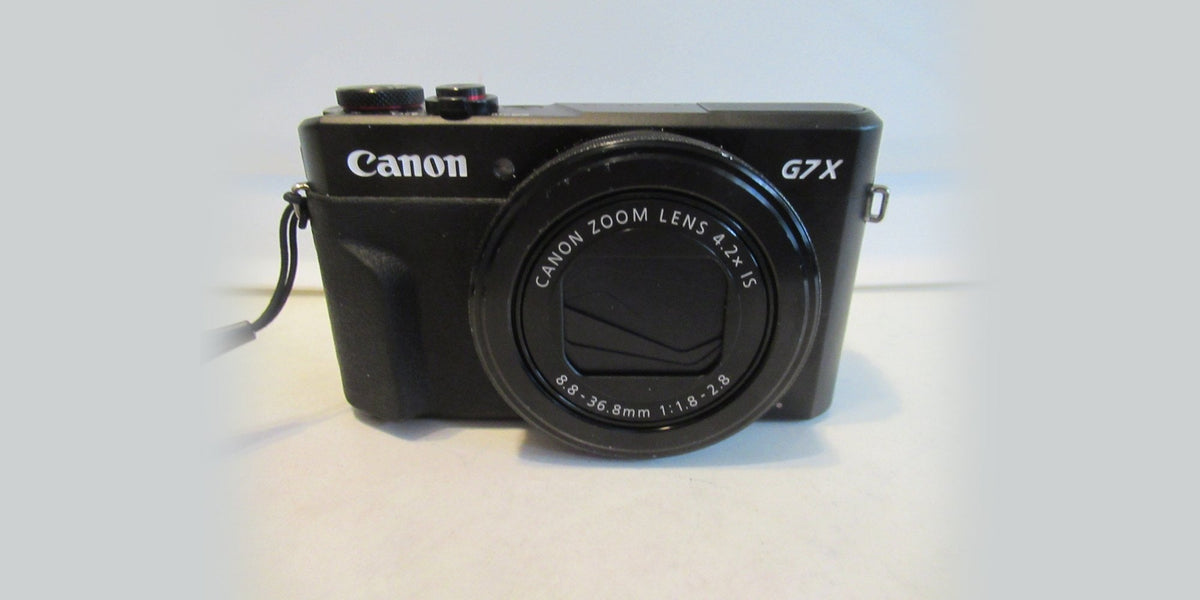
Comparison · Expert 1-inch compacts · Updated October 2026
Same sensor size, same resolution, same pocket size: on paper, the Canon G7 X and the Sony RX100 are evenly matched. In hand, they serve different photographers. Criterion by criterion, generation by generation, here is which one to choose used.
The Sony RX100 blazed the trail in 2012; Canon responded two years later with the PowerShot G7 X, designed explicitly to compete with it. Since then, the two ranges have matched each other blow for blow, up to the G7 X Mark III and the RX100 VII presented just a few weeks apart in the summer of 2019. All use a 1-inch type sensor of around 20 MP: for the same generation, the raw image quality is very close. What separates them are clear design choices. Canon bets on a bright and long zoom, a touchscreen, and dial-based ergonomics. Sony bets on an electronic viewfinder, extreme miniaturization, and, from the VI onwards, a travel zoom. This comparison helps you figure out which of these compromises is right for you.
Which one to choose in 30 seconds
- Get a G7 X: if you want a bright 24-100 mm zoom across the entire range, a touchscreen, and an exposure compensation dial. The Mark III for video with a mic.
- Get an RX100: if the viewfinder matters (in bright sunlight, it makes all the difference), or if you want the 24-200 mm zoom of the VI and VII to travel light.
- For vlogging: G7 X Mark III or RX100 VII: these are the only two with 4K and a mic jack. The Canon is simpler, the Sony has better autofocus tracking.
- For a tight budget: a G7 X Mark I or an RX100 III: two excellent cameras, without 4K.
- The trap: comparing different generations. A 2014 RX100 III and a 2019 G7 X Mark III are not in the same category.


The comparison table
To compare fairly, we pit the two complete ranges against each other. When a feature depends on the version, it is specified. The values come from the official Canon and Sony spec sheets and the RX100 series summary table.
| Criterion | Canon G7 X (I, II, III) | Sony RX100 (I to VII) |
|---|---|---|
| Sensor | 1 inch, 20.1-20.2 MP; stacked on the Mark III | 1 inch, 20.1-20.2 MP; stacked from the IV |
| Lens | 24-100 mm f/1.8-2.8 on all three | 28-100 f/1.8-4.9 (I, II), 24-70 f/1.8-2.8 (III to VA), 24-200 f/2.8-4.5 (VI, VII) |
| Viewfinder | None | Pop-up from the III to the VII |
| Touchscreen | Yes, on all three | Only VI and VII |
| Selfie screen | Yes, on all three | From the III to the VII |
| Built-in ND filter | Yes, 3 stops, on all three | III to VA only |
| Exposure compensation dial | Yes, dedicated | No (multifunction rear dial) |
| 4K | Mark III (uncropped, 30p) | IV, V, VA, VI, VII |
| Mic jack | Mark III | VII |
| Max burst | 20 fps (Mark III) | 24 fps (V, VA, VI) |
| Autofocus | Contrast detection | Phase detection from the V |
| USB charging | Mark II and III | All versions |
| Weight | 304 to 319 g | 240 to 302 g |
| Battery | NB-13L | NP-BX1 |
Bold: the advantage in each row. Sources at the bottom of the page.
Generation against generation
The two brands released their models at different paces. For a fair comparison, you have to pit cameras from the same era against each other, which are also in neighboring used price ranges.
| Era | Canon | Sony | Advantage |
|---|---|---|---|
| 2014 | G7 X | RX100 III | Tie: longer and touchscreen zoom on Canon, viewfinder on Sony |
| 2015-2016 | G7 X Mark II | RX100 IV and V | Sony for 4K and autofocus (V); Canon for handling |
| 2018-2019 | G7 X Mark III | RX100 VI and VII | Canon for brightness and price; Sony for the 24-200 zoom and AF tracking |
To check
Don't compare an "RX100" listing to a "G7 X" listing without knowing the exact version. On the Sony, the code under the camera (DSC-RX100M3, M5A, M7...) indicates it. On the Canon, only the Mark III has a USB-C port and a mic jack. Our guides Sony RX100: which version and Canon G7 X: Mark I, II or III detail each model.
Lens and image quality
The sensor is the same format on both brands, with identical resolution. For the same generation, the differences in noise and dynamic range are small and are more about JPEG processing than the sensor. The real difference comes from the lens.
The Canon offers a 24-100 mm that stays bright all the way: f/2.8 at 100 mm. It's the best of the two for portraiture in indoor light, at a medium focal length. The Sony 24-70 mm of the III to VA also opens to f/1.8-2.8, but stops at 70 mm. The I and II lose a lot of brightness at the telephoto (f/4.9 at 100 mm), and the VI and VII trade brightness for reach: 200 mm, but f/4.5 at this focal length.


In practice, if you mostly photograph people, meals, interiors, the Canon zoom is more versatile. If you photograph landscapes and monuments on trips, the 24-200 mm of the Sony RX100 VI or VII will prevent you from regretting the telephoto. To understand what these focal lengths change, read our article equivalent focal length and crop factor.
Viewfinder and screen
This is the criterion that most often makes the difference. No G7 X has a viewfinder. In bright sunlight, the rear screen becomes difficult to read, and holding the camera at arm's length makes slow shutter speeds riskier. The RX100s, from the III onwards, hide an OLED electronic viewfinder in the top cover. On the III, IV, V and VA, you have to pull it out then pull the eyepiece; on the VI and VII, a single gesture is enough.
Canon takes the lead on the screen: the three G7 Xs have a touchscreen that allows you to choose the focus point with your fingertip, shoot, and navigate the menus. On Sony, touch only arrives with the VI and remains limited to focusing. Both tilt 180° for selfies (except RX100 I and II), and the G7 X Mark II and III like the RX100 III to VII also tilt downwards.

Handling and controls
The G7 X is thicker and a little heavier (304 to 319 g versus 240 to 302 g), but it holds better, especially the Mark II and the Mark III with their grip. Its top cover features a mode dial superimposed on a dedicated exposure compensation dial: you correct blindly, camera on or off. A ring around the lens completes the whole.
The RX100 is smaller and smoother. It also has a ring around the lens and a rear dial, but no dedicated compensation dial. Many users add an adhesive grip (Sony AG-R2 or equivalent). Its menus, especially before the VA, are known to be more cluttered than Canon's. If you are starting out, the Canon interface is more welcoming; our guide P, A, S, M modes and exposure metering will help you with either.
Expert tip
Whatever your choice, configure the lens ring. On the G7 X, set it to aperture in Av mode; on the RX100, to aperture too, or to zoom in steps if you want to work at a fixed focal length (24, 28, 35, 50, 70 mm). It's the gesture that transforms these compacts into expert cameras.
Video and vlogging
For filming, two models stand out: the G7 X Mark III and the RX100 VII, the only ones to combine 4K and 3.5 mm jack mic jack. The Canon shoots in 4K 30p uncropped, in Full HD up to 120 fps, vertically, and broadcasts live on YouTube. The Sony offers phase detection autofocus with eye tracking, more reliable on a moving face, active electronic stabilization, and advanced image profiles.
The other versions are split as follows: the RX100 IV, V, VA and VI shoot in 4K but limit clips to around 5 minutes and have no microphone jack; the G7 X Mark I and II remain at Full HD 60p. For vlogging without an external microphone, a G7 X Mark II or an RX100 V still does a good job. The Sony ZV-1, derived from the RX100 and designed for vlogging, is a third option: side-oriented screen, refined built-in microphone, but no viewfinder.

To compare all the options, read which used camera for vlogging and filming with a digicam.
Battery life and charging
| Model | Battery life | USB charging |
|---|---|---|
| G7 X | ≈ 210 shots | No |
| G7 X Mark II | ≈ 265 shots | Micro-USB (CA-DC30 adapter) |
| G7 X Mark III | ≈ 235 shots | USB-C |
| RX100 III | 320 shots | Micro-USB |
| RX100 V | 220 shots | Micro-USB |
| RX100 VII | 260 shots | Micro-USB |
Neither of them is long-lasting: the small batteries in these compacts last half a day of travel, even less in video. The RX100s have the advantage of USB charging on all versions, convenient with a power bank. In both cases, buy two spare batteries (NB-13L for Canon, NP-BX1 for Sony) and read our guide battery that does not charge if a used battery is weakening.
Reliability and buying used
Both families share the weaknesses of compacts with retractable zoom lenses: the lens block is sensitive to sand and impacts, and dust can enter it over time. On Sony, the pop-up viewfinder adds a moving part to check. On Canon, check the screen hinge, which is heavily used in selfie mode.
Classic trap
The lens error message is the most expensive failure on these two ranges, as it often requires replacing the entire lens block. Always zoom in and out several times before buying, and be wary of a seller who refuses this check. Our guide lens error explains the causes.
- Zoom through the entire range, several times in and out, without noise or messages.
- Photo of a plain sky at f/8, enlarged to 100% to spot dust.
- Screen: full tilt, touch (G7 X, RX100 VI and VII), no dead pixels.
- Viewfinder (RX100 III to VII): pop-up, sharpness, retraction.
- Battery: consistent battery life, no swelling.
- Ports: micro-USB or USB-C without play, microphone jack (G7 X Mark III, RX100 VII).
For the rest, our advice for buying a used digital camera and avoiding scams applies. The G7 X Mark III, which has become highly sought after since 2024, is particularly targeted by fake listings.
Verdict by profile

You travel and photograph landscapes
Sony RX100 VI or VII: the 24-200 mm and the viewfinder make the difference in the sun and at a distance.
You photograph people, indoors
Canon G7 X Mark II: bright zoom up to 100 mm, touch screen, grip. The best value for money for this use.

You film with a microphone
G7 X Mark III if you want simplicity and YouTube live; RX100 VII if you need the best autofocus tracking.

You have a tight budget
RX100 III or G7 X Mark I: two excellent cameras from 2014, to choose according to whether you prefer the viewfinder (Sony) or the zoom and touch (Canon).
The Canon G7 X wins over…
- telephoto zoom brightness (f/2.8 at 100 mm);
- touch screen on all versions;
- exposure compensation dial;
- ND filter on all versions;
- menu simplicity.
The Sony RX100 wins over…
- electronic viewfinder (III to VII);
- compactness and weight;
- 24-200 mm zoom (VI, VII);
- phase detection autofocus (V to VII);
- USB charging on all versions.
And what if neither of them suits you? If you are looking for the imperfect and colorful look of the 2000s rather than image quality, look at a CCD digicam instead: our guide of the best budget digicams and compact expert or digicam will guide you.
Frequently asked questions
G7 X or RX100 for vlogging?
The G7 X Mark III and the RX100 VII are the only two that combine 4K and microphone jack. The Canon has a brighter telephoto zoom, a touch screen and YouTube live; the Sony has a much longer zoom and better autofocus tracking. Without an external microphone, a G7 X Mark II or an RX100 V also works.
Does the Canon G7 X have a viewfinder?
No, no version of the G7 X has a viewfinder. On Sony, the RX100 III to VII have one, pop-up.
Do they have the same sensor?
They have the same format, 1 inch (13.2 × 8.8 mm), and a resolution of around 20 Mpx. Recent versions (G7 X Mark III, RX100 IV and later) use a stacked sensor, faster to read.
Which one is brighter?
At 24 mm, the G7 X and the RX100 III to VA all open to f/1.8. At telephoto, the G7 X keeps f/2.8 up to 100 mm, while the RX100 III to VA stop at 70 mm (f/2.8) and the VI and VII open to f/4.5 at 200 mm.
Which one is more reliable?
Neither range has any documented systematic defect. The points to check are the same: lens block, dust, articulated screen, and viewfinder on Sony. The condition of the specimen matters more than the brand.
What size difference is there between the two?
The RX100s measure around 102 × 58 × 36 to 43 mm depending on the version, the G7 Xs around 103 to 105.5 × 60 to 61 × 40 to 42 mm. The Sony is therefore a little thinner, but both fit in a jacket pocket.
Vibes Photo
Find your compact expert
We check every digital camera before it goes on sale. Browse the collection or write to us for a specific model.
Sources
- Canon Hong Kong, PowerShot G7 X sheet ; Canon USA, G7 X Mark II ; Canon Asia, G7 X Mark III (lens, battery life, weight, dimensions, charging).
- Canon USA, press release of July 8, 2019 (4K without cropping, microphone jack, YouTube live).
- Wikipedia, « Sony Cyber-shot DSC-RX100 series » (dates, comparison table: viewfinder, ND, burst, battery life, weight, 4K limits).
- DPReview, RX100 VA (July 13, 2018).
- Canon Camera Museum, G7 X (positioning against the RX100).
Images: authors, licenses and sources indicated under each photo.