










Equivalent focal length and crop factor: understanding “35mm equivalent”
Conversion factor (crop factor), 24 × 36 equivalent focal length, sensor sizes: what you need to know to compare lenses for digital cameras, DSLRs, and film cameras.
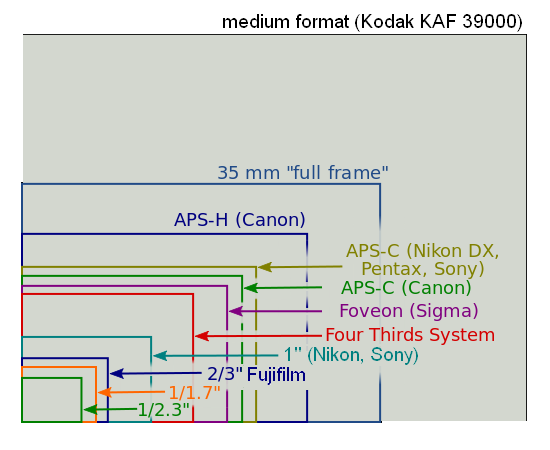
The "35 mm equivalent" focal length allows you to compare the framing of lenses mounted on cameras with different sensor sizes. It is obtained by multiplying the actual focal length by the sensor's crop factor: approximately 1.5 for a Nikon, Sony, Fujifilm or Pentax APS-C, 1.6 for a Canon APS-C, 2 for a Micro 4/3, and approximately 5 to 6 for a digicam. Example: the 5.8-17.4 mm zoom on the Canon IXUS 70 corresponds to a 35-105 mm on a 24 × 36 film camera.
The verdict in 30 seconds
What it changes
- framing (angle of view);
- depth of field at the same framing;
- comparison between cameras.
What it does not change
- exposure: f/2.8 remains f/2.8 for light;
- the actual focal length engraved on the lens;
- perspective, which depends on your distance from the subject.

Why do we talk about "35 mm equivalent"?
The 24 × 36 mm film format (35 mm film) was the standard for decades: everyone knew that a 50 mm gave a "normal" framing, a 28 mm a wide-angle, and a 135 mm a telephoto lens. A smaller sensor only "sees" the center of the image: with the same focal length, the framing is tighter. To maintain reference points, manufacturers indicate the 24 × 36 equivalent focal length.
The crop factor table
| Sensor or film | Approximate crop factor | Camera examples |
|---|---|---|
| 24 × 36 (full frame, 35 mm film) | 1 | Film SLRs, film compacts, full-frame digital SLRs |
| APS-C | 1.5 (1.6 for Canon) | Consumer digital SLRs, Fujifilm X100, Ricoh GR (from the 2013 GR onwards) |
| Micro 4/3 | 2 | Olympus and Panasonic mirrorless cameras |
| 1 inch | approximately 2.7 | Recent premium compacts (for example Canon G7 X) |
| 1/1.7 inch | approximately 4.6 | Premium compacts from the 2000s-2010s (Canon PowerShot G and S, for example) |
| 1/2.3 to 1/2.5 inch | approximately 5.6 to 6 | Most consumer digicams |
The "inch" designations for small sensors are conventions inherited from video tubes: they do not correspond to the actual diagonal. Rely on the equivalent focal length indicated in the camera's specifications.
And the equivalent aperture?
For light, f/2.8 remains f/2.8 regardless of the sensor: the shutter speed and ISO will be the same. But for background blur, at the same framing, a small sensor behaves like a narrower aperture. You can multiply the aperture by the crop factor to compare: an f/2.8 on a digicam with a crop factor of 6 gives roughly the same depth of field as an f/16 on 24 × 36. That is why everything is sharp on a digicam. Our depth of field and bokeh guide details this point.
Reading a digicam spec sheet carefully
On a compact camera's lens, the engraved focal length is the actual focal length (5.8-17.4 mm on a Canon IXUS 70, for example). The spec sheet gives the equivalent (35-105 mm for this same IXUS 70). To compare two cameras, always compare the equivalents. A "28 mm equivalent" wide-angle is valuable indoors and for travel; many digicams start at 35 or 38 mm, which is tighter. Our guides which Canon IXUS to choose and CCD or CMOS help you choose.
Using a film lens on a mirrorless camera
With an adapter ring, a film lens can be mounted on many mirrorless cameras. On an APS-C sensor, your 50 mm will then frame like approximately a 75 mm: ideal for portraits. On a Micro 4/3, it frames like a 100 mm.