










Used Canon PowerShot SX: Which Model to Choose? (SX100 to SX740 HS)
From the SX110 IS, powered by AA batteries, to the SX740 HS, which shoots 4K video: our guide to choosing a used Canon PowerShot SX, model by model, backed by figures from reviews of the time.
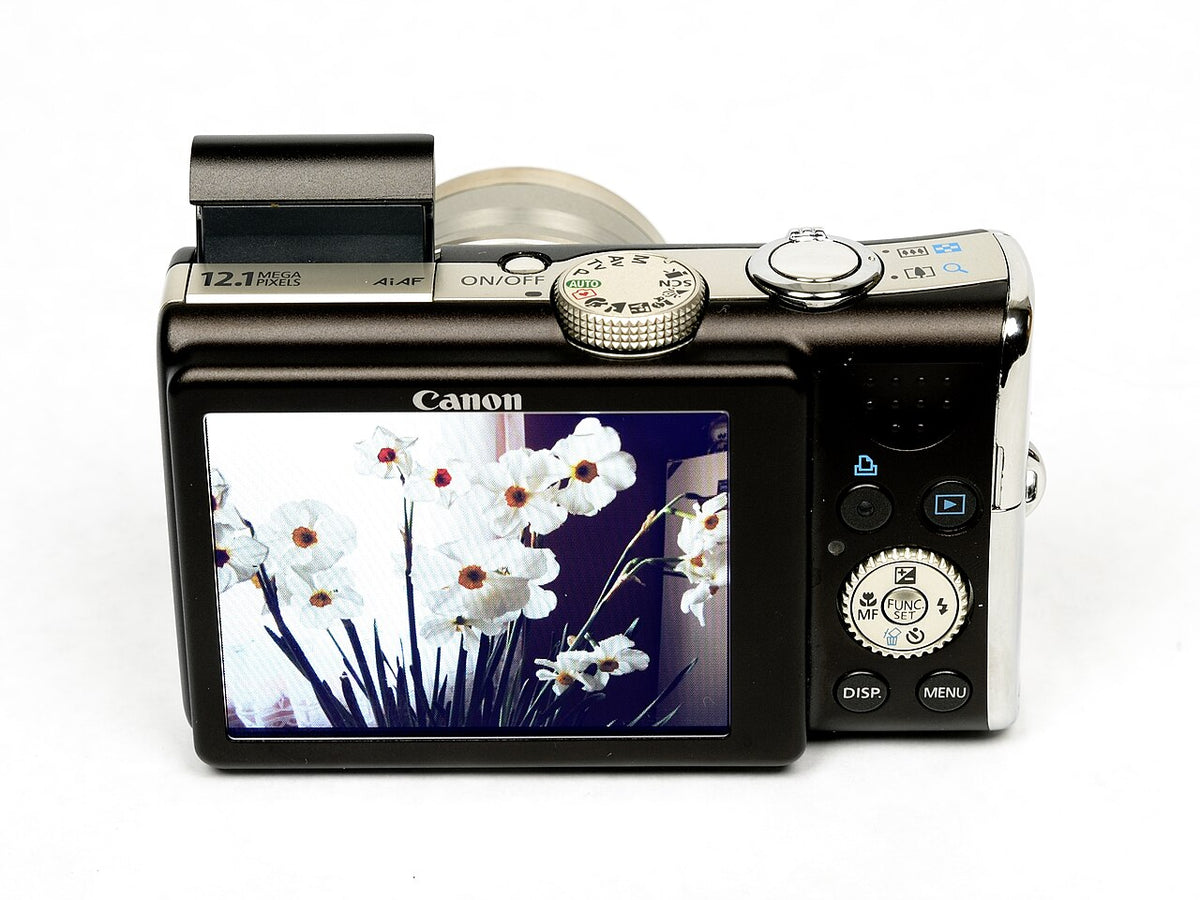
Buying Guide · Compact Cameras with Large Zooms · Updated November 2026
The Canon PowerShot SX series packs a long zoom into a pocket-sized body. From 2008 to 2018, the range evolved from a 10x zoom powered by AA batteries to a 40x zoom that shoots 4K video. In between, there were about a dozen models with almost identical names. Here’s how to tell them apart, model by model, backed by figures from reviews published at the time.
A PowerShot SX is a simple proposition: keep the size of a compact camera but give it the zoom of a small telephoto lens. The problem is that Canon released this formula in a long series of models: SX110 IS, SX200 IS, SX230 HS, SX600 HS, SX610 HS, SX620 HS, SX700 HS, SX710 HS, SX730 HS, SX740 HS… This guide groups the range by family, explains what really changes from one model to the next, and helps you choose the one that suits your style of photography. All the figures come from reviews published when each camera was released and from technical specifications.
The essentials in 30 seconds
- Two families: the early SX “IS” models (SX110 IS, SX200 IS) have a CCD sensor with a late-2000s look; from the SX230 HS (2011) onwards, the “HS” models switched to back-illuminated CMOS and Full HD video.
- The most compact: SX600 HS, SX610 HS and SX620 HS, weighing between 182 and 191 g, with an 18x or 25x zoom and Wi-Fi.
- The most feature-packed: SX700 HS and SX710 HS, with 30x zoom and P, Av, Tv and M manual modes.
- The most versatile: SX730 HS and SX740 HS, with 40x zoom (24–960 mm) and a flip-out screen; the SX740 HS also adds 4K video.
- The best approach: test the zoom through its full range, the stabilisation at maximum zoom and the flash, and ask to see a photo taken that day.

Two families, one principle
The letter after the number tells you a lot. Among the models covered here, those marked IS (SX110 IS, SX200 IS) use a CCD sensor. Those marked HS use a back-illuminated CMOS sensor: this includes the SX230 HS tested by PhotographyBlog in 2011, and all SX6xx and SX7xx models. Don’t assume this applies to any model not covered by this guide: always check the sensor type in its technical specifications.
This change in sensor has practical consequences. CCDs produce the look sought after in today’s digicams, with vivid colours and pronounced contrast when using the flash, but they perform poorly at high sensitivity and can shoot video at best in 720p. Back-illuminated CMOS sensors offer Full HD video, faster continuous shooting and, on the latest models, Wi-Fi, Bluetooth and 4K. Their images look cleaner and less distinctive. Our article CCD or CMOS: what’s the difference explains what separates the two technologies.
- SX110 IS: 9 Mpx CCD, 10x zoom (36–360 mm equivalent), two AA batteries.
- SX200 IS: 12.1 Mpx CCD, 12x zoom starting at 28 mm, 720p video.
- SX230 HS: switch to back-illuminated CMOS, Full HD video and built-in GPS.
- SX600 HS (18x zoom, Wi-Fi and NFC) and SX700 HS (30x zoom, manual modes).
- SX610 HS and SX710 HS: 20 Mpx sensors.
- SX620 HS: 25x zoom in a 182 g body.
- SX730 HS: 40x zoom, flip-out screen for selfies, Bluetooth.
- SX740 HS: DIGIC 8 processor and 4K video.
The entire range in one table
This table brings together the models you are most likely to find used. Weights include the battery (and memory card when specified in the review), except for the SX200 IS, which is given as body only.
| Model | Sensor | Zoom (equiv.) | Video | Battery | Weight |
|---|---|---|---|---|---|
| SX110 IS (2008) | 9 Mpx 1/2.3" CCD | 10x, 36–360 mm | 640 × 480 | 2 AA batteries | 245 g |
| SX200 IS (2009) | 12.1 Mpx 1/2.3" CCD | 12x, 28–336 mm | 720p | NB-5L, ≈280 shots | ≈220 g (body only) |
| SX230 HS (2011) | 12.1 Mpx BSI CMOS | 14x, 28–392 mm | 1080p 24 fps | NB-5L, ≈210 shots | ≈223 g |
| SX600 HS (2014) | 16 Mpx BSI CMOS | 18x, 25–450 mm | 1080p 30 fps | NB-6LH, ≈290 shots | ≈188 g |
| SX610 HS (2015) | 20.2 Mpx BSI CMOS | 18x, 25–450 mm | 1080p 30 fps | NB-6LH, ≈270 shots | ≈191 g |
| SX620 HS (2016) | 20.2 Mpx CMOS | 25x, 25–625 mm | 1080p 30 fps | NB-13L, ≈295 shots | ≈182 g |
| SX700 HS (2014) | 16.1 Mpx BSI CMOS | 30x, 25–750 mm | 1080p 60 fps | ≈250 shots | ≈269 g |
| SX710 HS (2015) | 20.3 Mpx BSI CMOS | 30x, 25–750 mm | 1080p 60 fps | NB-6LH, ≈230 shots | ≈269 g |
| SX730 HS (2017) | 20.3 Mpx CMOS | 40x, 24–960 mm | 1080p 60 fps | NB-13L, ≈250 shots | ≈300 g |
| SX740 HS (2018) | 20.3 Mpx BSI CMOS | 40x, 24–960 mm | 4K 30 fps | NB-13L, ≈265 shots | ≈299 g |
Sources: PhotographyBlog reviews (SX200 IS, SX230 HS, SX600 HS, SX610 HS, SX700 HS, SX710 HS, SX730 HS, SX740 HS), The Register (SX110 IS) and Imaging Resource spec sheets (SX620 HS, SX710 HS, SX730 HS, SX740 HS). Battery life figures follow the CIPA standard, with the screen on and Eco mode disabled. “BSI” means back-illuminated sensor.
From CCD SX models to the first CMOS
The SX110 IS resembles a small bridge camera, with a pronounced grip. Its 9 Mpx CCD sensor is paired with a 10x zoom (36–360 mm equivalent) that opens at f/2.8–4.8, and it runs on two AA batteries, alkaline or rechargeable NiMH. It offers aperture and shutter priority as well as a manual mode. The Register, which tested it in 2008, found the image quality “very good” but noted noise from 400 ISO, a continuous shooting speed of around one shot per second and a flash that had to be raised by hand, even in Auto mode. Its predecessor, the SX100 IS, used a smaller 8 Mpx CCD (1/2.5 inch) and weighed 266 g.
The SX200 IS, announced in February 2009, changed the format. The body became truly compact, the zoom increased to 12x and started at 28 mm, which makes all the difference indoors and in the city. The CCD sensor increased to 12.1 Mpx, the screen to 3 inches, and the camera shoots 720p video. It retains P, Av, Tv and M modes. Its major flaw, noted by PhotographyBlog: the flash pops up automatically with every shot, even when not in use, and cannot be lowered. The continuous shooting speed, around 0.8 shots per second, is also very slow.

In terms of image quality, PhotographyBlog finds the SX200 IS clean from 100 to 400 ISO, softer at 800 ISO and significantly degraded at 1600 ISO. In practical terms, it is a camera for daylight and flash. That is also why it is still popular today: in the evening, direct flash on a CCD gives exactly the look of photos from the late 2000s. To learn more about this model, read our review of the PowerShot SX200 IS.
To check
On an SX200 IS, turn on the camera and check the flash: it should pop up clearly and then retract when turned off. A flash that remains halfway out or feels loose indicates a worn mechanism. On an SX110 IS, check the battery compartment: a leaked battery leaves traces of oxidation on the contacts. Our guide to AA-battery digicams explains how to check them.
The SX230 HS, the switch to CMOS
With the SX230 HS, tested by PhotographyBlog in May 2011, Canon adopted a 12.1 Mpx back-illuminated CMOS sensor paired with the DIGIC 4 processor. The zoom increased to 14x (28–392 mm, f/3.1–5.9), video to Full HD 1080p at 24 frames per second with stereo sound, and the camera included a GPS, disabled by default, which distinguished it from the SX220 HS. P, Av, Tv and M modes were still there.
The gain in sensitivity is clear: PhotographyBlog obtained noise-free images up to 400 ISO, a little noise at 800 ISO and files that were still “perfectly usable” at 1600 ISO. In return, the reviewer found the images a little soft with the default settings, regretted the lack of RAW, and again pointed out the flash that pops up when turned on. The stated battery life, around 210 shots with the NB-5L battery, is measured with GPS turned off: leave it off if you do not need it.
SX600 HS and SX610 HS: the pocket zoom
The SX600 HS, announced in January 2014, focused entirely on compactness: 188 g and 26 mm thick for a stabilized 18x zoom (25–450 mm, f/3.8–6.9). It featured a 16 Mpx back-illuminated CMOS, the DIGIC 4+ processor, Full HD video at 30 frames per second and Wi-Fi with NFC to transfer photos to a phone. It was sold for £199.99 across the Channel. In terms of settings, it was limited to Program mode: no aperture or shutter priority, no manual mode.
PhotographyBlog praised its sharpness and colours in good light, fast autofocus even in low light and comfortable handling for its size. The criticisms were aimed at the all-plastic body, a poorly defined 3-inch screen (around 461,000 dots), a weak flash (around 3.5 m range) and visible colour noise from 800 ISO.
The SX610 HS, tested in April 2015, kept the same 18x zoom and increased to 20.2 Mpx. It corrected two flaws of its predecessor: the screen increased to around 922,000 dots and handling improved with a thumb rest and a more pronounced grip, plus a metal tripod mount. It could also retrieve the GPS location of a connected smartphone. But PhotographyBlog noted that the 20 Mpx did not add much detail, that noise appeared from 400 ISO, that continuous shooting dropped from 3.9 to 2.5 shots per second and that battery life fell from 290 to 270 shots.


SX700 HS and SX710 HS: the 30x with manual modes
Announced in February 2014, the SX700 HS is the “expert” model of the range. It combined a 16.1 Mpx back-illuminated CMOS, the DIGIC 6 processor and a 30x zoom (25–750 mm, f/3.2–6.9) with a metal body. It shot Full HD video at 60 frames per second with stereo sound, offered the full range of P, Av, Tv and M modes, and connected via Wi-Fi with NFC. It launched for around £329 or $349.
PhotographyBlog appreciated its solid body, grip rib, fast autofocus even in low light and two-speed zoom control. The images were detailed and the colours vivid, with noise appearing at 800 ISO; 3200 ISO remained usable for small prints. As for its flaws: no touchscreen or viewfinder, a weak flash (around 3.5 m) and an average battery life of around 250 shots.
The SX710 HS, tested in January 2015, was judged “practically identical” by the same site. It brought faster continuous shooting, 5-axis video stabilisation and manual focus with focus peaking, but increased to 20.3 Mpx. The result according to PhotographyBlog: image quality slightly set back, with visible noise at 800 ISO and 3200 ISO to be avoided, and battery life falling to around 230 shots. The reviewer gave it 3.5 out of 5 and recommended the SX700 HS at the time, which was on sale.


The SX620 HS, the best zoom-to-weight ratio
Available from the summer of 2016, the SX620 HS achieves a remarkable feat: a 25x zoom (25–625 mm, f/3.2–6.6) in a 97 × 57 × 28 mm body weighing around 182 g, making it lighter than the SX610 HS and its 18x zoom. It retains the 20.2 Mpx CMOS sensor, DIGIC 4+ processor, 3-inch screen with approximately 922,000 dots, Full HD at 30 frames per second, and Wi-Fi with NFC, according to the Imaging Resource spec sheet.
It uses a different battery: the NB-13L, rated for around 295 shots (405 in Eco mode), replaces the NB-6LH used by the SX600 and SX610. This is something to check when buying, as the two batteries are not interchangeable. In terms of settings, it retains Program, Auto, and Creative Shot modes, without priority or manual modes. Continuous shooting reaches around 7 shots per second in high-speed mode, 2.5 shots per second in Auto and P.


Did you know?
The SX600 HS, SX610 HS, and SX710 HS use the NB-6LH battery, while the SX620 HS, SX730 HS, and SX740 HS use the NB-13L. The SX200 IS and SX230 HS use the NB-5L. Always check the model number before buying a spare battery.
SX730 HS and SX740 HS: 40x zoom, selfies, and 4K
The SX730 HS arrived in 2017 with a 40x zoom (24–960 mm, f/3.3–6.9), a 20.3 Mpx CMOS sensor, and the DIGIC 6 processor. Compared to the SX720 HS that preceded it, PhotographyBlog highlights the 3-inch screen that flips up for selfies, a dedicated selfie mode, and the addition of Bluetooth, which maintains a low-power connection with your phone for remote control. It offers P, Av, Tv, and M modes, Full HD at 60 frames per second, and weighs around 300 g. It launched at £379 or $399.
The reviewer finds the detail good up to around 800 ISO, acceptable at 1600 ISO for everyday use, with a loss of detail visible up close. They appreciate the telephoto framing assist (Zoom Frame Assist) and regret the small buttons, lack of RAW, viewfinder, and touchscreen, as well as a flash limited to around 4 m. Their conclusion: “an excellent little compact for travel photographers.”
The SX740 HS, announced on July 31, 2018, at $399.99, retains the same 40x zoom and dimensions (110 × 64 × 40 mm, around 299 g). It adds the DIGIC 8 processor and 4K video at 30 or 25 frames per second, a first for a PowerShot according to PhotographyBlog. Continuous shooting increases from 4.6 to 7.4 shots per second with autofocus tracking, and 10 shots per second with focus locked. However, it loses NFC and the SuperFine JPEG format. The announced battery life is around 265 shots with the NB-13L.

The SX730 HS is enough if you rarely shoot video. Our detailed review of the SX740 HS goes further, and our selection of compacts with flip-out screens compares it to other selfie models.
Expert tip
At 960 mm equivalent, even the slightest vibration is visible. Even with stabilization, brace yourself against a wall or railing, keep your elbow against your body, and let the shutter speed rise. And at full zoom, the aperture closes significantly: late in the day, the sensitivity increases and noise appears quickly.
Don't confuse them with SX bridge cameras
Canon also uses the SX prefix for bridge cameras, cameras in the size of a small DSLR with a large grip. The PowerShot SX10 IS or the SX70 HS are among them. They offer a better grip, but won't fit in a pocket. Before buying a “Canon SX” listing, therefore, check the exact model, dimensions, and weight: this guide only covers compact cameras. Our articles on the PowerShot S2 IS and SX10 IS and the SX70 HS detail these models.

Which SX for your use
| Use | Recommended model | Why |
|---|---|---|
| CCD rendering, evening photos with flash | SX200 IS | 12.1 Mpx CCD, 28 mm, direct flash |
| AA batteries, tight budget | SX110 IS | Runs on two standard batteries |
| As lightweight as possible | SX620 HS | 25x for around 182 g |
| Learn exposure | SX700 HS | P, Av, Tv, M modes, metal body |
| Travel, selfies, sharing on your phone | SX730 HS | 40x, flip-out screen, Bluetooth |
| 4K video and extreme zoom | SX740 HS | The only one in this guide with 4K |
| Concert from the back of the venue | SX710 HS or SX730 HS | Long zoom and Full HD video at 60 fps |
If your main criterion is compactness rather than zoom, also check out our guide which Canon IXUS to choose and our comparison IXUS or PowerShot. For a larger sensor and better low-light quality, at the cost of a much shorter zoom, the G7 X family plays in a different category.
Image quality: what to expect
| Model | Clean up to | Visible noise | Practical limit |
|---|---|---|---|
| SX200 IS (CCD) | 400 ISO | 800 ISO | 1600 ISO, very smoothed |
| SX230 HS | 400 ISO | 800 ISO | 1600 ISO still usable |
| SX600 HS | 400 ISO | 800 ISO | 1600 ISO, degraded detail |
| SX610 HS | 200 ISO | 400 to 800 ISO | 3200 ISO for the web |
| SX700 HS | 400 ISO | 800 ISO | 3200 ISO in small format |
| SX710 HS | 200 ISO | 800 ISO | 1600 ISO in small format |
| SX730 HS | 800 ISO | 1600 ISO | 1600 ISO for everyday use |
Two takeaways. First, more megapixels have not always been an improvement: PhotographyBlog notes that the SX610 HS (20 Mpx) offers almost no additional detail over the SX600 HS (16 Mpx), and that the SX710 HS performs slightly worse than the SX700 HS. Second, tests of the SX230 HS, SX710 HS, SX730 HS, and SX740 HS highlight the lack of RAW format: you must take care with exposure when shooting. For the evening, flash remains your best ally at short distances; our settings for a 2000s look also apply to the SX.
Check before buying
A high-zoom compact has more moving parts than a classic compact: a lens that extends far, a stabilization unit, sometimes a pop-up flash or an articulated screen. Here is what to test before paying.
- The zoom through its full range: from wide-angle to telephoto and back, without jerks, rubbing noise, or an “Objective Error” message. Our objective error article details the causes.
- The stabilization: at full zoom, the image on the screen should settle after one second. If it shakes or jumps, the stabilization unit is worn out.
- The flash: fire a photo with forced flash. On an SX200 IS or an SX230 HS, also check that it rises and retracts normally.
- The screen: no spots or lines; on an SX730 HS or an SX740 HS, flip the screen out several times and check that the image does not cut off.
- The test photo: one photo in full definition at wide-angle and one at telephoto, to be viewed on a computer: sharpness of the corners, absence of spots (dust in the lens).
- The battery and charger: NB-5L, NB-6LH, or NB-13L depending on the model, or AA batteries for the SX110 IS. A swollen battery is easily spotted, see our swollen battery article.
- The Wi-Fi: on the connected models, test the pairing with your phone if you plan to use it.
To check
Always ask for a photo taken that same day with the camera, at wide-angle and at full zoom. If the seller cannot provide it, consider that the camera has not been tested. Our complete checklist: checks before buying a digicam.
At Vibes Photo, each camera is checked before being put up for sale and covered by a six-month commercial warranty, in addition to the legal warranties of conformity and hidden defects. The details are in our general terms and conditions of sale.
Our verdict
There is no single best PowerShot SX, but a good SX for every use. For the CCD rendering and evening photos, the SX200 IS remains the benchmark of the range, provided you accept its flash that pops up on its own and video limited to 720p. To travel light, the SX620 HS offers the best ratio between zoom and weight. To learn how to set exposure, the SX700 HS and its metal body are the most rewarding. And to do everything with a single camera, distant photos, selfies, and 4K video, the SX740 HS is the most complete.
For
- 10x to 40x zoom in a pocket-sized body
- Optical stabilization across the entire range
- Very good images in broad daylight
- Wi-Fi on the SX6xx and SX7xx, Bluetooth on the SX730 and SX740 HS
- Manual modes on several models
- Selfie screen and 4K on the SX740 HS
Against
- Small sensor: noise from 400 to 800 ISO
- No RAW (SX230 HS, SX710, SX730, and SX740 HS)
- No viewfinder
- Weak flash (3.5 to 4 m)
- Average battery life, 210 to 295 shots
Frequently asked questions
Which Canon PowerShot SX has a CCD sensor?
Among the models in this guide, the SX110 IS (9 Mpx) and the SX200 IS (12.1 Mpx), as well as the SX100 IS (8 Mpx). From the SX230 HS onwards, the HS models use a backlit CMOS sensor.
Which PowerShot SX runs on AA batteries?
The SX110 IS runs on two AA batteries, alkaline or rechargeable NiMH. The other models in this guide use a lithium-ion battery: NB-5L, NB-6LH, or NB-13L depending on the generation.
Which PowerShot SX shoots 4K video?
The SX740 HS, in 4K at 30 or 25 frames per second. The SX730 HS, which is very close, is limited to Full HD at 60 frames per second.
SX730 HS or SX740 HS?
Same 40x zoom, same flip-out screen, and same dimensions. The SX740 HS adds 4K, the DIGIC 8 processor, and faster continuous shooting, but loses NFC. If you rarely shoot video, the SX730 HS is enough.
Which PowerShot SX has manual modes?
The SX200 IS, SX230 HS, SX700 HS, SX710 HS, SX730 HS, and SX740 HS offer P, Av, Tv, and M modes; the SX110 IS also offers priority and a manual mode. The SX600 HS, SX610 HS, and SX620 HS are limited to Program and Auto modes.
Which PowerShot SX is the lightest?
The SX620 HS, weighing around 182 g including the battery and with a 25x zoom. The SX600 HS and SX610 HS weigh slightly less than 190 g for an 18x zoom.
SX or IXUS for travel?
An SX if you want zoom for distant landscapes, animals, or monuments; an IXUS if you prefer the slimness of the body and close-up flash photos.
Vibes Photo
Find your PowerShot SX
We check every compact before it is put up for sale: zoom, stabilization, screen, flash, battery, and test photo. Have a question about a model? Write to us.
Sources
- The Register, Canon PowerShot SX110 IS review (October 2008).
- PhotographyBlog, Canon PowerShot SX200 IS Review (March 2009).
- PhotographyBlog, Canon PowerShot SX230 HS Review (May 2011).
- PhotographyBlog, Canon PowerShot SX600 HS Review (May 2014).
- PhotographyBlog, Canon PowerShot SX700 HS Review (May 2014).
- PhotographyBlog, Canon PowerShot SX710 HS Review (January 2015).
- PhotographyBlog, Canon PowerShot SX610 HS Review (April 2015).
- PhotographyBlog, Canon PowerShot SX730 HS Review (2017).
- PhotographyBlog, Canon PowerShot SX740 HS Review (August 2018).
- Imaging Resource, spec sheets SX620 HS, SX710 HS, SX730 HS and SX740 HS.
Images: Vibes Photo photos, unless otherwise stated under the image (author, license and source indicated).