










Canon PowerShot SX740 HS: review of the 40x zoom 4K compact camera
40x zoom (24–960 mm), 4K crop, selfie screen and 299 g: our full review of the Canon PowerShot SX740 HS, its real limitations (no RAW or viewfinder) and what to check before buying it used.
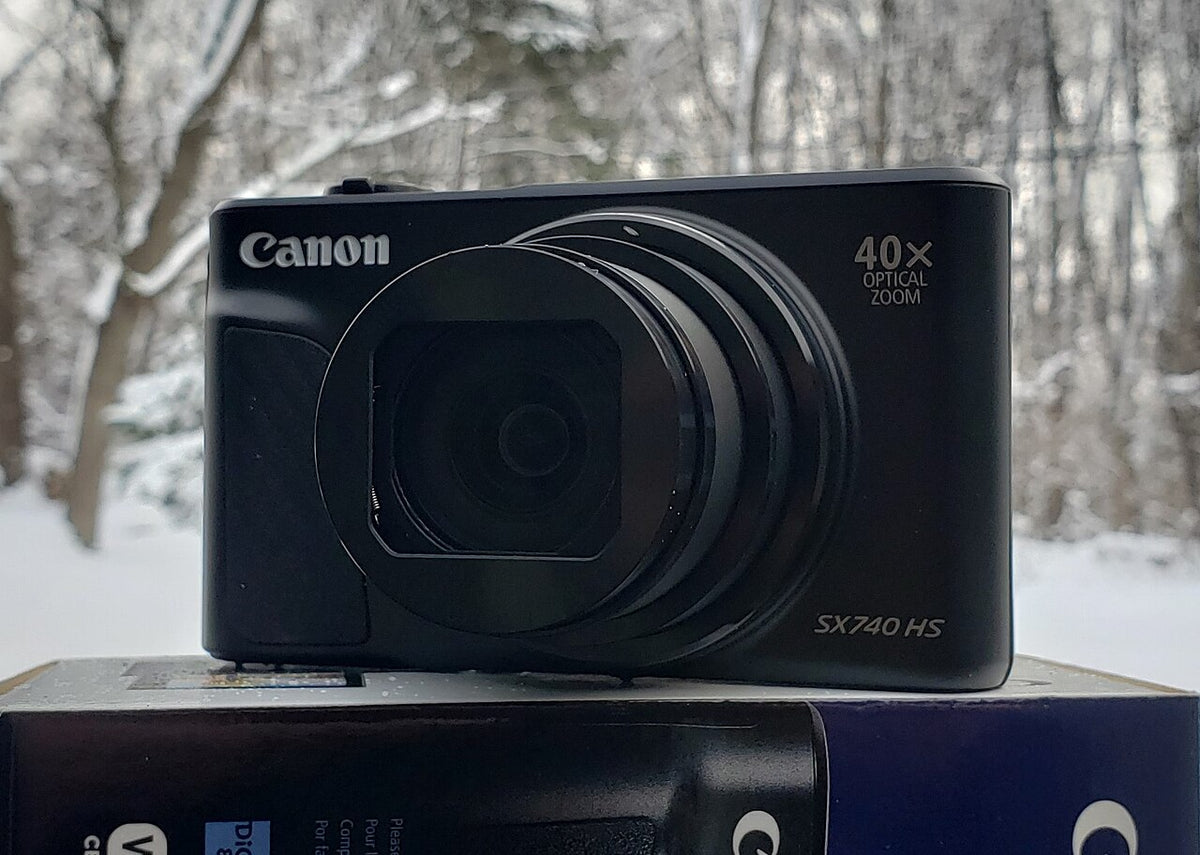
Reference sheet · Compact zoom · November 2026 update
Announced in July 2018, the Canon PowerShot SX740 HS puts a 40x zoom (24–960 mm), 4K video and a flip-up screen for selfies in a 299 g body. It is the first PowerShot to shoot in 4K. Here is what it is really like, what its spec sheets hide and how to choose it properly second-hand.
The SX740 HS answers a simple question: how to photograph from afar without carrying a bridge camera? Canon fitted a 40x optical zoom, from 24 to 960 mm in 24 × 36 equivalent, into a camera that fits in a jacket pocket. At its launch, the press welcomed it favorably but without overflowing enthusiasm: a "modest" evolution of the SX730 HS for PhotographyBlog, a "recommended" camera for Cameralabs, a "mixed review" for TechRadar. The complaints are always the same: no RAW format, no viewfinder, no touchscreen, heavily cropped 4K. The strengths too: a unique zoom range in this format, fast autofocus in good light, a burst rate of 10 images per second. This guide sorts through it, with figures in hand, based on the tests published in 2018 and 2019 and Canon's data.
The essentials in 30 seconds
- The highlight: a stabilized 24–960 mm zoom (about 3.5 stops) in 110 × 64 × 40 mm. The longest zoom in a pocket-sized body, according to Cameralabs.
- The sensor: 1/2.3 inch backlit CMOS, 20.3 Mpx, paired with the DIGIC 8. Good in daylight, quickly limited when the sensitivity goes up.
- The video: 4K at 30 or 25 fps, but with a strong center crop; Full HD up to 60 fps uses the full width of the sensor.
- The limits: JPEG only, no viewfinder, non-touch screen, non-selectable AF point, just flash.
- The good reflex: test the zoom through its full range, check the screen in selfie position and take a test photo at 960 mm.

A travel compact, 2018 edition
Canon USA announced the PowerShot SX740 HS on July 31, 2018, for availability at the end of August. The retail price was then $399.99, £349.99 and €419.99, in black or silver. It is exactly the launch price of its predecessor, the SX730 HS.
The two cameras are very close: same lens, same 20.3 Mpx sensor, same flip-up screen, same wireless functions. What changes is inside. The DIGIC 8 processor replaces the DIGIC 6, and it is what brings the novelties: 4K video, a burst rate increased from 5.9 to 10 images per second (from 4.6 to 7.4 with AF tracking), stabilization announced at 3.5 stops instead of 3, an exposure correction of ±3 stops instead of ±2. The battery life also gains a little: 265 shots per charge against 250.
Against it, the great rival is the Panasonic Lumix TZ90 (ZS70 in the United States). It zooms less far, 30x or 24–720 mm, but has an electronic viewfinder, a touchscreen and the RAW format. It is the comparison that comes back among the testers of the time, and we come back to it below.
- PowerShot SX730 HS: 40x, 20.3 Mpx, flip-up screen, DIGIC 6, Full HD video.
- Announcement of the SX740 HS by Canon USA: DIGIC 8, 4K, 10 fps.
- On sale, in black or silver.
- Cameralabs ranks it as "recommended".
- TechRadar publishes its test and prefers the SX730 for a small budget.
Did you know?
The SX740 HS is the first PowerShot capable of shooting in 4K, as Imaging Resource highlights in its presentation.
Technical sheet
- Sensor
- 1/2.3 inch backlit CMOS, about 20.3 effective Mpx
- Processor
- DIGIC 8
- Lens
- 4.3–172 mm f/3.3–6.9, or 24–960 mm equivalent (40x zoom), 13 lenses in 11 groups
- Stabilization
- Optical by shifting, about 3.5 stops; 5-axis stabilization in video
- Sensitivity
- 100 to 3200 ISO
- Speeds
- 15 s to 1/3200 s
- Minimum focus
- 1 cm at wide angle (macro)
- Burst
- About 10 fps (AF locked on the 1st image), 7.4 fps with AF Servo
- Video
- 4K 3840 × 2160 at 30/25 fps; Full HD up to 60 fps; MP4 H.264, stereo sound
- Screen
- 3 inches, about 922,000 dots, flip-up to 180°, non-touch
- Viewfinder
- None
- Photo formats
- JPEG only (no RAW)
- Wireless
- 2.4 GHz Wi-Fi, Bluetooth low energy
- Connectivity
- Micro-USB, micro-HDMI
- Cards
- SD, SDHC, SDXC (UHS-I)
- Battery
- NB-13L, about 265 shots (CIPA), 370 in Eco mode; USB charging
- Dimensions
- 110.1 × 63.8 × 39.9 mm
- Weight
- About 299 g with battery
Sources: PhotographyBlog (sheet and test, 2018), Imaging Resource, Canon.
Handling and settings
For a 40x zoom, the body is thin: less than 4 cm thick with the lens retracted. Cameralabs even finds it a little easier to slip into a pocket than the Lumix TZ90. TechRadar describes a mix of metal and polycarbonate that inspires confidence, clear buttons and dials that turn effortlessly. A rubberized area at the front helps handling, even if TechRadar judges it a little too smooth.
The zoom is controlled by a ring around the shutter button, judged smooth by PhotographyBlog. The video button is placed separately, which avoids accidental shots. At the back, the buttons are small and tight, the dial also serves as a directional pad, and no button is customizable. The menu follows the logic of EOS reflex cameras, a real improvement for TechRadar.
The mode dial gives access to the Intelligent Auto mode, which recognizes the scene, the P, S, A and M modes for those who want to keep control, a Sport mode and scene modes. The Hybrid Auto mode records a two-second clip before each photo, then assembles them into a small film of the day; the clips are not editable in the camera. Cameralabs regrets the absence of a panorama mode.
Regarding responsiveness, the startup takes a few seconds, the time for the lens to deploy. The autofocus is then fast in good light, across the entire focal range according to TechRadar, and face detection works well. On the other hand, it slows down significantly in low light. And the most frequent complaint concerns the focus area: you cannot choose the AF point, the AF area remains central, which Cameralabs finds frustrating.
Expert advice
For an off-center subject, focus in the center by pressing halfway, keep your finger pressed, reframe then shoot. It is the classic workaround for the fixed AF area of the SX740 HS.


The 40x zoom in practice
It is the reason to buy an SX740 HS. The lens goes from 24 mm, wide enough for a landscape or a room, to 960 mm, enough to isolate a bird on a branch or an architectural detail at the top of a facade. In macro, it focuses at 1 cm from the subject at wide angle. Cameralabs notes however that the lens can cast a shadow on very close subjects.
At 960 mm, the slightest vibration is visible. The optical stabilization, announced for about 3.5 stops, does a real job: Cameralabs praises it in Full HD video at full focal length. But the aperture drops to f/6.9 at the telephoto, and TechRadar observes that the stabilization "cannot always keep images sharp" at the end of the zoom, with a slight color fringing visible at 100%. Cameralabs, who tested the same lens on the SX730 HS, finds on the contrary that images at 960 mm are as good as at 720 mm, with a little more color fringing. The two findings agree: in good light, the end of the zoom is usable; when the light drops, it becomes tricky.
A button is dedicated to framing assistance (Zoom Frame Assist). As long as you hold it, the camera zooms out to allow you to find your subject, then returns to the starting focal length when you release it. At 960 mm, where a bird leaves the frame at the slightest movement, it is a tool that PhotographyBlog and Cameralabs both judge very useful.
| Situation | Setting | Why |
|---|---|---|
| Landscape, architecture | 24 mm, Auto or P mode, low sensitivity | This is where the lens is sharpest |
| Animals, sports from afar | Telephoto, S mode, fast speed | Limits motion blur at long focal length |
| Subject lost at 960 mm | Framing assistance button | Find the subject without zooming out completely |
| End of day at telephoto | Stable support, burst of 3 or 4 images | Increases the chances of having a sharp image |
| Macro | Wide angle, 1 to a few cm | Watch out for the lens's cast shadow |
Expert advice
At 960 mm, brace yourself against a wall, a railing or a post, elbows tight. The gain in sharpness is often more important than any setting in the menu.
Image quality
The 1/2.3 inch sensor is the standard size for large zoom compacts. It is backlit, but 20.3 million photosites on such a small surface impose their limits. The testers agree on one point: in good light and at low sensitivity, the photos are good, with pleasant colors. Cameralabs finds the wide angle "quite sharp and without distortion".
When the sensitivity goes up, the DIGIC 8 smooths more than the DIGIC 6 of the SX730. Cameralabs notes less grainy images than those of the predecessor, but at the cost of a loss of fine details: the noise is not visible, it is the texture that disappears. TechRadar notes on its part a reduction of visible noise and a slightly aggressive sharpening in the default settings.
The real problem is that you can't do anything about it: the SX740 HS only records in JPEG, in Fine or Normal quality. PhotographyBlog notes that the SuperFine quality of the SX730 has even disappeared. No RAW, so no possibility to develop the files yourself to recover details. It is the main argument of its Panasonic competitors.
| Conditions | Rendering observed by the testers | Recommended use |
|---|---|---|
| Full daylight, low sensitivity | Good images, pleasant colors | Prints, travel, landscape |
| Telephoto, good light | Usable, slight color fringing | Animals, details, sports |
| Indoors, high sensitivity | Details smoothed by processing | Screen, social networks |
| Backlight, high contrast | Limited dynamic range (TechRadar) | Expose for the highlights |

To check
The SX740 HS is a CMOS sensor camera, not a CCD. If you are looking for the rendering of the 2000s digicams, this is not the right camera; our article CCD or CMOS: what difference explains why.
4K video and its limits
On paper, the SX740 HS shoots in 4K UHD (3840 × 2160) at 30 or 25 frames per second, in MP4 H.264 with stereo sound, in sequences up to 29 min 59 s. In fact, Cameralabs calculated that 4K is taken from a central area of the sensor, which reduces the horizontal field by about 1.35 times. The 24 mm therefore becomes much tighter, which makes 4K poorly suited for selfies, vlogging, group photos or tight interiors. TechRadar finds 4K reasonably detailed but notes a "rolling shutter" effect (distortion of vertical lines) when the subject or the camera moves.
Full HD, meanwhile, uses the full width of the sensor and shoots up to 60 frames per second. For most uses, and especially for filming yourself with the screen flipped up, this is the mode to choose: you keep the wide-angle, and the 5-axis stabilization does its job well. Another limitation noted by Cameralabs: no manual exposure control in video. And the camera has no microphone jack.

For vlog use, the screen that flips up 180° is a real asset, but you have to accept sound captured by the built-in microphone and a tighter framing in 4K. Our guide used vlog camera compares the options. On the card side, PhotographyBlog indicates class 6 minimum for Full HD; for 4K, a fast UHS-I card is safer. Our article which memory card to choose details the standards.
Screen, connectivity and battery
The 3-inch screen displays about 922,000 dots. It flips up 180° forward for selfies and low-angle shots, but it is not touch-sensitive. There is no viewfinder: in bright sunlight, aiming becomes difficult, a common complaint from PhotographyBlog, TechRadar, and Cameralabs.
Wi-Fi (2.4 GHz) and Bluetooth Low Energy allow you to transfer photos to a smartphone with the Canon Camera Connect app, shoot remotely, and add the phone's GPS location to the images. The SX730's NFC is gone. For connectivity, there is a micro-USB port and a micro-HDMI output.
The NB-13L battery is rated for about 265 shots according to the CIPA standard, and 370 in Eco mode. It's average for a day trip with a lot of zooming and video; TechRadar estimates that normal use does better than the official figure. Big advantage: charging is done directly via USB in the camera. Still, plan for a second battery, and check that it is not swollen (how to spot it).
Did you know?
Canon released an optional firmware update that disables sending to the image.canon service and live streaming on YouTube via this service. It does not change anything about shooting.
The SX740 HS on a trip
The SX740 HS is designed for travel, and that is where it is most convincing. In the same day, it goes from an entire place at wide-angle to a facade detail with the telephoto lens, then to stabilized Full HD video, without changing lenses or carrying a camera bag. PhotographyBlog sees it more as a family camera than a hobbyist's tool, and that is exactly its field: it delivers clean results in Auto mode, outdoors, and in good light.
It is less comfortable indoors and in the evening. The modest aperture, noise processing, and autofocus that slows down in low light make dark scenes more difficult. The built-in flash is judged weak by PhotographyBlog, which measured a range of about 4 m at wide-angle and vignetting at close range. For evenings, it is better to stay close to the subject.
The burst mode at 10 frames per second, with focus locked on the first image, is useful for running children or a race start. With AF tracking, it drops to 7.4 frames per second, which remains respectable for a compact. For more ideas on the ideal camera for travel, read our guide which camera to take on a trip.
The SX740 HS in pictures
These examples went through our stock. Each camera is checked before being put up for sale: zoom out and in through its entire range, screen in normal and selfie position, flash, battery, and test photo.


Against the SX730 and rivals
The first competitor of the SX740 HS is its predecessor. Cameralabs as well as TechRadar conclude that the SX730 HS offers the essentials for less, if you do not need 4K or the 10 frames per second burst mode. On the Panasonic side, the Lumix TZ models offer what the Canon lacks, at the price of a shorter zoom.
| Model | Zoom (equiv.) | Key features |
|---|---|---|
| Canon SX730 HS | 24–960 mm (40x) | Same lens and sensor, DIGIC 6, Full HD, 5.9 fps |
| Canon SX740 HS | 24–960 mm (40x) | Cropped 4K, 10 fps, JPEG only, no viewfinder |
| Panasonic TZ90 / ZS70 | 24–720 mm (30x) | Viewfinder, touch screen, RAW, more controls |
| Panasonic TZ95 / ZS80 | 30x | Viewfinder, touch screen, RAW |
| Nikon Coolpix A1000 | 35x | 4K, viewfinder, touch screen, RAW, more expensive |
| Panasonic TZ100 / ZS100 | 25–250 mm | 1-inch sensor, viewfinder, RAW, much shorter zoom |
The Cameralabs verdict summarizes the trade-off well: the SX740 HS is the choice for those who want the longest zoom in the smallest body; the TZ90 for those who want more controls, a touch screen, RAW, or a viewfinder. On noise, Cameralabs places both cameras in the same situation.


To place the SX740 HS in the entire range, our guide which PowerShot SX to choose compares the models. If you want even more zoom with a viewfinder, look at the bridge PowerShot SX70 HS. On the Sony side, our review of the Cyber-shot HX80 details another travel compact, and the guide Lumix compacts presents the TZ models.
Check before purchase
An SX740 HS is a recent camera, but its long multi-element zoom remains the most sensitive part. Here is what to check before paying, especially between private individuals.
- The zoom: pull it out and push it in, then go through the entire range from 24 to 960 mm. No grinding noise, no jerks, no "Lens Error" message. Our article lens error details the causes.
- The test photo at 960 mm: in good light, on a distant subject. A repeatedly blurry image can betray a stabilization or focus problem.
- The screen: no spots or dead pixels, and check that it flips up 180° without play and always displays the image once flipped.
- The video: record a few seconds in 4K and Full HD, with sound, and play them back.
- Wi-Fi and Bluetooth: if you plan to transfer your photos, test the pairing with Canon Camera Connect.
- The battery and USB charging: NB-13L battery not swollen, and check that the camera recharges properly via the micro-USB port.
- The flash: take a photo with forced flash, indoors.
To check
Always ask for a photo taken the same day with the camera, at wide-angle and telephoto. If the seller cannot provide it, consider that the camera has not been tested. Our complete checklist: checks before buying a used digital camera.
At Vibes Photo, each camera is checked before being put up for sale and covered by a six-month commercial warranty, in addition to the legal warranties of conformity and hidden defects. The details are in our general terms and conditions of sale.
Our verdict
The SX740 HS is not a hobbyist's camera, and its limitations are real: no RAW, no viewfinder, a 4K that is too cropped for vlogging, an AF zone that cannot be moved. But it does one thing that very few cameras can do: fit a stabilized 24–960 mm in a pocket. For traveling light, photographing children, animals, or a monument from afar, in Auto mode and in good light, it remains an excellent companion. If you do not need 4K, the SX730 HS does almost the same thing; if you want RAW and a viewfinder, turn to a Lumix TZ.
For
- 24–960 mm zoom in 299 g
- Effective stabilization
- 10 fps burst mode
- Flip-up screen for selfies
- Full HD 60p full width
- USB charging
Against
- No RAW format
- No viewfinder, non-touch screen
- Heavily cropped 4K
- Non-selectable AF zone
- Just enough flash and battery life
Frequently asked questions
Does the Canon SX740 HS shoot in 4K?
Yes, in 3840 × 2160 at 30 or 25 frames per second. But 4K uses a central area of the sensor, which significantly tightens the field. Full HD up to 60 frames per second keeps the full width.
Does the SX740 HS have a selfie screen?
Yes, its 3-inch screen flips up 180° forward. However, it is not touch-sensitive.
Which battery for the Canon SX740 HS?
The Canon NB-13L battery, rated for about 265 shots (370 in Eco mode). It recharges directly in the camera via USB.
Does the SX740 HS have a viewfinder?
No, aiming is done only on the screen, which can be annoying in bright sunlight.
Does the SX740 HS record in RAW?
No, it only records in JPEG, in Fine or Normal quality. For RAW in a zoom compact, look at the Panasonic Lumix TZ90 or TZ95.
SX740 HS or SX730 HS?
Same lens, same sensor, same screen. The SX740 HS adds 4K, the 10 fps burst mode, slightly better stabilization, and the DIGIC 8 processor. If you do not need 4K, the SX730 HS is enough.
What is the weight of the Canon SX740 HS?
About 299 g with the battery, for 110.1 × 63.8 × 39.9 mm.
Vibes Photo
Find your zoom compact
We check each camera before it is put up for sale: zoom through its entire range, screen, flash, battery, and test photo. A question about a model? Write to us.
Sources
- PhotographyBlog, Canon PowerShot SX740 HS Review (August 2018).
- Cameralabs, Canon SX740 HS review (September 2018), pages quality and verdict.
- TechRadar, Canon PowerShot SX740 HS review (2019).
- Imaging Resource, Canon SX740 HS.
- Canon, PowerShot SX740 HS.
Images: Vibes Photo photos, unless otherwise stated under the image (author, license, and source indicated).