










Canon IXUS or PowerShot: what’s the difference and which should you choose?
IXUS or PowerShot: for a given era, Canon often uses the same sensors in both ranges. Size, AA batteries or rechargeable battery, manual settings and zoom: our model-by-model comparison to help you choose your used Canon compact camera.
Comparison · Digicam · November 2026 Update
On the used market, almost all Canon digital compacts bear one of these two names: IXUS or PowerShot. At the same time, they often share the same sensor, processor, and sometimes even zoom. What sets them apart is their size, power source, and controls. Here is how to tell them apart, model by model, with the numbers to back it up.
At Canon, an IXUS and a PowerShot released in the same year often look more alike than you might think. Take the 2014 IXUS 145 and the 2012 PowerShot A4000 IS: same 16 MP CCD sensor, same 5.0 to 40.0 mm focal length, which is a 28–224 mm equivalent, same NB-11L battery. And yet, they are not the same cameras. One focuses on slimness and simplicity, while the other adds optical stabilization and a slightly brighter aperture. This is the logic behind both ranges: IXUS refers to stylish, slim, and metallic compacts designed for automatic mode; PowerShot is the generic name for all other Canon digital compacts, from the small battery-powered model to the large travel zoom. This guide explains the difference, family by family, based on Canon's spec sheets and reviews published at the launch of each camera.
The essentials in 30 seconds
- The sensor is not the deciding factor: for their respective eras, consumer IXUS and PowerShot cameras use CCD sensors (later CMOS) of the same size, 1/2.3 or 1/2.5 inches. The image quality is very similar.
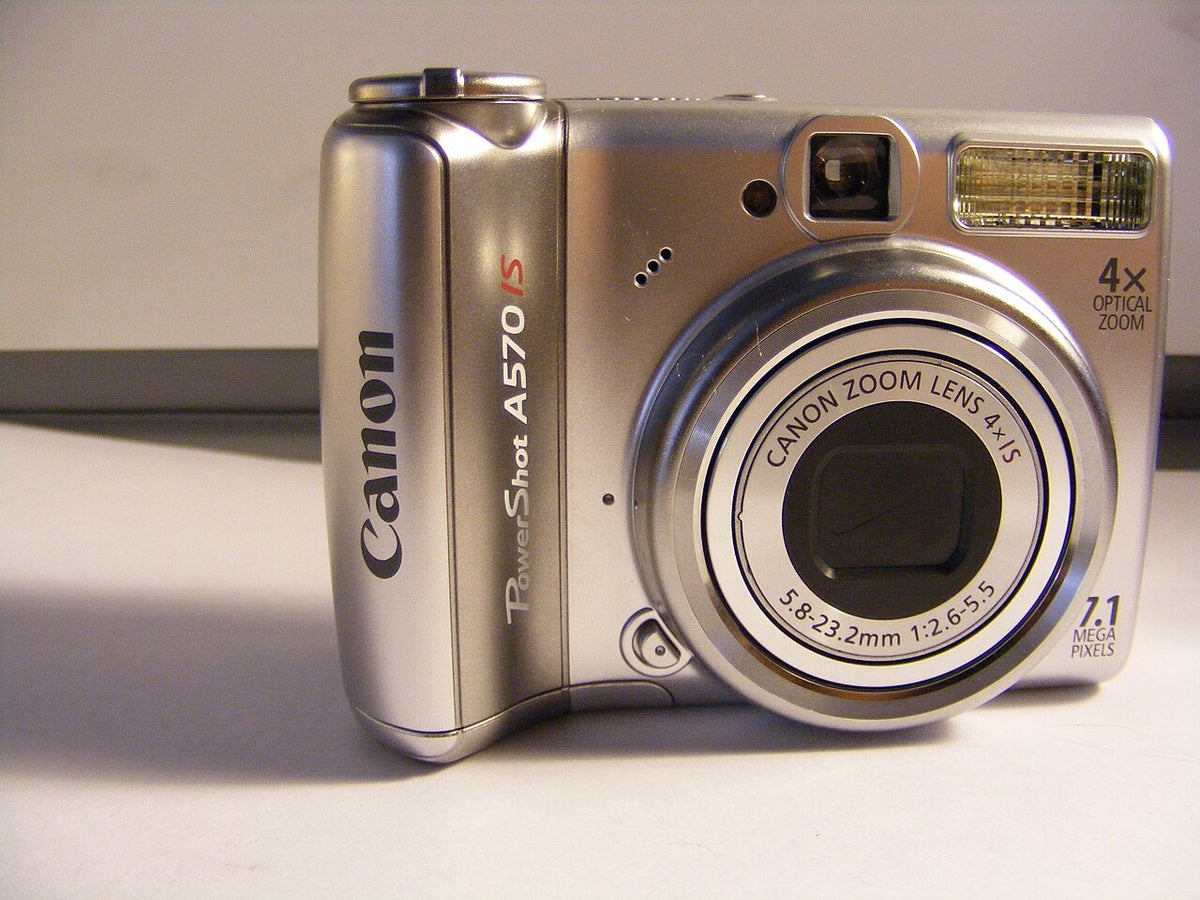
- Size, however, is different: an IXUS 100 IS is 18 mm thick, while a PowerShot A570 IS is nearly 43 mm. The IXUS fits in a jeans pocket, while the PowerShot A is carried on a wrist strap.
- Power source: all IXUS cameras run on lithium-ion batteries. The 2000s PowerShot A models (A520, A570 IS, A590 IS) and the SX110 IS take two AA batteries, a real asset when traveling.
- Settings: most IXUS cameras are limited to Auto and P modes. Some PowerShot A and high-end SX models offer P, Av, Tv, and M modes.
- Zoom: IXUS cameras max out at around 8x to 12x; PowerShot SX cameras go up to 40x.

The difference in brief
If you only remember one table, keep this one. It summarizes what distinguishes the two families on the used market, across all generations. Exceptions exist, and we detail them below, but these trends hold true for the vast majority of models.
| Criterion | IXUS | PowerShot |
|---|---|---|
| Size | Very slim, often around 18 to 22 mm | From compact with a grip (A) to bridge (S, SX) |
| Body | Metal on many models (IXUS 60, 105...) | Varies by series and model |
| Settings | Auto and P, rarely more | P, Av, Tv, M on some A, G, and high-end SX models |
| Power source | Lithium-ion battery | AA batteries on 2000s A models and the SX110 IS, battery thereafter |
| Viewfinder | Optical until the end of the 2000s, then none | Optical on classic A models, absent on recent A models |
| Zoom | 3x to 12x | 4x to 8x (A), 10x to 40x (SX) |
| Style | Pocket jewelry, 2000s look | More like a "camera", better grip |
Did you know?
An IXUS sold in the United States is called PowerShot SD, then PowerShot ELPH on newer models (the IXUS 175 is the PowerShot ELPH 180), and IXY in Japan. The IXUS 105, for example, is sold under the name PowerShot SD1300 IS. Technically, an IXUS is therefore a PowerShot from the "style" line. Manuals, batteries, and chargers are common to the different names.
Two names born in 1996
The two brands appeared in the same year, but not on the same medium. In July 1996, Canon launched the PowerShot 600, its first digital camera in the series: a 0.57 MP CCD sensor, a fixed focal length equivalent to 50 mm, no screen on the back, and 1 MB of internal memory, which is about four photos in full definition. The same year, the name IXUS appeared on a small film compact in APS format, called ELPH in the United States and IXY in Japan.
In 2000, the IXUS recipe went digital with the Digital IXUS (PowerShot S100 Digital ELPH in the United States): stainless steel body, 2 MP CCD sensor, 2x zoom, and CompactFlash cards. The same year, Canon launched the PowerShot G1, the first expert compact of the range. In 2003, the IXUS II adopted the SD card. From there, the two families advanced in parallel: the IXUS for style and the pocket, the PowerShot for everything else.
- PowerShot 600, first PowerShot; film IXUS in APS format.
- Digital IXUS, first digital IXUS; PowerShot G1, first expert compact.
- IXUS II: switch to SD card.
- PowerShot A520, A570 IS, A590 IS: the A series with AA batteries, with optical viewfinder.
- IXUS 100 IS, the slimmest of the Canon range at the time according to Cameralabs; IXUS 200 IS, first touchscreen IXUS.
- IXUS 105 and 130 switch to 28 mm; the IXUS 300 HS inaugurates the backlit CMOS at Canon.
- IXUS 175, 185, and 190, last IXUS with CCD sensor; SX620 HS (25x zoom).
- PowerShot SX740 HS: 40x zoom and 4K video.

The IXUS range: the jewelry compact
The IXUS has always had the same ambition: a camera slim enough to never stay at home. The first generations play the solid metal and optical viewfinder card. The IXUS 60 from 2006, for example, combines a 6 MP CCD sensor, a 35–105 mm zoom, an optical viewfinder, and a 2.5-inch screen in a 21.7 mm thick body. Three years later, the IXUS 100 IS drops to 18 mm with 12.1 MP and optical stabilization; Cameralabs then presents it as the slimmest compact in the Canon range, with an optical viewfinder considered tiny.
From 2009-2010, the viewfinder disappears in favor of larger screens, and the focal lengths widen. The IXUS 200 IS paved the way with a 24–120 mm and a 3-inch touchscreen, a first among IXUS cameras according to PhotographyBlog. The IXUS 105 adopts a 28–112 mm. The last CCD models, like the IXUS 175 from 2016, go up to 20 MP with an 8x zoom, but abandon optical stabilization in favor of a simple digital mode.
| Model | Sensor | Zoom (equiv.) | Stabilization | Battery | Weight / thickness |
|---|---|---|---|---|---|
| IXUS 60 (2006) | 6 MP CCD | 35–105 mm (3x) | None | NB-4L, ≈160 shots | ≈140 g empty, 21.7 mm |
| IXUS 100 IS (2009) | 12.1 MP CCD | 33–100 mm (3x) | Optical | NB-4L, 210 shots | 132 g, 18 mm |
| IXUS 200 IS (2009) | 12.1 MP CCD | 24–120 mm (5x) | Optical | NB-6L, ≈240 shots | ≈130 g empty, 22.9 mm |
| IXUS 105 (2010) | 12.1 MP CCD | 28–112 mm (4x) | Optical | NB-6L, ≈240 shots | ≈140 g, 21.2 mm |
| IXUS 145 (2014) | 16 MP CCD | 28–224 mm (8x) | Digital | NB-11L, ≈230 shots | ≈127 g, 22.1 mm |
| IXUS 175 (2016) | 20 MP CCD | 28–224 mm (8x) | Digital | NB-11L, ≈220 shots | ≈126 g, 22.1 mm |
| IXUS 285 HS (2016) | 20.2 MP BSI CMOS | 25–300 mm (12x) | Optical | NB-11LH, ≈180 shots | ≈147 g, 22.8 mm |
Regarding controls, an IXUS like the 105 is operated with a simple three-position mode dial, including automatic mode and P mode. This P mode leaves control of ISO, white balance, metering, and exposure compensation, but not aperture or shutter speed. For 90% of uses, especially parties with flash, this is more than enough. The details of each model are in our guide which Canon IXUS to choose.


The PowerShot: one family, several personalities
PowerShot is not a range, it is an umbrella. Under this name, Canon has grouped very different cameras, distinguished by the letter that follows. For the used market, four series really count.
| Series | Examples | Personality | Our guide |
|---|---|---|---|
| A | A520, A570 IS, A590 IS, A2200, A4000 IS | Consumer; AA batteries and viewfinder on 2000s models | A Series |
| SX | SX110 IS, SX200 IS, SX620 HS, SX740 HS | Travel zooms, from 10x to 40x | SX Series |
| G | G1, G9, G10, G11, G12 | Expert compacts, dials, RAW | Vintage G Series |
| S / bridges | S2 IS, SX10 IS | Large zooms with a grip | S2 IS and SX10 IS |
The A series is the closest to the IXUS in terms of use and price. Its 2000s models are recognizable by their rounded grip, which houses two AA batteries, and their optical viewfinder. The PowerShot A570 IS from 2007, for example, features a 7.1 MP CCD, a stabilized 35–140 mm zoom, an optical viewfinder, and P, Av, Tv, and M modes, for around 225 g with batteries. From 2011, the A series changes its face: the A2200, A3300 IS, or A4000 IS adopt a lithium-ion battery, lose the viewfinder, and get closer to the IXUS in size.
The SX series meets another need: zoom. The SX200 IS from 2009 already offers a 28–336 mm (12x) with a 12.1 MP CCD sensor. Recent models switch to CMOS and push the zoom very far: 25x for the SX620 HS (around 182 g), 40x and 4K video for the SX740 HS (around 299 g). These cameras remain compact, but are significantly thicker than an IXUS.


Same sensor, same rendering?
This is the question that comes up most often, and the answer is pretty much yes. On consumer compacts, Canon long used the same sensor sizes in both families: 1/2.5 inch on 2006-2008 models, then 1/2.3 inch. The technology also evolves at the same pace: CCD until the mid-2010s (the last CCD IXUS models are the 175, 185, and 190), then backlit CMOS, indicated by the HS label on IXUS models as well as PowerShots.
The similarities are sometimes striking. The IXUS 145 and the PowerShot A4000 IS share a 16 Mpx CCD sensor and a 5.0–40.0 mm focal length, which is a 28–224 mm equivalent, with the same NB-11L battery. The IXUS 105 and the PowerShot A2200 cover the same 28–112 mm with a one-year difference. The difference then lies in details that matter: optical stabilization or not, maximum aperture, metal or plastic body.
| Pair | Commonalities | What changes |
|---|---|---|
| IXUS 145 / A4000 IS | 16 Mpx CCD, 28–224 mm, NB-11L battery | A4000 IS: optical stabilization and f/3.0 instead of f/3.2; IXUS 145: lighter (≈127 g versus ≈145 g) |
| IXUS 105 / A2200 | CCD, 28–112 mm (4x) | IXUS 105: optical stabilization, aluminum body; A2200: 14.1 Mpx, NB-8L battery |
| IXUS 175 / SX620 HS (2016) | 20 Mpx, 1/2.3 inch | IXUS 175: CCD, 8x zoom; SX620 HS: CMOS, 25x zoom |
For the "2000s" look sought today, the real dividing line is therefore not IXUS versus PowerShot, but CCD versus CMOS. An IXUS 105 and a PowerShot A570 IS have the same type of flash rendering; an IXUS 285 HS and an SX740 HS, with CMOS sensors, produce files with a more neutral and modern rendering. Our article CCD or CMOS: what difference explains why, and the list of CCD cameras helps you check a model.
Image quality sensitivity by sensitivity
Since the sensors are close, their performance at different sensitivities is too. Tests from the time show comparable results: very good at low sensitivity, decent up to 400 ISO, to be reserved for small formats beyond that. The table below compares an IXUS and two generations of PowerShot A tested by TrustedReviews and PhotographyBlog.
| Sensitivity | IXUS 105 (TrustedReviews) | A590 IS (TrustedReviews) | A3400 IS / A4000 IS (PhotographyBlog) |
|---|---|---|---|
| 80–100 ISO | Very good, no noticeable flaws | Excellent at 80, slight colored grain at 100 | Clean, no visible colored noise |
| 200 ISO | Very fine grain, still very good | Visible noise | Practically identical to 100 ISO |
| 400 ISO | A little more noise, still printable | Noise attacks fine details | First drop, contours still good |
| 800 ISO | Smoothing erases fine details | Significant noise | Colored noise and JPEG artifacts |
| 1600 ISO | No more fine details | "Practically unusable" | Maximum, reserved for small formats |
What makes the difference in low light is not the range name but optical stabilization. A stabilized camera can lower the shutter speed without motion blur and keep a lower sensitivity. This is why Cameralabs placed the IXUS 105 ahead of a Nikon of the same resolution in low light, and why Reviewed.com recommended the A4000 IS rather than the A2400 IS in the same conditions.


AA batteries or lithium-ion battery
This is often the deciding factor. All IXUS models run on a proprietary lithium-ion battery: NB-4L for the IXUS 60 and 100 IS, NB-6L for the IXUS 105 and 200 IS, NB-11L for the IXUS 145 and 175. The stated battery life is around 160 to 240 shots according to the CIPA standard, which is enough for an evening but requires recharging, or having a spare battery.
The PowerShot A models from the 2000s run on two AA batteries. The A570 IS, A590 IS, or A520 accept standard alkaline batteries as a backup and NiMH rechargeable batteries for everyday use, with which the A series is reputed to last around 400 shots. On a trip, this is a clear advantage: no specific charger to carry, batteries available everywhere. The SX110 IS also runs on two AA batteries. Be careful with recent A models, however: from the A2200 and A3300 IS, the A series also switched to a lithium-ion battery (NB-8L then NB-11L).
Expert advice
On a battery-powered PowerShot A, keep the alkalines for emergencies and switch to rechargeable NiMH batteries for everyday use: it is with them that the A series reaches its reference battery life. Our article AA battery digicams details this point.
For an IXUS, check the battery condition before any purchase: a swollen battery should no longer be used, and our article swollen battery: what to do explains how to spot it. To find the right reference, consult our guide batteries for old digital cameras.
Handling and settings
An IXUS is held between two fingers. The body is smooth, often slippery, and all the controls are on the back: a mode slider, a directional pad, and a few buttons. It is a camera you take out, turn on, and shoot without thinking. TrustedReviews also noted regarding the IXUS 105 that its rounded shapes made it slippery; a wrist strap is not a luxury.
A 2000s PowerShot A is held in the full hand thanks to its grip. Models like the A570 IS or A590 IS add a mode dial with P, Av (aperture priority), Tv (shutter priority), and M (manual) modes, and an optical viewfinder that allows framing in full sun. It is a good camera for learning exposure without investing in an expert compact. The newer, thinner A models return to a logic close to the IXUS: automatic mode, P mode, and a screen without a viewfinder.
| Camera | Viewfinder | Screen |
|---|---|---|
| IXUS 60 (2006) | Optical, zooming | 2.5 inches |
| IXUS 100 IS (2009) | Optical (small) | 2.5 inches |
| IXUS 105 (2010) | None | 2.7 inches |
| IXUS 200 IS (2009) | None | 3-inch touchscreen |
| PowerShot A570 IS (2007) | Optical, ≈80% of the field | 2.5 inches |
| PowerShot A4000 IS (2012) | None | 3 inches |
If manual settings are your main criterion, also look at the PowerShot G or high-end SX models like the SX700 HS, which offer all the modes. Our article expert compact or digicam helps you decide between retro rendering and full control.
IXUS and PowerShot from our stock
These cameras have passed through our stock. Each copy is checked before being put up for sale: lens release, screen, flash, power supply, and a full-definition test photo.


What use, what camera
Rather than choosing a range, choose a use. Here are our ideas, all built from the detailed characteristics above.
| Your need | Our idea | Why |
|---|---|---|
| Flash parties, 2000s look | IXUS 60, 100 IS, 105 | CCD, metal body, jean pocket |
| Wide framing indoors | IXUS 200 IS, IXUS 105, A2200 | 24 or 28 mm equivalent |
| Travel without a charger | PowerShot A570 IS, A590 IS, SX110 IS | Two AA batteries available everywhere |
| Learn exposure | PowerShot A570 IS, A590 IS | P, Av, Tv, M modes and optical viewfinder |
| Versatile zoom, small budget | IXUS 145, IXUS 175, A4000 IS | 28–224 mm, CCD sensor |
| Large travel zoom | PowerShot SX620 HS, SX740 HS | 25x to 40x, CMOS sensor |
| Video | IXUS 285 HS, SX740 HS | Full HD or 4K depending on the model |
For party photos, the IXUS has a practical advantage: it fits in a pocket and can be pulled out in a second. For travel, the battery-powered PowerShot A remains unbeatable in terms of battery life. And if you mainly want to zoom, the SX series is in a league of its own. Once you've chosen your camera, our guide to digicam settings for a 2000s look applies to both families.
Expert tip
A wide-angle lens changes how you use your camera more than resolution does. Between a 35 mm (IXUS 60, A570 IS) and a 28 mm (IXUS 105, A2200), the difference indoors is that you can fit the whole table in the photo without backing up a meter. Look at the starting focal length before the megapixels.
Pre-purchase check before buying
Whether it's an IXUS or a PowerShot, the points to check are the same, with two specific details depending on the family.
- The lens: it must extend and retract without any grinding noise or "Lens Error" message. This is the most common fault in compact cameras with retractable zoom lenses. Our article on lens errors details the causes.
- The screen: no spots, lines, or dark areas.
- The sensor: on mid-2000s models, a black, purple, or blurry image can indicate a faulty CCD. See our article on CCD faults and recalls.
- The flash: take a photo with forced flash indoors.
- For the IXUS: the battery (not swollen, correct model) and the battery cover; on the IXUS 105, TrustedReviews reports a fragile plastic hinge.
- For the battery-powered PowerShot A: the battery compartment, where a leaked battery leaves signs of oxidation on the contacts.
- The memory card: older IXUS models often stop at SD or SDHC; check compatibility with our guide on which card for an older camera.
To check
Always ask for a photo taken that day with the camera, in full resolution. If the seller cannot provide it, assume the camera has not been tested. Our complete checklist: checks before buying a digicam.
At Vibes Photo, every camera is checked before being put up for sale and covered by a six-month commercial warranty, in addition to the legal warranties of conformity and against hidden defects. The details are in our general terms and conditions of sale.
Our verdict
IXUS and PowerShot are not opposed in terms of image quality: for the same era, they often use the same sensors. They differ in how you live with the camera. The IXUS is the compact camera you forget in your pocket and pull out for party photos. The PowerShot is the camera you choose for a specific reason: AA batteries, manual modes, or a powerful zoom.
Choose an IXUS if
- you want a very slim camera, often made of metal
- you are looking for the CCD look with flash (models up to 2017)
- Auto and P modes are enough for you
- you want a 24 or 28 mm wide-angle lens (from 2009-2010)
Choose a PowerShot if
- you want AA batteries (A models from the 2000s, SX110 IS)
- you want P, Av, Tv, and M modes (A570 IS, A590 IS, high-end SX)
- you want an optical viewfinder (classic A models)
- you want a 25x to 40x zoom (recent SX models)
If you are still undecided, ask yourself one question: does the camera need to fit in a jeans pocket? If so, IXUS. Otherwise, the PowerShot that suits your needs.
Frequently asked questions
What is the difference between a Canon IXUS and a PowerShot?
The IXUS is Canon's line of slim, metal compact cameras, designed for automatic mode. PowerShot is the generic name for Canon's other digital compact cameras: the consumer A series, the high-zoom SX series, and the expert G series.
Do the IXUS and PowerShot have the same sensor?
Often, for the same era. The IXUS 145 and PowerShot A4000 IS, for example, share a 16 MP CCD and a 28–224 mm zoom. The difference lies in the format, stabilization, and controls.
Which PowerShot takes AA batteries?
The PowerShot A models from the 2000s, such as the A520, A570 IS, and A590 IS, as well as the SX110 IS, take two AA batteries. From 2011, the A2200, A3300 IS, and A4000 IS switched to lithium-ion batteries.
Are IXUS and ELPH the same?
Yes. In the United States, IXUS cameras are sold under the PowerShot SD name, then PowerShot ELPH, and IXY in Japan. The IXUS 105, for example, is the PowerShot SD1300 IS.
Which is best for party photos?
An IXUS with a CCD sensor, such as the IXUS 60, 100 IS, or 105: it fits in your pocket, and the direct flash gives it a 2000s look. A PowerShot A with a CCD gives a similar look in a larger body.
Do IXUS cameras have manual modes?
Rarely. Most stop at P mode, which sets the sensitivity, white balance, and exposure compensation. For Av, Tv, and M modes, you should look at the PowerShot A570 IS, A590 IS, a high-end SX, or a G.
What does HS mean on an IXUS or PowerShot?
HS indicates a backlit CMOS sensor, which performs better in low light than older CCDs but lacks their distinctive look. Canon introduced it in 2010 with the IXUS 300 HS.
Vibes Photo
Find your Canon compact camera
We check every digicam before it goes on sale: lens, screen, flash, power supply, and test photo. Have a question about a model? Write to us.
Sources
- Cameralabs, Canon IXUS 100 IS / PowerShot SD780 IS (2009).
- PhotographyBlog, Canon Digital IXUS 200 IS Review (October 2009).
- Cameralabs, Canon IXUS 105 / PowerShot SD1300 IS and TrustedReviews, Canon IXUS 105.
- DPReview, Canon IXUS 60 / PowerShot SD600 announcement (2006).
- PhotographyBlog, Canon IXUS 145 Review (2014).
- DPReview, Canon PowerShot A570 IS and Canon Camera Museum.
- TrustedReviews, Canon PowerShot A590 IS.
- PhotographyBlog, Canon PowerShot A4000 IS and Reviewed, A2400 IS vs A4000 IS.
- Imaging Resource, PowerShot A2200.
- Imaging Resource, PowerShot SX620 HS and PhotographyBlog, PowerShot SX740 HS.
- Digital Camera World, the PowerShot 600 and iconic Canon compact cameras.
Images: Vibes Photo photos, unless otherwise stated under the image (author, license, and source indicated).