










Film Canon EOS: which model to choose?
The range of film Canon EOS cameras (650, 500N, 300, 30, EOS-3, EOS-1V), their differences, batteries, EF lens compatibility, and the right choice for your needs.
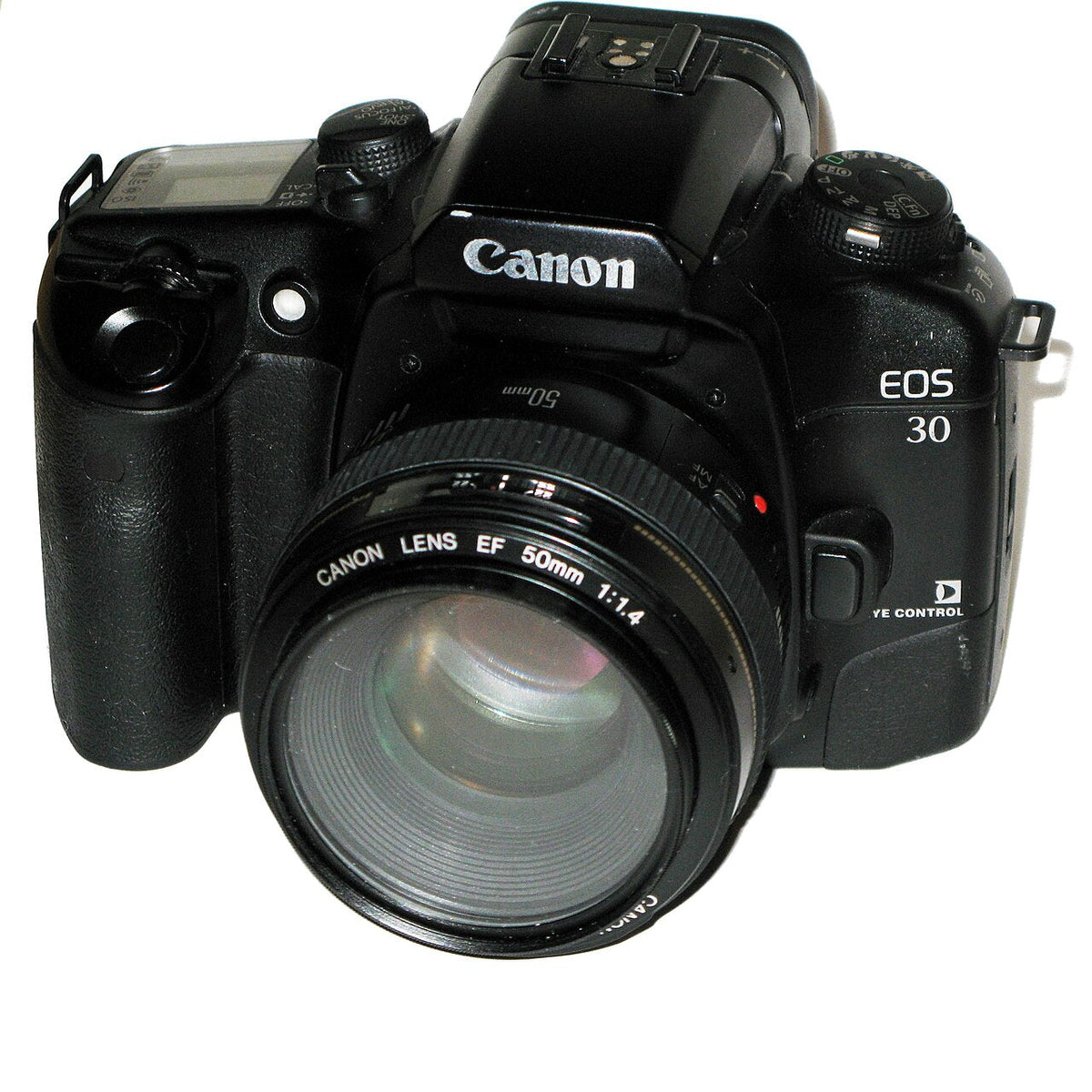
Canon film EOS cameras are one of the best deals in used film photography: autofocus, full automation, motor drives, and above all, the EF mount, the same as on Canon digital SLRs until 2018. An EOS 300 or an EOS 30 lets you shoot film with your digital SLR lenses. Here is the range, the differences between models and the right choice for your profile.
EOS: a system born for autofocus
Canon launched the EOS (Electro-Optical System) system in 1987 with the EOS 650. It broke with the FD mount: all mechanical connections between the body and the lens disappeared, the focus and the diaphragm are controlled electronically by motors in the lens. This mount is called EF. Then came the professional EOS-1 (1989), the entry-level EOS 1000 (1990), the EOS 5 (1992) with its eye-controlled focus, then a whole family up to the EOS 300X of 2004, the last film SLR designed by Canon. The EOS-1V, released in 2000, was manufactured until 2018.

The table of the main film EOS
| Model | Range | Speeds | Power | Features |
|---|---|---|---|---|
| EOS 650 (1987) | Expert | 30 s to 1/2000 s | 1 2CR5 battery | First EOS; depth of field mode |
| EOS 500N | Entry-level | 30 s to 1/2000 s | 2 CR123A batteries | 370 g; E-TTL flash with compatible flashes |
| EOS 300 (1999-2002) | Entry-level | 30 s to 1/2000 s | 2 CR2 batteries | 355 g; 35-zone evaluative metering; rewinding of already exposed film |
| EOS 300V | Entry-level | 30 s to 1/2000 s | 2 CR2 batteries | 365 g |
| EOS 3000 | Entry-level | — | 2 CR123A batteries | Pentaprism viewfinder, built-in flash |
| EOS 50 / 50E | Mid-range | 30 s to 1/4000 s | 1 2CR5 battery | Eye-controlled focus (50E) |
| EOS 30 / 33 (2000) | Mid-range | 30 s to 1/4000 s | — | 7 metering points; eye-controlled focus on the EOS 30 |
| EOS 5 (1992) | Expert | 30 s to 1/8000 s | 1 2CR5 battery | First EOS with eye-controlled focus |
| EOS-3 (1998) | Expert / pro | 30 s to 1/8000 s | 2CR5 | 45 metering points, eye-controlled focus |
| EOS-1V (2000) | Professional | — | — | Up to 10 images/s with the booster; produced until 2018 |
The boxes "—" correspond to unverified data in our sources; consult the model sheet before purchase.
Which film Canon EOS to choose?
To start at a low price: EOS 300, 300V, 500N
Lightweight (around 350 to 370 g), fully automatic but with aperture priority, shutter priority and manual mode, these are the most common EOS. The EOS 300 shares the autofocus system of the EOS 30, more expensive at the time. Particularity: it winds the whole film on loading then rewinds it frame by frame in the cartridge. If the back opens by accident, the photos already taken are protected. However, it is not compatible with infrared films, because it uses infrared light to count the frames.

For more advanced use: EOS 50E, EOS 30/33
The shutter goes up to 1/4000 s, the controls are more numerous and the construction more solid. The EOS 30 (also sold as EOS 7 in Japan and Elan 7E in the United States) has seven metering points, eye-controlled focus, and a motor drive up to 4 images/s. The EOS 33 is identical, without the eye control.

For the expert: EOS-3 and EOS-1V
The EOS-3 inaugurated the autofocus with 45 metering points taken by the EOS-1V and the first digital EOS-1D, with the same weather sealing as the EOS-1N. Its shutter is tested for 100,000 cycles, against at least 150,000 for the EOS-1V. The EOS-1V was, at its release, the fastest film SLR with a moving mirror ever produced: 10 images/s with the PB-E2 booster.

The lenses: the great asset of the EOS
All EF lenses work on film EOS, autofocus included: those of your Canon full-frame digital SLR, the kit zooms, and the famous EF 50 mm f/1.8. Be careful however with EF-S lenses, which appeared in 2003 with the EOS 300D: they are designed for APS-C sensors and are not intended for film EOS. For Canon digital SLRs, see the Canon EOS 300D to 40D digital EOS and the Canon EOS 5D; for mounts in general, film lens mounts and the 50 mm in film.

The points to check before buying
- The LCD screen: it must be readable, without leaks or missing segments.
- The battery: depending on the model, 2CR5, CR2 or CR123A, to provide before trying. See what battery for a film camera.
- The back and the counter: load a test film; the advance and rewinding must be regular.
- The foam of the back, the origin of light leaks.
More tests in our checklist for buying a used film camera. For the complete Canon range, from the AE-1 to the Prima compacts, see our guide to Canon cameras and the Canon AE-1 if you prefer manual focus.
Want to see more images? Browse the most popular photos taken with a Canon EOS 300 on Lomography (Lomography community gallery, photos protected by the copyright of their authors).
All cameras sold by Vibes Photo are checked before being put on sale and covered by a six-month commercial warranty, in addition to legal warranties. The detail is in our general terms and conditions of sale.
Frequently asked questions
Do my digital Canon lenses work on a film EOS?
Yes for EF lenses, autofocus included. EF-S, designed for APS-C sensors, are not intended for film EOS.
What is the best film Canon EOS?
The EOS-1V is the most advanced; the EOS-3 and the EOS 30 offer an excellent compromise. To start, the EOS 300 or the 500N are more than enough.
What battery for a Canon EOS 300?
Two CR2 lithium batteries.
Is a film EOS a good first camera?
Yes: its automatic mode allows you to start without knowledge, then the priority and manual modes allow you to learn.
What was the last film Canon?
The EOS 300X (2004) is the last film SLR designed by Canon; the EOS-1V was manufactured until 2018.
Sources: Wikipedia – Canon EOS; Wikipedia – Canon EOS-1V; Wikipedia – Canon EOS-3; Wikipedia – Canon EOS 300; Camera-wiki – Canon EOS 300; Camera-wiki – Canon EOS 30; Camera-wiki – Canon EOS 500N.