










Used Canon EOS 5D and 5D Mark II: affordable full-frame cameras
The Canon EOS 5D made full-frame accessible in 2005, and the 5D Mark II added Full HD video. Differences, compatible lenses, and used-market checks.
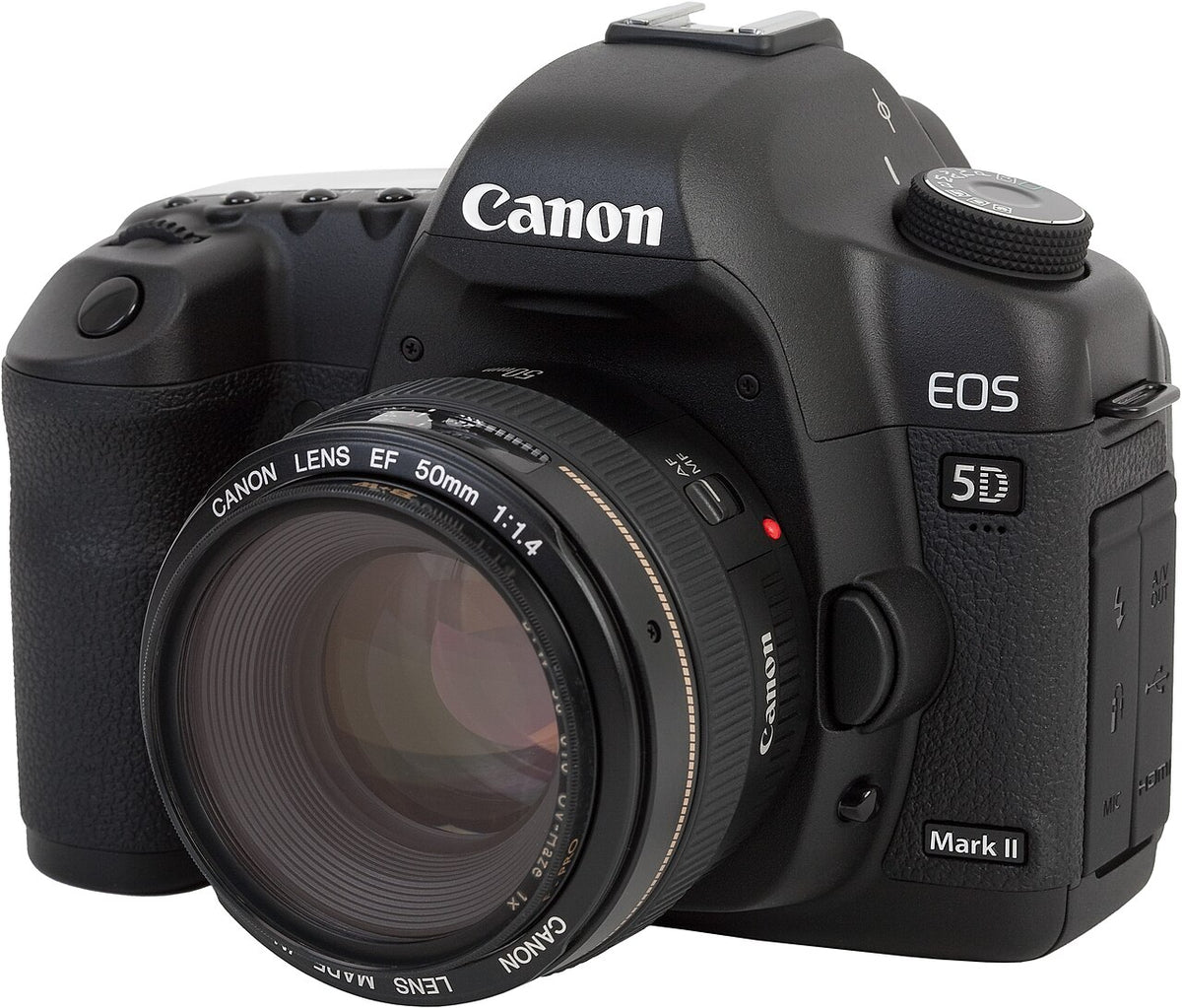
The Canon EOS 5D (2005) was one of the first relatively affordable full-frame DSLRs: 12.8 MP, soft rendering, and shallow depth of field that are still appealing today. The 5D Mark II (2008) moves up to 21.1 MP, a 3-inch screen, and above all, Full HD video. For pure photography on a tight budget, the original 5D remains appealing; for versatility, the Mark II is more modern. Note: neither accepts EF-S lenses.
5D or 5D Mark II: the differences
| EOS 5D (2005) | EOS 5D Mark II (2008) | |
|---|---|---|
| Sensor | 12.8 MP full-frame CMOS | 21.1 MP full-frame CMOS |
| Continuous shooting | 3 fps | 3.9 fps |
| Screen | 2.5 inches, 230,000 dots | 3 inches, 920,000 dots |
| Video | No | Full HD 1920 x 1080 |
| Card | CompactFlash | CompactFlash (UDMA) |
| Battery | BP-511A | LP-E6 |
Sources: Canon Camera Museum (EOS 5D), Canon spec sheet (EOS 5D Mark II), DPReview.
Why full-frame?
A 24 x 36 mm sensor, the size of a 35 mm negative, offers better low-light performance at the same generation, more pronounced background blur, and focal lengths that retain their "film" angle: a 50 mm behaves like a 50 mm. It is also ideal for reusing adapted vintage lenses. If you are coming from film, read film or vintage digital.
Lenses to pair with it
Only EF lenses (Canon, Sigma, Tamron, Tokina in full-frame version) are compatible. The EF 50 mm f/1.8 and the EF 50 mm f/1.4 are the classic fast choices; the 24-105 mm f/4 L and 24-70 mm f/2.8 L zooms are the versatile standards. Mounting an EF-S is impossible: the rear element risks hitting the mirror. See our guide to lenses and mounts.

Limitations to be aware of
- 9-point autofocus, effective mainly in the center;
- no sensor cleaning on the original 5D (present on the Mark II);
- no live view on the original 5D;
- heavy bodies, slow continuous shooting for sports.
Checks before buying a used body
- Shutter count: for Nikon, it is generally found in the EXIF data of the photos; for Canon, a third-party software is often required. A high number is not necessarily a dealbreaker, but it influences the price.
- The sensor: photograph a plain sky at f/16 to spot dust, and check for dead pixels.
- The viewfinder and screen: clean, without mold or deep scratches.
- The dials, buttons, and flaps: all functional, card flap properly closed.
- The mount: no play, clean contacts.
- The battery and charger: original or high-quality compatible ones.
Note: Canon issued a service bulletin regarding a rare risk of the main mirror detaching from the original 5D (degrading glue). Free repair ended in September 2015 and Canon indicates it can no longer repair this model: check that the mirror is properly secured and ask the seller if it has been reinforced.
For the complete Canon range: our guide to Canon cameras and the EOS APS-C DSLRs.
At Vibes Photo, each camera is checked before being put on sale and covered by a six-month commercial warranty, in addition to the legal warranties of conformity and hidden defects. Details are in our general terms and conditions of sale.
Frequently asked questions
Is the Canon 5D still good today?
Yes for photography: its 12.8 MP full-frame sensor provides an appealing rendering. However, it is limited in autofocus and screen, and it does not shoot video.
Does the 5D Mark II shoot in Full HD?
Yes, in 1920 x 1080. It is one of the DSLRs that popularized video in DSLR format.
Can you mount an EF-S lens on a 5D?
No, only EF lenses are compatible with Canon full-frame bodies.
What battery for the 5D Mark II?
The LP-E6, different from the BP-511A of the original 5D.
Main image: Canon EOS 5D Mark II full-frame DSLR equipped with a 50 mm f/1.4 lens. Photo: Charles Lanteigne, CC BY-SA 3.0, via Wikimedia Commons