










DSLR and mirrorless lenses and bodies: the compatibility guide
EF or EF-S, AF-S or AF-D, A or E mount: the guide to understanding the mounts of digital DSLRs and mirrorless cameras and buying the right used lens.
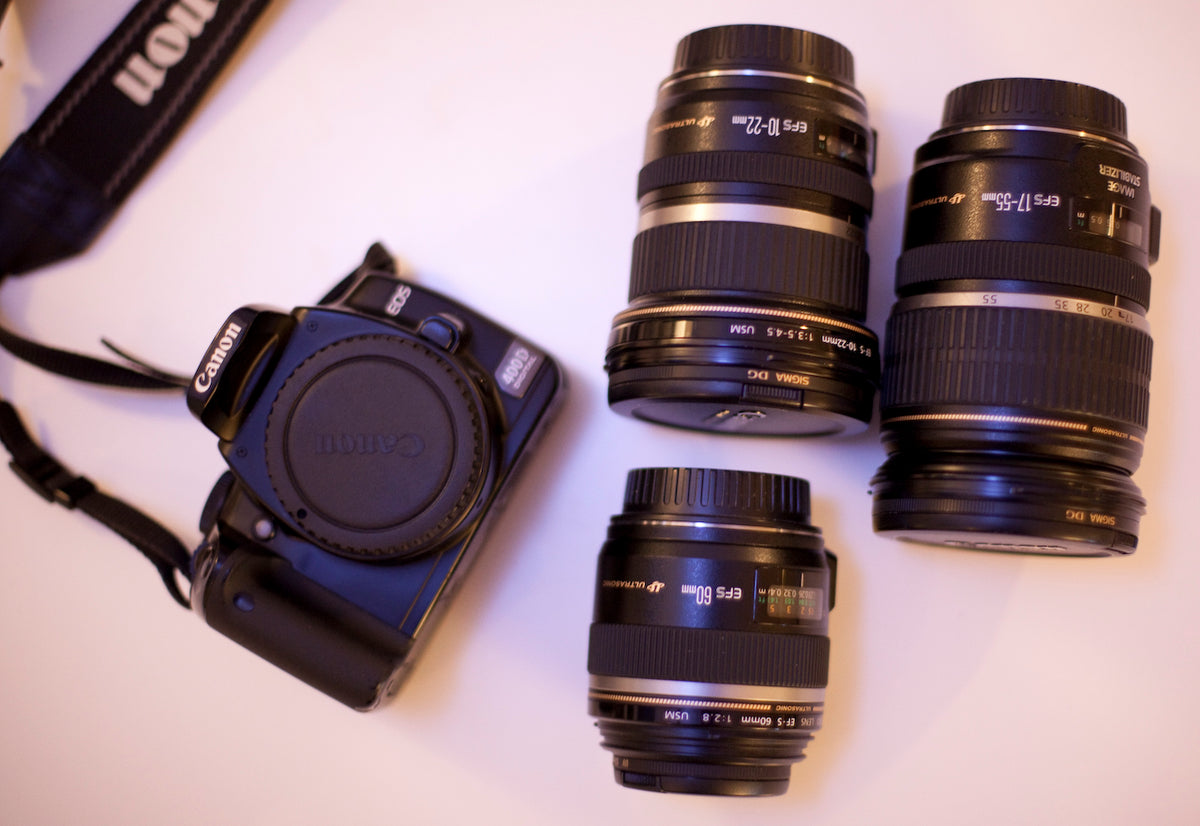
On an interchangeable lens camera, the mount determines everything: which lenses you can attach, whether they support autofocus, and which adapters are available. The essential rules: with Canon, EF lenses fit all EOS cameras, while EF-S lenses only fit APS-C bodies. With Nikon, the F mount is standard, but autofocus depends on the motor (AF-S in the lens, AF-D in the camera body). Mirrorless cameras (Sony E, Micro 4/3, Fujifilm X) can adapt almost any vintage lens for manual focus.
The main mounts
| Mount | Cameras | Format | Good to know |
|---|---|---|---|
| Canon EF | All EOS DSLRs | Full-frame and APS-C | Compatible with all EOS DSLRs |
| Canon EF-S | APS-C EOS (300D, 350D, 40D…) | APS-C | Not for full-frame cameras (5D…) |
| Nikon F (DX / FX) | Nikon DSLRs | APS-C (DX) and full-frame (FX) | AF-D: autofocus only with a camera-body motor |
| Sony / Minolta A | Alpha DSLRs (A100…) | APS-C and full-frame | Compatible with Minolta AF lenses |
| Sony E | NEX, Alpha 6000… | APS-C and full-frame | Very easy to adapt |
| Micro 4/3 | Olympus PEN, OM-D, Panasonic G | 4/3 | 2x crop factor |
| Fujifilm X | X-T, X-E, X-Pro… | APS-C | XF and XC lenses |
| Pentax K | Pentax DSLRs (K10D, K200D…) | APS-C and full-frame | Compatible with many vintage K lenses |
Canon: EF and EF-S
The EF mount dates back to 1987, and the EF-S variant was introduced in 2003 for APS-C sensors. An EF-S lens cannot be attached to a 5D: its rear element could strike the mirror. Conversely, an EF lens works on all EOS DSLRs. See our Canon EOS DSLRs and the Canon 5D.
Nikon: DX, FX, AF-S and AF-D
Nikon DSLRs have retained the F mount since 1959, but compatibility varies:
- AF-S / AF-P: motor in the lens, autofocus on all recent DSLRs (AF-P depending on the camera body);
- AF / AF-D: autofocus only on camera-body motor models (D70, D80, D90, D200, D700…), manual focus on the D40, D60, D3000, and D5000;
- DX: lenses for APS-C; on an FX body, they operate in crop mode.
See our Nikon D40 to D90 comparison.

Mirrorless: the realm of adapters
Mirrorless cameras have no mirror: the lens is closer to the sensor, leaving room for an adapter ring. A Sony NEX, Olympus PEN, or Fujifilm X-T can therefore mount vintage film lenses (M42, Canon FD, Minolta MD, Nikon F, Pentax K, Leica M) for manual focus. See Sony NEX, Olympus PEN and OM-D, and Fujifilm X-T.
Tip: adaptation is more limited on DSLRs. An M42 lens easily adapts to a Canon EOS with a simple ring, but not a Canon FD without a correction element (resulting in loss of image quality and infinity focus).
The crop factor
| Sensor | Factor | A 50 mm lens frames like… |
|---|---|---|
| Full-frame (24 x 36) | 1x | 50 mm |
| Nikon, Sony, Pentax, Fujifilm APS-C | 1.5x | 75 mm |
| Canon APS-C | 1.6x | 80 mm |
| Micro 4/3 | 2x | 100 mm |
Checking a used lens
- lenses free of scratches, mold, or haze (look through them with a flashlight);
- smooth focus and zoom rings without sticking points;
- responsive aperture blades free of oil;
- clean electrical contacts.
For maintenance, see our maintenance guide.
At Vibes Photo, every camera is inspected before being put up for sale and covered by a six-month commercial warranty, in addition to statutory warranties for conformity and hidden defects. Details can be found in our general terms and conditions of sale.
Frequently asked questions
Is an EF-S lens compatible with a full-frame Canon?
No. EF-S lenses are reserved for Canon APS-C DSLRs. EF lenses work on all EOS DSLRs.
What is the difference between Nikon AF-S and AF-D?
AF-S lenses have a motor in the lens and autofocus on all Nikon DSLRs; AF-D lenses use the camera-body motor, which is absent on the D40, D60, D3000, and D5000.
Can you mount a film lens on a digital camera?
Yes, especially on a mirrorless camera with an adapter ring, for manual focus. On a DSLR, this is only possible with certain mounts.
What is the crop factor?
It is the ratio between the size of a full-frame sensor and that of a smaller sensor. It changes the framing achieved with a given focal length.
Main image: Canon EOS 400D DSLR surrounded by three Canon EF-S lenses. Photo: Eirik Solheim, CC BY-SA 2.0, via Wikimedia Commons