










Used Sony Alpha and NEX: A100, NEX-5, NEX-7—which camera should you choose?
Sony has two used families: the Alpha DSLRs with the A mount, heirs to Minolta, and the NEX mirrorless cameras with the E mount. A100, NEX-5, NEX-5N, NEX-6 and NEX-7 compared.
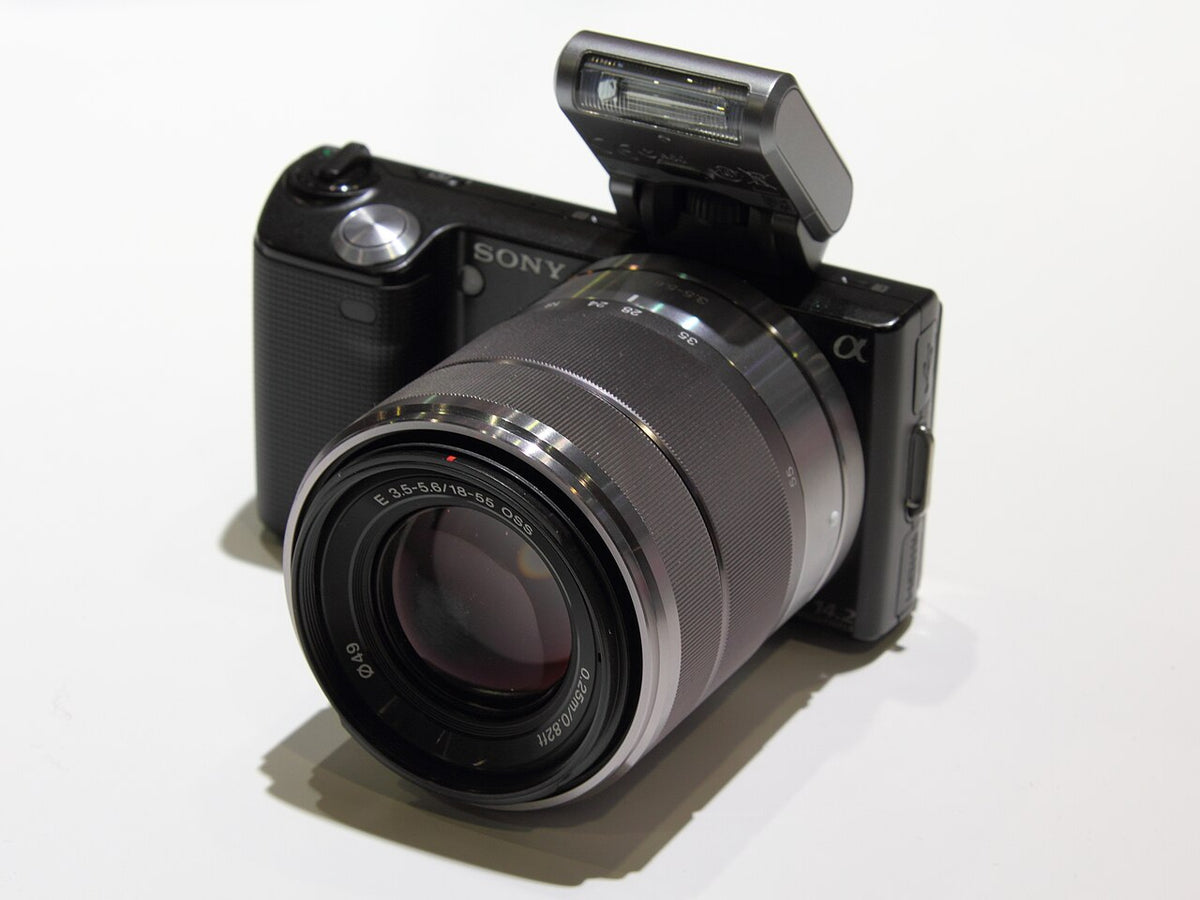
Sony offers two used camera ranges. Alpha DSLRs with an A mount (starting with the A100 from 2006) use Minolta's autofocus mount and feature in-body image stabilization. NEX mirrorless cameras with an E mount (starting with the NEX-3 and NEX-5 from 2010) are very compact and easily adapt almost any vintage lens. For an affordable first mirrorless camera, a NEX-5N or NEX-6 is an excellent choice; the NEX-7 offers 24.3 Mpx and a built-in viewfinder.
Comparison table
| Model | Type | Sensor | Feature |
|---|---|---|---|
| Alpha A100 (2006) | A mount DSLR | 10.2 Mpx APS-C CCD | In-body Super SteadyShot stabilization |
| NEX-5 (2010) | E mount mirrorless | 14.2 Mpx APS-C CMOS | Very compact, optional viewfinder |
| NEX-5N | E mount mirrorless | 16.1 Mpx APS-C CMOS | Tilting touchscreen |
| NEX-6 | E mount mirrorless | 16 Mpx APS-C CMOS | Built-in electronic viewfinder |
| NEX-7 | E mount mirrorless | 24.3 Mpx APS-C CMOS | Built-in electronic viewfinder and flash |
Sources: Sony, Wikipedia (Sony Alpha 100, list of Sony E mount cameras), DPReview.
The Alpha A100: the stabilized CCD DSLR
The first Sony DSLR, the A100 directly inherits Minolta's technology. Its 10.2 Mpx CCD sensor and built-in stabilization work with all Minolta and Sony A mount autofocus lenses, which are often affordable used. It is part of the list of CCD cameras.

The NEX: a playground for vintage lenses
The E mount has a very short mechanical flange: with a simple adapter ring, you can mount Minolta MD, Canon FD, Nikon F, M42, Leica M... film lenses... in manual focus. The NEX cameras offer focus assistance (magnification and "focus peaking" on the NEX-5N, NEX-6 and NEX-7). Sony also produced LA-EA adapters for mounting A mount lenses.

Which one to choose?
- NEX-5: the smallest, but no built-in viewfinder and menu-based ergonomics;
- NEX-5N: better sensor, touchscreen, very good compromise;
- NEX-6: built-in viewfinder and mode dial, the most pleasant for everyday use;
- NEX-7: 24.3 Mpx and two dials, for the most demanding users.
Tip: the NEX cameras use the NP-FW50 battery, common to many Sony APS-C mirrorless cameras up to the Alpha 6500. Good quality compatible batteries are easily found.
Checks before buying a used camera body
- Shutter count: for Nikon, it is generally found in the EXIF data of the photos; for Canon, a third-party software is often needed. A high number is not a dealbreaker, but it influences the price.
- The sensor: photograph a plain sky at f/16 to spot dust, and check for dead pixels.
- The viewfinder and screen: clean, without mold or deep scratches.
- The dials, buttons and flaps: all functional, card flap properly closed.
- The mount: no play, clean contacts.
- The battery and charger: original or good quality compatible ones.
The entire brand: our Sony camera guide. Lenses and adapters: our lens and mount guide.
At Vibes Photo, each camera is checked before being put on sale and covered by a six-month commercial warranty, in addition to the legal warranties of conformity and hidden defects. The details are in our general terms and conditions of sale.
Frequently asked questions
What is the difference between A mount and E mount on Sony?
The A mount equips Alpha DSLRs (inherited from Minolta); the E mount equips recent NEX and Alpha mirrorless cameras. An LA-EA adapter allows mounting A lenses on an E body.
Does the Sony NEX-5 have a viewfinder?
No, it is framed on the screen. An optional electronic viewfinder exists for some NEX models; the NEX-6 and NEX-7 have one built-in.
Can you mount film lenses on a Sony NEX?
Yes, with an adapter ring suitable for the lens mount, in manual focus.
Does the Sony A100 have a CCD sensor?
Yes, a 10.2 Mpx APS-C CCD, with in-body stabilization.
Main image: Sony NEX-5 mirrorless camera with its clip-on flash and an E mount lens. Photo: decltype, CC BY-SA 3.0, via Wikimedia Commons