










Canon IXUS 80 IS: review, specifications and buying advice
Canon IXUS 80 IS (PowerShot SD1100 IS): full review, specifications, image stabilization and viewfinder, image quality, flash, responsiveness, comparison with the IXUS 70, 85 IS and 95 IS, and pre-purchase checklist.
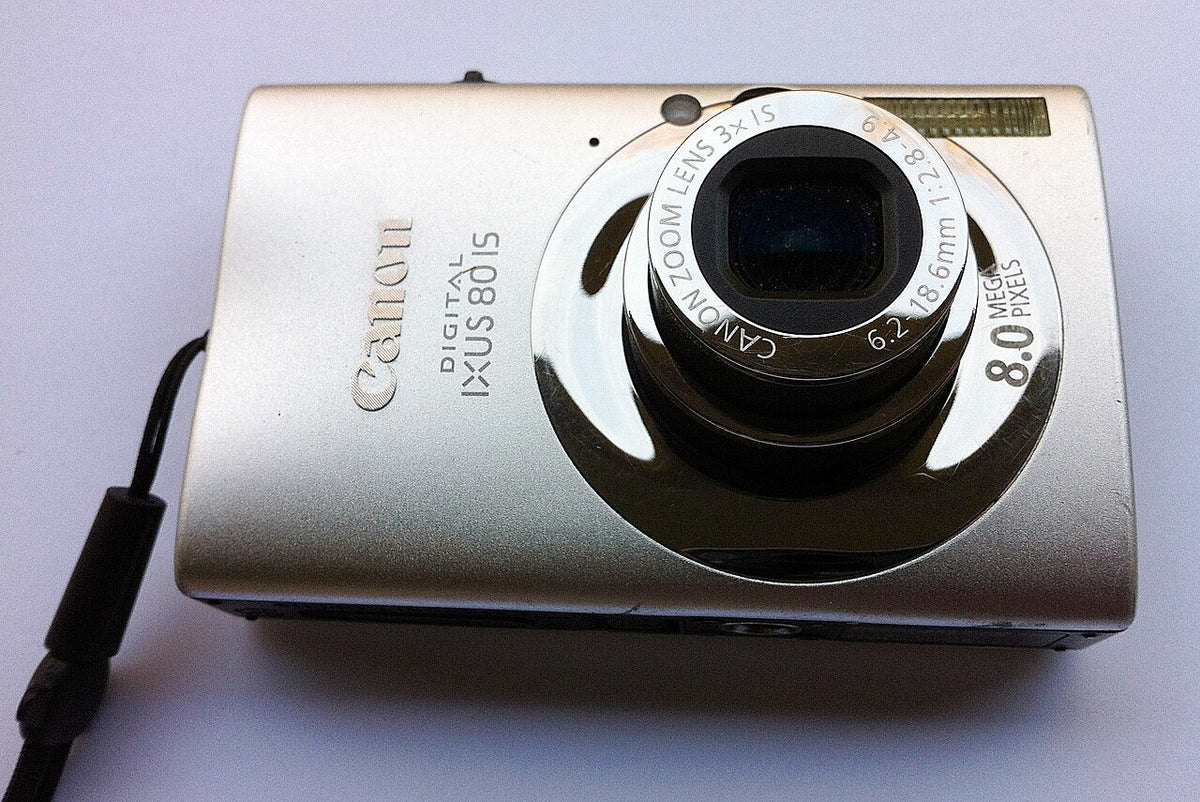
Reference sheet · Digicam · Updated November 2026
Announced in early 2008, the Canon IXUS 80 IS (PowerShot SD1100 IS) packed into a credit card-sized body what few compacts offered: an 8 Mpx CCD, an optical viewfinder, and optical image stabilisation. Here is what it is really like, with measurements to back it up, and how to choose one second-hand.
The IXUS 80 IS is one of the most common IXUS models on the second-hand market, and for good reason. In 2008, it retained the very slim silhouette of the IXUS 70 and added what was missing: optical stabilisation, which reduces camera shake blur indoors and when zoomed. It retains a small optical viewfinder, comes in a range of colours (silver, but also brown, blue, pink or caramel depending on the market), and sells for around 250 dollars or 210 pounds. DPReview sums it up in one sentence: a very good camera, "a little dull". Today, this subdued character is precisely what makes it a good first digicam: simple, reliable, and with a typical CCD look. Here are the details.
The essentials in 30 seconds
- The highlight: optical stabilisation and an optical viewfinder in a 125 g body, a rare combination.
- The look: 8 Mpx CCD, accurate colours and clean images at low sensitivity; visible noise from 400 ISO, pronounced at 800.
- The limitations: only a 38 mm wide-angle, a slightly weak flash (3.5 m), and an orange white balance under incandescent light.
- Responsiveness: ready in less than a second, focus in 0.3 s at wide-angle according to DPReview.
- The right approach: check the lens, stabilisation, and the condition of the NB-4L battery.

An IXUS 70 with stabilisation
To understand the IXUS 80 IS, you have to start with the IXUS 70, one of the most popular compacts of 2007. Thin and metallic, it produced good images but had no stabilisation. The IXUS 80 IS corrects this with a lens-shifting optical stabiliser, increases from 7.1 to 8 megapixels, and improves face detection and red-eye correction. The Register calls it an evolution rather than a revolution, and that is exactly what it is.
The price to pay is a slight step back in wide-angle: the 3x zoom covers an equivalent 38 to 114 mm, whereas the IXUS 70 started at 35 mm. Indoors, these three millimetres are noticeable: you have to step back a little further to frame a group. On the other hand, the stabiliser allows you to shoot at slower shutter speeds without camera shake blur, which matters more for ambient photos without flash.
- IXUS 70: 7.1 Mpx, 35–105 mm, no stabilisation.
- IXUS 80 IS announced before the Las Vegas PMA show.
- DPReview review: "a very good camera, a little dull".
- IXUS 85 IS and IXUS 90 IS: 10 Mpx, the 90 IS with a 3-inch screen.
- IXUS 95 IS, one of the last with a viewfinder.
Did you know?
The IXUS 80 IS has three names: Digital IXUS 80 IS in Europe, PowerShot SD1100 IS Digital ELPH in the United States, and IXY Digital 20 IS in Japan. The accessories are common, which expands the choice of batteries and chargers.
Technical sheet
- Sensor
- 1/2.5-inch CCD, 8 effective megapixels
- Processor
- DIGIC III
- Lens
- 6.2–18.6 mm f/2.8–4.9, or 38–114 mm equivalent (3x zoom)
- Stabilisation
- Optical, several modes (continuous, shooting only, panoramic)
- Viewfinder
- Optical, coupled with the zoom
- Screen
- 2.5 inches, approximately 230,000 dots
- Sensitivity
- 80 to 1600 ISO, plus Auto and High ISO Auto
- Macro
- From 3 cm at wide-angle
- Flash
- 30 cm to 3.5 m at wide-angle, 30 cm to 2 m at telephoto
- Video
- 640 × 480 and 320 × 240 at 30 fps, Motion JPEG (AVI), mono sound
- Cards
- SD, SDHC, MMC
- Battery
- NB-4L, approximately 240 shots (CIPA)
- Dimensions
- 86.8 × 54.8 × 22 mm
- Weight
- Approximately 125 g without battery or card
Sources: Canon technical sheet and user guide, Canon Camera Museum, DPReview reviews (2008), and The Register.
Measured responsiveness
DPReview timed the IXUS 80 IS in detail, and the results are good for a 2008 compact. The camera is ready to shoot in just under a second after turning it on. Focus takes about 0.3 seconds at wide-angle and 0.5 seconds at telephoto, then 0.7 and 1 second in low light. Once focus is locked, the shutter lag drops to about 0.1 seconds.
| Operation | Time | What it means |
|---|---|---|
| Power-on | Just under 1 s | Ready as soon as it leaves your pocket |
| Focus, wide-angle | 0.3 s (0.7 s in low light) | Fast during the day |
| Focus, telephoto | 0.5 s (1 s in low light) | Anticipate indoors |
| Lag after focus | About 0.1 s | Pre-frame halfway through |
| Shot to shot | 1.6 s without flash, 2.1 to 3.2 s with | The flash slows the pace |
| Burst mode | About 1.3 shots/s | Not for sports |
In practice, the trick is to press the shutter halfway to focus, then wait for the right moment to fully press it. The shutter becomes almost instantaneous. The FUNC. menu, accessible via a central button, allows you to change the sensitivity, white balance, or My Colors effects without digging through the menus; DPReview also praises the dedicated ISO button and a very intuitive interface.
Expert tip
In the evening, keep your finger halfway on the shutter while you frame: focus is locked, and the photo is taken in a tenth of a second when everyone smiles.
Stabilisation and viewfinder
The optical stabiliser is the real novelty compared to the IXUS 70, and DPReview judges it effective. It offers several modes: continuous (the image is constantly stabilised on the screen), shooting only (it activates when you take a shot, which saves a little battery and gives a more natural view), and panoramic (it only corrects vertical movement when you follow a subject). For most uses, shooting only mode is the best choice.
The optical viewfinder is more controversial. The Register finds it practical in bright light; DPReview judges it so small that it is almost useless. The truth is somewhere in between: it does not replace the screen for precise composition, but when the sun makes the screen unreadable, it at least allows you to aim. As with all compacts with a viewfinder, the framing shifts when close (parallax): under one metre, use the screen.


Image quality
At low sensitivity, the IXUS 80 IS gives good results. DPReview notes decent sharpness from edge to edge, clean colours that are easy to print, and good resolution for its category. The Register finds the colours accurate, the details sharp, and the exposure reliable even in automatic mode. Barrel distortion at wide-angle is low, around 1.1%, and zero at telephoto.
The limitations appear when the light drops. DPReview notes clean images up to 400 ISO with the first patches of colour noise in low-contrast areas, then very visible noise and smoothing from 800 ISO. PhotographyBlog also cites noise at medium and high sensitivities as the main weakness. Another noted flaw: a tendency to blow out highlights, which DPReview advises compensating for with negative exposure compensation.
| Sensitivity | Look | Recommended use |
|---|---|---|
| 80 to 200 ISO | Clean, faithful colours | Outdoors, prints |
| 400 ISO | Still clean, slight colour noise | Bright indoors |
| 800 ISO | Very visible noise and smoothing | Screen, grain effect |
| 1600 ISO | Very degraded | Avoid, unless the effect is intended |

The My Colors effects (Positive Film, Vibrant, Sepia, black and white) and Color Accent, which keeps a single colour in a black and white image, allow you to style directly while shooting. For a more pronounced CCD look, Vibrant is the most used setting. Our article digicam settings for a 2000s look details these options.
Flash and evening photos
The flash reaches from 30 cm to 3.5 m at wide-angle and only up to 2 m at telephoto. DPReview judges it a little weak, with a slight tendency to underexpose and a slightly warm tone, but without blown-out highlights. Its recycle time is fast, even with red-eye reduction. Practical conclusion: stay close to your subject, one or two metres away, and avoid zooming when using the flash.
Under artificial light without flash, the automatic white balance is the weak point: DPReview notes a marked orange cast under incandescent light. The presets do better. For a faithful ambient photo, choose the Tungsten preset; for a warm and nostalgic look, leave it on automatic.
| Situation | Setting | Why |
|---|---|---|
| Group photo | Wide-angle, forced flash, 1 to 2 m | The flash only reaches 3.5 m |
| Ambient without flash | Active stabilisation, 400 ISO, Tungsten preset | Avoid the orange cast |
| Faces too bright | Correction −1/3 to −2/3 | Limits blown-out highlights |
| More vivid colours | My Colors: Vibrant | More typical CCD look |
Video and battery
Video is limited to 640 × 480 or 320 × 240 at 30 frames per second, plus a small 160 × 120 format at 15 frames per second designed for emailing back then. DPReview judges the video quality good for the category and highlights a time-lapse mode that takes an image every one or two seconds. For "pocket camera" videos with a 2000s look, this is exactly what we are looking for.
The NB-4L battery is rated for about 240 shots according to the CIPA standard, a figure that DPReview finds average, or even a little weak, especially if you use the flash or the playback screen a lot. A spare battery is highly recommended for an evening or a weekend. The original batteries are often over fifteen years old: check that they are not swollen, our article swollen battery explains how to do it.
To check
The IXUS 80 IS accepts SD and SDHC cards. A 4 to 8 GB SDHC is more than enough: it holds several thousand 8 Mpx photos. SDXC cards are not recognized. See our guide which memory card for an old camera.
IXUS 70, 80, 85 or 95?
The IXUS 80 IS belongs to a family of very similar compact cameras, released between 2007 and 2009. They share the same spirit, with differences that matter depending on how you use it.
| Model | Sensor | Zoom | Stabilization | Battery |
|---|---|---|---|---|
| IXUS 70 | 7.1 Mpx CCD | 35–105 mm | None | NB-4L |
| IXUS 80 IS | 8 Mpx CCD | 38–114 mm | Optical | NB-4L |
| IXUS 85 IS | 10 Mpx CCD | 35–105 mm | Optical | NB-6L |
| IXUS 95 IS | 10 Mpx CCD | 35–105 mm | Optical | NB-6L |
The IXUS 70 is the thinnest and cheapest, but has no stabilization. The IXUS 85 IS and 95 IS offer 10 Mpx and a 35 mm wide-angle lens; the 95 IS also boasts an advertised battery life of up to 700 shots with the screen off. The IXUS 80 IS remains the most common compromise, and therefore the easiest to find in good condition.


To learn more, read our reviews of the IXUS 70, IXUS 85 IS and IXUS 95 IS, or our guide which Canon IXUS to choose.
Pre-purchase check list
- The lens: opens and closes without any issues or "Lens Error" message. See our article on lens errors.
- Stabilization: at telephoto, a constantly jumping image or clicking sound may indicate a fault.
- The viewfinder: clear, free from dust or fogging, and zooms with the lens.
- The screen: no deep scratches, lines or spots.
- The battery and card cover: it must close firmly.
- The battery: NB-4L, not swollen, holds a charge, with its charger.
- The test photo: in full resolution, check the sharpness of the corners and the absence of spots.
To check
DPReview found softer corners on its test copy. On a used camera, photograph a textured wall or a building facade at wide-angle and check the four corners on a computer. Our complete checklist: checks before buying a digicam.
At Vibes Photo, every camera is checked before being put up for sale and covered by a six-month commercial warranty, in addition to legal warranties for conformity and hidden defects. The details are in our general terms and conditions of sale.
Our verdict
The IXUS 80 IS is a sensible camera, and that is its strength. Responsive, simple, well-built, it combines stabilization and an optical viewfinder in a pocket-sized body. Its limitations are known: a 38 mm wide-angle lens, a flash that requires staying close, and noise from 400 ISO. For a first digicam with CCD rendering, easy to find and maintain, it is one of the best choices in the IXUS range.
For
- Effective optical stabilization
- Optical viewfinder for bright sunlight
- Very responsive (ready in less than 1 s)
- Natural colors at low sensitivity
- Macro from 3 cm
- Solid build
Against
- Wide-angle limited to 38 mm
- Noise from 400 ISO
- Slightly weak flash
- Orange cast under incandescent light
- Average battery life (≈240 shots)
Frequently asked questions
Is the Canon IXUS 80 IS stabilized?
Yes, it has optical stabilization by shifting the lens, with three modes: continuous, shooting only, and panoramic.
What is the difference between the IXUS 80 IS and SD1100 IS?
None technically: SD1100 IS is the American name, IXUS 80 IS the European name, and IXY Digital 20 IS the Japanese name.
Which battery for the IXUS 80 IS?
The Canon NB-4L battery, rated for approximately 240 shots per charge. Plan for a spare battery for a long day.
Which SD card for the IXUS 80 IS?
An SD or SDHC card. A 4 or 8 GB SDHC card holds several thousand 8 Mpx photos. SDXC cards are not recognized.
Does the IXUS 80 IS record in HD?
No, video is limited to 640 × 480 at 30 frames per second, with mono sound.
Does the IXUS 80 IS have a viewfinder?
Yes, a small optical viewfinder linked to the zoom, useful in bright sunlight. It is small and shifts the framing when close up: for close-ups, use the screen.
IXUS 80 IS or IXUS 70?
The IXUS 80 IS for stabilization and 8 Mpx; the IXUS 70 for a slightly wider wide-angle (35 mm) and an even thinner body.
Vibes Photo
Find your IXUS
We check every digicam before it is put up for sale: lens, stabilization, viewfinder, screen, flash, and battery. Have a question about a model? Write to us.
Sources
- DPReview, Canon SD1100 IS (IXUS 80 IS) Concise Review (February 2008).
- PhotographyBlog, Canon Digital IXUS 80 IS Review.
- The Register, Canon Digital Ixus 80 IS (May 2008).
- Canon, IXUS 80 IS specifications and user guide; Canon Camera Museum.
Images: Vibes Photo photos, unless otherwise stated under the image (author, license, and source indicated).