










Canon AF35M (Sure Shot, Autoboy): Review and Buying Guide
The Canon AF35M (Sure Shot, Autoboy), Canon's first compact autofocus camera: technical specifications, how its infrared autofocus works, ISO sensitivity settings, successors, and points to check before buying.
Review · Film compact · Updated November 2026
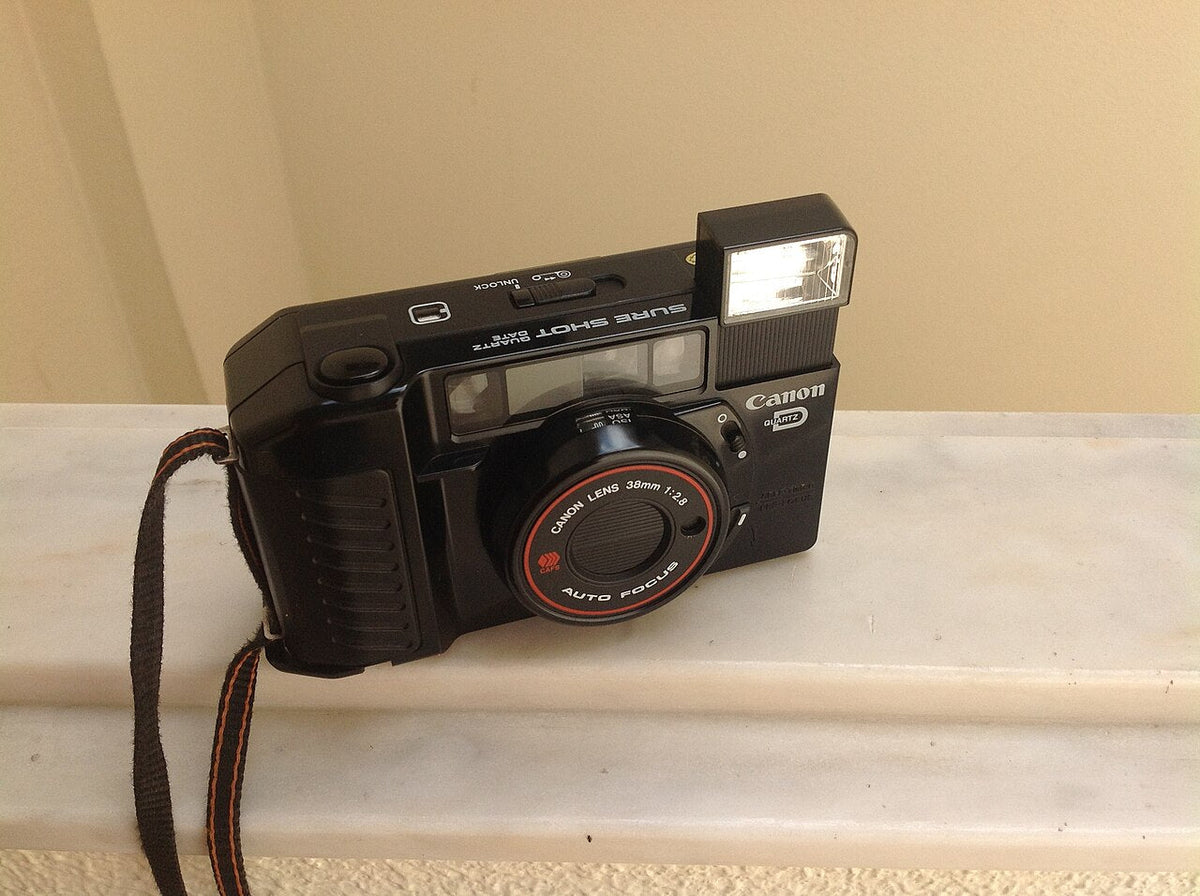
Launched in November 1979, the Canon AF35M (Sure Shot in the United States, Autoboy in Japan) is Canon's first autofocus compact camera and the ancestor of the entire Prima range. A 38 mm f/2.8 lens, infrared autofocus, and two AA batteries: here is what it is worth today, how to use it without making mistakes, and what to check before buying it.
There are cameras we buy for their photos and others for what they represent. The AF35M ticks both boxes. In 1979, it made autofocus accessible to everyone in a motorized compact camera, with a built-in flash and automatic film advance. More than forty years later, it remains a very simple camera to use, with a fast lens and AA battery power that can be found everywhere. It also has its quirks: an ISO setting that must be done manually, a noisy motor, and focusing that gets fooled by glass. This guide provides an overview based on the Canon Museum data sheet and tests published by collectors.
The essentials in 30 seconds
- The lens: a 38 mm f/2.8 with 4 elements, fast for a compact, sharp in the center, softer in the corners.
- The autofocus: active, using a near-infrared beam. It works even in the dark, but only targets the center and cannot focus through glass.
- The ISO: set manually from 25 to 400 ISO with a ring around the lens. The camera does not read the DX code.
- The power: two AA batteries, for both the camera and the flash.
- The reflex: check the battery compartment, autofocus, flash, and motor before buying.

The first autofocus from Canon
The AF35M was released in November 1979, at a price of 42,800 yen in Japan, plus 2,000 yen for the case, according to the Canon Museum. The name is a shorthand for AF-Plus Motor-Drive Camera. It replaces the Canon A35F, a manual focus compact, and inaugurates the line that would become Sure Shot in North America, Autoboy in Japan, and Prima in Europe. Canon took fourteen years to develop its autofocus system.
The success was immediate. Production reached 110,000 copies per month in the second half of 1981, and the camera received the Good Design Award from the Japanese Ministry of International Trade and Industry in September 1980. In Japan, the nickname "Autoboy" even became, according to the Canon Museum, synonymous with autofocus compact.
Did you know?
The AF35M is not the very first autofocus compact in history: the Konica C35 AF, released in November 1977, already had autofocus, but it was passive. The AF35M, on the other hand, is one of the first compacts with active autofocus, which measures the distance by emitting its own infrared beam. This is the principle that prevailed afterwards.
- Konica C35 AF, first autofocus compact (passive system).
- Launch of the AF35M (Sure Shot, Autoboy).
- Good Design Award in Japan.
- AF35ML (Super Sure Shot), 40 mm f/1.9 lens.
- Production of 110,000 AF35M per month.
- AF35M II (New Sure Shot) replaces the AF35M.

Technical specifications
- Type
- 24 × 36 compact with central shutter, programmed exposure
- Lens
- 38 mm f/2.8, 4 elements in 3 groups, 48 mm filter thread
- Focusing
- Active autofocus by triangulation, near-infrared beam
- Shutter
- Electronic, from 1/8 s to 1/500 s
- Exposure
- Automatic program, CdS cell, IL 6 to 17 (100 ISO)
- Sensitivity
- 25 to 400 ISO, manual setting by ring
- Flash
- Built-in, manual pop-up, guide number 14 (100 ISO, m)
- Viewfinder
- Inverted Galilean, 0.5× magnification, 85% coverage
- Film
- Motorized advance, motorized rewind
- Self-timer
- Electronic, with focus lock function
- Power
- 2 1.5 V AA batteries
- Dimensions / weight
- 132 × 77 × 54 mm, 405 g
Sources: Canon Camera Museum (AF35M / Sure Shot), Mike Eckman (Canon AF35M, 1979).
The exposure program automatically combines aperture and speed: from f/2.8 at 1/8 s in low light to f/16 at 1/500 s in full sun. There are no exposure settings to make, except for the film sensitivity. The 1/500 s maximum slightly limits the use of a fast film in full sun: at 400 ISO, the camera reaches its limit faster than with a 100 or 200 ISO.
How its autofocus works
The system, which Canon called CAFS (Canon Auto Focus System), emits a near-infrared beam from a small diode. A photodiode receives the reflection and the camera calculates the distance by triangulation, like a rangefinder. Since the beam comes from the camera, the focus does not depend on ambient light: this is what allowed the AF35M to focus in a dark room, where passive systems of the time struggled.
The measurement is made only in the center of the image, in the small mark of the viewfinder. A zone scale (portrait, group, landscape) with a needle indicates the estimated distance, but the focus is only set at the moment of release: there is no preview in the viewfinder. Mike Eckman points out that there is no classic half-press focus lock. To reframe, you have to use the "pre-focus" position of the self-timer lever: you aim, press to lock the distance, reframe, then press again.
Expert advice
For an off-center portrait, flip the self-timer lever to the lock position, aim at the face, press once, reframe, then release. It is a bit slow, but it is the only way to prevent the camera from focusing on the background between two people.
To check
Infrared does not pass through glass: behind a train or car window, the AF35M focuses on the glass and the landscape will be blurry. Press the lens against the glass or lower it.
Everyday handling
The AF35M is bulkier than 1990s compacts: 132 mm wide and 405 g with its batteries. It fits well in the hand and Blue Moon Camera says they used it with gloves during a walk in the snow, slipped in a coat pocket. It is not a jeans pocket camera, but it is easy to carry.
Loading is semi-automatic: you slide the leader into the slot receiver, close the back, then press the shutter button once or twice to bring the film to the first frame, as Mike Eckman explains. The counter goes up and resets to zero when the back is opened. At the end of the film, rewinding is not automatic: you have to press a button under the camera then activate the motorized rewind. One of Mike Eckman's readers notes that forgetting to rewind quickly drained his batteries.
The viewfinder, a Galilean type, magnifies 0.5 times and covers 85% of the image: you will have a little more in the photo than what you see. It does not display speed or aperture, but a red diode warns when the flash is necessary or when there is a risk of motion blur. The motors are noisy, pretty much like those of other motorized compacts from the early 1980s according to Blue Moon Camera: the AF35M is not the most discreet camera for street photography.


Setting the ISO: the step not to forget
This is the main difference with a newer compact: the AF35M does not read the DX code of the cartridge. The sensitivity is set manually, from 25 to 400 ISO, with a ring around the lens. If you load a 400 ISO and leave the ring on 100, the entire film will be underexposed by two stops.
| Film | Ring setting | Recommended use |
|---|---|---|
| Kodak Gold 200 / ColorPlus 200 | 200 | Daylight, outdoors |
| Kodak Ultramax 400 / Portra 400 | 400 | Versatile, indoors with flash |
| Ilford HP5 Plus 400 | 400 | Black and white, changing light |
| 800 ISO film | 400 (maximum) | Overexposed by one stop: acceptable in color negative |
| 100 ISO film | 100 | Bright sun, fine details |
Mike Eckman also advises not to exceed 400 ISO, the limit of the ring. With a color negative, which handles overexposure well, an 800 ISO set to 400 is still possible, but a 400 is the simplest choice. For the differences between these films, read our comparison 200 or 400 ISO film.
Image quality and flash
The 38 mm f/2.8 lens is one of the camera's assets. Blue Moon Camera finds it sharp in the center but significantly softer at the edges, at all apertures, and compares this rendering to that of the Lomo LC-A. Mike Eckman judges the exposure and fill flash reliable outdoors as well as indoors, with a sharp lens; only a very close-up portrait came out blurry in his test. The overall result is a classic compact rendering: a sharp subject in the center, softer corners that focus the gaze.
The flash pops out manually thanks to a latch on the front. Its guide number of 14 (at 100 ISO, in meters) is comfortable for a compact of the time, and it also works as fill in broad daylight to fill in a face against the light. Allow about 8 seconds for recharging according to Mike Eckman, with an effective range of about 5 meters. In the evening, you must therefore leave time for the flash to recharge between two photos.
| Situation | Setting | Expected result |
|---|---|---|
| Broad daylight, landscape | 100–200 film, flash stowed | Good sharpness in the center, softer corners |
| Portrait against the light | Flash popped out for fill | Filled-in face, properly exposed background |
| Indoors, evening | 400 film, flash popped out | Subject lit up to a few meters, slow recharge |
| Behind glass | Lens pressed against the glass | Avoids focusing on the glass |
| Off-center portrait | Locking via the self-timer | Focus on the face, not the background |
To see what the camera produces, the Lomography community shares many images: browse popular photos taken with a Canon AF35M (photos protected by the copyright of their authors). To properly use the flash of a compact, our guide photo with flash details the right reflexes.
AF35ML and New Sure Shot: the successors
In July 1981, Canon launched the AF35ML (Super Sure Shot, Autoboy Super). The Canon Museum details its differences: a 5-element f/1.9 40 mm lens, linear CCD focus with focus locking, a reduced maximum shutter speed of 1/400 s, a guide number 11 flash, and a weight of 440 g. Its lens is faster, but Mike Eckman found its autofocus unreliable indoors on his copy, and therefore could not recommend it for that reason.
In 1983, the AF35M II (New Sure Shot) completely replaced the AF35M. It retained the 38 mm f/2.8, in a revised body with a more pronounced grip and a quick film loading system. To see where these models fit in the entire range, read our guide Canon Prima or Sure Shot: which model to choose.
| Model | Year | Lens | Max shutter speed | Weight |
|---|---|---|---|---|
| AF35M (Sure Shot) | 1979 | 38 mm f/2.8 | 1/500 s | 405 g |
| AF35ML (Super Sure Shot) | 1981 | 40 mm f/1.9 | 1/400 s | 440 g |
| AF35M II (New Sure Shot) | 1983 | 38 mm f/2.8 | — | — |


Pre-purchase check before buying
The AF35M was produced in large numbers and many copies are still working. Like any electronic device over forty years old, it deserves a few checks.
- The battery compartment: no oxidation on the contacts. Mike Eckman considers the door fragile: check that it closes and holds well.
- The autofocus: aim at a close object then a distant object; the needle of the distance scale must move and the motor react when shooting.
- The flash: it must come out with the latch, recharge and fire.
- The motorization: advance after each shot and rewinding must work, without abnormal friction noise.
- The ISO ring: it must turn and stay in place on the chosen value.
- The lens: no deep scratches, haze, or mold.
- The foam on the back: replace if it is sticky or crumbling.
To check
The AF35M manual advises against NiCd rechargeable batteries, according to Mike Eckman. Use standard AA alkaline batteries and remove them if the camera remains stored for a long time. If a battery has already leaked, our article leaked battery explains what to do.
The complete checklist can be found in our article buying a used film camera. At Vibes Photo, each camera is checked before being put on sale and covered by a six-month commercial warranty, in addition to the legal warranties of conformity and hidden defects. The details are in our general terms and conditions of sale.
Our verdict
The AF35M is a beautiful camera to own and a good camera to use. Its f/2.8 lens, infrared autofocus that works in the dark and its AA batteries make it a simple and reliable compact for travel or everyday life. You just have to remember to set the ISO ring for each film, accept a noisy motor and learn focus locking by the self-timer. If you want a smaller and fully automatic compact, look at a Prima Mini or a Prima 5 instead; if you want a piece of history that still takes beautiful photos, the AF35M is an excellent choice.
For
- Fast f/2.8 38 mm lens
- Active autofocus, effective even in the dark
- Two easy-to-find AA batteries
- Motorized advance and rewind
- Flash usable as fill flash in broad daylight
Against
- Sensitivity set by hand, no DX
- Speed limited to 1/500 s
- Autofocus fooled by glass
- Focus locking is inconvenient
- Noisy motors, bulky body
Frequently asked questions
Is the Canon AF35M the same camera as the Sure Shot?
Yes: AF35M in Europe, Sure Shot in North America and Autoboy in Japan. It is the same camera, launched in November 1979.
What batteries for the Canon AF35M?
Two 1.5 V AA batteries, which power the camera and the flash. The manual advises against NiCd rechargeable batteries.
Does the Canon AF35M read the DX code?
No. The sensitivity is set by hand, from 25 to 400 ISO, with a ring around the lens. Remember to set it for each new film.
Is the Canon AF35M the first autofocus compact?
It is Canon's first autofocus compact and one of the first with active autofocus. The Konica C35 AF, released in 1977, already had autofocus, but of the passive type.
How to lock focus on the AF35M?
There is no focus locking halfway through. You have to switch the self-timer lever to the lock position, aim, press once, reframe, then press again.
Why are my photos behind glass blurry?
Infrared autofocus does not pass through glass: it focuses on the glass. Press the lens against the glass or open it.
AF35M or AF35ML?
The AF35ML has a faster lens (40 mm f/1.9) and focus locking, but its autofocus was judged less reliable indoors by some testers. The AF35M remains simpler and lighter (405 g versus 440 g).
Vibes Photo
Find your film compact
We check each camera before it is put on sale: batteries, autofocus, shutter, flash and motorization. Have a question about the AF35M? Write to us.
Sources
- Canon Camera Museum, AF35M / Sure Shot.
- Canon Camera Museum, AF35ML / Super Sure Shot.
- Mike Eckman, Canon AF35M (1979).
- Mike Eckman, Canon AF35ML (1981).
- Blue Moon Camera, Canon AF35M / Autoboy / Sure Shot.
- Camera-wiki, Canon Sure Shot / AF35M / Autoboy.
Images: photos by Vibes Photo, unless otherwise stated under the image (author, license and source indicated).