










Kodak Ektar H35: Review and Alternatives
Is the Kodak Ektar H35 worth it? Medium format, lens, limitations, H35N version and the best vintage alternatives.
You see it everywhere, from big-box stores to social media: the Kodak Ektar H35 has become the most popular new film camera for beginners. Small, colorful, and affordable, it promises twice as many photos per roll. But is it really worth it, and what are the alternatives? Here is our honest review.
The verdict in 30 seconds
Pros
- half-frame photography cuts the cost of each photo in half;
- a new, lightweight, and very easy-to-use camera;
- a built-in flash for evening shots.
Cons
- an acrylic lens, less precise than a glass lens;
- fixed focus and very limited settings;
- a smaller negative, so more visible grain.
Specifications
| Kodak Ektar H35 | |
|---|---|
| Format | Half-frame on 35 mm film |
| Number of exposures | About 72 on a 36-exposure roll |
| Lens | 22 mm f/9.5, 2 acrylic lenses |
| Focus | Fixed |
| Flash | Built-in |
| Film advance | Manual, with a dial |
| Price | Affordable (entry-level) |
Half-frame, its real advantage
The H35 exposes two vertical images where a standard camera only exposes one. You therefore get twice as many photos for the same film and development cost. When scanned, labs often deliver the images in pairs, which makes for nice diptychs. To measure the savings, use our film photography cost guide, choosing 72 exposures.
Limitations to know
Like many reusables, the H35 has a fixed aperture and fixed focus. It therefore needs light: in broad daylight, it does well, but as soon as the light fades, the flash becomes essential. Its acrylic lens produces softer and less detailed images than a glass lens, especially around the edges.
Tip: load a 400 ISO film. With such a slow lens, it gives you much more leeway than a 200 ISO. More info in Film 200 or 400 ISO: which one to choose?
And the Kodak Ektar H35N?
Its H35N version adds a built-in star filter for light sources, a long exposure, and a tripod mount. It costs a little more, but remains within the same simple camera philosophy.
Twice as many photos, but not twice as much detail.
Alternatives
- An affordable vintage compact: glass lens, autofocus, automatic exposure, full frame. It is the best value for money if you want sharper photos. We compare the two worlds in Reusable film camera: new or vintage?
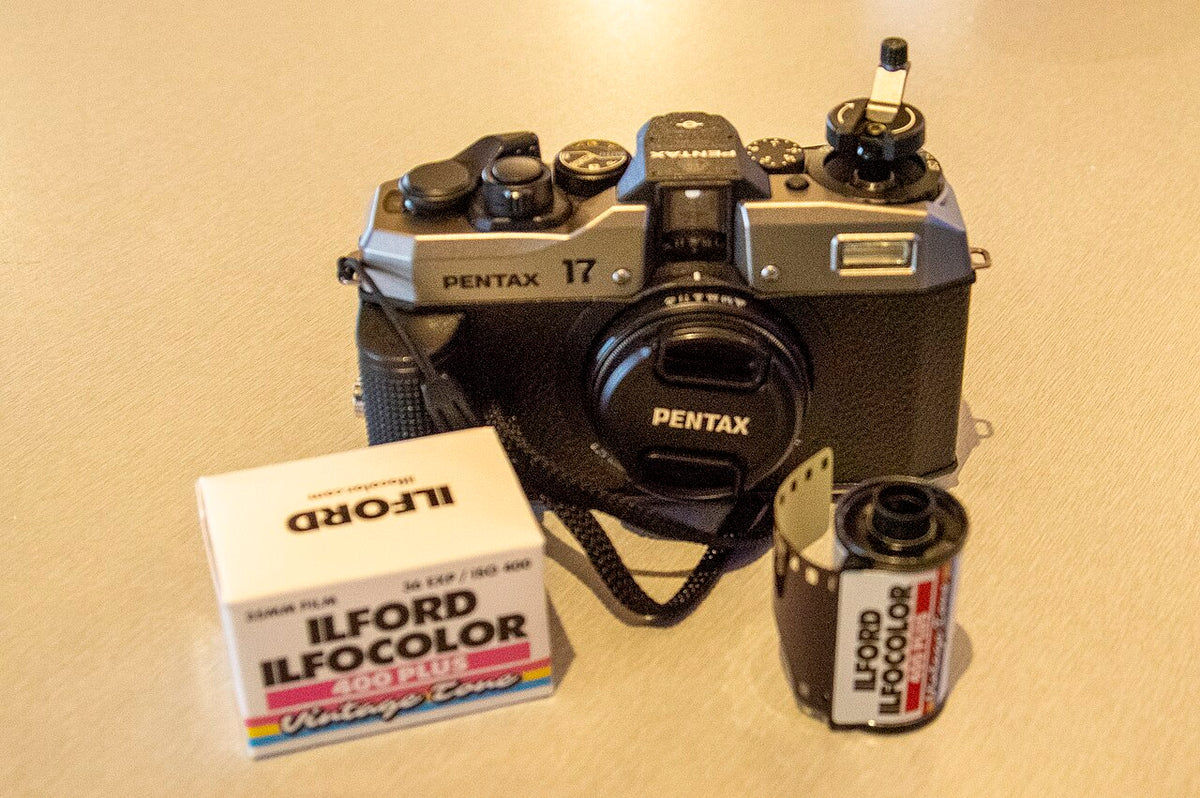
- The Pentax 17: the high-end half-frame, with a real lens and settings, but significantly more expensive.
- A vintage half-frame, such as the Olympus Pen EE-2 or the Canon Demi, for the same principle with the charm of the 60s.
- The Olympus Trip 35, battery-free and full frame, for those who like timeless cameras. See our Trip 35 guide.
Our verdict
The Kodak Ektar H35 is a very good camera for having fun, discovering film photography, and taking party photos without spending a fortune on film. If you are primarily looking for image quality, a tested vintage compact will offer significantly sharper photos for a similar budget.
Also read: Which film camera to choose for beginners? and Buying a used camera: warranty, condition, and trust.
Frequently asked questions
Is the Kodak Ektar H35 worth it?
Yes for discovering film photography at a low price and doubling the number of photos per roll. No if you are looking for the best possible image quality.
What film to put in the H35?
A 400 ISO color or black and white film, which compensates for the lens's lack of light.
Do labs develop half-frame?
Yes: the film is a standard 35 mm. Simply tell the lab that it is half-frame, so that the scans are cropped correctly.
Cover photo: Gnangarra, via Wikimedia Commons, license CC BY-SA 4.0.