










Olympus Pen EE, EE-2, EE-3 and Pen F: review of half-format cameras
Olympus half-frame cameras compared: Pen EE, EE-S, EE-2, EE-3 and Pen F, battery-free operation, shooting tips, diptychs and pre-purchase checks.
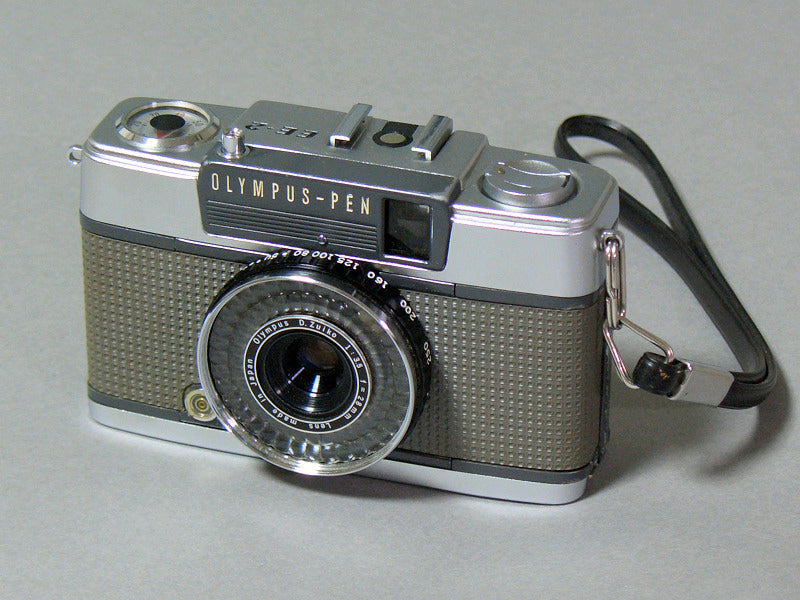
The Olympus Pen cameras are the most famous half-frame cameras: on a 36-exposure roll of film, they take about 72 photos. Launched in 1959 by engineer Yoshihisa Maitani, the range sold around 17 million copies. The Pen EE models are the “fully automatic” models; the Pen F is a rare half-frame SLR. Here is how to choose, and what their photos look like.
Half-frame in brief
A half-frame camera exposes images measuring 18 × 24 mm, which is half the size of a 24 × 36 negative. You double the number of views, so you halve the cost per photo. The images are in vertical format when you hold the camera normally, and labs often scan them in pairs: it is an opportunity to create diptychs. The trade-off: a smaller negative, so more grain and less detail in large prints.

The Pen EE: the fully automatic half-frame
| Model | Years | Lens | Features |
|---|---|---|---|
| Pen EE | 1961 | 28 mm f/3.5, fixed focus | Automatic exposure with selenium cell |
| Pen EE-S | 1962 | 30 mm f/2.8, zone focusing | Brighter |
| Pen EE-2 | 1968-1977 | 28 mm f/3.5, fixed focus | Hot shoe added |
| Pen EE-3 | 1973-1983 | 28 mm f/3.5, fixed focus | "Flashmatic" system with dedicated flash |
| Pen EF | 1981 | 28 mm f/3.5 | Built-in flash, last Pen |
The Pen EE models use a selenium cell around the lens: no battery needed. The camera selects the aperture and one of its two shutter speeds (1/200 s or 1/40 s on the two-speed versions). If the light is insufficient, a red flag appears in the viewfinder and blocks the shutter release. On the EE, EE-2, and EE-3, the focus is fixed: avoid subjects that are too close, and keep the EE-S (zone focusing) if you like close-up portraits.

The Pen F: the half-frame SLR
Launched in 1963, the Pen F is a half-frame SLR with interchangeable lenses. Its mirror flips to the side, eliminating the prism hump, and its metal rotary shutter synchronizes flash up to 1/500 s. The Pen F does not have a built-in light meter; the Pen FT (1966) adds one, and the Pen FV (1967) is an FT without a light meter. These are more expensive and more complex cameras than the EE models.

Our tips for using a Pen EE
- Choose the right film: ISO 200 or 400 for outdoors. Check that the sensitivity set on the ring matches your film.
- Keep the light meter clean and do not cover it with your fingers.
- Tell your lab that it is half-frame, so they can properly separate the views when scanning.
- Think in diptychs: two adjacent images on the film are often shown side by side.
- Respect the red flag: if it appears, you need more light or a flash (EE-2, EE-3).

Pre-purchase inspection points
- The red flag appears when you cover the light meter, and disappears in bright light.
- The aperture blades move when you fire in front of a light (look through the lens, back open).
- The selenium light meter is not dead (some have lost their sensitivity over time).
- The seals on the back and lens are clean.
Our used camera buying checklist completes these checks.
All cameras sold by Vibes Photo are inspected before being put up for sale and covered by a six-month commercial warranty, in addition to legal warranties. Details can be found in our general terms and conditions of sale.
Want to see more images? Browse the most popular photos taken with the Olympus Pen EE-2 on Lomography (Lomography community gallery, photos protected by the copyright of their authors).
Want to see more images? Browse the most popular photos taken with the Olympus Pen EE-3 on Lomography (Lomography community gallery, photos protected by the copyright of their authors).
Want to see more images? Browse the most popular photos taken with the Olympus Pen F on Lomography (Lomography community gallery, photos protected by the copyright of their authors).
Also read: the Olympus Trip 35, Olympus's other battery-free automatic, and our Olympus camera guide.
Frequently asked questions
How many photos with an Olympus Pen EE?
About 72 views on a 36-exposure roll of film, and about 48 on a 24-exposure roll, because each image is 18 × 24 mm.
Does the Olympus Pen EE need a battery?
No. Its selenium light meter generates the current needed for automatic exposure itself.
What is the difference between the Pen EE-2 and the Pen EE-3?
They are almost identical; the EE-3 adds the Flashmatic system with the dedicated flash.
Does developing half-frame film cost more?
Developing is the same as a normal roll of film; only the scan may be billed differently depending on the labs. Let them know.
Why is there a red flag in my Pen's viewfinder?
The light is insufficient: the shutter release is blocked. Use a flash or find more light.
Sources: Wikipedia – Olympus Pen; camera-wiki.org – Olympus Pen; camera-wiki.org – Olympus Pen F.