










Getting Started with Medium Format Film: Formats, Cameras, and 120 Film
6 × 4.5, 6 × 6, 6 × 7 and 6 × 9 formats, camera types, recommended first camera, 120 film loading and cost per shot: everything you need to get started with medium format.
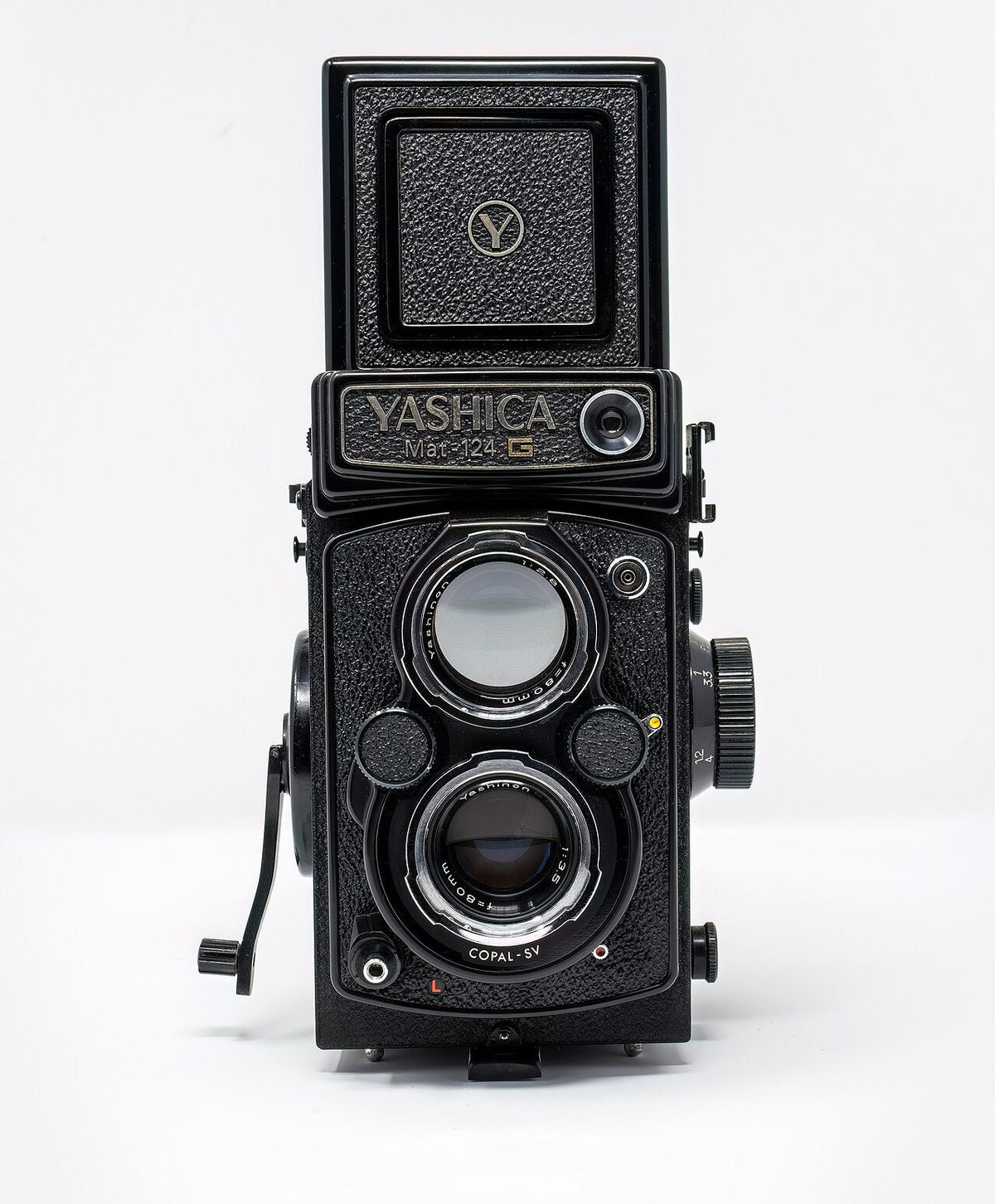
You've grown fond of 35mm and dream of a larger negative, a square format, and the soft look of Rolleiflex portraits? Medium format is the next step. It uses 120 film, offers an image two to six times larger than 24 × 36, and changes the way you photograph: fewer shots, more thought. Here's everything you need to know to get started without making a mistake.
What is medium format?
Medium format refers to formats larger than 24 × 36 mm but smaller than 4 × 5 inches (large format). In film photography, this almost always means 120 film: a 6 cm wide roll without a cartridge, wound with protective paper on a spool. It was introduced by Kodak in 1901 for the Brownie No. 2 and is now the only widely available medium format film. 220, which is twice as long and has no protective paper, has become very rare.

Why switch to medium format?
- A more detailed image: with a larger negative, grain is less visible and gradients are smoother, even in large prints.
- A shallower depth of field at the same framing, resulting in a blurrier background in portraits.
- The square format of 6 × 6, which has become a signature.
- Another way of photographing: with 10 or 12 exposures, every shot counts.
The drawbacks: bulk, weight (a Pentax 67 with its 105mm lens weighs about 2.3 kg), cost per exposure, and more delicate loading.
Image formats: 6 × 4.5, 6 × 6, 6 × 7, 6 × 9
120 film is always the same; the camera determines the image size, and therefore the number of exposures.
| Format | Exposures per 120 roll | Camera examples |
|---|---|---|
| 6 × 4.5 cm | 15 or 16 | Mamiya M645, Bronica ETR |
| 6 × 6 cm | 12 | Rolleiflex, Yashica Mat-124 G, Hasselblad 500 C/M, Lubitel 166, Holga |
| 6 × 7 cm | 10 | Pentax 67, Mamiya RB67, Mamiya 7 |
| 6 × 9 cm | 8 | Vintage folding cameras, press cameras |
6 × 4.5 is the most economical per exposure; 6 × 7 gives an image ratio close to 20 × 25 paper; 6 × 9 has the proportions of 24 × 36. Details for each format are in how many photos on a roll.
Types of medium format cameras
| Type | Examples | Strengths | Weaknesses |
|---|---|---|---|
| Twin-lens reflex (TLR) | Rolleiflex, Yashica Mat-124 G, Lubitel 166 | Quiet, affordable, waist-level viewfinder | Generally fixed lens, parallax at close range |
| Modular reflex | Hasselblad 500 C/M, Mamiya RB67, Bronica | Interchangeable backs, complete system | Heavy, expensive |
| Giant 35mm reflex | Pentax 67 | Familiar handling | Very heavy, noisy |
| Rangefinder | Mamiya 7 | Compact for 6 × 7, very sharp lenses | High price |
| Folding bellows | Cameras from the 1930s-1950s | Foldable, lightweight, often 6 × 9 | Age, bellows to check |
| Toy camera | Holga, Diana F+ | Very cheap, lo-fi look | Inconsistent image quality |

Which medium format camera to choose first?
The twin-lens reflex (TLR): the most common choice
The Yashica Mat-124 G, produced from 1970 to 1986, is Yashica's last TLR and one of the most recommended for beginners. It has a four-element Yashinon 80mm f/3.5 lens, a Copal SV shutter from 1/1000 to 1/500 s plus B exposure, a coupled light meter, and a crank advance (no red window to check). Its light meter was designed for a 1.3V mercury battery: see replacing a mercury battery. The Soviet Lubitel 166 (6 × 6, three-element T-22 75mm lens, 1/15 to 1/250 s) is a very affordable, more basic alternative. Rolleiflexes are the benchmark, at a different budget.
The modular reflex: to go further
The Hasselblad 500 C/M descends from the 1957 500 C, whose Zeiss lenses incorporate the central shutter: the flash is synchronized at all speeds. The Mamiya RB67 (1970) is an all-mechanical 6 × 7, with bellows focusing and central shutter Sekor lenses, designed for the studio. To compare these systems in detail, read Mamiya, Hasselblad, Rollei, Bronica: the medium format guide.

The 6 × 7: the large negative
The Pentax 6 × 7 (renamed Pentax 67 in 1990) resembles a giant 35mm reflex: about 2.3 kg with the prism and the 105mm f/2.4, a real 56 × 70 mm image. The Mamiya 7 (1995-2014) is a much lighter 6 × 7 rangefinder, which makes ten exposures per 120 roll.

Loading 120 film: the method
- Load the film in the shade: the protective paper protects the film, but a poorly tensioned roll can let light in at the edges.
- Place the full spool on the designated side, then pull the paper toward the empty spool (take-up spool).
- Insert the paper leader into the take-up spool slot and make one or two turns while keeping the paper taut.
- Align the start arrow printed on the paper with the camera mark (on cameras with automatic stop) or close the back and advance until "1" in the red window.
- At the end of the roll, advance until all the paper is on the take-up spool, then stick the label on so it doesn't unspool.
- Keep the empty spool: it becomes your take-up spool for the next roll.
More details on 35mm loading in our page loading a roll.
How much does it cost?
A 120 roll is not necessarily more expensive than a 135 roll: as of 30/10/2026, Le Blog Argentique listed Fomapan Classic 100 in 120 at €5.35 and Kentmere Pan 100 in 120 at €6.79. Development is often a little more expensive: at Labo Gris Souris, €9.90 in 120 compared to €7.00 in 135; Reportage Image applies the same development rate for 120 and 135. Since you only have 8 to 16 exposures, the cost per photo is higher than in 35mm. The full rates are in film development prices.
Which 120 film to choose?
- For learning: an affordable black and white (Fomapan, Kentmere) or the Ilford HP5 Plus.
- For color portrait: the Kodak Portra 400, very forgiving.
- For landscape: the Kodak Ektar 100, with very fine grain, or a slide.
And to scan your negatives, see scanning your own negatives: a 120-compatible flatbed scanner is often necessary.
Want to see more images? Browse the most popular photos taken with a Yashica Mat-124 G on Lomography (Lomography community gallery, photos protected by the copyright of their authors).
All cameras sold by Vibes Photo are checked before being put on sale and covered by a six-month commercial warranty, in addition to legal warranties. Details are in our general terms and conditions of sale.
Frequently asked questions
What is the best medium format camera to start with?
A twin-lens reflex like the Yashica Mat-124 G is a classic choice: simple, mechanical, with a built-in light meter. The Lubitel 166 is more affordable, a Hasselblad or Mamiya more advanced.
How many photos on a 120 film?
8 in 6 × 9, 10 in 6 × 7, 12 in 6 × 6 and 15 or 16 in 6 × 4.5.
Is medium format more expensive than 35mm?
The roll can cost the same price, but with fewer exposures: the cost per photo is higher.
Can you use 220 film?
It has become very rare. Cameras compatible with 120 and 220 often have a film back setting to be positioned on 120.
Should 120 be loaded in the shade?
Yes, as much as possible: the paper protects the film, but a poorly tensioned roll can let light in at the edges.
Sources: Wikipedia – Medium format; Wikipedia – 120 film; Wikipedia – Pentax 6×7; Wikipedia – Mamiya 7; Wikipedia – Mamiya RB67; Camera-wiki – Yashica 6×6 TLR; Camera-wiki – Lubitel 166; Labo Gris Souris – rates.