










Medium format film: Rolleiflex, Hasselblad, Mamiya, Bronica—which one to choose?
Rolleiflex, Hasselblad, Mamiya, Bronica: the formats, the systems, and how to choose a used film medium format camera.
Medium format means a negative up to four times larger than 24 × 36, fine details, soft blurs, and a slower way of photographing. Four names dominate the field: Rollei, Hasselblad, Mamiya, and Bronica, along with Pentax and Fujifilm. In short: a Rolleiflex or Yashica Mat to get started with a twin-lens camera, a Hasselblad 500 C/M for the benchmark modular system, a Mamiya RB67 or RZ67 for the studio, a Mamiya 7 for travel, or a Bronica for a complete system at a more affordable price.

Film formats on 120 film
| Format | Exposures per 120 roll | Camera examples |
|---|---|---|
| 6 × 4.5 | 15 or 16 | Mamiya 645, Bronica ETRS, Pentax 645, Fujifilm GA645 |
| 6 × 6 | 12 | Rolleiflex, Hasselblad 500, Bronica SQ, Yashica Mat-124G |
| 6 × 7 | 10 | Mamiya RB67 / RZ67, Mamiya 7, Pentax 67, Bronica GS-1 |
| 6 × 9 | 8 | Fujifilm GW690 / GSW690 |
120 film is loaded without a cartridge, using a protective backing. 220 film, which is twice as long, is no longer commonly manufactured. Most labs develop 120 film: see our list of labs.
Rollei: the benchmark twin-lens camera
Franke & Heidecke, founded in Braunschweig in 1920, launched the Rolleiflex in 1929: a 6 × 6 twin-lens reflex (TLR) camera with one lens for viewing and another for taking photos. The Rolleiflex 2.8 and 3.5 (with Planar or Xenotar lenses) remained benchmarks for photojournalism. The simpler Rolleicord is an excellent entry point. Rollei also produced the Rollei 35 (1966), a tiny 24 × 36 compact camera, and the SL66 SLR.

Hasselblad: the modular system
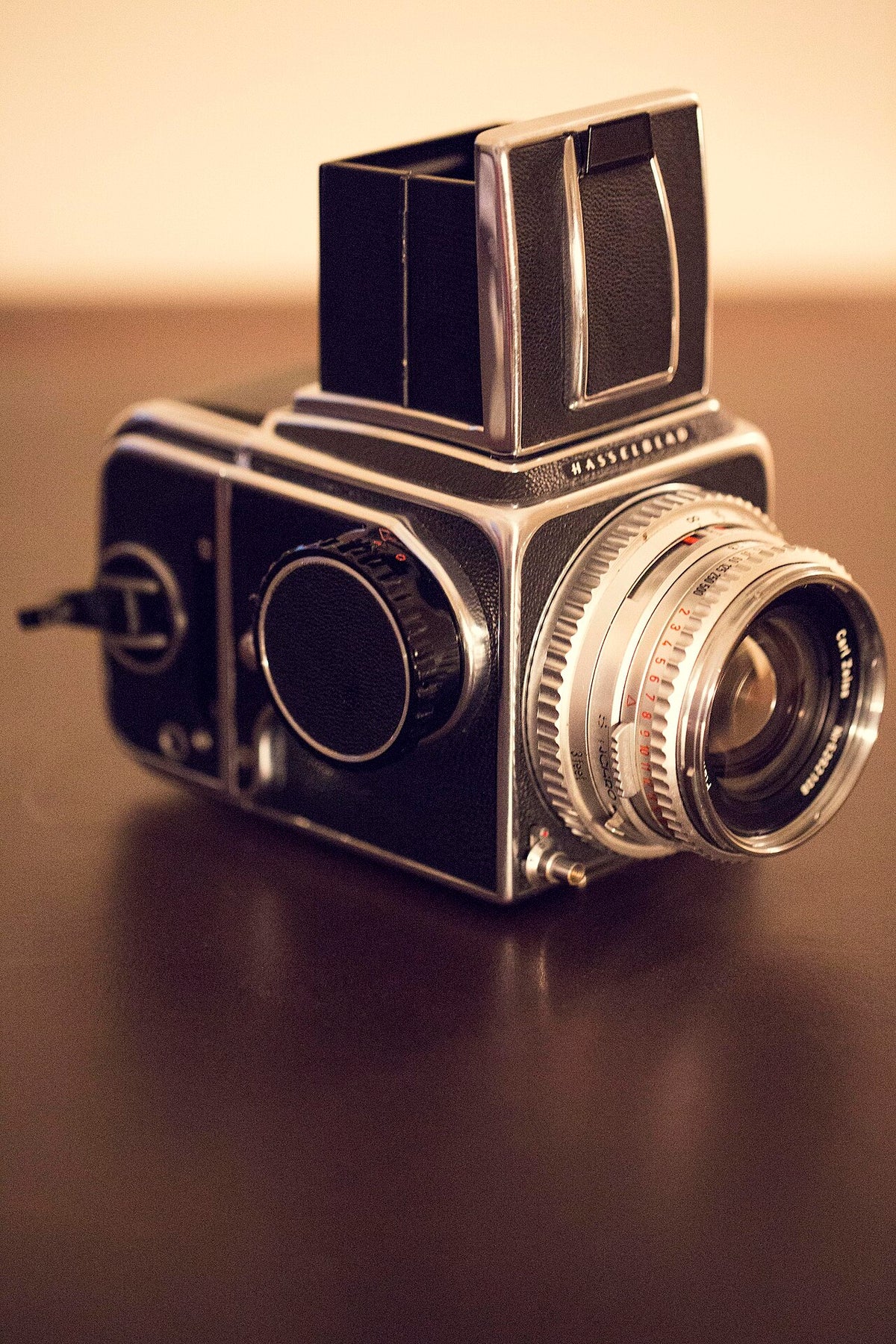
Victor Hasselblad introduced the 1600F in 1948. The 500C (1957) and then the 500 C/M established the formula: a 6 × 6 box body, interchangeable film backs (allowing you to change film mid-roll), viewfinders, and Carl Zeiss lenses with central shutters. Hasselblad cameras were taken to the Moon during the Apollo program. Hasselblad also produced the XPan, a 24 × 65 panoramic camera using 35 mm film, developed with Fujifilm.

Mamiya: from the studio to travel
- C220, C330: twin-lens cameras with interchangeable lenses, a rare design.
- RB67 (1970) and RZ67 (1982): heavy but indestructible 6 × 7 studio SLRs with rotating backs.
- Mamiya 645: a lighter 6 × 4.5 SLR, available in many versions (1000S, Super, Pro, 645 AF).
- Mamiya 6 and Mamiya 7: compact medium format rangefinders, popular for travel and landscape photography.

Bronica: the complete system at a more affordable price
Zenza Bronica, founded by Zenzaburo Yoshino, launched its first camera in 1959. The ETRS (6 × 4.5), SQ (6 × 6), and GS-1 (6 × 7) series adopted Hasselblad's modular design, with electronic central shutters and often more affordable second-hand prices. The brand ceased production in the mid-2000s.
Comparison
| System | Format | Weight | Best for? |
|---|---|---|---|
| Rolleiflex / Rolleicord | 6 × 6 TLR | Light | Street, portrait, travel |
| Yashica Mat-124G | 6 × 6 TLR | Light | Getting started on a budget (Yashica guide) |
| Hasselblad 500 C/M | 6 × 6 modular | Medium | The benchmark system |
| Mamiya RB67 / RZ67 | 6 × 7 modular | Heavy | Studio, posed portraits |
| Mamiya 7 | 6 × 7 rangefinder | Light | Travel, landscape |
| Bronica SQ / ETRS | 6 × 6 / 6 × 4.5 modular | Medium | Complete system, controlled budget |
| Pentax 67 / 645 | 6 × 7 / 6 × 4.5 SLR | Heavy / medium | For those familiar with 35 mm SLRs (Pentax guide) |
| Fujifilm GW690 | 6 × 9 rangefinder | Medium | Large negatives, landscape photography (Fujifilm guide) |
Points to consider
- Central shutters (Hasselblad, Bronica, Mamiya RB): each lens has its own shutter, which should be tested at all shutter speeds.
- Film backs: check the spacing between exposures, the foam, and whether the numbers on the back match the insert (Hasselblad).
- Body-lens synchronization on Hasselblad: a disabled lens can block the body, so never force it.
- TLR: tarnished viewfinder mirror, close-up parallax, and smooth focusing.
- Electronics (RZ67, Bronica, Mamiya 7): check batteries and contacts.
At Vibes Photo, every camera is inspected before being put up for sale and covered by a six-month commercial warranty, in addition to statutory warranties for conformity and hidden defects. Full details can be found in our general terms and conditions of sale.
Find all the brands in our camera brand guide and the basics in the complete guide to film photography.
All our medium format articles
Reviews, comparisons, and related guides:
- Which camera went to the Moon? Hasselblad and NASA
- Getting started with film medium format: formats, cameras, and 120 film
Frequently Asked Questions
Which medium format camera is best for getting started?
A twin-lens camera (Yashica Mat-124G, Rolleicord) is the simplest and lightest option. A Bronica or Mamiya 645 provides access to a complete system.
How many photos can you get on a roll of 120 film?
8 on 6 × 9, 10 on 6 × 7, 12 on 6 × 6, and 15 or 16 on 6 × 4.5.
Hasselblad or Bronica?
Hasselblad is the benchmark, with Zeiss lenses; Bronica offers an equivalent system that is often cheaper.
Is medium format much more expensive to use?
Each roll provides fewer exposures than 35 mm film, so the cost per photo is higher. See the cost of film photography.
Sources: Rollei – Wikipedia; Hasselblad – Wikipedia; Mamiya – Wikipedia; Zenza Bronica – Wikipedia.