










APS camera (Advantix, IXUS): the format, its history and its use today
Everything about the APS format: the cartridge, the H, C and P formats, the cameras (IXUS, Pronea, EOS IX) and what you need to know to use it today.
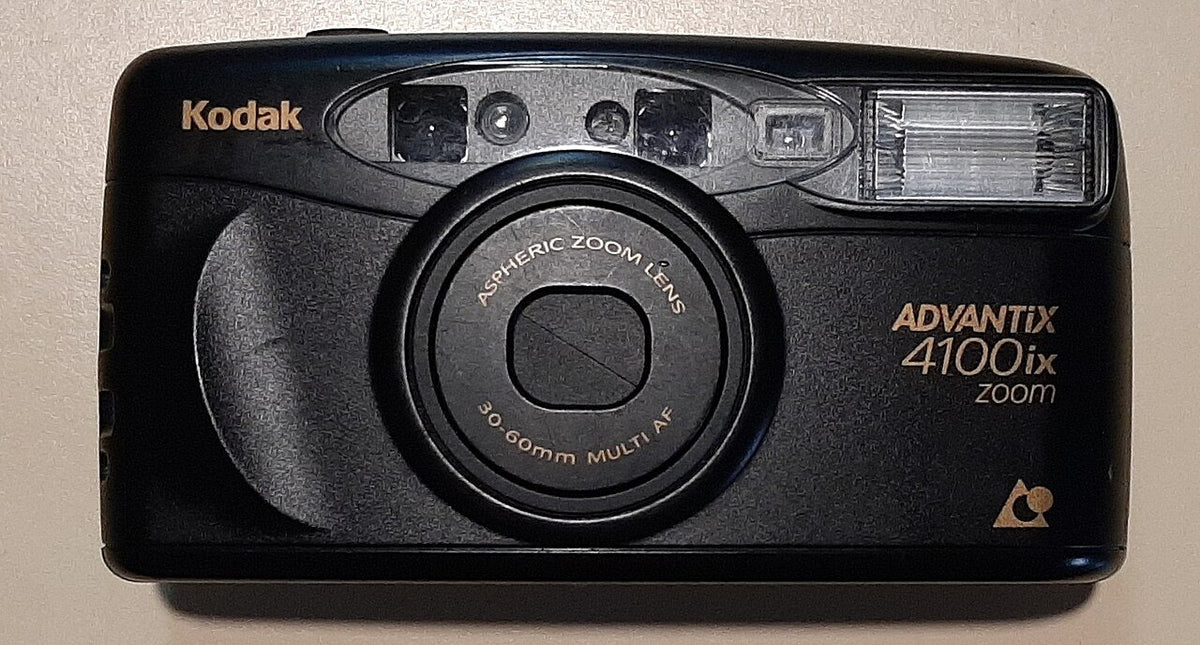
Did you find a small film Canon IXUS or a Kodak Advantix in a drawer, with a strange cartridge? It's an APS (Advanced Photo System) camera. Launched in 1996 to replace 35 mm film for amateurs, this format disappeared in 2011. Here is its history, its H, C and P formats, and what you need to know before using one today.
What is APS?
Developed by Kodak from the mid-1980s, then by a consortium formed in 1991 with Canon, Fujifilm, Minolta and Nikon, APS was launched in February 1996. The film was sold under several brands: Kodak Advantix, Fujifilm Nexia, Agfa Futura, Konica Centuria. Its goal: to eliminate loading errors (according to Kodak, one in five films received at the lab had a loading-related defect) and enable smaller cameras.

How does an APS cartridge work
- Automatic loading: you insert the cartridge, the camera does the rest, then rewinds it automatically.
- Mid-roll changes: some cameras rewind a partially used cartridge to use it again later.
- Visual indicators on the cartridge: solid circle (virgin), half circle (partially exposed), cross (exposed, undeveloped), rectangle (developed).
- The negative remains in its cartridge after development, unlike 35 mm.
- A magnetic layer on the film records information (format, date, settings) for the lab.
The three formats: H, C and P
APS film is 24 mm wide. For each frame, the camera records the entire 30.2 × 16.7 mm "H" frame, and tells the lab the chosen print format:
| Format | Aspect ratio | Use |
|---|---|---|
| H (High Definition) | 16:9 | Full frame, "HD television" format |
| C (Classic) | 3:2 | Like a classic 35 mm print, cropped within the H |
| P (Panorama) | Very wide | Panoramic print, cropped within the H |
Since the entire H frame is always exposed, a photo taken in P format can be cropped to H. The name APS-C for digital sensors comes from this. To learn more about panoramic cameras: panoramic film cameras.
APS cameras
Most were compacts. The Canon ELPH (IXUS in Europe, IXY in Japan), a small all-metal body, was particularly notable at its launch. There were also APS SLR cameras with interchangeable lenses: the Canon EOS IX (compatible with EF lenses), the Nikon Pronea (compatible with Nikon F lenses) and the Minolta Vectis S-1 (with its own V mount).

Why APS disappeared
The APS negative is smaller than 35 mm (58% of its area), and the choice of films was limited: mostly color negative, a few quickly discontinued slides, and chromogenic black and white. Above all, APS arrived at the same time as the first digital cameras, which offered the same advantages without development. Kodak stopped making APS cameras in 2004, then Fuji and Kodak, the last film manufacturers, stopped production in 2011.
Using an APS camera today?
Let's be honest: it's a collector's or experimenter's choice.
- The film is no longer manufactured since 2011: you will only find cartridges that have been expired for over ten years. Expect fogging and shifted colors: see expired film.
- Development: check with your lab before sending an APS cartridge, not all of them support it.
- To start, a 35 mm compact will be much easier: new film, development available everywhere. See the best film compact cameras.
- Digital cameras that use the IXUS name have nothing to do with APS: see which digital Canon IXUS to choose.
All cameras sold by Vibes Photo are inspected before being put on sale and covered by a six-month commercial warranty, in addition to legal warranties. Details are in our general terms and conditions of sale.
Frequently asked questions
Can you still find APS film?
No longer in production since 2011. Only expired cartridges are available, with unpredictable results.
Can you get APS film developed?
Some labs still do: ask before sending your cartridge.
What is the difference between H, C and P formats?
H is the full 16:9 format, C is the classic 3:2 format, P is panoramic. All three are cropped within the same exposed frame.
Does a film Canon IXUS use 35 mm?
No: the first film IXUS cameras use APS film.
Sources: Wikipedia – Advanced Photo System.