










Rangefinder film camera: the complete guide
How a rangefinder works, its advantages and limitations compared to a reflex camera, the main families (Leica M, M39, Kiev, compacts) and points to check before buying.
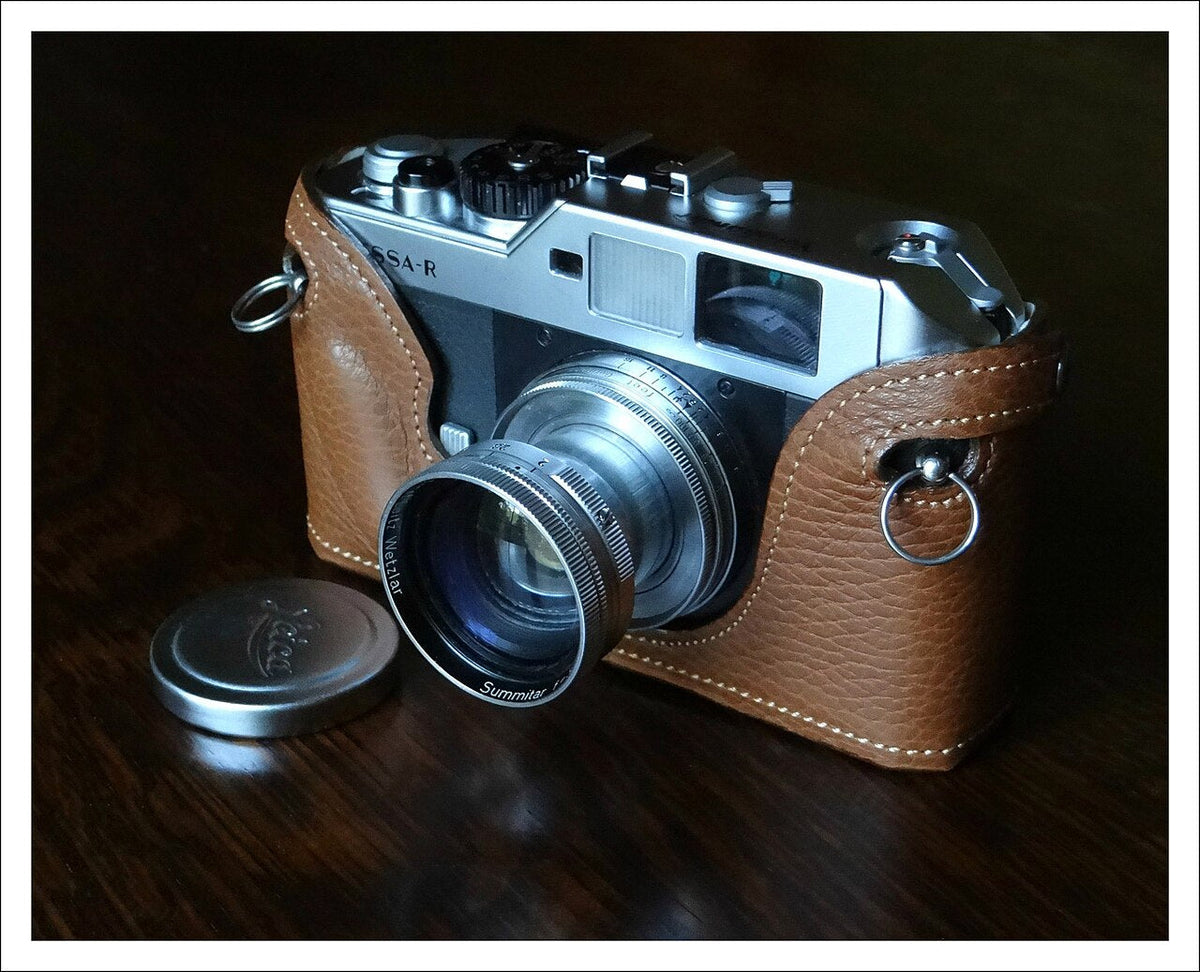
A rangefinder camera isn't aimed like a reflex: you look through a small window, and you focus by superimposing two images in the center of the viewfinder. Leica M, Canonet, Yashica Electro, Olympus XA, Zorki, Kiev, Voigtländer Bessa… These cameras have a special place in film photography: compact, quiet, and very pleasant for street photography. Here's how they work, their strengths, their limitations, and how to choose yours.
How does a rangefinder work?
The rangefinder measures the distance to the subject by triangulation. In the viewfinder, a small area in the center shows a second image of the subject, taken through another window on the front. When you turn the focusing ring, this image moves. When the two images coincide, your subject is in focus. On so-called "coupled" cameras, the rangefinder is linked to the lens: focusing is done in a single operation. On older uncoupled models, you had to read the distance and then transfer it to the lens.
The first coupled rangefinder camera marketed was the Kodak 3A Autographic Special in 1916. The Leica II and the Contax I, in 1932, popularized the 35mm rangefinder, and the Contax II in 1936 integrated it into the center of the viewfinder.

Rangefinder or reflex: the real differences
| Criterion | Rangefinder | Reflex |
|---|---|---|
| Aiming | Separate window from the lens | Through the lens (mirror and prism) |
| Focusing | Superimposition of two images | Sharp image on the viewing glass |
| Noise when shooting | Low (no mirror) | Louder (mirror slap) |
| Viewfinder when shooting | Remains visible | Black for a short moment |
| Size | Often more compact | Larger with the prism |
| Close-up framing | Parallax error | Accurate |
| Telephoto lenses, macro | Not well suited | Suitable |
| Filters, depth of field | Not visible in the viewfinder | Visible |
To compare with reflex aiming, read our selection of film reflex cameras and film compact or reflex.
The advantages of a rangefinder
- Discretion: without a mirror, the shutter release is quiet. This is why rangefinders are associated with street photography and photojournalism. See our street photography tips.
- The viewfinder is always visible: you see the moment of release, and what is happening outside the frame thanks to the rangefinder patches.
- Focusing in low light: the superimposition remains readable when a reflex viewfinder becomes dark, especially with fast lenses.
- Slow handheld shutter speeds: without mirror slap, there are fewer vibrations.
- The central shutter of rangefinder compacts (Canonet, Yashica Electro) allows flash at all speeds.
The limitations to know
- Parallax: the viewfinder is offset from the lens. At close range, your framing is not exactly what will be on the film. Many models partially correct this with movable rangefinder patches.
- The minimum distance is often greater than on a reflex: close-up photography is not their strong point.
- Long focal lengths are difficult to frame and focus; rangefinders are mainly made for short and medium focal lengths.
- The rangefinder can go out of adjustment: if the two images no longer coincide at infinity or if they are vertically offset, adjustment is necessary. See blurry film photos.
- The forgotten lens cap: since you are not aiming through the lens, you don't see it in the viewfinder!
The major families of film rangefinders
| Family | Examples | For whom |
|---|---|---|
| Leica M (M mount, 1954) | Leica M3, M6; Voigtländer Bessa, Minolta CLE, Zeiss Ikon bodies | Demanding photographer, high budget |
| M39 screw mount (Leica and copies) | Leica II and III, FED, Zorki | Curious, small budget, patience for maintenance |
| Contax and derivatives | Contax II, Kiev (Soviet post-war version) | Vintage mechanics enthusiast |
| Fixed-lens compacts (1960s-1970s) | Canonet QL17 GIII, Yashica Electro 35, Minolta 7sII | Beginner, value for money |
| Pocket compacts | Olympus XA | Daily use, jacket pocket |
| Medium format | Mamiya 7, rangefinder folding camera | Landscape, large negative |

Leica M: the benchmark
The M mount was launched in 1954 with the Leica M3, which abandoned the M39 screw mount in favor of a bayonet and combined the viewfinder and rangefinder into a single window. It has remained the same through to today's Leica cameras, film and digital. The Leica M6 (1984), with its built-in light meter, is often considered the most versatile: see our review of the Leica M6 and our Leica camera guide.
Soviet rangefinders
The FEDs and early Zorkis are copies of the Leica II; the Kievs are based on the Contax. They are affordable entry points, but their mechanics require attention. On most Zorkis, for example, you must cock the shutter before changing the speed, or risk damaging the mechanism. To learn more: Eastern European cameras.
Rangefinder compacts: the best value for money
In the 1960s-1970s, Canon, Konica, Minolta, Olympus, Yashica and others produced many fixed-lens rangefinders, often very fast. They are excellent first cameras today: see Canonet QL17 GIII, Yashica Electro 35 and Olympus XA.

How to focus properly with a rangefinder
- Aim at a high-contrast area of your subject, ideally a vertical line (the edge of a face, a door frame).
- Turn the ring until the two images coincide exactly.
- For a portrait, focus on the closest eye.
- Reframe if necessary, without moving forward or backward.
- In street photography, pre-set the distance and work at f/8: see hyperfocal and zone focusing.
Points to check before buying
- The rangefinder: aim at a distant object at infinity; the two images must coincide, without vertical offset.
- The brightness of the double image: a tarnished semi-transparent mirror makes focusing difficult.
- The shutter: listen to the slow speeds; on cloth shutters, look for holes.
- The light meter and battery: many rangefinders from the 1960s-1970s used mercury batteries. See replacing a PX625 battery.
- The foam on the back, which causes light leaks.
Our checklist for buying a used film camera details each test.
Want to see more images? Browse the most popular photos taken with a Leica M6 on Lomography (Lomography community gallery, photos protected by the copyright of their authors).
All cameras sold by Vibes Photo are checked before being put on sale and covered by a six-month commercial warranty, in addition to legal warranties. Details are in our general terms and conditions of sale.
Frequently asked questions
What is a rangefinder camera?
A camera that focuses by superimposing two images of the subject in the viewfinder, without a mirror or aiming through the lens.
Rangefinder or reflex to start with?
Both are suitable. The reflex shows exactly the framing and sharpness; the rangefinder is more compact and discreet. A rangefinder compact like the Canonet QL17 GIII is an affordable entry.
What is the cheapest film rangefinder?
Soviet rangefinders (FED, Zorki, Kiev) and Japanese compacts from the 1960s-1970s are generally the most affordable.
Can Leica M lenses be used on another body?
Yes on bodies with an M mount (Voigtländer Bessa with M mount, Minolta CLE, Zeiss Ikon...), and, with an adapter, on most digital hybrids: see vintage lens on hybrid.
How to tell if the rangefinder is out of adjustment?
Aim at a very distant object, set the ring to infinity: if the two images do not coincide, or are vertically offset, the camera needs to be adjusted.
Sources: Wikipedia – Rangefinder camera; Wikipedia – Leica M mount; Wikipedia – Zorki; Wikipedia – FED.