










Fujifilm 200 and 400 Film: Characteristics, Uses, and Comparison
Fujifilm's two consumer color film stocks: specifications, what the brand claims, which one to choose, and how they compare to Kodak.
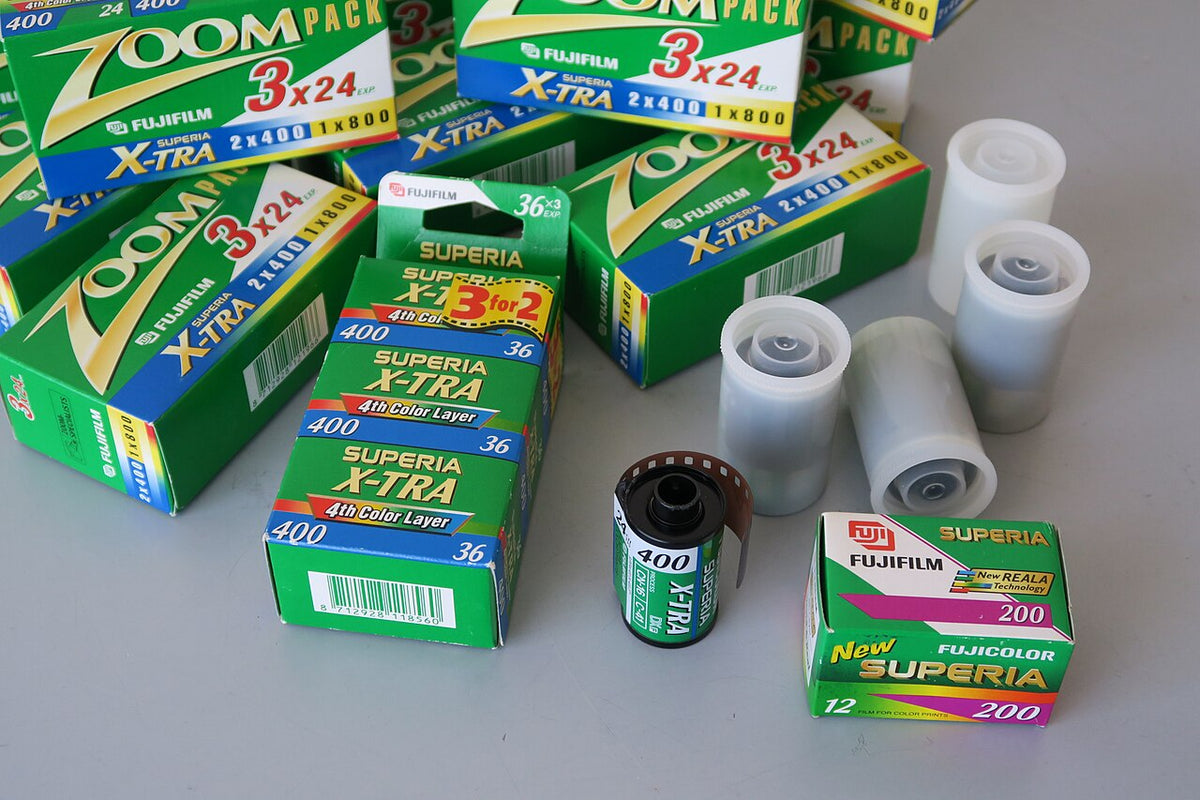
Fujifilm currently sells two consumer color films in 35 mm format, simply named Fujifilm 200 and Fujifilm 400. These are its current consumer color films, comparable to Kodak Gold 200 and Ultramax 400. Here are their official specifications, uses, and how to choose between the two.
Official specifications
| Fujifilm 200 | Fujifilm 400 | |
|---|---|---|
| Type | Color negative | Color negative |
| Sensitivity | ISO 200 | ISO 400 |
| Format | 35 mm (135) | 35 mm (135) |
| Exposures | 36 (pack of 3: 108) | 36 (pack of 3: 108) |
| Balance | Daylight | Daylight |
| Processing | C-41 | C-41 |
| Resolution | 125 lines/mm | 125 lines/mm |

Fujifilm 400: what the brand states
Launched in 2024 (spec sheet dated April 2024), Fujifilm 400 is presented by Fujifilm as a versatile film. The brand highlights:
- fine grain for a 400 ISO film, even when enlarged;
- a wide exposure latitude and suitability for low-light photography;
- vivid and natural colors: reds, blues, yellows, purples, and greens;
- soft and natural skin tones;
- good sharpness and a good balance of grays.
The spec sheet also provides practical information: no filter is needed in sunlight or with flash; under tungsten lighting (3200 K), use an LBB-12 filter (equivalent to Wratten 80A) and an effective sensitivity of ISO 100; no exposure compensation is needed between 1/4000 s and 2 s. For storage, Fujifilm recommends a cool, dark place, and temperatures below 10°C for long-term storage.
Fujifilm 200: the everyday film
Same format, same processing, same stated resolution: Fujifilm 200 is best suited for daytime, outdoor photography. With a compact camera and a small aperture, it requires light: keep it for sunny days, the beach, and summer trips.

200 or 400: which one to choose?
| Situation | Recommendation |
|---|---|
| Bright sunlight, beach, mountains | Fujifilm 200 |
| Disposable camera or compact camera with a small aperture | Fujifilm 400, more versatile |
| Indoors, late afternoon, overcast skies | Fujifilm 400 |
| A single film for the entire trip | Fujifilm 400 |
The general rule: the higher the sensitivity, the better you can shoot in low light, at the cost of slightly more noticeable grain. For more details, read 200 or 400 ISO: which film to choose.
Fujifilm or Kodak?
Fujifilm 200 and 400 are positioned as alternatives to Kodak Gold 200 and Kodak Ultramax 400. All can be processed in C-41, available everywhere. The choice mainly depends on color rendering, availability, and current price: the easiest way is to try one roll of each and compare. For other budget-friendly options, see the cheapest films and Kodak ColorPlus 200.
Processing and scanning
Like all C-41 color negatives, these films can be processed at any lab. Fujifilm states that Fujifilm 400 is compatible with its CN-16 and C-41 processes. See film processing prices and mail-order photo labs. To store them properly before use: storing your film.
Frequently asked questions
What is the difference between Fujifilm 200 and Fujifilm 400?
Sensitivity: 400 allows you to shoot in lower light. Both are 36-exposure 35 mm color negatives processed in C-41.
Is Fujifilm 400 a Superia?
Fujifilm presents it as a separate product, launched in 2024 under the name Fujifilm 400. Its specifications are those listed in its spec sheet.
How do you process Fujifilm 200 or 400 film?
In C-41, the standard process for color negatives, available at all labs.
Does Fujifilm 400 work indoors?
Yes, with flash or good lighting. Under tungsten lighting, Fujifilm recommends an LBB-12 filter, with an effective sensitivity of ISO 100.
Sources: Fujifilm – Fujifilm 400; Fujifilm – Fujifilm 400, specifications; Fujifilm – Fujifilm 400, spec sheet (2024); Fujifilm – Fujifilm 200, specifications; Fujifilm – Consumer film support.