










Minolta Riva: reviews and which model to choose
The Minolta Riva compact range explained: model chart, the DX limited-reading trap, the Riva Mini cousin of the Leica Mini II, and points to check.
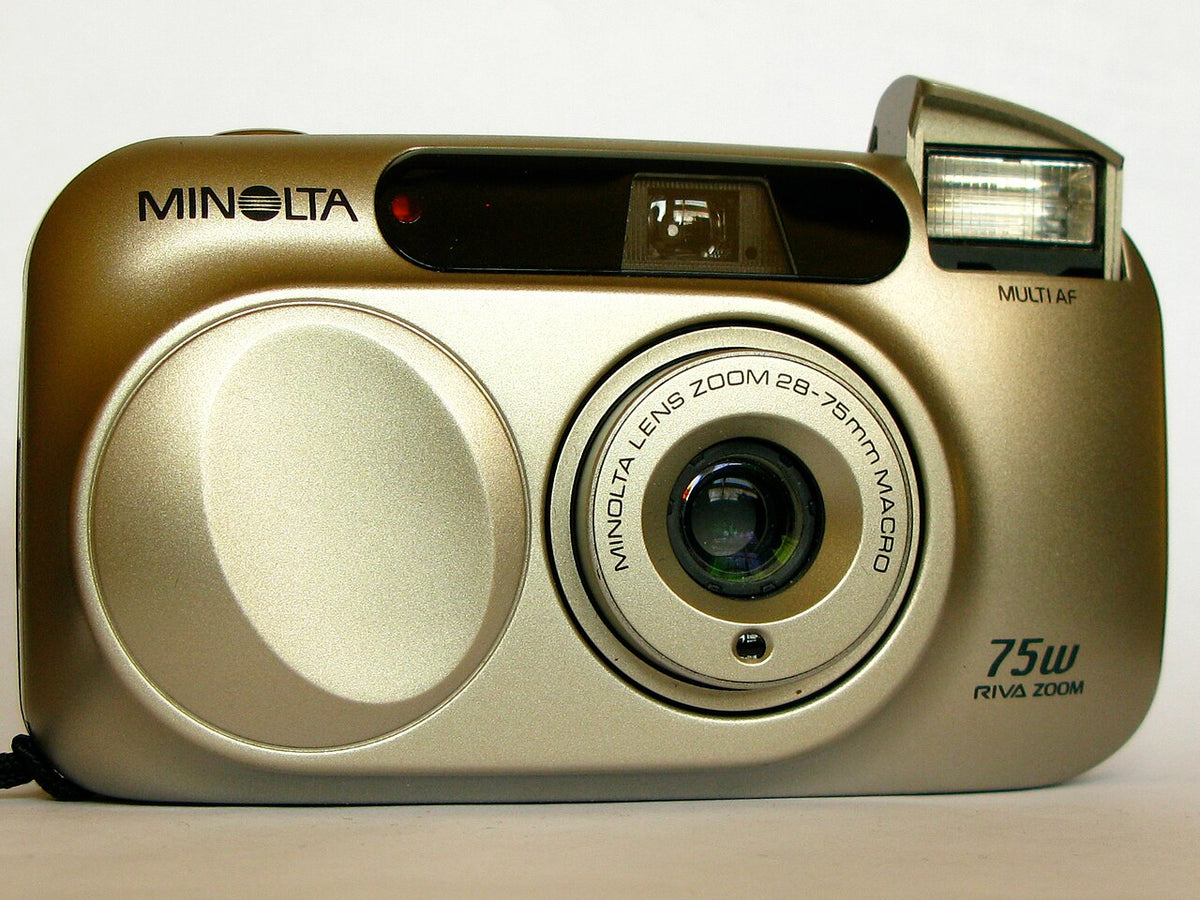
Minolta Rivas are everywhere on the second-hand market: small film compacts from the 1990s and 2000s that are often found at the back of a drawer. But behind this name lies a very wide range, from fixed-focus compacts to 150 mm zooms, including a cousin of the Leica Mini II. Here is how to navigate them, which models are worth it, and the pitfalls to avoid.
Riva, Freedom, Capios: one camera, several names
Minolta sold the same camera under different names depending on the market: Riva in Europe, Freedom in North America, and names specific to Japan (Pico, Mac, P's, Capios...). The Riva Zoom 70W, for example, is also called the Freedom Zoom Explorer 70W and Capios 25. Remember to search for both names when comparing listings or a user manual.
The table of the main Minolta Rivas
| Model | Lens | Focus | Battery | To remember |
|---|---|---|---|---|
| Riva 35 / Riva GT | 35 mm f/4.5 | Fixed (1.5 m to infinity) | 2 × AA | Fixed shutter at 1/125 s; very basic |
| Riva 35 ST | 35 mm f/4.5 | Fixed | 2 × AA | Speeds from 1/35 to 1/100 s, self-timer |
| Riva AF 35 | 35 mm f/4.5 | Infrared autofocus from 0.95 m | 2 × AA | Flash cannot be disabled |
| Riva Mini (1991) | 34 mm f/3.5, 4 lenses | Autofocus | CR123A | Cousin of the Leica Mini II, lens renowned for being very sharp |
| Riva Twin 28 (1991) | 28 mm f/4 and 40 mm f/5.6 | Autofocus | 2CR5 | Two focal lengths, 270 g |
| Riva Panorama (1991) | 24 mm f/4.5 | — | CR123A | Panoramic format by mask (12.2 mm high) |
| Riva Zoom 70 | 35-70 mm f/5.3-9.8 | Autofocus from 1.3 m | CR123A | Four speeds, from 1/15 to 1/200 s |
| Riva Zoom 70W (1995) | 28-70 mm f/3.5-8.4 | Autofocus from 0.5 m | CR123A | 28 mm wide-angle, ISO 25 to 3200, 240 g |
| Riva Zoom Pico (1993) | 38-60 mm | Autofocus | CR123A | ISO 25 to 3200 |
| Riva Zoom 115 (around 2002) | 37.5-115 mm f/5.4-10.9 | Autofocus from 0.55 m | CR123A | 10 s to 1/390 s, 205 g |
| Riva Zoom 150 (2000) | 37.5-150 mm f/5.4-11.9 | Autofocus from 0.6 m | CR123A | 190 g; made in China |
« — »: data not specified in our sources.

The trap: limited DX reading
Some Rivas, like the Riva AF 35 and the Riva Twin 28, only read two sensitivities: film under 400 ISO is exposed as 100 ISO, 400 ISO or higher as 400 ISO, and film without a DX code as 100 ISO. In practical terms:
- A 200 ISO (Kodak Gold, ColorPlus) will be exposed as 100 ISO, therefore overexposed by one stop: with color negative film, this is generally not a problem.
- An 800 ISO will be exposed as 400 ISO: it still works well with color negative film.
- Avoid slide film, which is much less forgiving.
The easiest option: a Kodak Ultramax 400 or a Kodak Gold 200. To understand film latitude, see 200 or 400 ISO. The Riva 35 and 35 ST accept DX films from 100 to 400 ISO; newer zooms (70W, Pico, 115, 150) read from 25 to 3200 ISO.
Which Rivas are worth it?
The Riva Mini: the gem
Released around 1991, the Riva Mini (Freedom Escort in the United States, Pico in Japan) is a close cousin of the Leica Mini II: glass lens attributed to Minolta and Matsushita electronics with Leica specifications. It was also sold under the Panasonic brand. Its 34 mm f/3.5 is renowned for being very sharp for such a discreet camera. It is the most sought-after Riva.
The Riva Zoom 70W: the versatile zoom
Released in 1995, it starts at 28 mm, wider than most zoom compacts, with focus from 0.5 m (macro from 0.4 to 1 m) and full DX reading. It was replaced by the Riva Zoom 75W, almost identical with a slightly longer zoom.
The Riva Twin 28: two focal lengths
A 28 mm f/4 and a 40 mm f/5.6 to choose from, with a simple button. Beware of its limited DX reading and its 2CR5 battery.

Fixed-focus Rivas
The Riva 35, GT and 35 ST are close to a reusable disposable camera: fixed focus from 1.5 m, very simple shutter. Perfect for a child or an evening, less so for close-up portraits. See also a camera for children.
Points to check before buying
- Powering on: without a battery, it is impossible to test. Make sure you have the right one (CR123A, 2CR5 or AA depending on the model): see which battery for a film camera.
- The zoom: it must extend and retract without jerks or abnormal noise.
- The lens cap: it must open completely.
- The flash: check that it fires.
- The battery compartment: no signs of oxidation. See leaking battery.
Want to see more images? Browse the most popular photos taken with a Minolta Riva Zoom 70W on Lomography (Lomography community gallery, photos protected by the copyright of their authors).
Alternatives
If you are looking for a brighter compact, check out the Olympus Mju II (35 mm f/2.8) or our Mju II alternatives. For the entire brand range, from the X-700 to the Dynax, read our Minolta camera guide. And to compare other compacts: the best film compacts.
All cameras sold by Vibes Photo are checked before being put on sale and covered by a six-month commercial warranty, in addition to legal warranties. Details are in our general terms and conditions of sale.
Frequently Asked Questions
What is the best Minolta Riva?
The Riva Mini, cousin of the Leica Mini II, is the most renowned for its lens. The Riva Zoom 70W is the most versatile zoom thanks to its 28 mm.
What battery for a Minolta Riva?
Depending on the model: a CR123A (Riva Mini, Panorama, most zooms), a 2CR5 (Twin 28) or two AA batteries (Riva 35, 35 ST, AF 35).
What film in a Minolta Riva?
A 400 ISO color negative film is suitable for all models, including those that only read 100 and 400 ISO.
Riva and Freedom, is it the same camera?
Yes: Riva is the European name, Freedom the North American name of the same models.
Sources: Camera-wiki – Minolta Riva Mini; Camera-wiki – Riva Zoom 70W; Camera-wiki – Riva Twin 28; Camera-wiki – Riva AF 35; Camera-wiki – Riva Zoom 70; Camera-wiki – Riva Zoom 115; Camera-wiki – Riva Zoom 150; Camera-wiki – Riva Panorama.