










Konica cameras: history, Big Mini, Hexar AF and which model to choose
From the C35 AF to the Hexar AF and the Big Mini: the history of Konica and which used model to choose.
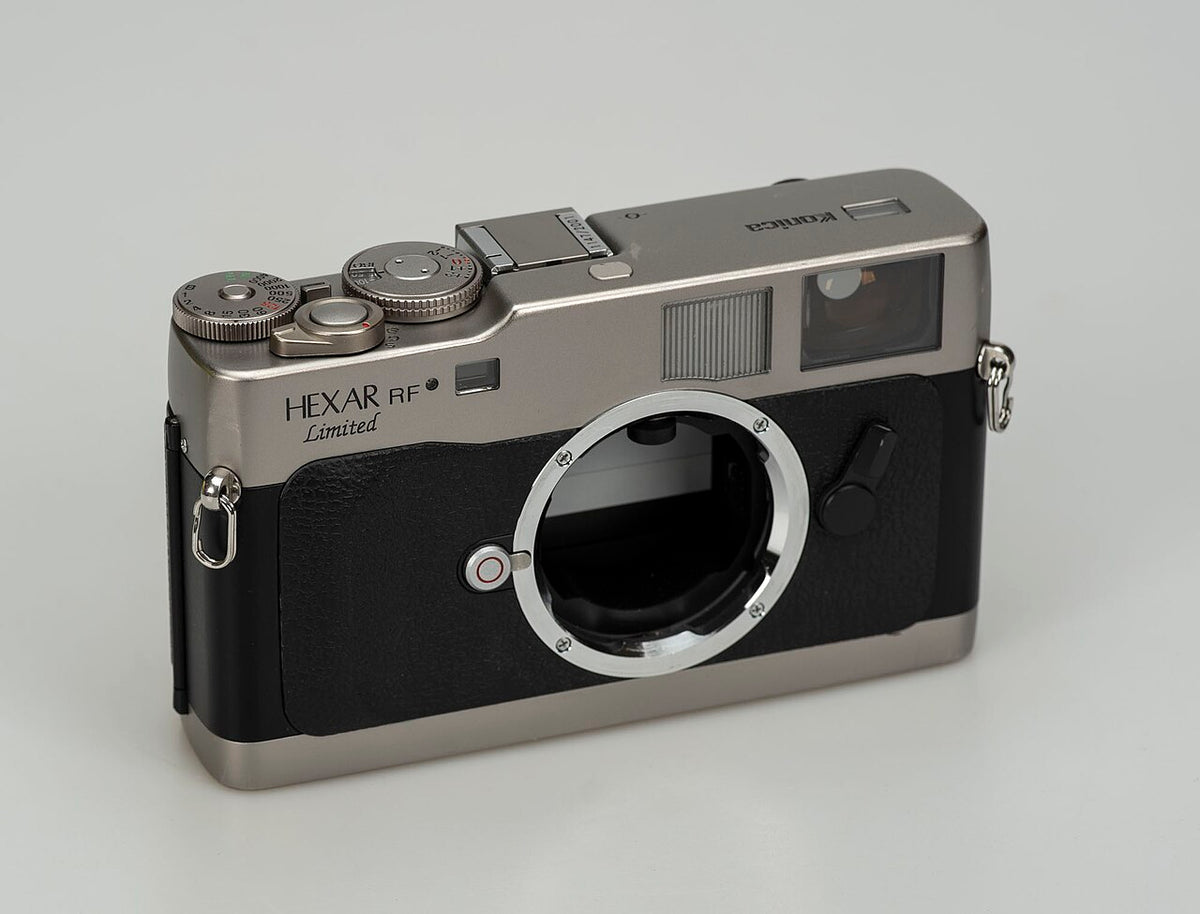
Konica is the oldest Japanese camera company and the inventor of the consumer autofocus compact camera. In short: a Big Mini for a lightweight compact with sharp results, an Hexar AF for a silent enthusiast compact, a C35 for a small automatic rangefinder, an Autoreflex for a SLR; in digital, a Revio or a Dimage from the Konica Minolta era. These cameras are often cheaper than their competitors of equal quality.

Konica's history by date
| Year | Milestone |
|---|---|
| 1873 | Rokusaburo Sugiura begins selling photographic equipment at Konishiya Rokubeiten in Tokyo: the origin of Konica. |
| 1960s | Autoreflex SLR and C35 compacts (1968). |
| 1977 | C35 AF, first mass-produced autofocus compact (Honeywell Visitronic system). |
| 1980s-1990s | Pop, MG, then Big Mini compacts (late 1980s). |
| 1993 | Hexar AF, enthusiast compact with a 35 mm f/2 lens and silent mode. |
| 1999 | Hexar RF, M-mount rangefinder. |
| 2003 | Merger with Minolta: birth of Konica Minolta. |
| 2006 | Konica Minolta leaves photography; Sony takes over the SLR business. Film production is subsequently discontinued. |
Konica cameras
| Model | Type | For whom? | Our article |
|---|---|---|---|
| Big Mini (BM-201, BM-301, BM-302…) | Lightweight 35 mm compact | Everyday compact with sharp results | Konica Big Mini review |
| Hexar AF | 35 mm f/2 enthusiast compact | Street photography, low light | — |
| Hexar RF | M-mount rangefinder | Leica M alternative | — |
| C35, C35 AF | Small automatic rangefinder, then autofocus | Simple vintage compact | — |
| Autoreflex T, T3, TC, FS-1 | Shutter-priority SLR (AR mount) | Affordable Hexanon lenses | — |
| Pop, MG, Z-up | Consumer compacts | Low budget | — |
| Revio, Digital Revio, KD | Digital compacts | 2000s digicams | Konica Minolta Dimage |

Which Konica to choose?
| Your need | Our Konica recommendation |
|---|---|
| A lightweight and reliable compact | Big Mini |
| A bright enthusiast compact | Hexar AF |
| An M rangefinder cheaper than a Leica | Hexar RF |
| A small vintage automatic rangefinder | C35 |
| An affordable SLR | Autoreflex T3 + Hexanon 50 mm |
Points to watch out for
- Hexar AF: runs on a 2CR5 lithium battery; test the autofocus and display. There are many versions (black, titanium, "Silver", limited editions).
- Big Mini: check the LCD screen, flash, and lens release. See our Big Mini guide.
- C35: designed for a mercury battery, to be replaced by an equivalent; the light meter must block the shutter release in low light.
- Autoreflex: Konica's proprietary AR mount, few third-party lenses; Hexanons adapt well to hybrid bodies.
- Hexar RF: electronic shutter; check the motorized advance and rangefinder superimposition.
Batteries: see which battery for my film camera.
At Vibes Photo, each camera is checked before being put up for sale and covered by a six-month commercial warranty, in addition to the legal warranties of conformity and hidden defects. The details are in our general terms and conditions of sale.
Find all brands in our camera brand guide, and our in-depth guides: the complete film photography guide and the complete digicam guide. Before buying an expensive model, also read scams to avoid and how to estimate a fair price.
All our Konica articles
Detailed reviews, comparisons, and model-by-model guides:
Frequently asked questions
Is the Konica Big Mini a good compact?
Yes: lightweight, sharp, and often cheaper than the most publicized compacts. See our detailed review.
Are Konica and Minolta the same brand?
They merged in 2003 to form Konica Minolta, which left photography in 2006.
Is the Hexar AF really silent?
Its silent mode makes it very discreet for a motorized compact, hence its reputation in street photography.
Do Konica AR lenses fit hybrid bodies?
Yes, with an adapter ring: Hexanons are renowned and often affordable.
Sources: Konica Minolta – history; Konica C35 AF – camera-wiki; Konica Hexar – Wikipedia; Konica – Wikipedia.