










The best vintage lenses to adapt to a mirrorless camera
Our selection of vintage lenses for mirrorless cameras: their rendering, their mount, their known flaws, and what to choose them for.
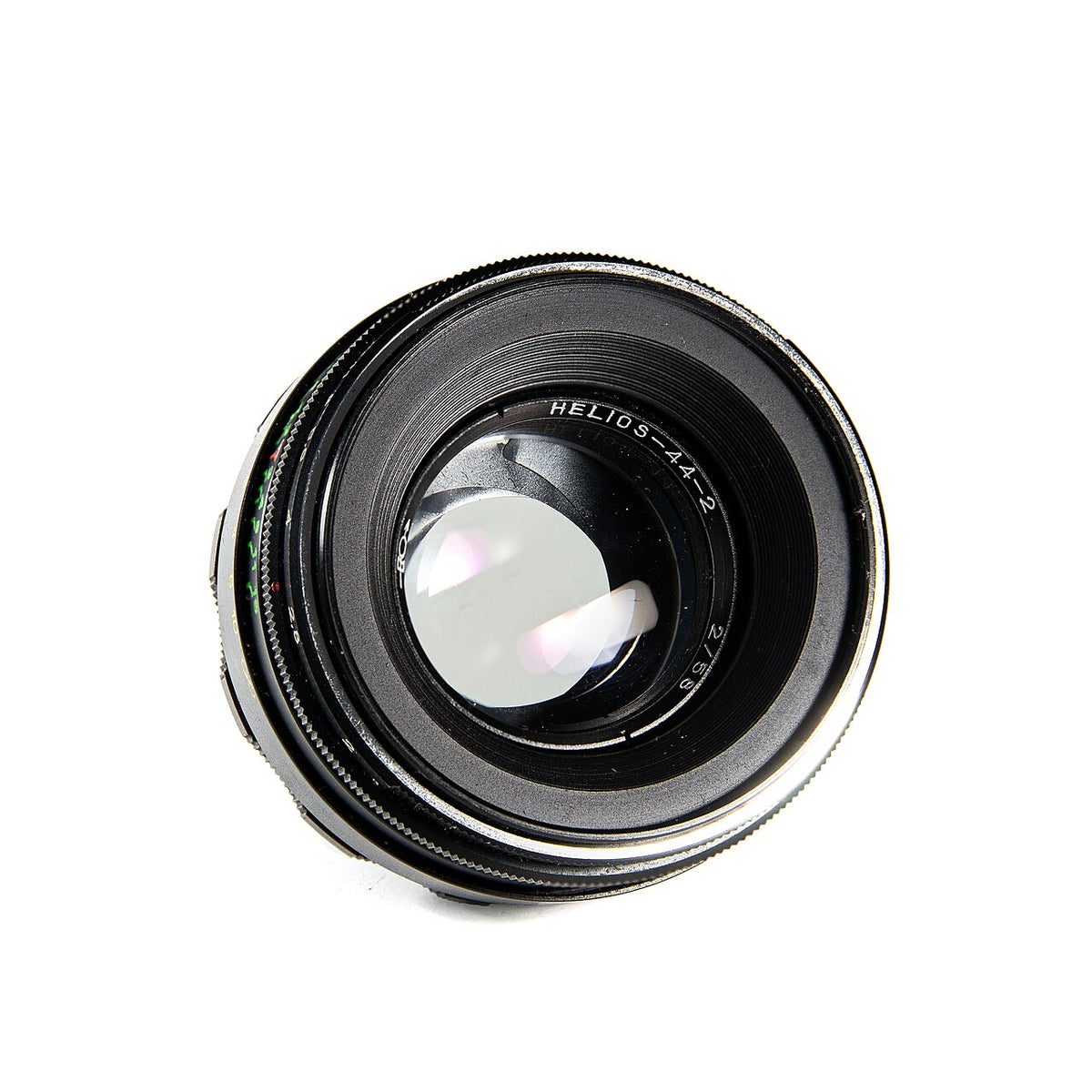
The most interesting vintage lenses to adapt to a mirrorless camera are the Helios 44-2 58 mm f/2 for its swirling blur, the Super-Takumar 50 mm f/1.4 for its softness, the Jupiter-9 85 mm f/2 for portraits, and the 50 mm lenses from the major Japanese brands (Canon FD, Minolta Rokkor, Olympus Zuiko, Nikon) for reliable performance at a low price. They can all be mounted with a simple adapter ring and are manually focused.
Our selection
| Lens | Mount | Rendering | Best for |
|---|---|---|---|
| Helios 44-2 58 mm f/2 | M42 | Swirling bokeh, soft contrast | Portraits, atmosphere |
| Super-Takumar / SMC Takumar 50 mm f/1.4 | M42 | Soft at wide open, very sharp when stopped down | Versatile, low light |
| Jupiter-9 85 mm f/2 | M42 or M39 | Round blur, classic rendering | Close-up portraits |
| Pentacon 50 mm f/1.8 | M42 | Simple, sharp, sometimes nervous bokeh | First vintage lens |
| Carl Zeiss Jena Flektogon 35 mm f/2.4 or 20 mm f/4 | M42 | Wide-angle, close focusing | Landscape, interiors |
| Minolta MC Rokkor 58 mm f/1.4 | Minolta MC/MD | Warm and soft rendering | Portraits |
| Canon FD 50 mm f/1.8 | Canon FD | Neutral, reliable, very common | Everyday use |
| Olympus OM Zuiko 50 mm f/1.8 | Olympus OM | Compact and sharp | Travel |
| Nikon 50 mm f/1.8 AI-S | Nikon F | Sharp, modern contrast | Versatile |
| Konica Hexanon AR 40 mm f/1.8 | Konica AR | Very flat pancake lens | Street |
Helios 44-2: the bokeh star
Derived from the Zeiss Biotar 58 mm f/2 and mounted on millions of Zenit SLRs, the Helios 44-2 is the most famous vintage lens. At wide open, with a bright and busy background (foliage, lights), it produces a blur that "swirls" around the subject. It is pre-set: one ring sets the chosen aperture, the other closes the diaphragm. More information about the cameras that accompanied it in Zenit and Praktica.

Takumar 50 mm f/1.4: Pentax softness
Pentax's Super-Takumar and SMC Takumar lenses are renowned for their build quality and very smooth focus ring. Some versions of the 50 mm f/1.4 contain thorium glass that yellows over time; prolonged exposure to UV light often fades this yellowing, and the white balance corrects the rest.

Jupiter-9: old-school portraiture
This Soviet copy of the Zeiss Sonnar 85 mm f/2 produces a soft, round background blur. On an APS-C sensor, it becomes a short telephoto lens (about 130 mm equivalent, see equivalent focal length).

The Japanese 50 mm lenses: the sensible choice
Canon FD, Minolta Rokkor, Olympus Zuiko, Nikon: these 50 mm lenses equipped millions of SLRs, they are easy to find and are generally in good condition. They are perfect for discovering manual focus before buying more "characterful" lenses. Our guide to the film 50 mm compares them.
Buying a vintage lens properly
- Inspect with a lamp: no fungus, haze, or deep scratches (fungus in a lens).
- Turn the rings: smooth focus, diaphragm that closes without oil on the blades.
- Choose the right ring for your mount: complete guide in mounting a vintage lens on a mirrorless camera, and special M42 in M42 lenses.
- Check the compatibility of the mounts in film lens mounts.
Frequently asked questions
Which vintage lens to start with?
A 50 mm f/1.8 from a major brand (Canon FD, Minolta, Olympus, Pentax) or a Pentacon 50 mm f/1.8 in M42: inexpensive, easy to adapt, and reliable.
Does autofocus work with a vintage lens?
No, focusing is done by hand. Mirrorless camera aids (magnifier, focus peaking) make it easy.
Does a vintage lens on an APS-C mirrorless camera retain its rendering?
The optical rendering is the same, but the framing is tighter: a 50 mm behaves like about a 75 mm.
All cameras sold on Vibes Photo are checked before shipping and covered by a 6-month warranty (details in our general terms and conditions of sale).