










Sony DCR-TRV: reviews, MiniDV or Digital8, TRV900 and TRV950
MiniDV or Digital8? How to identify the format of a Sony DCR-TRV, which models play Hi8 tapes, and what the three-sensor TRV900 and TRV950 are worth.
Review · Camcorder · October 2026 Update
Under the same DCR-TRV prefix, Sony sold MiniDV, Digital8, and two legendary three-sensor cameras. Here is how to identify the format of a DCR-TRV, which models read your old 8 mm tapes, and what the TRV900 and TRV950 are really worth.
The DCR-TRV prefix designates Sony digital HandyCams with flip-out LCD screens. For nearly ten years, it covered almost the entire consumer range: small MiniDV cameras for vacations, affordable Digital8 cameras designed for families who already owned 8 mm tapes, and two three-sensor models, the TRV900 and TRV950, which served independent videographers as well as journalists. For you, the challenge is simple: knowing what you are buying. A DCR-TRV can be the best machine for digitizing your family's Hi8 tapes, or an excellent camcorder for filming in MiniDV, but rarely both at the same time.
Our verdict
For filming, aim for a MiniDV DCR-TRV, and if your budget allows, a TRV900, the brightest three-sensor camera in the series. For digitizing Video8 or Hi8 tapes, choose a Digital8 DCR-TRV whose manual confirms analog playback. In any case, it is the logo on the body that counts, not the number.
Recognizing the format
Sony never systematically encoded the media in the DCR-TRV model numbers. We observe a trend: two-digit models (TRV11, TRV18, TRV22, TRV33, TRV50, TRV70...) are mostly MiniDV, while three-digit models (TRV120, TRV250, TRV340, TRV480, TRV830...) are mostly Digital8, with two major exceptions: the TRV900 and TRV950 in MiniDV. But a trend is not a rule. The only reliable indicator is the MiniDV or Digital8 logo on the body, and the model's manual, which Sony keeps online on its support site.


| Family | Media | Examples | Best Use |
|---|---|---|---|
| Two-Digit TRVs | MiniDV (Generally) | TRV18, TRV22, TRV33, TRV50 | Filming in MiniDV Today |
| TRV900 and TRV950 | MiniDV, Three Sensors | TRV900 (1998), TRV950 (2002) | The Best Image in the Series |
| Three-Digit TRVs | Digital8 (Generally) | TRV120, TRV340, TRV480, TRV830 | Playing Back and Digitizing 8 mm Tapes |
| CCD-TRV | Analog Video8 or Hi8 | CCD-TRV418E | The Analog Grain of the 1990s |
Don't confuse DCR-TRV with CCD-TRV either: the latter prefix designates analog Video8 and Hi8 HandyCams. To find your way through the entire Sony range, read which Sony HandyCam to choose.

The TRV900, the compact three-sensor camera
Sony announced the DCR-TRV900 on July 30, 1998, for a September 10 release in Japan at a recommended price of 300,000 yen. According to Sony, it was the first consumer three-sensor camcorder capable of switching between interlaced and progressive recording. It housed three 380,000-pixel (340,000 effective) CCDs behind a 12x optical zoom from 4.3 to 51.6 mm, or 41.3 to 496 mm in 24 × 36 equivalent, with an aperture of f/1.6. The magnesium alloy body weighed about 880 g without a battery, or roughly 1 kg in operating condition: half as much as a VX.

In use, it offers everything a demanding videographer expects: focus ring, shutter speed from 1/4 to 1/10,000 s, 16-bit 48 kHz audio, a large 3.5-inch screen, and a color viewfinder. It also has an analog input for digitizing old 8 mm tapes played through another device. Its Super SteadyShot stabilization is optical, with an active lens. Its minimum sensitivity is rated at 8 lux.
- Sensors
- 3 CCDs, 380,000 pixels each
- Lens
- 4.3 to 51.6 mm, f/1.6 to 2.8, 12x zoom
- Filter
- 52 mm
- Minimum illuminance
- 8 lux
- Shutter
- 1/4 to 1/10,000 s
- Screen
- 3.5 inches, 184,000 dots
- Viewfinder
- 0.55 inches, color
- Batteries
- InfoLITHIUM L series (NP-F550 to NP-F950)
- Weight
- About 880 g without battery
- Price in Japan
- 300,000 yen (September 1998)
Source: Sony press release from July 30, 1998. Period price, unrelated to current value.
Wikipedia ranks it among the "affordable" three-sensor DV cameras, along with the Canon GL1, which allowed users to produce image quality close to Betacam for a fraction of the price at the end of the 1990s. A professional DVCAM version, the DSR-PD100, also existed. To understand what three sensors change in an image, the review of the Sony VX1000, VX2000, and VX2100 explains the principle.

The TRV950, the megapixel version
Announced in Japan on April 4, 2002, and released on June 10, the DCR-TRV950 replaces the TRV900. Sony equipped it with three 1/4.7-inch megapixel sensors (1.07 million pixels, including 690,000 effective pixels in video), an announced resolution of 530 lines, and a 14-bit converter. The zoom remains 12x with an aperture of f/1.6, but is smaller: 3.6 to 43.2 mm, with a 37 mm thread. The 3.5-inch screen becomes touch-sensitive, allowing you to touch the subject to set the focus or exposure. The camcorder takes 1152 × 864-pixel photos on Memory Stick, connects via Bluetooth and USB, and switches to M-series InfoLITHIUM batteries.

Sony intended it for both demanding consumers and independent videographers and journalists. It retains the important settings: shutter speed from 1/4 to 1/10,000 s in 20 steps, two-level zebra, custom saturation, sharpness, exposure, and white balance presets, and one-touch infinity focus. Its professional version is called the DSR-PDX10.
TRV900 or TRV950
On paper, the TRV950 is more modern. In practice, the choice depends on the light in which you are filming. Its smaller, denser sensors give it more resolution in photos, but Sony rates its minimum illuminance at 15 lux, compared to 8 lux for the TRV900. The two figures are not measured in a standardized way, but the difference goes in the direction that physics would lead us to expect.
| Feature | DCR-TRV900 | DCR-TRV950 |
|---|---|---|
| Announcement | July 1998 | April 2002 |
| Sensors | 3 CCDs, 380,000 pixels | 3 1/4-inch CCDs, 1.07 million pixels |
| Lens | 4.3 to 51.6 mm, f/1.6 to 2.8 | 3.6 to 43.2 mm, f/1.6 to 2.8 |
| Filter | 52 mm | 37 mm |
| Minimum illuminance | 8 lux | 15 lux |
| Screen | 3.5 inches | 3.5-inch touch screen |
| Photos | 640 × 480 | 1152 × 864 |
| Batteries | InfoLITHIUM L series | InfoLITHIUM M series |
| Body weight | About 880 g | About 970 g |
| Pro version | DSR-PD100 | DSR-PDX10 |
Our advice
For shooting indoors, in the evening, or at a concert, choose the TRV900. For shooting mostly during the day with settings accessible at the touch of a button, the TRV950 is a great choice. The TRV900's 52 mm thread also accepts a wider selection of wide-angle accessories.
Consumer MiniDV TRVs
Single-sensor DCR-TRV MiniDVs (TRV11, TRV18, TRV22, TRV33, TRV50, TRV70 and their European variants) are simple camcorders with the typical look of the early 2000s. Many have NightShot, a DV output, and, on the best-equipped models, a Memory Stick slot for photos. They are good choices for shooting today, provided you check the mechanics: their image is less rich than that of a three-sensor model, but it's exactly the "home video" look sought for clips. The tapes are still available: see where to buy MiniDV tapes. NightShot is explained in our NightShot guide.
Digital8 TRVs, digitizing machines
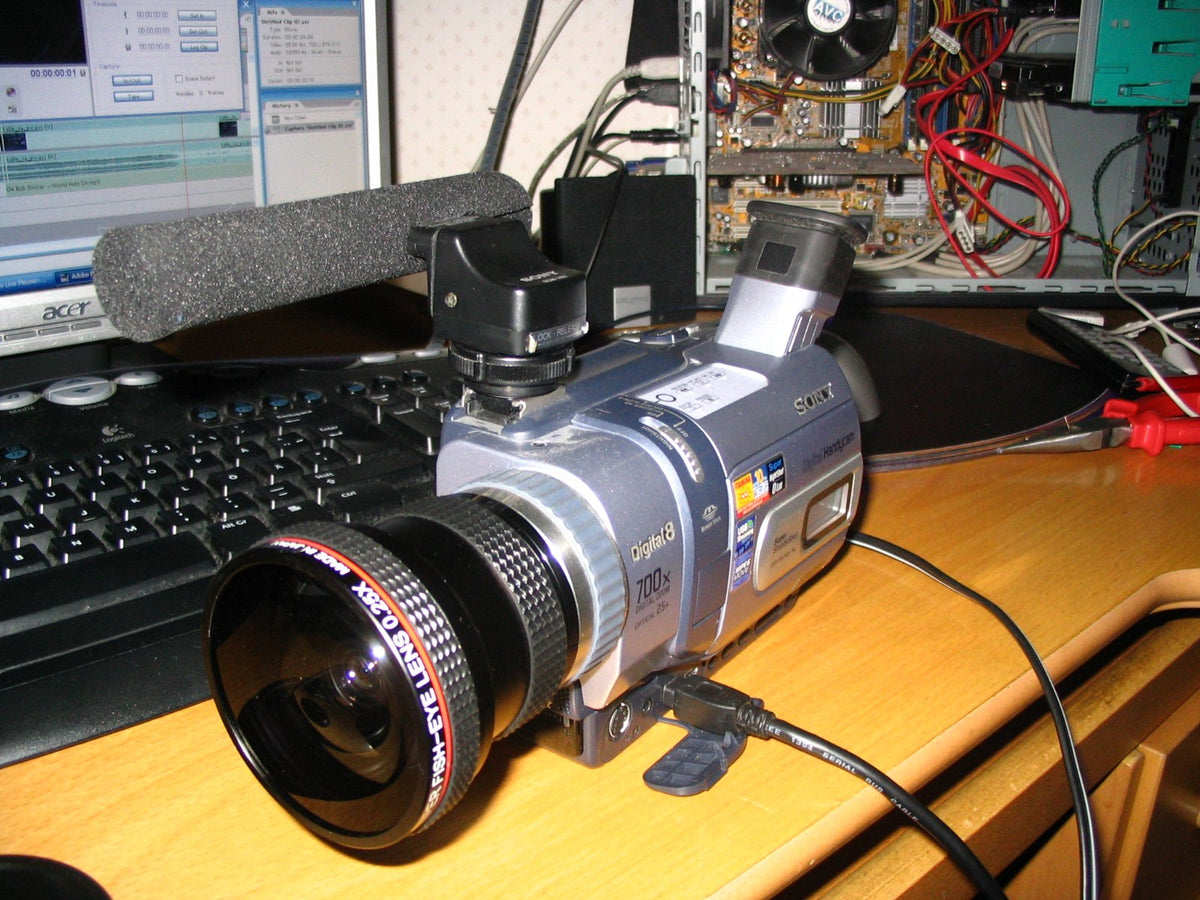
A DCR-TRV Digital8 records in DV quality on Hi8 tapes. Its real strength lies elsewhere: most also play back old analog Video8 and Hi8 tapes and output them digitally via the DV output. This is one of the cleanest ways to digitize 8 mm family archives.

Be careful, not all of them. The TransferVideoTapes website compiled, with manuals in hand, the list of Digital8s that do not play back analog: in the American version, the DCR-TRV130, TRV140, TRV150, TRV250, TRV260, TRV265 and TRV280, and in the European version, the DCR-TRV255E and TRV265E. Conversely, models like the DCR-TRV340E, TRV460E or TRV738E play Video8 and Hi8. Before buying, open the manual for the exact model and look for the mention of Hi8 and Video8 tape playback.
PAL or NTSC
To play back tapes recorded in France, take a European model (E suffix). An American model plays back NTSC; some PAL models also play NTSC, the reverse is rarer. And Digital8 only plays back analog: it never records in Hi8.
The entire method, from cabling to software, is in our Digital8 guide and transferring a tape to a computer.
Batteries and accessories
The DCR-TRVs do not all use the same battery. The TRV900 takes InfoLITHIUM L series (NP-F550, NP-F750, NP-F950); with the largest, Sony advertised more than eight hours of continuous recording through the viewfinder. The TRV950 and many DCR-TRVs from the early 2000s use the M series (NP-FM50, NP-FM70, NP-QM71D…). The two series are not interchangeable.

Check the series in the manual, then read how to find the right camcorder battery. Also think about the charger or AC adapter, and a DV cable (4-pin i.LINK) if you plan to transfer your videos.
Pre-purchase check
- Identify the format on the body: MiniDV or Digital8. For a Digital8, check the manual for analog tape playback if that's what you're looking for.
- Record then play back one minute of video: stable image, no blocks or lines, clean sound.
- Play back a tape recorded elsewhere, ideally one of your own archives: it's the real compatibility test.
- Open the screen in all positions: the image must not flicker. On a TRV950, also test the touch screen.
- Test the zoom, focus and NightShot if it has one.
- Check the DV output if you want to transfer without loss.
- Note the error codes: C:21:00 for condensation, C:22:00 for dirty heads, C:31 or C:32 for mechanics.
The codes are detailed in our Sony error code guide, and if the camcorder refuses the tapes, see my camcorder no longer reads tapes.
Frequently asked questions
How do I know if my DCR-TRV is MiniDV or Digital8?
Look at the logo near the tape hatch. The trend (two digits = MiniDV, three digits = Digital8, except TRV900 and TRV950) helps, but only the logo or the manual is authoritative.
Does a DCR-TRV Digital8 play back my Hi8 tapes?
Most do, some do not: the DCR-TRV130, TRV140, TRV150, TRV250, TRV260, TRV265, TRV280, TRV255E and TRV265E do not play back analog according to the list compiled by TransferVideoTapes. Always check the manual.
Is the TRV900 worth a VX2000?
Not quite: its sensors and lens are smaller, and it is less bright (8 lux versus 4). But it weighs half as much and already offers the three-sensor look.
Is the TRV950 better than the TRV900?
Sharper in photos and more modern (touch screen, Bluetooth), but less sensitive in low light according to Sony's figures. For indoor video, the TRV900 keeps the advantage.
What battery for a DCR-TRV?
It depends on the model: L series (NP-F) for the TRV900, M series (NP-FM, NP-QM) for the TRV950 and many others. The manual indicates the right series.
Can a Digital8 record in Hi8?
No. It always records digitally on the Hi8 tape; it can only play back analog, and even then, not all models.
Vibes Photo
Find your DCR-TRV
We select vintage MiniDV and Digital8 camcorders. Are you looking for a model capable of playing back your tapes? Write to us with the format of your archives.
To go further
Sources
- Sony, DCR-TRV900 press release (July 30, 1998).
- Sony Japan, DCR-TRV950 press release (April 4, 2002).
- Wikipedia, Sony DCR-VX1000 (three-sensor DV context) (accessed in October 2026).
- Wikipedia, Digital8 (accessed in October 2026).
- TransferVideoTapes, Digital8 and Hi8/Video8 playback (accessed in October 2026).
- MediaCollege, the Sony DCR-TRV series (accessed in October 2026).
- Sony UK, camcorder error codes (accessed in October 2026).
Images: authors, licenses and sources indicated under each photo. Checks performed in October 2026.