










Photo filters: UV, polarizing, ND and color, which ones are actually useful?
UV, skylight, polarizing, neutral density and color filters for black and white: what they are really used for, how to choose the diameter and compensate for exposure.
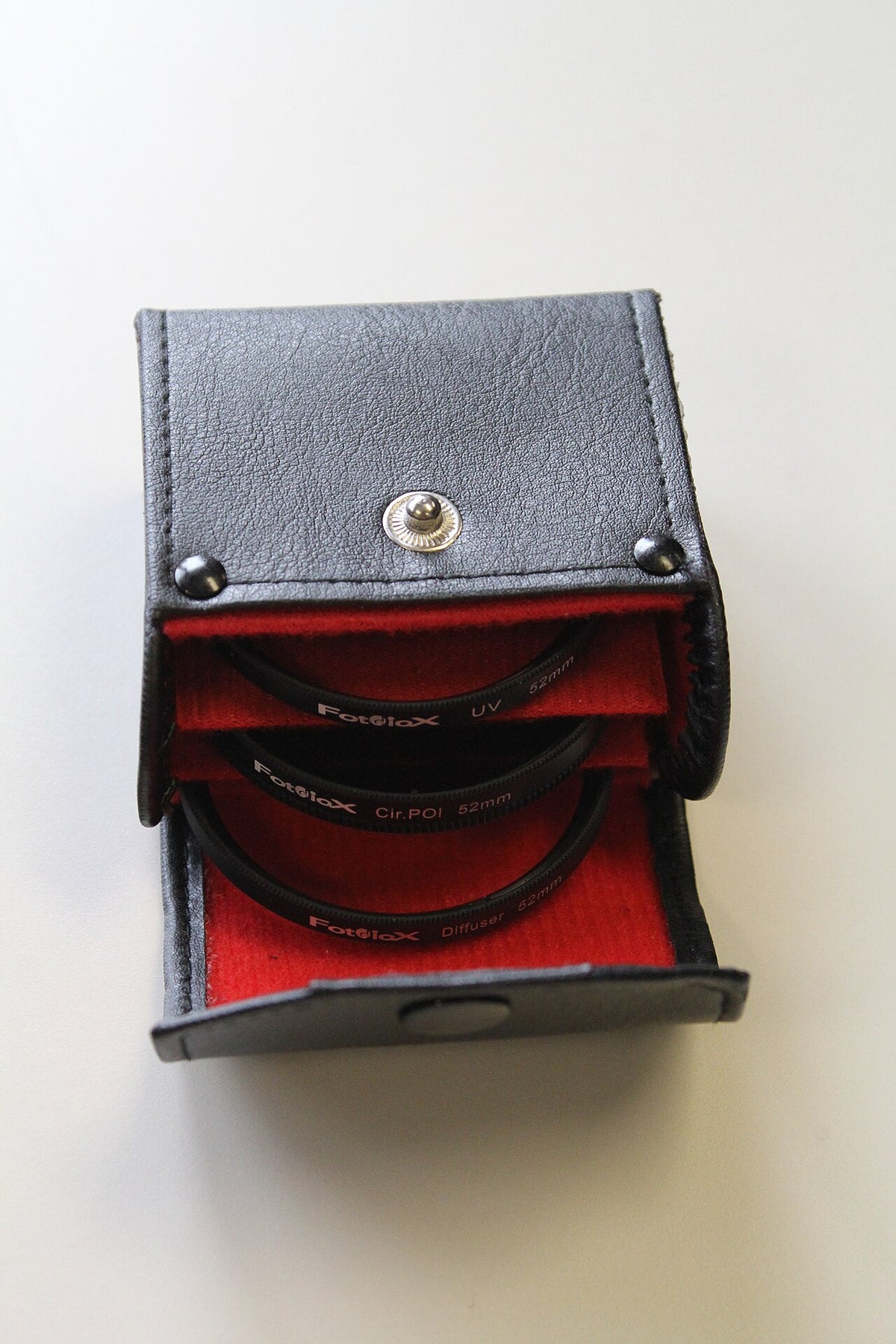
Three filters are really useful: the polarizer (bluer sky, reduced reflections), the neutral density (ND) filter for longer exposure times, and, in black-and-white film photography, yellow, orange, or red filters that darken the sky. The UV filter is mainly used to protect the front lens. Before buying, check the filter diameter engraved on the front ring of the lens (the Ø symbol followed by a number in millimeters).
Filter Chart
| Filter | Effect | Compensation | Useful for |
|---|---|---|---|
| UV / Skylight | Almost invisible; skylight slightly warms the image | None | Protecting the lens; skylight was mainly used with slide film |
| Circular polarizer (CPL) | Darker sky, reduced reflections, saturated colors | About 1 to 2 stops | Landscapes, water, shop windows, foliage |
| Linear polarizer | Same effect | About 1 to 2 stops | Vintage manual SLRs; avoid on autofocus and TTL through-the-lens metering |
| ND (neutral density) | Darkens everything without affecting color | ND2: 1 stop; ND4: 2 stops; ND8: 3 stops; ND1000: 10 stops | Long exposures, wide apertures in bright sunlight |
| Graduated ND | Darkens only the sky | Variable | High-contrast landscapes |
| Yellow (B&W) | Slightly darker sky | About 1 stop | Everyday black-and-white photography |
| Orange (B&W) | Significantly darker sky, softened skin | About 2 stops | Landscapes, architecture |
| Red (B&W) | Almost black sky, dramatic effect | About 3 stops | Spectacular landscapes |
| Green (B&W) | Lighter foliage, more pronounced skin tones | About 1 to 2 stops | Nature, outdoor portraits |
| 80A / 85B (conversion) | Blue / amber for correcting color temperature | 80A: about 2 stops; 85B: about 2/3 of a stop | Daylight film under tungsten light and vice versa |
The compensations are typical values (filter factor); they vary by manufacturer and are indicated on the filter mount or in the filter's instructions. On a TTL-metering SLR, the sensor measures through the filter and compensates largely automatically.

Polarizer: circular or linear?
Both have the same visible effect. However, autofocus cameras and many SLRs with semi-transparent mirror metering may meter incorrectly or struggle to focus with a linear polarizer. Circular polarizers work everywhere: they are the default choice. Turn the ring while looking through the viewfinder; the effect is strongest when the sun is at a 90° angle to your line of sight.
Filters for black-and-white photography
Black-and-white film renders colors as shades of gray. A color filter brightens its own color and darkens its complement: a red filter significantly darkens the blue of the sky and makes clouds stand out. It is the most creative tool in film black-and-white photography. To choose the right film, read Which black-and-white film should I choose?.

ND filters for long exposures
An ND filter "slows down" the light: with an ND1000 (10 stops), a 1/30 s exposure becomes approximately 30 seconds. Water becomes silky, clouds stretch out, and passersby disappear. Focus and frame without the filter, then screw it on: you will see almost nothing through the viewfinder.

Diameter, rings, and non-threaded cameras
- the diameter is engraved on the front of the lens (49, 52, 55, 58 mm…); many 50 mm film SLRs are 49, 52, or 55 mm;
- a "step-up" adapter ring allows you to use a larger filter on a small lens (the reverse causes vignetting);
- compact cameras and digicams often have no threads: some expert models accept an adapter tube sold separately; otherwise, holding a filter in front of the lens can work in a pinch.
Tip: avoid stacking multiple filters on a wide-angle lens, as you risk vignetting in the corners. And when shooting against the light, a poor-quality filter adds unwanted reflections.
Do you need a UV filter to protect the lens?
It is a personal choice. A good UV filter protects the front lens from scratches and impacts, at the risk of introducing slight additional reflections. A lens hood also protects against impacts without affecting optical quality. On a used vintage lens, the filter already screwed on may have protected the lens for decades: check its condition and clean it.
A filter does not correct poor lighting; it helps make the most of good lighting.
To apply these filters, read Landscape photography, and for macro photography with lens hoods, Macro photography.
See the essentials → See our film cameras →
Frequently asked questions
How do I find out the filter diameter of my lens?
It is engraved on the front ring or the cap, preceded by the Ø symbol (for example Ø52). Otherwise, the manual or lens data sheet indicates it.
Are color filters useful in digital photography?
Black-and-white filters are mainly useful in film photography; in digital photography, you can achieve the same effect by converting the color image. Polarizers and ND filters remain indispensable.
Does a skylight filter ruin colors?
It slightly warms the image, with no noticeable effect on color negative film. It was mainly useful with slide film, which was more sensitive to blue color casts.