










Canon IXUS 145: review of the 16 MP CCD compact camera with 8x zoom
Canon IXUS 145 (PowerShot ELPH 135): 16 MP CCD, 8x zoom 28–224 mm, 127 g, no optical stabilization. Specifications, image quality, evening flash, comparison with the IXUS 132 and 185 and points to check before buying used.
Reference guide · Digicam · Updated November 2026
Tested in the summer of 2014 and sold for around £80 across the Channel, the Canon IXUS 145 (PowerShot ELPH 135 in the United States) is one of the last IXUS models with a CCD sensor: 16 Mpx, an 8x zoom starting at 28 mm and a 127 g body. Here is what it is really like, what it is missing, and how to choose it properly second-hand.
The IXUS 145 never aimed to impress. It is an entry-level compact camera, designed for people who want something better than a 2014 phone without asking too many questions: an Auto button, a long zoom, a flash. Reviewers at the time received it as such, without overflowing enthusiasm but with respect for its value for money. Ten years later, it has taken on another value: it is one of the simplest ways to get the look of a CCD sensor in a still-recent camera, with an easy-to-find battery and HD video. It also has its limits, and one in particular: it has no optical stabilization. This guide covers everything, with figures to back it up, based on the tests published at its launch.
The essentials in 30 seconds
- The strong point: an 8x zoom, from 28 to 224 mm equivalent, in a 22 mm thick body. Wide-angle for parties, telephoto for travel.
- The rendering: 16 Mpx 1/2.3-inch CCD, vivid colors and accurate white balance according to TechRadar, with chromatic aberrations and limited dynamic range according to PhotographyBlog.
- The big limitation: no optical stabilization, only a "Digital IS" mode. At telephoto or without flash, camera shake is a real threat.
- Battery life: NB-11L battery, around 230 shots, around 310 in Eco mode (CIPA standard).
- The right reflex: check the lens, the battery cover and take a test photo at telephoto.

A 2014 IXUS, among the last CCDs
In 2014, most compact cameras had already switched to CMOS sensors, which are faster and better in low light. Canon still kept CCD sensors on its most affordable IXUS models. The IXUS 145 is one of them, alongside the 2013 IXUS 132, with which it shares the 28–224 mm zoom, the 16 Mpx resolution and the NB-11L battery. It is sold under the name PowerShot ELPH 135 in the United States and IXY 120 in Japan.
PhotographyBlog tested it on July 31, 2014 and announced it for around £80 or $120. TechRadar published its test the same day and described it as a "no-frills" compact camera aimed at beginners, not very innovative but effective. It is offered in silver, red, purple and black. Facing it, the competition at the time often offered more: PhotographyBlog cites, for example, the Nikon Coolpix S5300, with the same 8x zoom but with Wi-Fi and 1080p video.
Today, the reasoning is reversed. What the IXUS 145 lacked in 2014—Wi-Fi, Full HD, a touchscreen, all that—your phone already does. What it brings is precisely what your phone does not: the rendering of a small CCD sensor and a direct flash.
- The IXUS 132 (PowerShot ELPH 115 IS) introduces the formula: 16 Mpx CCD, stabilized 8x zoom.
- The IXUS 145 takes back the zoom and resolution, without optical stabilization, with a DIGIC 4+ processor.
- Tests by PhotographyBlog (4 out of 5) and TechRadar.
- The IXUS 175 and 185 move to 20 Mpx, still in CCD and with the same 8x zoom.
- Return of CCD digicams to favor for their "2000s" look.
Did you know?
The IXUS 145 has three names: IXUS 145 in Europe, PowerShot ELPH 135 in the United States and IXY 120 in Japan. It is the same camera, with the same NB-11L battery. An American listing can therefore perfectly match the model you are looking for.
Technical specifications
- Sensor
- 1/2.3-inch CCD, around 16.0 effective Mpx
- Processor
- DIGIC 4+, iSAPS
- Lens
- 5.0–40.0 mm f/3.2–6.9, i.e. 28–224 mm equivalent (8x zoom)
- Stabilization
- No optical, "Digital IS" mode
- Sensitivity
- 100 to 1600 ISO, plus Auto
- Minimum focus
- 1 cm at wide-angle (macro)
- Speeds
- 15 s to 1/2000 s depending on the mode
- Screen
- 2.7 inches, around 230,000 dots
- Flash
- 50 cm to 3.0 m at wide-angle, 1.3 to 1.5 m at telephoto
- Burst
- Around 0.8 shots/s
- Video
- 1280 × 720 at 25 fps, or 640 × 480 at 30 fps, MOV (H.264) format with mono sound
- Battery
- NB-11L: around 230 shots, 310 in Eco mode (CIPA)
- Dimensions
- 95.2 × 54.3 × 22.1 mm
- Weight
- Around 127 g with battery and card
Sources: technical specifications published by PhotographyBlog (July 2014), TechRadar test, Canon Europe specifications.
Handling and settings
The IXUS 145 is slim and light, without a grip. TechRadar still finds it easy to hold and notes a solid body, without fragile plastic parts; PhotographyBlog makes the same observation and notes a lens that shows almost no play once pulled out, as well as a metal tripod thread. The buttons are larger and better spaced than on previous IXUS models, according to TechRadar.
Operation is very simple. Smart Auto mode recognizes 32 types of scenes and sets everything automatically. P mode gives control over exposure compensation (±2 EV per third), white balance, light metering, and sensitivity. Common settings are accessed via the FUNC/SET button. There is also a "Live View Control" mode and a series of effects: fisheye, miniature, toy camera, monochrome, Super Vivid, and Poster.
The two tests note a few flaws. PhotographyBlog finds the Auto/Live button easy to confuse with the FUNC button and the screen small compared to competing models. TechRadar regrets the beveled screen edge, which is dated and traps dust, and a battery cover that is difficult to open for lack of a grip. In terms of responsiveness, there is about 1.5 seconds between turning it on and the first photo and about half a second for focusing. The burst, at around 0.8 shots per second, is not really a burst.


No optical stabilization: what changes
This is the real difference between the IXUS 145 and its older sibling, the IXUS 132. The 132 has optical stabilization by lens shifting; the 145 does not. Instead, it offers a "Digital IS" mode which, according to TechRadar, combines several shots to limit blur in low light or on a moving subject. It is a shooting mode to choose, not a permanent aid.
In practice, this matters especially in two cases. At telephoto first: at 224 mm equivalent and f/6.9, the slightest shake is visible. Then without flash indoors: the camera chooses a slow shutter speed, and without stabilization, the photo will be blurry if you move. With flash, however, the very short flash freezes the subject and stabilization changes almost nothing. That is why the IXUS 145 remains a very good party camera.
| Situation | Blur risk | The solution |
|---|---|---|
| Party with flash, 1 to 3 m | Low | None: the flash freezes the subject |
| Daylight, wide-angle | Low | None |
| Daylight, telephoto | Medium | Lean against a wall, press the shutter gently |
| Indoors without flash | High | Digital IS mode or stable support |
| Night without flash | Very high | Self-timer and camera placed |
Expert advice
At telephoto, use the 2-second self-timer whenever you can place the camera: your press on the shutter no longer moves the image. And at parties, keep the forced flash: it is what provides sharpness, not stabilization.
Image quality and rendering
The sensor is a 1/2.3-inch CCD with 16 million pixels, paired with the DIGIC 4+ processor. TechRadar praises an "excellent image quality" for the category: well-balanced exposures, vivid colors, an automatic white balance that faithfully reproduces colors, and good capture of fine details. The macro mode, which focuses from 1 cm, is judged "quite impressive".
PhotographyBlog, which gives it 4 out of 5 for image quality, is more nuanced: it notes chromatic aberrations, colored fringes on high-contrast edges visible up to the center of the image, and a limited dynamic range, which quickly loses details in the highlights in bright sunlight. The sensitivity stops at 1600 ISO, a range that the same test judges "quite limited".
To put the noise increase in perspective, the PhotographyBlog test of the IXUS 132, which shares the same 16 Mpx resolution and sensor format, gives a good benchmark: light noise in the shadows from 100 ISO, visible at 800 ISO, bothersome at 1600. For a digicam, that is the rule: keep the sensitivity low and use the flash as soon as the light drops.
| Sensitivity | Recommended use | Note |
|---|---|---|
| 100–200 ISO | Daylight, landscapes, travel | The best sensor rendering |
| 400 ISO | Bright interior, overcast sky | Good compromise |
| 800 ISO | Indoors without flash | Visible noise (IXUS 132 benchmark) |
| 1600 ISO | Emergency, small formats | Bothersome noise (IXUS 132 benchmark) |
The CCD rendering is precisely this mix of saturated colors, stark contrast, and small optical flaws that we find in photos from the 2000s. To understand where it comes from, read our article CCD or CMOS: what difference.
At parties, with flash
The flash range is from 50 cm to 3 m at wide-angle, but only from 1.3 to 1.5 m at telephoto. The rule is therefore simple: stay at wide-angle, at 28 mm, and get closer. That is also where the IXUS 145 is most comfortable: the 28 mm brings a whole group into the frame, and the f/3.2 aperture lets in the maximum amount of light.
| Situation | Setting | Why |
|---|---|---|
| Group photo | Wide-angle, forced flash, 1 to 3 m | Within flash range at wide-angle |
| Arm's length selfie | Wide-angle, forced flash | The 28 mm frames wide from close up |
| Faces too bright | P mode, −1/3 or −2/3 correction | Direct flash overexposes quickly from close up |
| More vivid colors | Super Vivid effect | Accentuates saturation |
| No-flash atmosphere | Digital IS mode, stable support | No optical stabilization |
Avoid zooming with flash: beyond 1.5 m at telephoto, the photo becomes dark and the camera compensates by increasing sensitivity. To go further, our guide on digicam settings for a 2000s look details each option, and our tips for flash photography will help you get the right balance.
Video, battery and cards
The IXUS 145 records in HD 720p (1280 × 720) at 25 frames per second, or in 640 × 480 at 30 frames per second, in MOV (H.264) format with mono sound. An HD clip is limited to 4 GB or 29 min 59 s. It is not Full HD, but for short videos with a "pocket camera" look, it is more than enough and much more practical than an AVI file from older IXUS models.
The NB-11L battery provides around 230 shots per charge according to the CIPA standard, and around 310 in Eco mode, designed by Canon to reduce power consumption. That's enough for a day of sightseeing; for an evening using flash, plan on a second battery. The NB-11L and NB-11LH batteries power most entry-level IXUS cameras released after 2012, and CB-2LD or CB-2LF chargers are easy to find. Our article battery and charger for vintage digital cameras details compatibility.
It has no Wi-Fi or GPS: photos are transferred via USB cable or with a card reader. An 8 to 32 GB SDHC card is the simplest choice; our guide which memory card for a vintage camera breaks it down.
The IXUS 145 in pictures
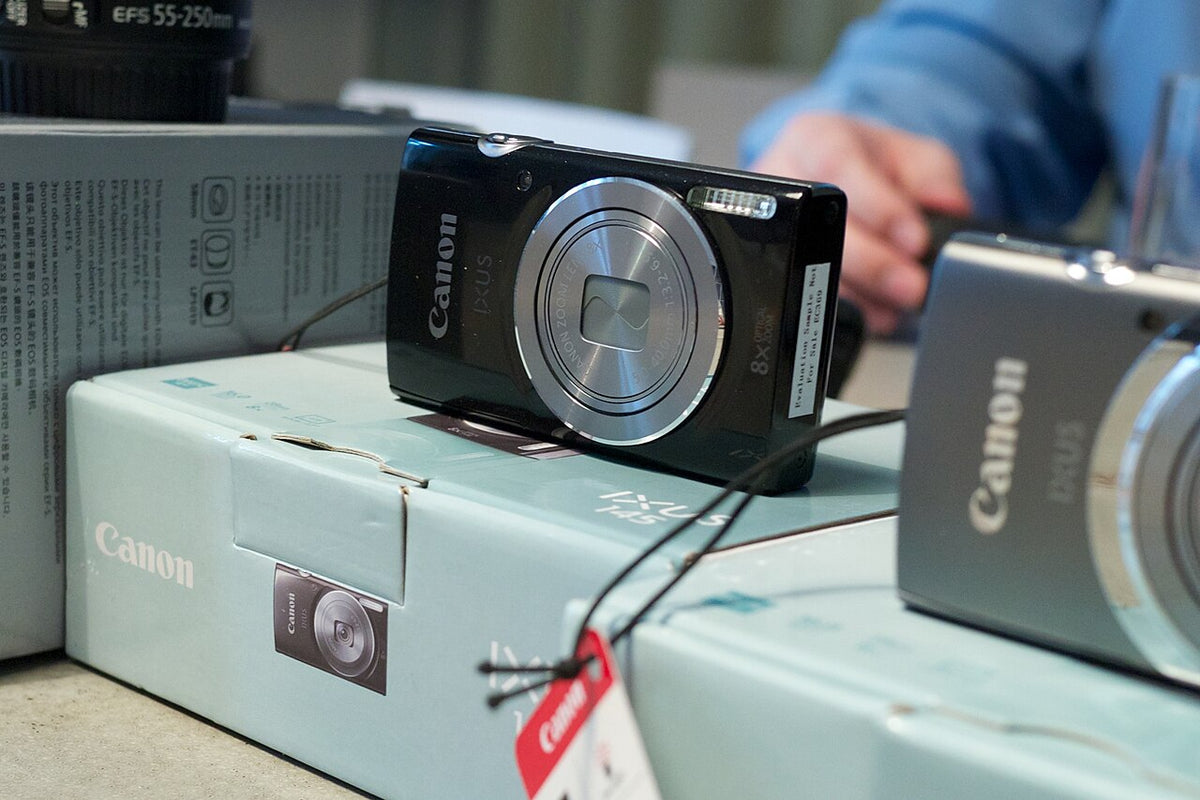
These examples have passed through our stock. Each camera is checked before being put up for sale: lens extension, screen, flash, battery, and full-definition test photo.


Compared to its siblings and rivals
The IXUS 145 is first compared to the other CCD IXUS cameras with 8x zoom: the IXUS 132 that preceded it, and the IXUS 175 and 185 that followed it. PhotographyBlog also compares it to several 2014 rivals.
| Model | Sensor | Zoom | Key features |
|---|---|---|---|
| Canon IXUS 132 (2013) | 16 Mpx CCD | 28–224 mm (8x) | Optical stabilization, DIGIC 4 |
| Canon IXUS 145 (2014) | 16 Mpx CCD | 28–224 mm (8x) | No optical stabilization, 127 g |
| Canon IXUS 185 (2017) | 20 Mpx CCD | 28–224 mm (8x) | Higher resolution, same battery |
| Nikon Coolpix S5300 | 16 Mpx | 8x, from 25 mm | Wi-Fi, 1080p video, 3-inch screen |
| Fujifilm FinePix T400 | 16 Mpx | 10x | Cheaper in 2014, 3-inch screen |
At the same price, the IXUS 132 is more comfortable thanks to its optical stabilization, especially at telephoto. The IXUS 185 goes up to 20 Mpx. The IXUS 145 remains the lightest of the three and often the easiest to find.


To compare the entire range, our guide which Canon IXUS to choose covers the generations, and our list of CCD cameras lists the other models.
Check before purchase
An IXUS 145 is about ten years old. That's young for a digicam, but a few points deserve to be checked before paying, especially between private individuals.
- The lens: with an 8x zoom, the lens extends far from the body. It must extend and retract without a grinding noise or an "Lens Error" message. Our article lens error details the causes.
- The zoom: make it go from wide-angle to telephoto several times. It must be smooth, without jerking.
- The battery cover: it has no lock; check that it closes properly and holds the battery.
- The screen: no spots, dead pixels, or deep scratches.
- The flash: a photo with forced flash indoors.
- The battery: an NB-11L or NB-11LH that holds a charge and is not swollen.
- The test photo: one at wide-angle, one at telephoto, in full definition, to look at on a computer.
To check
Always ask for a photo taken that same day with the camera. If the seller cannot provide it, assume the camera has not been tested. Our complete checklist: checks before buying a digicam.
At Vibes Photo, each camera is checked before being put up for sale and covered by a six-month commercial warranty, in addition to the legal warranties of conformity and hidden defects. The details are in our general terms and conditions of sale.
Our verdict
The IXUS 145 was not the most complete compact camera of 2014, and its reviewers said so: no Wi-Fi, no Full HD, no optical stabilization, a symbolic burst mode. But it does the essentials well: an 8x zoom with a real wide-angle, a CCD sensor with vivid colors, a light and sturdy body, an easy-to-replace battery. It is an excellent first digicam for evening flash photography and travel, provided you hold the camera very steady at telephoto. If you find an IXUS 132 at the same price, its stabilization gives it the advantage.
For
- 8x zoom, from 28 to 224 mm
- CCD sensor with vivid colors
- Very light (127 g)
- Macro from 1 cm
- Metal tripod thread
- 720p HD video, widely available NB-11L battery
Against
- No optical stabilization
- Chromatic aberrations, limited dynamic range
- Very slow burst mode (≈0.8 shots/s)
- Short flash at telephoto
- No Wi-Fi or Full HD
Frequently asked questions
Does the Canon IXUS 145 have a CCD sensor?
Yes, a 1/2.3-inch CCD with around 16 effective megapixels, paired with the DIGIC 4+ processor.
Is the IXUS 145 stabilized?
No, it has no optical stabilization. It only offers a "Digital IS" mode that combines several shots. For a stabilized IXUS with the same zoom, look at the IXUS 132.
Which battery for the IXUS 145?
The Canon NB-11L battery (the NB-11LH also works), recharged with a CB-2LD or CB-2LF charger. Expect around 230 shots per charge, 310 in Eco mode.
Does the IXUS 145 record in HD?
Yes, in 720p (1280 × 720) at 25 frames per second, in MOV format. No Full HD.
Does the IXUS 145 have Wi-Fi?
No, no Wi-Fi or GPS. Photos are transferred via USB cable or with a card reader.
What is the American name of the IXUS 145?
PowerShot ELPH 135. In Japan, it is called the IXY 120. It is the same camera.
IXUS 145 or IXUS 132?
Same 16 Mpx CCD sensor and same 8x zoom. The 132 has optical stabilization, useful at telephoto and without flash; the 145 is slightly lighter. At the same price, prefer the 132.
Vibes Photo
Find your IXUS
We check each digicam before being put up for sale: lens, screen, flash, battery, and test photo. Have a question about a model? Write to us.
Sources
- PhotographyBlog, Canon IXUS 145 Review (July 2014) and rival comparison.
- TechRadar, Canon IXUS 145 review (July 2014).
- PhotographyBlog, Canon IXUS 132 Review (January 2014), for noise benchmarks.
- Canon Europe and Canon Asia, IXUS 145 / PowerShot ELPH 135 spec sheets.
Images: Vibes Photo photos, unless otherwise stated under the image (author, license, and source indicated).