










Canon IXUS 132: review of the CCD compact with image stabilization and 8x zoom
Canon IXUS 132 (PowerShot ELPH 115 IS): 16 MP CCD sensor, 8x 28–224 mm stabilized zoom. Specifications, image quality by ISO, low-light flash performance, comparison with the IXUS 105, 140 and 145, and checks before buying used.
Reference guide · Digicam · November 2026 update
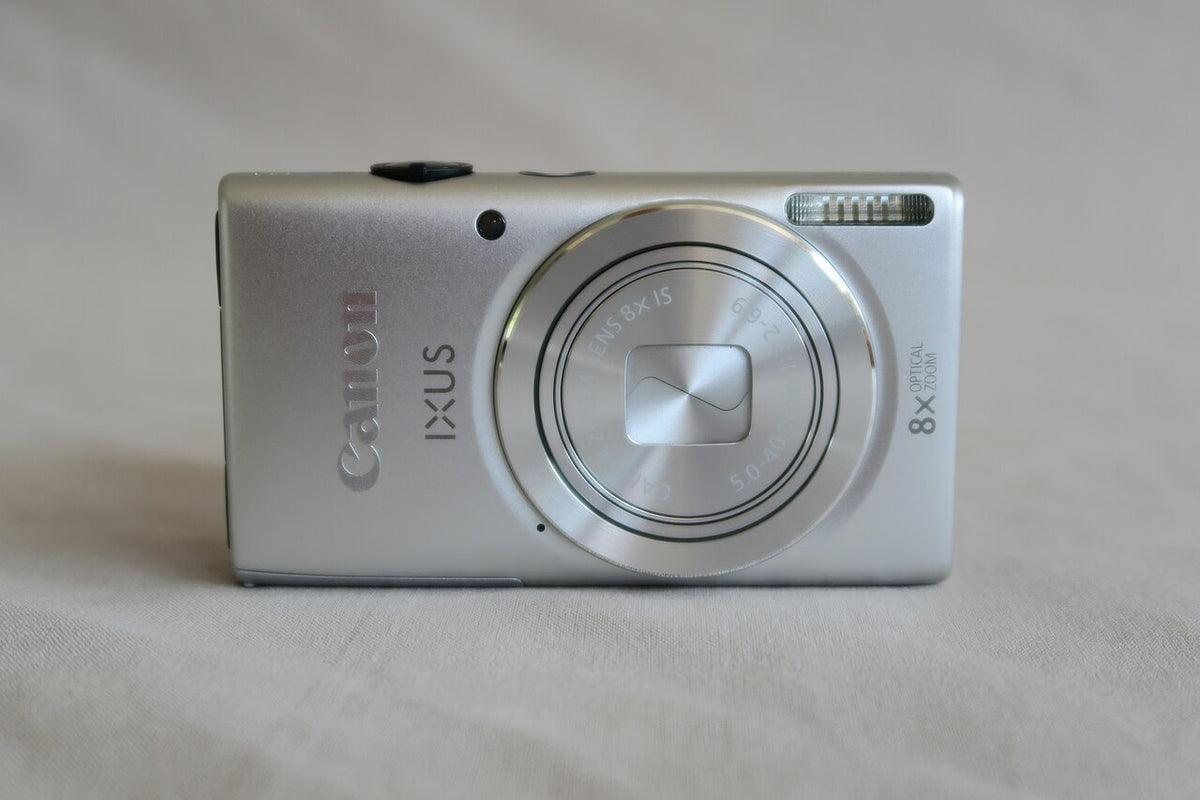
Announced in early 2013, the Canon IXUS 132 (PowerShot ELPH 115 IS in the United States) is one of the last IXUS models with a CCD sensor: 16 Mpx, an 8x zoom from 28 to 224 mm, and optical stabilization in a 133 g body. Here is what it is really like, where it shines, where it falls short, and how to choose it properly when buying second-hand.
At launch, the IXUS 132 was just one of many entry-level compact cameras: announced at $169.99 in the United States, it cost around £80 in the United Kingdom less than a year later, when PhotographyBlog tested it. The press judged it simple, attractive, and convenient, but limited in image quality. Today, we look at it differently. It is a CCD sensor camera with direct flash and bold colors, featuring a true stabilized 8x zoom: a rare combination in such a small body, and exactly what those seeking the look of 2000s photos without giving up a telephoto lens are looking for. This guide weighs its strengths and weaknesses, based on Canon's technical specifications, 2013 announcements, and the review published at the time.
The essentials in 30 seconds
- The highlight: an 8x zoom, from 28 to 224 mm equivalent, with optical lens-shift stabilization. Wide-angle for parties, telephoto for travel.
- The image: 1/2.3-inch 16 Mpx CCD sensor, clean at 100 ISO, still decent up to 800 ISO, very noisy at 1600 ISO.
- The limitations: pronounced chromatic aberrations on high-contrast edges, low dynamic range, very slow burst shooting (0.6 fps measured), video capped at 720p.
- Battery life: NB-11L battery rated for around 200 shots, or about 275 in Eco mode.
- The best approach: test the zoom through its full range, the screen, the flash, and take a full-definition test photo before buying.

A 2013 IXUS, with an added zoom
Canon introduced the PowerShot ELPH 115 IS in the United States on January 28, 2013, at the same time as the ELPH 330 HS and the PowerShot A2500. In Europe, the same camera is called the IXUS 132. The announcement describes it as an "all-purpose" compact camera, designed for those who want something better than their smartphone camera. Deliveries began in March 2013, in four colors: black, blue, pink, and silver.
On paper, it has the specifications of a well-equipped entry-level compact camera: 16-megapixel CCD sensor, DIGIC 4 processor, 8x optical zoom starting at 28 mm, 2.7-inch screen, and 720p HD video. What sets it apart from many IXUS models of the same era is the combination of a long zoom and optical stabilization. The "IS" in its American name, for Image Stabilizer, is not just for show: Canon paired it with its Intelligent IS system, which automatically selects one of six stabilization modes depending on the scene.
The IXUS 132 has an almost identical sibling, the IXUS 135, and an older sibling, the IXUS 140 (PowerShot ELPH 130 IS), announced a few weeks earlier. According to Cameralabs, the 132 is identical to the 135, but without Wi-Fi. The 140 features the same 16 Mpx CCD sensor and 28–224 mm zoom, with a larger 3-inch screen and built-in Wi-Fi. The 132 is therefore the simplest and least expensive model of the trio, without compromising on the essentials: the sensor and the lens.
- Announcement of the IXUS 140 (PowerShot ELPH 130 IS): 16 Mpx CCD, 8x zoom, 3-inch screen, Wi-Fi.
- Canon USA announces the PowerShot ELPH 115 IS, the European IXUS 132, at $169.99.
- Deliveries begin, in black, blue, pink, and silver.
- PhotographyBlog review: 3.5 out of 5 stars, observed price around £80.
- CCD digicams make a comeback for their "2000s" look.
Did you know?
The same camera goes by two names: IXUS 132 in Europe and PowerShot ELPH 115 IS in the United States. The manuals, batteries, and chargers are the same, which greatly expands the choice when you are looking for an accessory or user manual.
Technical specifications
- Sensor
- 1/2.3-inch CCD, approximately 16 effective Mpx (4608 × 3456)
- Processor
- DIGIC 4
- Lens
- 5.0–40.0 mm f/3.2–6.9, or 28–224 mm equivalent (8x zoom)
- Stabilization
- Optical, lens-shift (Intelligent IS)
- Sensitivity
- 100 to 1600 ISO, plus Auto
- Minimum focus
- 1 cm at wide-angle
- Shutter speeds
- 1 to 1/2000 s; up to 15 s in Long Exposure mode
- Exposure compensation
- ±2 EV in thirds
- Screen
- 2.7 inches, approximately 230,000 dots
- Viewfinder
- None
- Flash
- 50 cm to 3.0 m at wide-angle, 1.3 to 1.5 m at telephoto
- Burst shooting
- Approximately 0.8 fps (P mode), approximately 2.9 fps in Low Light mode
- Video
- 1280 × 720 or 640 × 480, MOV (H.264), mono audio
- Cards
- SD, SDHC, SDXC
- Battery
- NB-11L lithium-ion, approximately 200 shots (CIPA), approximately 275 in Eco mode
- Dimensions
- 92.9 × 52.4 × 21.6 mm
- Weight
- Approximately 133 g with battery and card (117 g body only)
Sources: Canon PowerShot ELPH 115 IS / IXUS 132 technical specifications, Canon product page (Icecat), and PhotographyBlog review (2014).
Handling and settings
The IXUS 132 fits in any pocket. PhotographyBlog judged its build quality sufficient for everyday use, while noting that the body gives the impression of a plastic coating. A more flattering detail: the tripod mount is made of metal, which is usually reserved for more expensive cameras. The top has only two buttons, the power switch and the shutter button, surrounded by a thin zoom ring. The reviewer, however, found the buttons on the back unresponsive and not always easy to use, and reported a screen that moved slightly in its housing.
Operation relies on a small slider at the top right of the back, which toggles between automatic mode and P mode. In automatic mode, Smart Auto recognizes up to 32 situations and sets everything automatically; it is the mode most users keep. P mode gives control over sensitivity, white balance, focus, and light metering (evaluative, center-weighted, center-spot, or spot), as well as exposure compensation. The FUNC button opens a menu that appears over the image without obscuring it.
This FUNC menu also provides access to scene modes and effects: portrait, low light, snow, fireworks, long exposure, panorama assist, and Canon's full range of creative options, including fish-eye, miniature, toy camera, monochrome, super vibrant colors, poster effect, accentuation, and color inversion. Smart Shutter automatically takes a photo when the subject smiles or winks, or when a new face enters the frame in self-timer mode. In playback, the camera displays a histogram, a tool that PhotographyBlog judged rather welcome on a compact camera costing less than £100.
In terms of responsiveness, the reviewer was able to turn on the camera, focus, and take a photo in 1.9 seconds, with an average of around 2.5 seconds. This is decent for a compact camera with a retractable zoom. Burst shooting, however, is very slow: Canon announces approximately 0.8 fps in P mode, while PhotographyBlog measured approximately 0.6. In a moving scene, it is better to anticipate than to rely on burst shooting.
Expert tip
Low Light mode goes up to approximately 2.9 fps according to Canon. If you want to capture a series of expressions at night, this is the only way to get a true burst on this camera. Check the image size before using it for prints.


Image quality, sensitivity by sensitivity
The sensor is a 1/2.3-inch CCD, the standard format for compact cameras of the era, with 16 million photosites on a very small surface. In good light, it produces detailed and sharp files; PhotographyBlog speaks of very good edge definition at 100 ISO. When the light drops, the pixel density quickly takes its toll, and the DIGIC 4 noise reduction has to work hard.
| Sensitivity | Observed image | Recommended use |
|---|---|---|
| 100 ISO | Slight noise in the shadows, invisible from a normal distance; well-defined edges | Daylight, landscapes, prints |
| 200 ISO | Smoothing combats color blotches in dark areas | Shadow, overcast sky |
| 400 ISO | Shadows lose detail, midtones remain clean | Bright interior, late afternoon |
| 800 ISO | Visible noise, but light areas remain spared | Screen, social media |
| 1600 ISO | Chromatic noise destroys dark areas | Small formats, intentional grain effect |
These observations come from the PhotographyBlog review, which summarizes: visible noise at 800 ISO, only truly bothersome at 1600. The reviewer even believes that Canon was right to stop at 1600 ISO, a higher value being unusable in their opinion. The colors are judged quite realistic, sometimes a bit dull with the default settings; the Super Vibrant Colors mode or switching to P mode with an appropriate white balance allows them to be enhanced.
Two flaws recur in the review. First, chromatic aberrations, those colored fringes along highly contrasting edges, described as "terrible": they appear on most high-contrast edges, and even near the center of the image. Then, a very low dynamic range: in a high-contrast scene, you have to choose between blown-out highlights and crushed shadows. The i-Contrast function, accessible in the shooting menu, helps a little to brighten the shadows.
For the look sought today on a digicam, these flaws are less serious than they seem: a slightly blown-out sky, a purple fringe on a branch, or pronounced grain at 1600 ISO are part of the "pocket camera" aesthetic of the 2000s. To understand why CCD sensors have such a distinctive look, read our article CCD or CMOS: what's the difference.
To check
In macro, the IXUS 132 focuses from 1 cm at wide-angle, but PhotographyBlog notes that the depth of field is then very thin. Step back a few centimeters and check the sharpness on the screen before taking the next photo.
The 8x zoom and stabilization

This is the main argument of the IXUS 132 compared to older IXUS models. A 28–224 mm equivalent covers almost all everyday situations: wide-angle for a group or a street, mid-range for a portrait, telephoto for an architectural detail or a subject you cannot approach. A 2010 IXUS 105, by comparison, stopped at 112 mm.
The downside is the aperture: f/3.2 at wide-angle, but f/6.9 at telephoto. At full zoom, the camera receives more than four times less light than at wide-angle, which forces it to slow down the shutter speed or increase the sensitivity. This is where optical lens-shift stabilization makes all the sense: it compensates for small hand movements and allows you to maintain reasonable shutter speeds without motion blur. It does not freeze a moving subject, however.
| Focal length | Aperture | Typical use | Tip |
|---|---|---|---|
| 28 mm | f/3.2 | Party, group, street, interior | The best position for flash and low light |
| 50–100 mm | Intermediate | Portrait, candid scene | More flattering framing for faces |
| 224 mm | f/6.9 | Detail, distant subject, travel | In broad daylight, stabilization enabled, stable support |
A useful detail: the minimum focus distance changes with the zoom. In Auto mode, it is 1 cm at wide angle but 1.3 m at telephoto. If the camera refuses to focus on a close object, zoom out.
The flash and party photos
This is the use that brings IXUS cameras back into bags today: the direct flash of a small compact gives that recognizable look, well-lit faces and a background that fades into darkness. On the IXUS 132, Canon announces a range of 50 cm to 3.0 m at wide angle. At telephoto, it drops to 1.3–1.5 m: thanks to the f/6.9 aperture. The flash offers four settings: automatic, forced, slow sync, and disabled.
PhotographyBlog notes two flaws with the flash. Vignetting, those darker corners, is slight at wide angle without flash, but much more pronounced in its flash photos. And red eyes appeared often in its test photos, despite the built-in correction, before disappearing on portraits taken later. For the "2000s party" look, vignetting rather feels like charm; red eyes are easily corrected in editing.
| Situation | Setting | Why |
|---|---|---|
| Group photo | 28 mm, forced flash, 1 to 2.5 m | The wide angle frames widely and stays within the flash range |
| Arm's length selfie | 28 mm, forced flash | Beyond 50 cm, sharp and well-lit face |
| Atmosphere with visible background | Slow sync flash, stable support | The flash freezes the subject, the long exposure captures the background |
| Softer look | P mode, -1/3 or -2/3 correction | Avoids faces "burned" by the flash |
| More vivid colors | Super vibrant colors | Accentuates the typical CCD look |
The golden rule: stay at wide angle. Zooming at a party means halving the flash range and demanding more sensor sensitivity. For night without flash, PhotographyBlog recommends Night scene mode rather than P mode. Our guide of digicam settings for a 2000s look details each option.
Expert tip
Keep at least 50 cm between the camera and the closest face: this is the minimum flash range announced by Canon. Below that, the flash overexposes and the foreground becomes white.
Video, battery and cards
The IXUS 132 records in 1280 × 720 or 640 × 480, in MOV format (H.264) with mono sound. PhotographyBlog measured 25 frames per second in 720p on its European model, and indicates a maximum duration of 29 min 59 s per HD sequence. If you zoom during shooting, the zoom motor can be heard during playback, according to PhotographyBlog: zoom before pressing, or accept this little background noise. For short videos with a "pocket camera" look, it is more than enough; our article filming with a digicam gives a few tips.
The battery life is on the lower end of average. The NB-11L battery is rated for about 200 shots according to the CIPA standard, and about 275 with Eco mode enabled, which reduces the screen-on time. At a party, with a lot of flash, expect less. A second battery takes up no space and prevents having to go home mid-party; just make sure it is not swollen, our article swollen battery: what to do explains how to spot it. The NB-11L equips several IXUS cameras from this period, making it easy to find.
On the storage side, the IXUS 132 accepts SD, SDHC, and SDXC cards. A full-definition JPEG file at maximum quality weighs about 6 MB according to PhotographyBlog: an 8 to 32 GB SDHC card holds thousands of photos. Our guide which memory card for an old camera details the compatibilities. For transfer, the Canon sheet lists a Hi-Speed USB connection and an analog audio-video output; there is no Wi-Fi, reserved for the IXUS 135 and the IXUS 140.
The IXUS 132 in pictures
These models passed through our stock. Each camera is checked before being put up for sale: zoom operation through its full range, screen, flash, battery, and full-definition test photo.


Compared to its brothers and cousins
The IXUS 132 is mainly compared to other IXUS cameras with CCD sensors: those of the same generation, which share its sensor and zoom, and the IXUS 105 from 2010, an older model that is often found at the same used price.
| Model | Sensor | Zoom | Key features |
|---|---|---|---|
| Canon IXUS 105 (2010) | 12.1 Mpx CCD | 28–112 mm (4x) | 640 × 480 video, NB-6L battery (≈240 shots) |
| Canon IXUS 132 | 16 Mpx CCD | 28–224 mm (8x) | Optical stabilization, 720p, 133 g |
| Canon IXUS 135 | 16 Mpx CCD | 28–224 mm (8x) | Identical to the 132, with Wi-Fi |
| Canon IXUS 140 | 16 Mpx CCD | 28–224 mm (8x) | 3-inch screen with 461,000 dots, Wi-Fi |
| Canon IXUS 145 | 16 Mpx | 28–224 mm (8x) | Digital stabilization only, ≈230 shots, 127 g |
Compared to the IXUS 145, the difference comes down to one word: stabilization. The two share the same focal range, the same apertures, the same 2.7-inch screen, and the same NB-11L battery, but the Canon sheet for the 145 only mentions a "Digital IS" mode, whereas the 132 has optical stabilization by lens shifting. The 145 is slightly lighter (127 g) and rated for slightly more shots per charge. In use, at telephoto or indoors, the 132's optical stabilization makes the difference; at the same price, it is the one to get.
Compared to the IXUS 140, the 132 loses the better-defined 3-inch screen and Wi-Fi, but keeps the same sensor and the same zoom. Compared to the IXUS 105, it doubles the zoom range and moves to HD video, at the cost of slightly shorter battery life. If you are looking above all for the wide angle and simplicity, the 105 remains a good choice; if you want to be able to zoom on a trip, the 132 is much more versatile.


If you are hesitating between several IXUS cameras, our guide which Canon IXUS to choose compares the entire range. Detailed reviews of the IXUS 145 and the IXUS 105 complete this comparison, and our list of CCD cameras lists the other models.
Check before purchase
A well-preserved IXUS 132 can still serve for a long time, but an 8x zoom that extends over several elements is more exposed to shocks and sand than a short zoom. A few points deserve to be checked before paying, especially between private individuals.
- The zoom: it must extend and retract without grinding noise or "Lens Error" message, and go all the way through its range, from 28 to 224 mm. Our article lens error details the causes of this frequent failure.
- The stabilization: take a photo at telephoto, indoors, without flash. Systematic blur can betray a stabilization or focus issue.
- The screen: no spots, lines, or dark areas on the 2.7 inches. Also check that it does not move too much in its housing.
- The flash: trigger a photo with forced flash, indoors.
- The test photo: in full definition, look on a computer at the sharpness of the corners and the absence of spots (internal dust).
- The buttons: the tester of the time already found them unresponsive; check that each one responds, especially the FUNC button and the cross.
- The accessories: NB-11L battery and suitable charger. Without a charger, plan for a compatible model; our article battery and charger for an old digital camera helps to choose.
To check
Always ask for a photo taken the same day with the camera, in full definition. If the seller cannot provide it, consider that the camera has not been tested. Our complete checklist: checks before buying a digicam.
At Vibes Photo, each camera is checked before being put up for sale and covered by a six-month commercial warranty, in addition to the legal warranties of conformity and hidden defects. The detail is in our general terms and conditions of sale.
Our verdict
The IXUS 132 was not a reference camera for image quality, and the test of the time says it bluntly: chromatic aberrations, low dynamic range, noise from 800 ISO. But it brings together what matters for a digicam today: a CCD sensor with frank colors, an effective direct flash at close range, a 28 mm wide angle, and, as a bonus, a stabilized 8x zoom that makes it very versatile on a trip. It is an excellent first digicam, provided you accept a very slow burst, average battery life, and video limited to 720p.
For
- 8x zoom from 28 to 224 mm
- Optical stabilization
- CCD sensor with a typical look
- Very compact (133 g)
- Macro from 1 cm
- SDXC cards accepted
- Metal tripod screw
Against
- Marked chromatic aberrations
- Low dynamic range
- Visible noise from 800 ISO
- Very slow burst (≈0.6 shot/s measured)
- Average battery life (≈200 shots)
- 720p video, audible zoom
- 230,000 dot screen
Frequently asked questions
Does the Canon IXUS 132 have a CCD sensor?
Yes, a 1/2.3 inch CCD with about 16 effective megapixels, associated with the DIGIC 4 processor.
Is the IXUS 132 stabilized?
Yes, it has optical stabilization by lens shifting, managed by Canon's Intelligent IS system. This is its main difference with the IXUS 145, which only has a digital stabilization mode.
Which battery for the Canon IXUS 132?
The Canon NB-11L battery. It is rated for about 200 shots per charge, or about 275 with Eco mode enabled.
Does the Canon IXUS 132 record in HD?
Yes, in 1280 × 720, in MOV format with mono sound. It does not record in Full HD.
What difference between IXUS 132 and PowerShot ELPH 115 IS?
None on the technical level: it is the same camera, sold under the name IXUS 132 in Europe and PowerShot ELPH 115 IS in the United States.
Is the IXUS 132 good for party photos?
Yes, provided you stay at wide angle: the flash reaches up to about 3 m at 28 mm, but only 1.3 to 1.5 m at telephoto. Between 1 and 2.5 m from your subject, you get the typical 2000s flash look.
IXUS 132 or IXUS 145?
The two have the same 8x zoom and the same screen. The 132 has optical stabilization, the 145 does not. At the same price, prefer the 132.
Vibes Photo
Find your IXUS
We check each digicam before being put up for sale: zoom, screen, flash, battery, and test photo. A question about a model? Write to us.
Sources
- Canon, PowerShot ELPH 115 IS / IXUS 132 technical sheet.
- PhotographyBlog, Canon IXUS 132 Review (January 2014).
- Engadget, announcement of the PowerShot A2500, ELPH 330 HS and 115 IS (January 2013).
- Imaging Resource, announcement of the ELPH 115 IS (January 2013).
- Cameralabs, Canon ELPH 130 IS / IXUS 140, verdict.
- Canon, PowerShot ELPH 135 / IXUS 145 specifications.
Images: photos by Vibes Photo, unless otherwise stated under the image (author, license and source indicated).