










Vintage folding camera: models, film and checks
Vintage bellows cameras: how they work, models, compatible film, and what to check before buying.
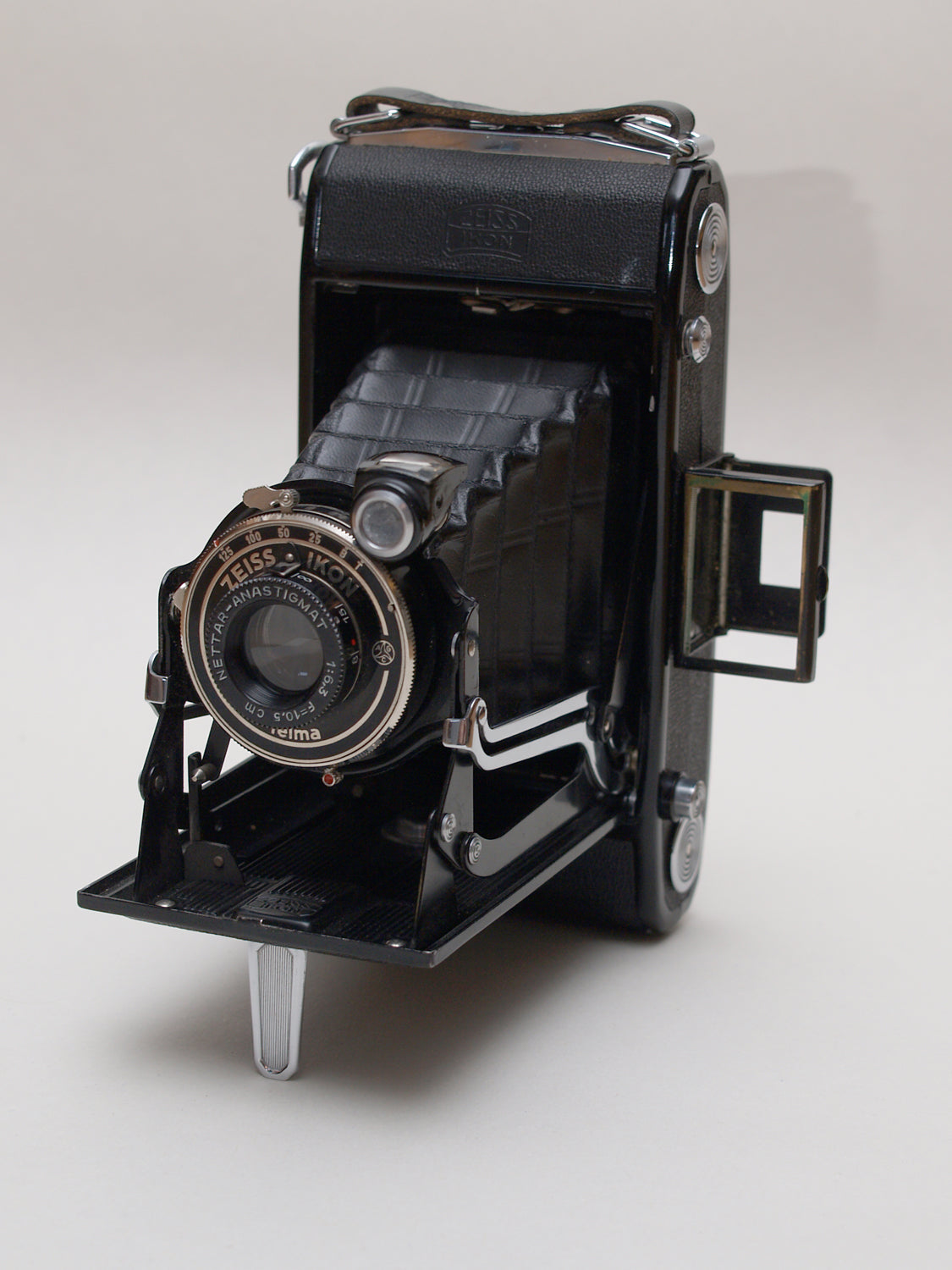
They fold out like an accordion, fit into a jacket pocket, and produce huge negatives. Vintage bellows cameras, also known as foldings or folding cameras, were the family cameras of the first half of the 20thth century. Many are still working. Here is how to recognize them, know which ones to use today, and what to check before buying.

How a bellows camera works
The bellows, made of leather or fabric, connects the lens to the body and blocks light. When closed, the camera is flat; when open, the lens is positioned at the correct distance from the film. Most are folding flap cameras: a door opens and the lens deploys on arms. The controls are simple: shutter speed and aperture on the lens, focusing on the distance scale (or with a rangefinder on high-end models), advancing the film by reading the frame number through a red window on the back.
Models to know
| Model | Brand | Format | To know |
|---|---|---|---|
| Nettar, Ikonta | Zeiss Ikon | 6 × 9, 6 × 6, 6 × 4.5 | Very common, good lenses on the Tessar versions |
| Super Ikonta | Zeiss Ikon | Several formats | Rangefinder coupled, high-end |
| Isolette, Super Isolette | Agfa | 6 × 6 | Perfect for getting started in medium format |
| Bessa, Bessa II | Voigtländer | 6 × 9 | The Bessa II with rangefinder is highly sought after |
| Retina | Kodak (Stuttgart) | 24 × 36 | Folding for 35 mm film |
| Vest Pocket, Folding Brownie | Kodak | Old formats (127, 116…) | Often for collecting, difficult film |
| Kinax, Lumirex | Kinax, Lumière | 6 × 9 | French foldings |
| Makina 67 | Plaubel | 6 × 7 | Folding with rangefinder from the late 1970s |

Which film for which camera
| Film | Availability | Cameras |
|---|---|---|
| 120 | Still manufactured, easy to find | The majority of 6 × 9, 6 × 6, 6 × 4.5 foldings |
| 135 (35 mm) | Still manufactured | Kodak Retina, a few 24 × 36 foldings |
| 620 | No longer manufactured by Kodak since 1995; 120 is rewound onto a 620 roll | Many Kodaks, some Photax |
| 127 | Produced in small quantities | Vest Pocket Kodak, small cameras |
| 116, 616, 122 | No longer mass-produced | Large old Kodak foldings: mostly for collecting |
Check the film before buying: it is the first question to ask. To choose your 120 film: choose your film.
Checks before buying
- The bellows: in the dark, open the back, set the shutter to B exposure and pass a lamp around the bellows. The slightest point of light is a hole.
- Deployment: the lens must lock perfectly straight, parallel to the film. A bent arm causes blurry photos on one side.
- The shutter: test all speeds. Slow speeds often stick after years.
- The lens: look through it, shutter open in B exposure, facing a light: no haze or fungus.

Photographing with a folding camera
- Focusing: without a rangefinder, estimate the distance or use the zone of sharpness. See focusing and hyperfocal distance.
- Exposure: often no light meter. Use the Sunny 16 rule or a light meter (see light meter and light meter cell).
- Double exposure: many foldings have no safety. Advance the film after each photo.
- Red window: with a sensitive film, cover it with opaque tape between two exposures, to avoid a haze.
- Stability: trigger gently, the camera is light and the lens is cantilevered.
To go further: the medium format guide, German brands and collecting vintage cameras.
Frequently asked questions
Can you still use a bellows camera?
Yes, most use 120 film, still manufactured. You need to check the bellows, shutter, and lens.
How to know which film goes in my folding camera?
Look at the inscription in the camera or the size of the roll. 120 and 620 have the same width but different rolls.
How to test the bellows of a vintage camera?
In the dark, back open and shutter in B exposure, pass a lamp around the bellows: the light passing through reveals the holes.
Is a bellows camera worth a lot?
Consumer models generally worth little. Rangefinder versions (Super Ikonta, Bessa II) and rare models are more sought after.
Which folding camera to start with in medium format?
An Agfa Isolette or a Zeiss Ikon Nettar in 6 × 6, serviced, is a simple and light entry.