










Thorium-contaminated lens: which ones, what risks, how to correct yellowing
Thorium lenses explained: why this glass is used, which models are affected, real risks, precautions, and how to correct yellowing.
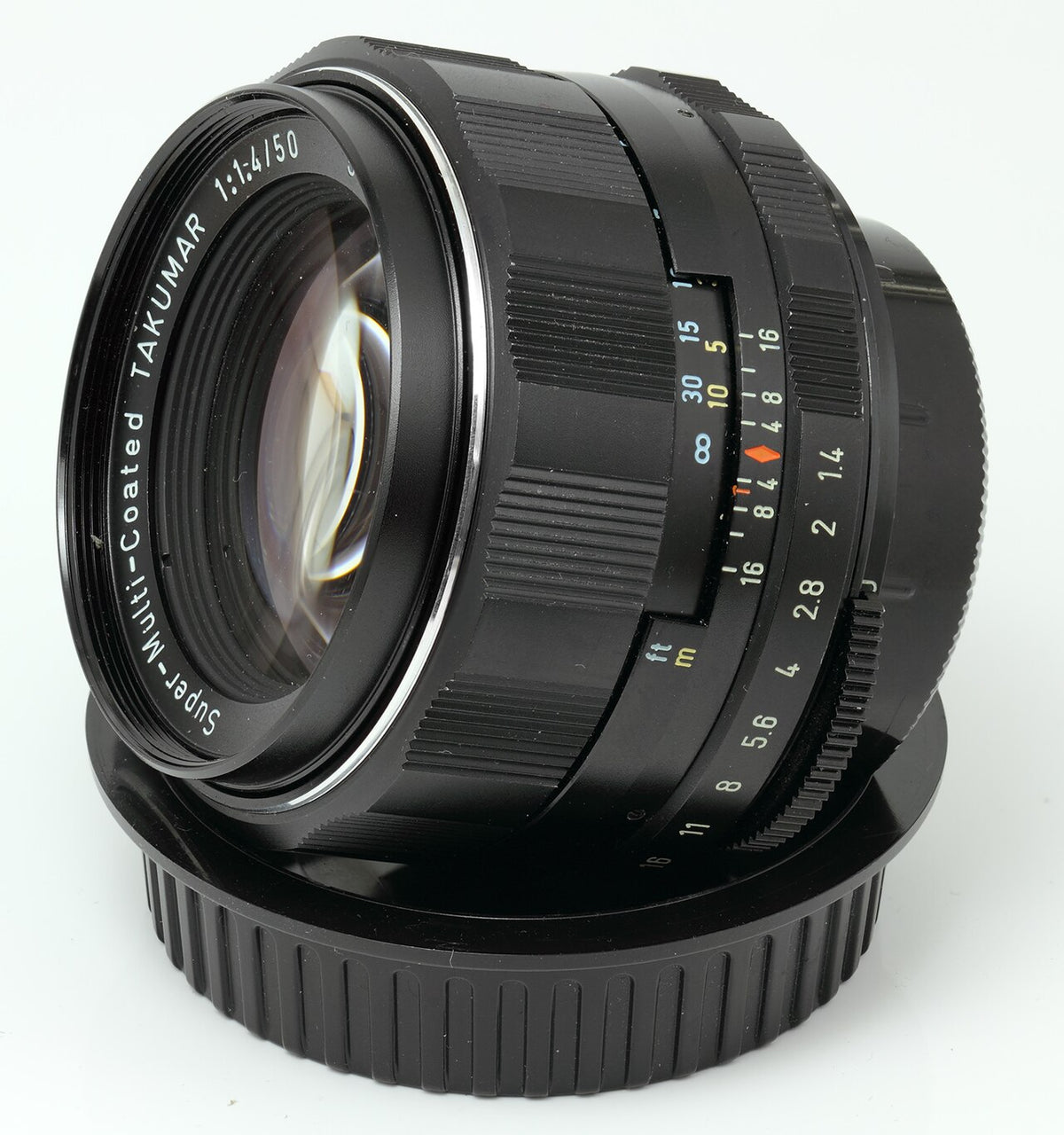
Does your vintage lens have a yellow or amber tint? Have you been told it's "radioactive"? It's possible: some lenses made in the mid-20th century contain thorium glass. Don't panic, but some common-sense precautions are necessary. Here's what you need to know, without exaggeration or downplaying.

Why is thorium in a lens?
Thorium oxide increases the refractive index of glass while limiting dispersion. This allowed opticians to design less curved, thinner lenses with better performance. According to the ORAU Museum of Radioactivity (Oak Ridge Associated Universities), patents for this type of glass were filed as early as 1939, the first commercial lenses probably appeared in the 1950s, and production seems to have ceased in the late 1980s.
Which lenses are affected?
Only a small portion of vintage lenses is affected, and often only certain versions of the same model. The ORAU notably cites:
- Asahi Pentax: SMC Takumar 50 mm f/1.4; Super Takumar 35 mm f/2, 50 mm f/1.4, 55 mm f/1.8 and f/2; Super Takumar 6×7 105 mm f/2.4; Macro-Takumar SMC.
- Canon: FL 58 mm f/1.2.
- Yashica: Yashinon-DS 50 mm f/1.7.
- Kodak: Ektanar and Ektanon lenses from certain cameras (Instamatic 804, Signet 40, Bantam RF), and GAF Anscomatic 38 mm f/2.8.
- Other lenses are reported by collectors: always check the exact version.
The presence of lanthanum in glass (LaK lenses, which are very common) does not mean it is radioactive: lanthanum is not a radioactive element. Do not confuse the two.
How to recognize it
- The tint: yellowing or amber browning of the lenses, visible when looking through the lens at a white sheet.
- The model and version: check the name, focal length, and serial number in the lists published by collectors.
- The measurement: only a radiation counter can confirm. Some clubs or enthusiasts own one.
Is it dangerous?
The radiation from these lenses is weak and decreases rapidly with distance. An assessment by the U.S. nuclear safety authority (NRC, NUREG-1717 report), cited by the ORAU, estimates the annual exposure of a regular photographer carrying such a camera at around 2 millirem per year, a low value. The ORAU emphasizes that the most serious concern involves eyepieces containing thorium, placed very close to the eye, which is prohibited by regulations. U.S. regulations also exclude the grinding or polishing of these lenses. A few common-sense rules:
- Do not disassemble and never grind a thorium lens.
- Do not keep the lens permanently against your body (in a pocket, for example) and store it out of a room, especially a child's room.
- Wash your hands if a lens is broken and pick up the debris with care.
- For a specific health question, ask the advice of a professional or a radiation protection organization.
Yellowing and how to correct it
Over time, thorium radiation yellows the glass (the ORAU speaks of a progressive darkening, often reddish-brown, which reduces light transmission; a film left in the camera for a very long time can also be affected). In color, this warms the images; in black and white, it causes a slight loss of light. The most common method to reduce it: expose the lens to UV for a long time (suitable UV lamp or sun), well-exposed lenses, while monitoring the heat. The result is gradual and the yellowing can return over the years. For general maintenance, see cleaning a lens and fungus in a lens.
Buying or using a thorium lens
Why they are popular
- Often excellent and bright optics
- Soft and warm rendering appreciated
- M42 mount easy to adapt to hybrid
To know
- Yellow tint to correct
- Exact version to check
- Storage and handling precautions
These lenses adapt very well to hybrid cameras: see vintage lens on hybrid. An honest seller must indicate if it is a thorium version and if the glass is yellowed: see warranty, condition and trust.
Frequently asked questions
Are thorium lenses dangerous?
Their radiation is weak and decreases quickly with distance. With common-sense precautions (do not disassemble, do not carry permanently on yourself, store out of a room), normal photographic use is common among collectors.
How to know if my lens is radioactive?
An amber tint and a model known to contain thorium are clues, but only a measurement with a radiation counter confirms it.
Why is my vintage lens yellow?
Often because of thorium glass, which yellows over time. Prolonged exposure to UV generally reduces this tint.
Which Takumars are radioactive?
The ORAU notably cites the SMC Takumar 50 mm f/1.4 and the Super Takumar 35 mm f/2, 50 mm f/1.4, 55 mm f/1.8 and f/2. Check the exact version.
Can you still buy thorium lenses?
Yes, they are available on the second-hand market. Ask the seller the exact version and the condition of the glass.
Sources: ORAU – Thoriated Camera Lens (ca. 1970s).