










Astrophotography for Beginners: Photographing the Stars and the Milky Way
The basics of telescope-free astrophotography: equipment, basic settings, the 500 rule, location, weather, moon phase, and focusing on stars.
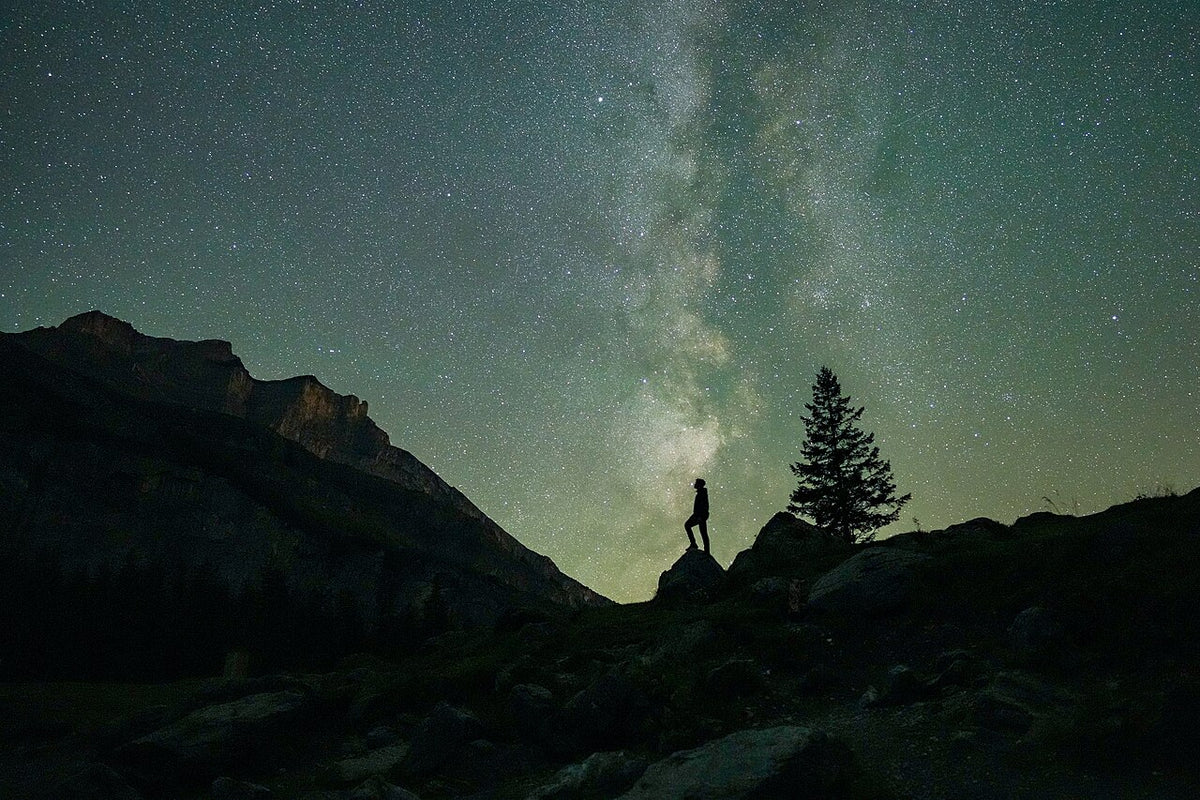
To photograph the stars and the Milky Way, you need a camera with manual controls, a fast wide-angle lens (ideally f/2.8 or wider), a tripod, and above all, a dark sky: far from cities, without the Moon, and on a clear night. Starting settings: maximum aperture, ISO 3200, 15 to 25-second exposure, manual focus on a bright star.
The equipment
- Camera: a DSLR or mirrorless camera that allows manual mode and multi-second exposures. Modern sensors handle high ISOs better.
- Lens: 14 to 24 mm, as fast as possible.
- Stable tripod: see choosing a tripod.
- Remote shutter or 2-second timer to avoid vibrations: remote shutter release and remote control.
- Headlamp with red light, warm clothes, spare batteries (the cold drains them quickly: photography in cold weather).
The starting settings
| Setting | Value |
|---|---|
| Mode | Manual (M), RAW |
| Aperture | Widest (f/1.8 to f/2.8) |
| ISO | 1600 to 6400 depending on the camera |
| Exposure | According to the 500 rule (see below) |
| Focus | Manual, on a bright star by zooming in on the screen |
| White balance | Fixed, around 3800 to 4200 K |
The 500 rule
The Earth rotates: beyond a certain duration, the stars become small streaks. The rule of thumb: 500 divided by the focal length in 24×36 equivalent gives the maximum exposure in seconds. At 20 mm: 500 / 20 = 25 s. On an APS-C sensor, first multiply the focal length by 1.5 (or 1.6 for Canon). With highly defined sensors, many photographers leave a margin (the 300 or 400 rule).

Where and when?
- Dark sky: consult a light pollution map and get away from cities. In France, several territories are designated International Dark Sky Reserves, such as Pic du Midi or the Cévennes.
- Without the Moon: around the new moon, or after moonset.
- Season: the heart of the Milky Way is best seen from spring to late summer in the Northern Hemisphere, and in the south.
- Weather: clear sky, and watch out for condensation on the lens.
And with film?
It is possible but difficult: films lose sensitivity on long exposures (reciprocity failure, see long exposure). Star trails on a 30-minute or longer B exposure, on the other hand, are a very beautiful subject in film.
Common mistakes
- Focusing on the barrel's infinity: on many lenses, the stop exceeds infinity. Check on the screen.
- Stabilization enabled on a tripod: turn it off if your camera recommends it.
- Screen too bright: lower it, and check the histogram.
All cameras sold on Vibes Photo are checked before shipping and covered by a 6-month warranty (details in our general terms and conditions of sale).